Strong Locking of Edge Ni−N₄ Sites for *COOH: New Breakthrough in Acidic CO₂RR Achieving FEco > 94% and Energy Efficiency of 44%
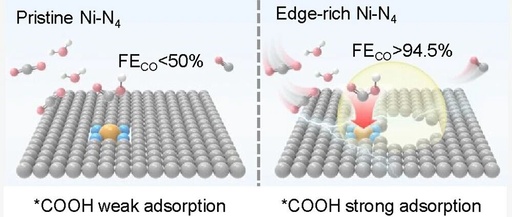
Strong Locking of Edge Ni−N₄ Sites for *COOH: New Breakthrough in Acidic CO₂RR Achieving FEco > 94% and Energy Efficiency of 44%

First Author: Ziwen Mei (Central South University)Corresponding Authors: Zhang Lin, Min Liu (Central South University) Research BackgroundElectrochemical CO₂ reduction to CO serves as an important bridge connecting renewable electricity with chemical feedstocks. Acidic media can completely avoid carbonate precipitation, benefiting device longevity; however, the hydrogen evolution reaction (HER) dominates in strong acids. Although single-atom Ni−N₄ … Read more
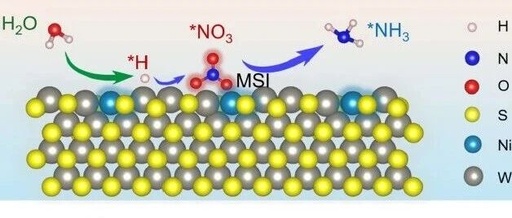
Metal-Support Interaction Breakthrough: Ni-WS₂ Nanosheet Catalyzes Nitrate Electroreduction with Ammonia Yield Exceeding 23 mgh⁻¹cm⁻²

Metal-Support Interaction Breakthrough: Ni-WS₂ Nanosheet Catalyzes Nitrate Electroreduction with Ammonia Yield Exceeding 23 mgh⁻¹cm⁻²

First Author: Jiangnan Lv, Institute of Materials Science, Shanxi Normal UniversityCorresponding Authors: Xiaohong Xu, Institute of Materials Science, Shanxi Normal University; Yang Liu, Department of Materials Science, Fudan University Research BackgroundNitrates (NO₃⁻) are one of the major pollutants in water bodies, and traditional biological/membrane separation methods are energy-intensive and produce many by-products. Electrochemical nitrate reduction … Read more

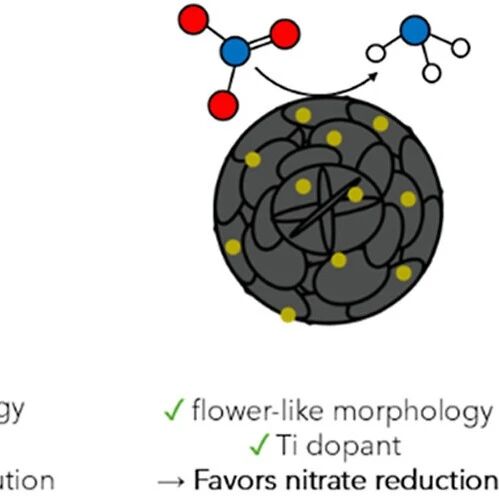
Titanium-Nitrogen-Doped Carbon Flowers Achieve Over 60% Selectivity for Ammonia in Alkaline Nitrate Reduction Reaction

Titanium-Nitrogen-Doped Carbon Flowers Achieve Over 60% Selectivity for Ammonia in Alkaline Nitrate Reduction Reaction

First Author: Matthew J. Liu (Stanford University)Corresponding Author: William A. Tarpeh (Stanford University) Research BackgroundElectrochemical nitrate reduction (NO₃RR) can convert wastewater NO₃⁻ into NH₃, which is considered an important route for the distributed production of green ammonia. Current metal-nitrogen doped carbon (MNC) strategies have achieved high NH₃ selectivity with catalysts such as Fe, Co, and … Read more

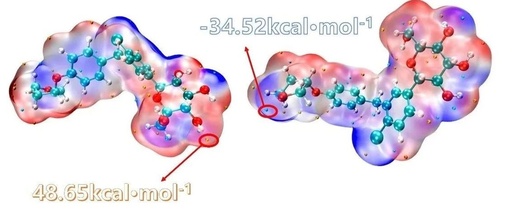
Advanced Molecular Electrostatic Potential Mapping

Advanced Molecular Electrostatic Potential Mapping

Currently, an increasing number of papers involve DFT calculations, with the Molecular Electrostatic Potential (MEP) being used more widely. So how can we obtain high-quality MEP maps? Let’s follow the steps outlined below. 1 Software Installation VMD Installation: https://www.ks.uiuc.edu/ Multiwfn Installation: http://sobereva.com/multiwfn/ 2 Software Preparation Locate the chk file generated after Gaussian optimization. Open Gaussian, … Read more

Study on the Mechanism of Capacitance Energy Regulation in Rare Earth Doped BaTiO₃/PbTiO₃/KNbO₃ Ferroelectrics

Study on the Mechanism of Capacitance Energy Regulation in Rare Earth Doped BaTiO₃/PbTiO₃/KNbO₃ Ferroelectrics

Title J Eur Ceram Soc:Study on the Mechanism of Capacitance Energy Regulation in Rare Earth Doped BaTiO₃/PbTiO₃/KNbO₃ Ferroelectrics Research Background Perovskite ferroelectrics are considered ideal energy storage materials due to their high dielectric constant, but their strong coupling ferroelectric domains lead to low breakdown strength and high losses. Experiments have shown that rare earth doping … Read more

Humidity Disrupts Structural and Chiroptical Properties of Chiral 2D Perovskites

Humidity Disrupts Structural and Chiroptical Properties of Chiral 2D Perovskites

Humidity Disrupts Structural and Chiroptical Properties of Chiral 2D PerovskitesOriginal link:https://pubs.acs.org/doi/full/10.1021/acsnano.5c00480Keywords:Chiral 2D Perovskites;Humidity Degradation;Chiroptical Properties;Phase Transition;DFT Calculations 01 — Overview Chiral two-dimensional organic-inorganic hybrid metal halide perovskite semiconductors have emerged as a highly promising material platform for spintronic applications. However, it remains unclear how these materials change in crystal structure and chiroptical properties when exposed … Read more