The Shanghai Institute of Materia Medica, Chinese Academy of Sciences, in collaboration with Researcher Hai Jun and Professor Xu Zhi’ai from the School of Chemistry and Molecular Engineering at East China Normal University, has developed a novel LNP component—ultrasound adjuvant lipids, which endow clinically approved LNP formulations with region-specific adjuvant properties.
mRNA vaccines based on lipid nanoparticles (LNPs) have shown great potential in enhancing innate immune responses. However, their commonly used adjuvants (such as TLR or STING agonists) often exhibit a “always-on” characteristic, leading to non-specific systemic immune activation, which in turn causes dose-limiting immune-related adverse reactions. The endosomal escape capability of existing LNP systems is limited, restricting the effective release of mRNA in the cytoplasm and antigen cross-presentation, further constraining the immunogenicity and therapeutic efficacy of the vaccines. Therefore, there is a need to develop a strategy for region-specific and spatiotemporally controllable innate immune activation.
To address this, the researchers developed an ultrasound-activated lipid nanoplatform (ULNP) by covalently coupling a clinically approved sonosensitizer—hematoporphyrin monomethyl ether (HMME) to a novel ultrasound adjuvant lipid, creating an LNP system with spatiotemporally adjustable adjuvant activity. Under ultrasound stimulation, ULNP can generate reactive oxygen species (ROS) in antigen-presenting cells (APCs), which not only enhances lysosomal membrane permeability, improves cytoplasmic release and transfection efficiency of mRNA, but also activates multiple innate immune pathways through endoplasmic reticulum stress.
Studies have shown that ULNP loaded with OVA-mRNA combined with ultrasound significantly enhances lymph node-specific mRNA delivery and induces antigen-specific CD8+ T cell responses in mouse models. Additionally, it has been successfully applied to circular RNA (circRNA) vaccines, where ci-ULNP loaded with novel liver cancer antigens, upon ultrasound activation, completely eliminated orthotopic liver tumors in mice and triggered a strong anti-tumor T cell immunity.
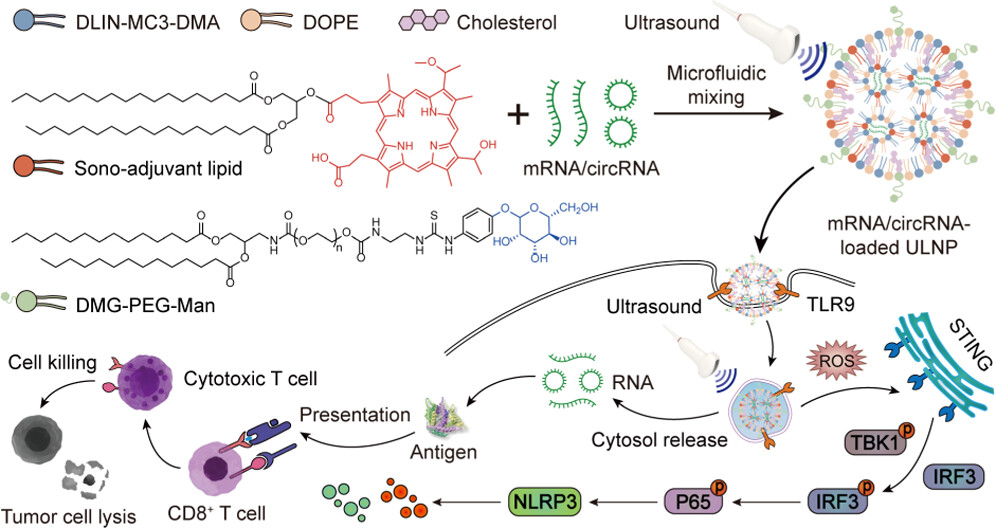
This study innovatively designs an ultrasound-activated lipid nanoplatform, achieving precise spatiotemporal control over innate immune responses, significantly enhancing the immunogenicity and therapeutic efficacy of mRNA and circRNA vaccines while avoiding systemic toxic side effects, providing a new strategy with clinical translational potential for the development of next-generation cancer vaccines.
Original link:
https://doi.org/10.1021/jacs.5c06028
Author: LXRProofreader: ZTHEditor: ZTH