|
Title |
J. Am. Ceram. Soc.:Lead-Free High Energy Storage Performance Ternary Bi₀.₅Na₀.₅TiO₃-BaTiO₃-Nd(Mg₀.₅Hf₀.₅)O₃Relaxor Ferroelectric Ceramics |
|
Research Background |
Dielectric energy storage ceramics have significant potential in pulse power systems, but their energy density is far below the requirements of next-generation power electronics applications. BNT-based ceramics (Bi₀.₅Na₀.₅TiO₃) have become important candidate materials due to their lead-free nature, high polarization strength, and low cost. However, the traditional 0.94BNT-0.06BT system suffers from high remnant polarization (Pᵣ), low breakdown field strength (E_b), and large losses (Wₗₒₛₛ). High-temperature sintering (>1100°C) leads to sodium/bismuth volatilization and oxygen vacancy defects, further limiting their energy storage performance (Wᵣₑc) and efficiency (η). There is an urgent need to synergistically optimize ΔP (Pₘₐₓ-Pᵣ) and E_b through compositional design to break through performance bottlenecks. |
|
Research Content |
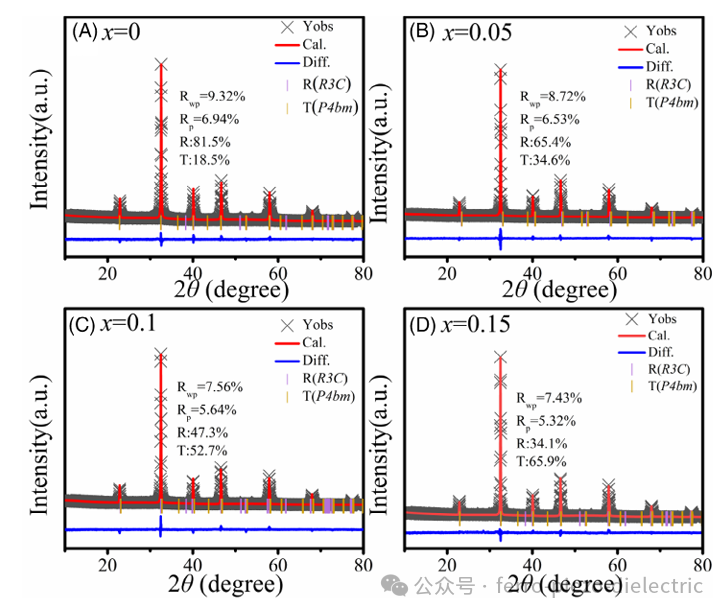
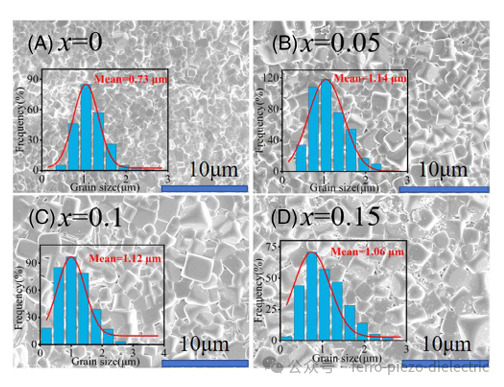
① Material Design:Nd(Mg₀.₅Hf₀.₅)O₃ (NMH) was introduced as a third component into the 0.94BNT-0.06BT binary system to construct (1-x)(0.94BNT-0.06BT)-xNMH ternary ceramics. ② Structural Characterization:NMH doping induced R3c→P4bm phase transition (65.9% T phase at x=0.15), refined grain size (SEM shows dense structure), and improved relative density (93.4%→96.3%).
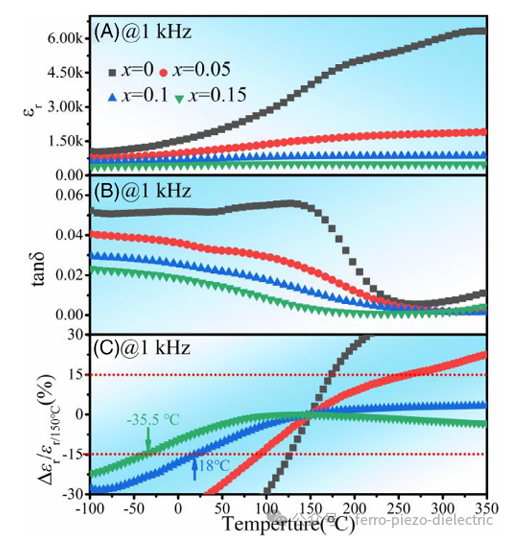
③ Dielectric Performance:NMH weakened the dielectric anomaly peak, and the dielectric loss tanδ decreased to 0.02, with temperature stability extended to -35.5~350°C (Δεᵣ≤±15%).
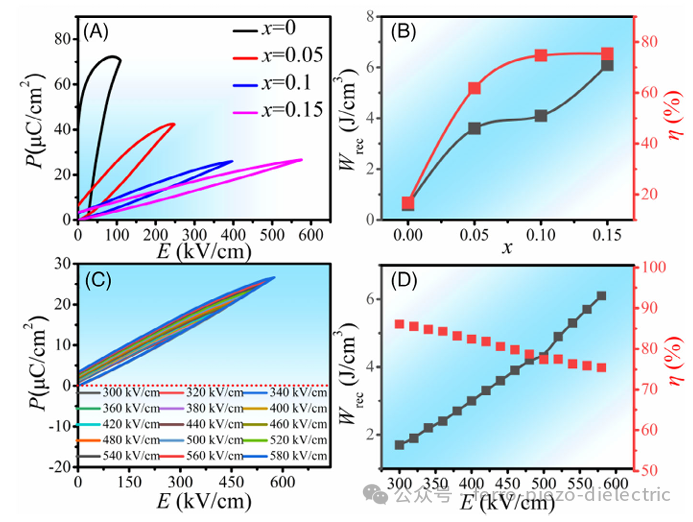
④ Energy Storage Mechanism:The breakdown field strength E_b increased from 110 kV/cm to 580 kV/cm (Weibull analysis), and the band gap E_g increased to 3.20 eV (UV-Vis).
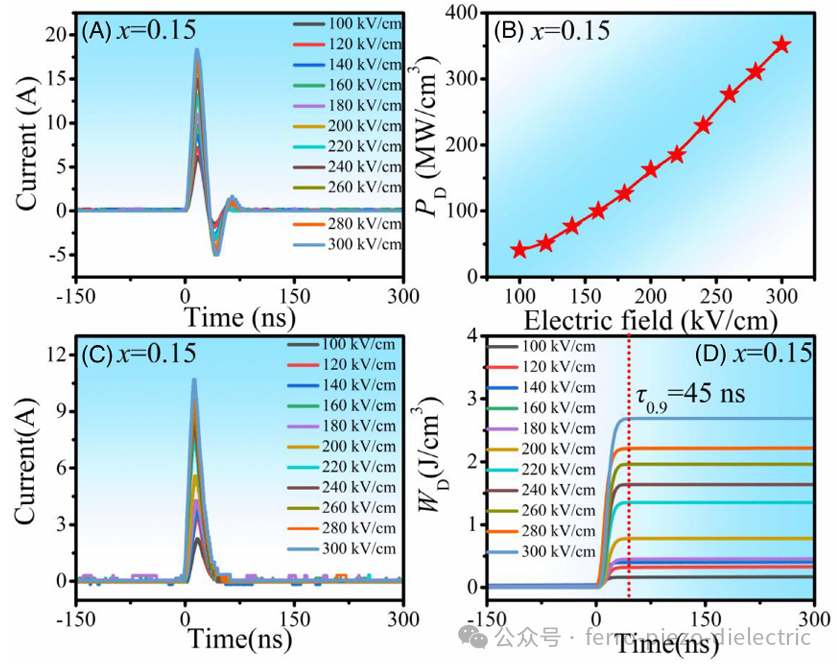
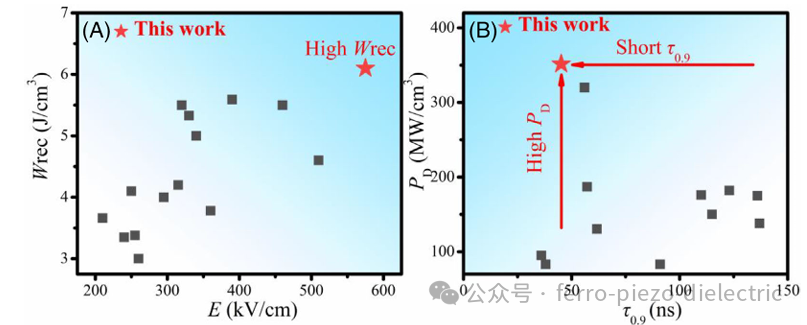
⑤ Charging and Discharging Characteristics:The ultra-fast discharge time τ₀.₉=45 ns, power density P_D=352 MW/cm³ (at 300 kV/cm).
|
|
Innovations |
① New Doping Strategy:For the first time, the ABO₃ type Nd(Mg₀.₅Hf₀.₅)O₃ was used as a single dopant to achieve synergistic modification of Nd³⁺/Mg²⁺/Hf⁴⁺. ② Multi-Mechanism Synergistic Optimization:NMH induced grain refinement, band gap widening (E_g↑), and improved electrical uniformity (impedance-modulus spectrum confirmed), breaking through the E_b limitation. ③ Performance Breakthrough:The 0.15NMH component achieved Wᵣₑc=6.1 J/cm³ (η=75.4%) at 580 kV/cm, one of the highest values for BNT-based ceramics.
④ Stability Innovation:Simultaneously achieving wide temperature (20–100°C) and wide frequency (1–1000 Hz) energy storage stability to meet practical application needs.
|
|
Paper Summary |
Through the doping of Nd(Mg₀.₅Hf₀.₅)O₃, the microstructure, energy band, and electrical uniformity of 0.94BNT-0.06BT ceramics were synergistically optimized: ① Grain refinement and densification (relative density 96.3%) increased E_b to 580 kV/cm; ② Band gap widening to 3.20 eV suppressed electron transitions; ③ R-T phase transition and PNRs evolution reduced Pᵣ and improved dielectric temperature stability (-35.5~350°C). The optimal composition 0.85(0.94BNT-0.06BT)-0.15NMH achieved Wᵣₑc=6.1 J/cm³ (η=75.4%), while also exhibiting excellent temperature/frequency stability. Charging and discharging tests showed ultra-high power density (352 MW/cm³) and ultra-fast response (τ₀.₉=45 ns), providing a high-performance lead-free energy storage solution for electric vehicle pulse power systems. |
|
Original Article |
10.1111/jace.70065 |
Disclaimer: This article summarizes information based on publicly available information from relevant academic journals and is not original. It is intended for academic exchange and does not represent the views of this public account.