The morning alarm gently wakes you up with the smart speaker, the curtains automatically open to let in sunlight, and the coffee machine in the kitchen starts brewing—this was once a scene from a science fiction movie, but it has now become a daily routine for millions of families. However, when a certain brand of smart speaker is exposed for continuously listening to user conversations while in standby mode, when home cameras become hackers’ “live streaming windows” due to weak password vulnerabilities, and when smart locks are cracked by forged Bluetooth signals… behind the “convenience” of smart homes, a trust crisis regarding privacy and security is spreading.
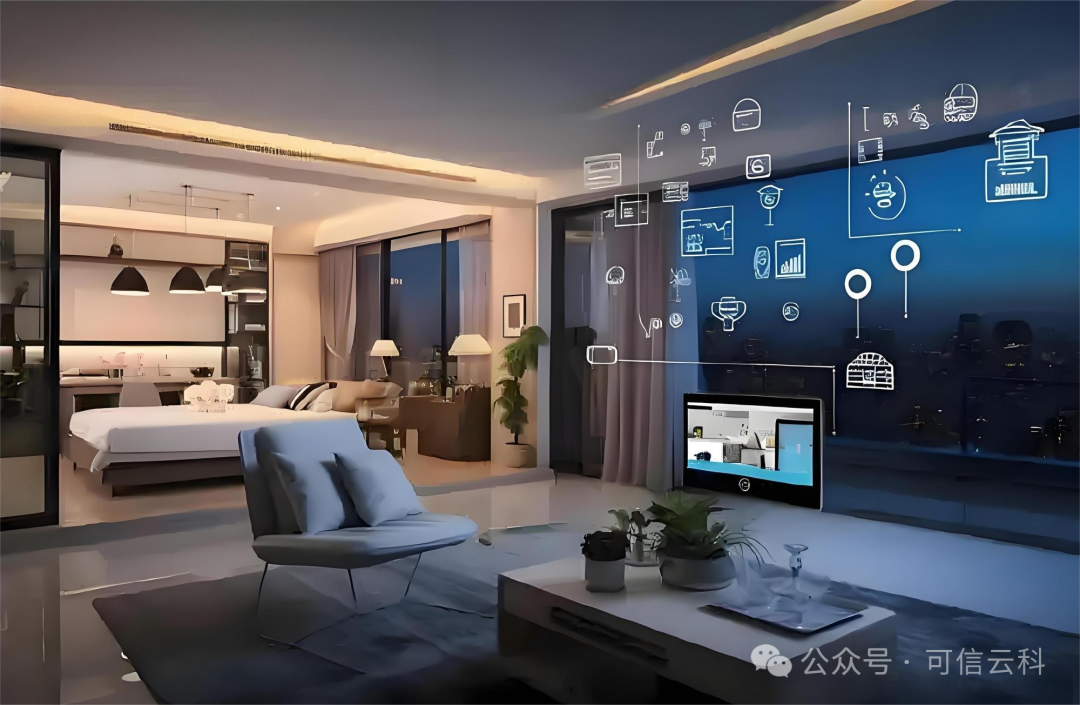
This crisis is not an exaggeration. National security agencies have disclosed that foreign espionage organizations have long-term audio monitoring of sensitive locations by tampering with smart speaker firmware; in a case concluded by a Beijing court, a smart lock camera captured the comings and goings of neighbors due to improper installation direction, leading to a privacy infringement lawsuit; Tencent Security Lab found that over one-third of 486 IoT devices have security vulnerabilities, with smart home devices being a “disaster area.” As smart devices transform from “tools” to “risk sources,” consumers cannot help but ask: how can we trust these “smart” housekeepers?

1. The Collapse of Trust: The “Three Hidden Doors” of Smart Homes
The security risks of smart homes are essentially a dual crisis of the lack of device trustworthiness and the failure of data controllability.
1. Device Trustworthiness
Smart speakers rely on continuous audio collection for voice interaction, but some manufacturers, in order to reduce costs, do not encrypt the microphone data stream end-to-end. Attackers can implant malicious programs through Bluetooth protocol vulnerabilities, allowing devices in “standby” mode to bypass wake word restrictions and upload user conversations to foreign servers. More dangerously, if such devices are deployed in sensitive locations, the collected meeting content, technical discussions, and other sensitive information may become an “intelligence source” for foreign intelligence agencies.
Smart cameras, due to weak video encryption algorithms and lack of authentication mechanisms, have become “peeping eyes” for hackers. In 2021, a certain brand of camera was hacked through brute force due to the absence of a dynamic key rotation mechanism, allowing hackers to gain control and live stream details of users’ home lives. Moreover, the communication protocol flaws of low-quality smart locks allow attackers to forge Bluetooth signals and crack fingerprint templates or copy temporary passwords within seconds, turning confidential file cabinets and laboratories into “doorless realms.”
2. Data Controllability
The data collected by smart home devices is far more sensitive than users imagine. Smart scales not only record weight changes but can also infer users’ health indicators through algorithms; if the Bluetooth communication link of a smart toilet is compromised, it can reveal users’ excretion frequency and other private information; even the electricity usage data from smart sockets can be analyzed through machine learning to determine users’ daily routines.
Even more concerning is the misuse of data. Some manufacturers collect voice commands, behavioral habits, and other data without user authorization to “feed” AI databases, using it for commercial marketing. For example, a certain brand of smart speaker was reported to share user voice data with third-party advertisers, resulting in users receiving targeted spam messages. When data transforms from “personal assets” to “commercial resources,” privacy protection becomes a mere talk.

2. Autonomous Trusted Computing: Installing an “Immune System” for Smart Homes
In the face of the trust crisis, the traditional security protection model of “plugging vulnerabilities, checking for malware, and killing viruses” has become ineffective. Autonomous trusted computing technology constructs a dual-layer defense system of “device trustworthiness + data controllability,” injecting “immune genes” into smart homes.
1. Device Trustworthiness
The core of trusted computing is the construction of trust roots and trust chains. For example, the PSP (Platform Security Processor) IP core built into a trusted CPU serves as a hardware-level trust root, running first before the CPU starts, measuring the system firmware, operating system, and application software step by step (i.e., calculating hash values and comparing them with preset baseline values). If tampering is detected, the PSP will block the boot process and raise an alarm, ensuring that the device is trustworthy from the “genetic” level.
This “bottom-up” trust transmission mechanism is like implanting “immune cells” into smart home devices. For instance, if the microphone driver of a smart speaker is implanted with malicious software, the PSP will detect its hash value anomaly during the loading phase, immediately terminate the startup, and notify the user; if the fingerprint recognition module of a smart lock is replaced, the trust chain will be interrupted due to mismatched hardware identifiers, preventing illegal unlocking.
2. Data Controllability
Trusted computing achieves full lifecycle protection of data throughTPM and dynamic key management. Taking smart cameras as an example:
· Collection Phase: Video data is encrypted at the sensor end using a session key generated by the trusted cryptographic module, forming a “data cage”; even if attackers intercept the data, they cannot decrypt it;
· Transmission Phase: Encrypted data is re-encapsulated using the national cryptographic SM4 algorithm and a secure channel is established through the TLS 1.3 protocol to prevent man-in-the-middle attacks;
· Storage Phase: Cloud servers use hardware-level keys from TCM to perform sharded storage of data; single shard data is meaningless and requires multiple keys for collaborative decryption, ensuring that even if the database is leaked, attackers cannot restore the complete video.
More critically, dynamic permission control is implemented. Trusted computing monitors device status in real-time through the Trusted Software Base (TSB); if a smart speaker detects that the microphone is being illegally accessed, the TSB will immediately cut off the audio stream and report the anomaly; if a smart lock is attempted to be unlocked at an unauthorized time, the TSB will trigger an anti-tampering alarm and lock the device, while sending location information to the user’s phone.

3. Technical Implementation and Scene Deployment
Autonomous trusted computing is not just a theoretical “security utopia”; its technical architecture has gradually been deployed in home scenarios.
1. Lightweight Measurement: Reducing Security Overhead with “Data Compression” and “Instruction Merging”
The core step of trusted computing—measuring device status—requires continuous verification of the integrity of firmware, operating systems, and applications during startup and operation. In traditional solutions, the storage and transmission of measurement logs often lead to storage pressure and interaction delays, while smart home devices are highly sensitive to real-time performance and resource usage. Therefore, trusted computing achieves lightweight implementation throughMerkle Tree storage optimization,TPM command batching technology, and dynamic power management.
Scene Deployment: After adopting this technology, a certain smart lock compressed the storage space of measurement logs while supporting rapid backtracking verification, meeting the requirements of GB/T 35273-2020 “Information Security Technology Personal Information Security Specification” for log auditing. This extended the standby endurance of the device while supporting dynamic measurement to meet real-time intrusion detection needs and reduced average power consumption, saving system CPU usage.
2. Dynamic Power Management: Balancing Power Consumption and Security with “State Awareness” and “Policy Scheduling”
Smart home devices need to remain in standby mode for long periods, but security monitoring (such as dynamic measurement and remote proof) must run continuously, leading to a prominent contradiction between power consumption and endurance. Trusted computing achieves “security without downtime, endurance without compromise” through dynamic power management (DPM) and low-power hardware collaboration:
Scene Deployment: After adopting this solution, a certain smart camera extended its standby endurance while supporting dynamic measurement to meet real-time intrusion detection needs; the DPM strategy reduced average power consumption while increasing the success rate of executing security tasks.
3. Pre-computation Proof Cache: Accelerating Security Interaction by “Trading Space for Time”
Remote proof is a key step for smart home devices to connect to cloud platforms or establish mutual trust with other devices, but traditional solutions require real-time computation of device status hashes and generating proofs, leading to extended authentication delays, making it difficult to meet real-time control needs (such as voice command responses). Trusted computing can compress delays through pre-computation proof cache technology.
Scene Deployment: In a certain smart speaker’s remote control scenario, when users send voice commands via a mobile app, the speaker must first prove its trusted status to the cloud. After adopting pre-computation caching, authentication delays were reduced, and the total command response time (including voice parsing) reached an acceptable range for users.

4. User Action Guide: Protecting Privacy Sovereignty in the Smart Era
Technology serves as a shield, while users act as a spear. Consumers can take the following actions to transform the advantages of trusted computing into actual security guarantees:
1. Choose “Trusted Certified” Devices
Prioritize products that have passed national information security technology certifications (such as GB/T 25068) or international certifications (such as FCC, CE), and avoid purchasing “no-name” white-label devices. Reputable manufacturers usually indicate security features in product descriptions, such as “end-to-end encryption” and “hardware-level trust roots.”
2. Build “Physical + Logical” Dual Isolation
· Physical Isolation: Prohibit the use of networked smart devices in sensitive locations, and use different routers for ordinary home devices and work devices to prevent “one network to rule them all”;
· Logical Isolation: Use router “guest mode” or subnet partitioning to isolate high-risk devices like smart speakers and cameras from computers and phones; even if devices are compromised, attackers cannot horizontally penetrate to other devices.
3. Implement the “Least Privilege” Principle
· Disable unnecessary permissions: In the mobile app, deny the smart speaker’s requests for permissions such as “contact reading” and “application list reading,” retaining only the microphone permission necessary for voice control;
· Use strong passwords: Set complex passwords of ≥12 characters (e.g., “Tj2025@Home#”), avoiding default or reused passwords;
· Enable two-factor authentication: Activate SMS or verification code verification for smart home accounts, so that even if passwords are leaked, attackers cannot log in.
4. Regular “Health Checks” and Updates
· Check device logs: Use the router management interface or manufacturer app to view abnormal login records (e.g., late-night IP access);
· Update firmware: Security patches pushed by manufacturers usually fix known vulnerabilities (e.g., a remote code execution vulnerability in a certain brand of smart speaker in 2023); timely updates can block attack paths;
· Physical protection: Install anti-tampering sensors on smart locks and apply privacy film to camera lenses to reduce the risk of physical attacks.

5. Future Outlook: Trusted Computing Drives the “Trusted Evolution” of Smart Homes
With the deep integration of AI large models and the Internet of Things, smart homes are evolving from “single product intelligence” to “whole house intelligence.” In this trend, autonomous trusted computing will play a more critical role:
· Trusted Interaction Between Devices: Through trusted computing technology, smart speakers, cameras, locks, and other devices can build a “trusted family alliance,” mutually verifying identities and statuses to prevent forged devices from connecting;
· Data Sovereignty Returns to Users: Based on autonomous trusted computing technology, users can encrypt and assert rights over collected data, deciding whether to share data and with whom, truly achieving “my data, my control”;
· Adaptive Security Protection: Combining AI behavior analysis, trusted computing systems can dynamically adjust security policies. For example, if the system detects that a user has not used the shopping function of the smart speaker for a long time, it will automatically disable the microphone permissions for that function, reducing data exposure.
The essence of smart homes is to serve life, not to create risks. When autonomous trusted computing injects “immune genes” into devices and builds “encrypted cages” for data, we will ultimately usher in a new era of smart homes that are both intelligent and trustworthy—where technology is no longer a “thief” of privacy but a “guardian” of life.


end
