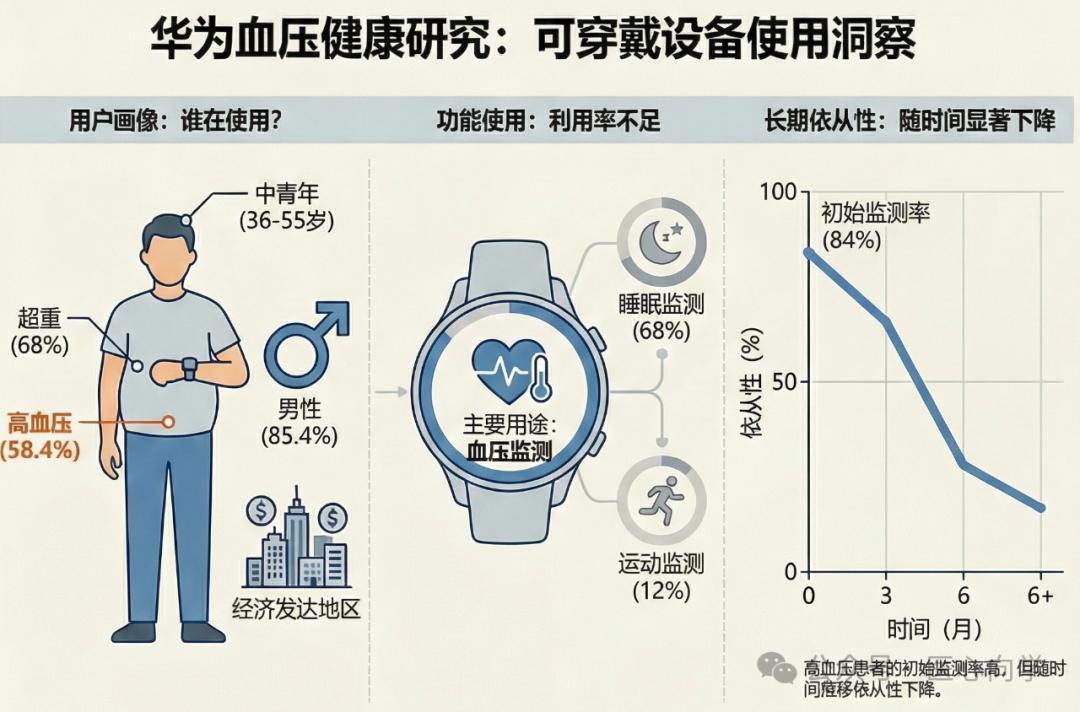
Wearable technology shows great potential in chronic disease management, especially in the field of hypertension. However, there is still a lack of large-scale data supporting the user profiles, actual usage patterns, and long-term adherence of these devices in the real world. To fill this gap, the “Huawei Blood Pressure Health Study” was initiated. This study is the first and currently the largest real-world investigation into the application of wearable devices in blood pressure management, with significant results published in the authoritative journal of cardiovascular digital health, the European Heart Journal – Digital Health.
Significant “Digital Health Divide” — Who is Really Using Health Watches?
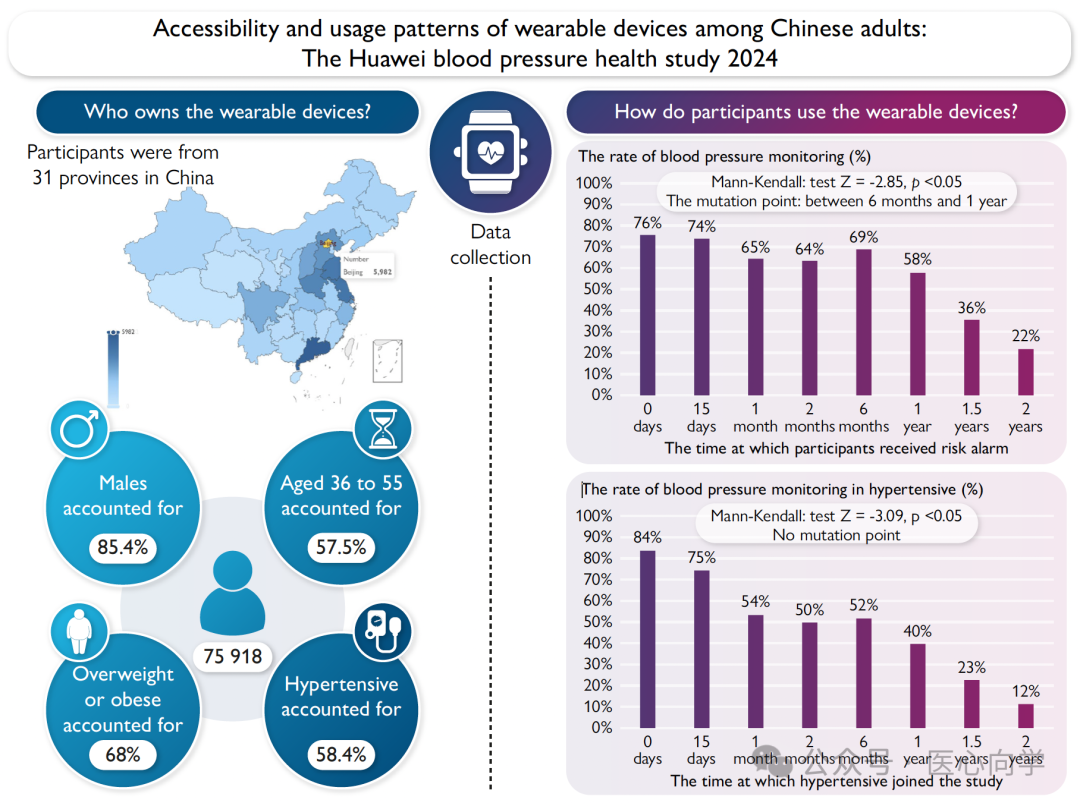
The study first reveals the existence of a “digital health divide” among users of wearable devices in China. By analyzing data from over 75,000 participants, the study clearly depicts the main user profile of current health watches, characterized by:
- Regional Concentration: Users are primarily concentrated in the economically developed South China and East China regions.
- Gender and Age: The main users are middle-aged men, with men accounting for 85.4%.
- Health Status: The proportion of overweight or obese individuals is 68%, while those diagnosed with hypertension account for 58.4%.
This data indicates that the current popularity of wearable health devices is significantly uneven across factors such as gender, age, and socioeconomic status. High-risk groups (middle-aged, overweight, diagnosed males) are the primary users, while participation from women, young people, and residents of underdeveloped areas is relatively low. This phenomenon reveals a dual challenge: on one hand, it is necessary to ensure the long-term adherence of the existing high-risk user group; on the other hand, strategies must be developed to extend the preventive value of wearable devices to a broader and more diverse population, thereby truly bridging the digital health divide.
Functions Underutilized — Advanced Health Tracking is “Idle”
Another unexpected finding of the study is that even when users possess powerful health monitoring devices, their advanced features are not fully utilized, and much valuable health data remains “idle.” Specific data shows:
- Among all participants, 73.8% used the core blood pressure monitoring function.
- However, only 70.0% used the sleep monitoring function.
- Even more surprisingly, only 19.9% of users recorded comprehensive data sufficient to analyze exercise intensity (rather than simple step counting), such as energy expenditure, weight, and duration of exercise, indicating that the vast majority of users are in a state of “superficial use” of the exercise monitoring function.
This phenomenon may mean that most users are missing the opportunity to manage their health more comprehensively through the integrated analysis of blood pressure, sleep, exercise, and other multidimensional health data. This presents a clear challenge for clinicians and public health practitioners: there must be an emphasis on patient education, guiding them on how to utilize these integrated data streams to transform the device from a single monitoring tool into a comprehensive, multidimensional health management partner.
Adherence Significantly Declines Over Time — Enthusiasm Followed by Forgetfulness
The findings of this study regarding long-term adherence provide an important warning for clinical practice. Data shows that whether users received hypertension risk alerts or were diagnosed hypertensive patients, their blood pressure monitoring rates significantly decline over time. This decline is specifically manifested as:
- For users who received hypertension risk alerts, their monitoring rates significantly declined between 6 months to 1 year.
- For diagnosed hypertensive patients, although the monitoring rates also decline over time, they remain above 50% during the initial 6 months.
Based on this clear pattern of declining adherence, the study proposes an important, data-driven clinical management recommendation: to maintain users’ monitoring behavior, it is suggested to conduct annual follow-ups for high-risk groups who received risk alerts, while diagnosed hypertensive patients should undergo semi-annual (every 6 months) follow-ups. This proactive intervention strategy is expected to improve the effectiveness of long-term management.
Conclusion
The Huawei Blood Pressure Health Study, as a large-scale real-world investigation, reveals three key realities regarding the application of wearable devices in blood pressure management: a significant digital health divide, underutilization of core device functions, and the general issue of users’ long-term adherence declining over time. These findings not only point the way for the optimization of digital health products but, more importantly, provide clinicians with specific, data-based management strategy references — namely, conducting annual follow-ups for high-risk groups and semi-annual follow-ups for hypertensive patients to maintain their monitoring adherence, thereby truly realizing the value of wearable devices in chronic disease management.
References:
Wang Y, Zhou S-S, Liu Y-Q, et al. Accessibility and usage patterns of wearable devices among Chinese adults: the Huawei Blood Pressure Health Study. European Heart Journal – Digital Health. 2025;6(6):1264-1272.
Disclaimer: The content of this article is for reference only and does not constitute any specific medical advice.
Keywords: #Blood Pressure #Wearable Devices #Hypertension #Real World Study #Accessibility #Digital Divide#