Click the card below to follow the “Rixin Yuyue” public account for future updates!
Smart Home: How Millimeter-Wave Radar Enables Air Conditioners to ‘Recognize’ People
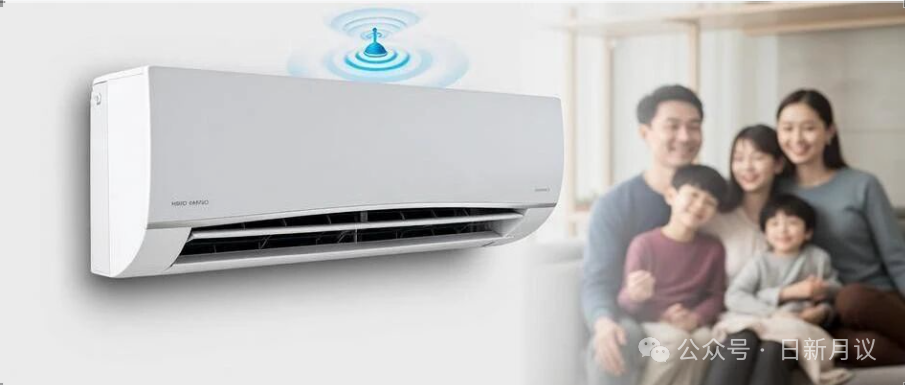
While traditional air conditioners are still “blindly blowing” air, millimeter-wave radar has taught air conditioners to “read the room”. It can accurately sense whether there are people in the room, their positions, whether they are sitting still or moving, and even determine sleep status through subtle breathing movements, achieving a truly intelligent experience of “wind stops when people leave, wind starts when people arrive”.
🔍 Three Key Elements of Millimeter-Wave Radar’s ‘Recognition’ Capability
The ‘recognition’ capability of millimeter-wave radar in smart homes is primarily based on three core perception dimensions:
| Perception Dimension | Technical Principle | Application Scenario |
|---|---|---|
| Presence Detection | Detecting micro-movements of the human body (breathing, heartbeat) | Determining whether there are people in the room to avoid unnecessary operation |
| Position Tracking | Multi-antenna angle measurement + distance measurement | Determining the exact position of a person in the room |
| Activity Recognition | Doppler frequency shift analysis | Distinguishing between sitting, moving, sleeping, and other states |
Presence Detection is the foundational capability. Millimeter-wave radar can penetrate clothing, thin blankets, and other materials, detecting micro-movements caused by chest fluctuations through the micro-Doppler effect, sensing movements at the level of 0.1mm. This means that even if a person is completely still, the radar can determine their presence through breathing and heartbeat, which infrared sensors cannot achieve.
Precise Positioning allows air conditioners to implement “directional air delivery”. By forming a narrow beam with an array antenna, millimeter-wave radar can accurately measure the relative angle and distance between the person and the air conditioner. When it detects a person on the sofa, the air conditioner automatically adjusts the airflow direction to avoid blowing directly; when the person moves to the desk, the airflow direction adjusts accordingly.
🌬️ Adaptive Working Modes of Smart Air Conditioners
Based on the perception data from millimeter-wave radar, smart air conditioners can establish various adaptive working modes:
Energy-Saving Mode: Automatically enters a low-power state or shuts down when no one is detected in the room, saving more than 30% energy compared to traditional air conditioners.
Comfortable Air Delivery Mode: Dynamically adjusts airflow direction based on human position, achieving “air follows people, air avoids when people leave”. When multiple people are detected, it automatically calculates the optimal airflow path to ensure every area receives a comfortable temperature.
Sleep Mode: Determines sleep status through breathing frequency and body micro-movements, automatically reducing airflow and noise to prevent cold during the night. When it detects a person leaving the bed (e.g., to use the bathroom), it temporarily raises the temperature setting and returns to sleep mode upon their return.
🛡️ Advantages of Privacy Protection Compared to Traditional Solutions
Compared to traditional camera solutions, millimeter-wave radar has inherent advantages in privacy protection:
- No Image Data Collection: Only outputs abstract data such as distance, speed, and angle, unable to reconstruct personal appearance or clothing details
- Penetrative Detection: Can penetrate curtains, thin walls, and other obstacles to achieve “wall-perception” without infringing on visual privacy
- Data Anonymization: Processed data only contains anonymous information such as “Target 1 position (x,y,z)”, which cannot be linked to specific personal identities
This feature makes millimeter-wave radar particularly suitable for smart control in private spaces such as bedrooms and bathrooms, maximizing user privacy while providing convenience.
🔧 Key Technological Breakthroughs in Implementation
The application of millimeter-wave radar in air conditioners benefits from several key technological breakthroughs:
Chip-Level Integration: Modern millimeter-wave radar chips (such as TI’s IWR series) integrate the entire radar system onto a chip the size of a fingernail, allowing direct embedding into the air conditioner panel without affecting the design.
Low-Power Design: Standby power consumption can be as low as milliwatt levels, suitable for the 24-hour continuous operation needs of household appliances.
AI Edge Processing: Directly completes target classification and trajectory tracking at the radar end, reducing the need to upload data to the cloud, thus protecting privacy and reducing latency.
🏠 Real-World Application Cases
After equipping a certain brand of smart air conditioner with a 60GHz millimeter-wave radar, the following intelligent functions were achieved:
- Senior Care: Automatically sends reminders to family members’ phones when it detects that an elderly person has been motionless for an extended period (potentially indicating an accident)
- Child Protection: Automatically switches to gentle wind mode when it detects a child near the air conditioner’s outlet to prevent direct blowing that could cause a cold
- Multi-Person Scenarios: During gatherings in the living room, intelligently partitions airflow based on the distribution of people to ensure balanced temperatures in every corner
Millimeter-wave radar transforms air conditioners from “temperature regulators” to “environmental sensors”, providing a truly personalized and humanized comfort experience by understanding human presence, position, and status. This ‘recognition’ capability is redefining the human-computer interaction in smart homes.
Welcome to follow the “Rixin Yuyue” public account for more interesting radar knowledge updates!