In March 2025, a hydrogen station in Jiangsu was forced to shut down due to false alarms from sensors, resulting in direct losses exceeding 500,000 yuan. In May of the same year, a station in Zhejiang set an industry record with two consecutive years of zero faults—both in the same hydrogen energy boom, yet with drastically different safety outcomes. Behind this lies a truth overlooked by 90% of purchasers: the core of safety monitoring for hydrogen stations is not about brand selection, but about choosing the lifeline.
1. The Dilemma of Selection Under Hydrogen Explosion Risks: Do You Really Understand the Parameters?
The explosion limit of hydrogen is 4% to 75%, which means a single sensor error could obliterate the entire station. However, 80% of the selection schemes on the market still pile up cold numbers like “response speed” and “detection accuracy,” yet no one tells you: in the -30°C winter, your sensor may have already frozen; when H₂S concentration exceeds the limit, imported big brands may collectively “go blind.”
The Bloody Reality of the Industry:
1. A certain station used international brand sensors, which lacked anti-interference capability, resulting in 16 false alarms within six months, with each shutdown costing over 100,000 yuan.
2. A project opted for cheap sensors to save costs, which only alarmed three minutes after a hydrogen leak, nearly causing an explosion.
3. A state-owned enterprise strictly followed the GB/T 50493-2019 standard to layout 28 detection points, yet faced a sensor failure rate of 8%, becoming a laughingstock in the industry.
2. The Iron Triangle of Selection: Standards, Technology, and Cases Must Not Be Lacking
(1) The National Standard Red Line Cannot Be Crossed: Professionalism Seen from Detection Point Layout
GB/T 50493-2019 clearly states: two detection points must be set within three meters around the hydrogen refueling machine, and the hydrogen storage tank area must achieve three-dimensional monitoring. However, the 28-point golden layout of Dexil in a project in Zhejiang tells you: compliance is just the baseline; true safety requires “predictive monitoring”—every corner where hydrogen may leak must have “eyes like a hawk” and “ears like the wind.”
The EN 17127 environmental standard further reveals a harsh reality: ordinary sensors can see accuracy errors soar to 15% in 90% humidity environments. This is why Dexil adopts military-grade protective designs to ensure that detection accuracy remains stable within ±2% in extreme environments of -40°C to +70°C and 15% to 95% RH.
(2) Technology Showdown: How Quantum Conductivity Outperforms Traditional Solutions?
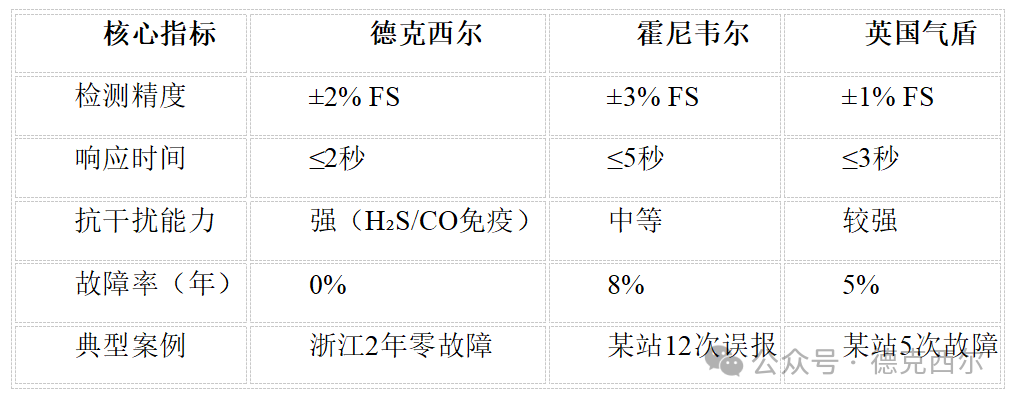
While Honeywell is still boasting about its ±3% detection accuracy, Dexil’s quantum conductivity technology has already achieved:
Response time ≤ 2 seconds: three times faster than the industry average, buying critical time for emergency response.
Resistance to H₂S/CO interference: can accurately identify hydrogen concentration even in environments with 100 ppm of interfering gases.
Zero failure rate: data from the Zhejiang hydrogen station over two years shows that Dexil’s equipment achieved zero failure records.
(3) Vendor Comparison: Data Doesn’t Lie
3. In-Depth Analysis of the Zhejiang Case: The Two Secrets Behind Zero Failures
Secret One: The Disruptive Breakthrough of Quantum Conductivity Technology
Traditional electrochemical sensors are like nearsighted patients, unable to “see clearly” when encountering interfering gases. Dexil’s quantum conductivity sensors are like wearing smart glasses—by monitoring the impact of hydrogen molecules on quantum states, they fundamentally avoid interference from gases like H₂S. The operation logs from the Zhejiang station show that even when H₂S occasionally exceeded the limit in surrounding chemical plant areas, the sensors continued to operate stably.
Secret Two: Military-Grade Protection with 28-Point Layout
After on-site inspections, Dexil engineers provided a 28-point three-dimensional monitoring scheme that is textbook-worthy:
1. The hydrogen storage tank area uses a “品” shaped layout to ensure no blind spots for leaks.
2. The area near the hydrogen refueling machine employs cross-validation designs to prevent single-point false alarms.
3. Miniature sensors are installed at pipeline interfaces to capture minor leaks.
This layout allowed the Zhejiang station to successfully issue a warning during the 2024 typhoon season for a minor leak caused by slight corrosion of the pipeline, avoiding a potential explosion.
4. Selection Decision Guide: Three Soul-Searching Questions
Can your sensors maintain accuracy in extreme environments?
Don’t just look at laboratory data; ask the supplier: can your equipment still function normally in the -30°C winter of Northeast China?
What to do when interfering gases come?
When there are chemical plants and gas stations nearby, interfering gases like H₂S and CO can turn ordinary sensors into “blind” devices; at this point, quantum conductivity technology is a lifesaver.
Who will be responsible if there is a failure?
Are there not many cases where international brands shirk responsibility after an incident? Choosing Dexil means choosing a commitment of 2 years warranty + lifetime technical support.
5. Call to Action: Safety Cannot Wait
Contact us now to receive three exclusive benefits:
Free on-site inspection: Dexil engineers will customize monitoring solutions on-site.
National standard compliance checklist: avoid 90% of selection pitfalls.
Complete report on the Zhejiang case: learn the secrets of zero-failure operation and maintenance.
Safety is not a multiple-choice question, but a matter of survival. While you are still hesitating over prices, smart peers have already built a safety barrier with Dexil. Remember: in the hydrogen energy industry, the most expensive cost is always the cost of accidents.