Fiber Bragg Grating (FBG) sensors exhibit significant application potential in monitoring lithium-ion batteries (LIB) due to their inherent advantages such as small size, lightweight, strong electromagnetic interference resistance, corrosion resistance, distributed sensing capability, and long-term stability。LIB is widely used in fields such as electric vehicles and energy storage systems, but safety incidents are frequent, making real-time monitoring of battery status crucial。FBG sensors can effectively monitor key parameters inside and outside lithium-ion batteries, such as temperature, strain, and pressure, thereby improving battery performance, extending service life, and ensuring safe operation。
The basic working principle of FBG sensors is based on the periodic refractive index modulation (i.e., grating) of the fiber core reflecting specific wavelength light (Bragg wavelength, λBλB)。When external physical quantities (such as temperature or strain) cause changes in the grating period (ΛΛ) or effective refractive index (neffneff), the Bragg wavelength will drift。By measuring this wavelength drift, sensing of the corresponding physical quantity can be achieved。
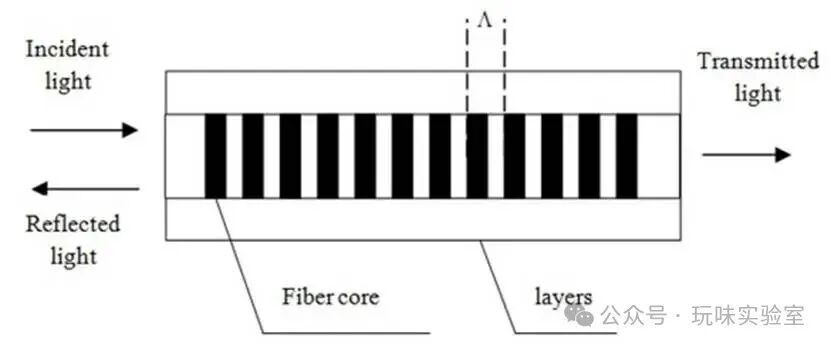
Illustration of Fiber Bragg Grating (FBG)
The above image illustrates the basic principle of FBG sensors: incident light enters the fiber, and when it encounters the grating area, specific wavelength light that meets the Bragg condition will be reflected (reflected light), while other wavelengths will transmit through (transmitted light). Changes in the grating period (Λ) will lead to shifts in the Bragg wavelength.
In the monitoring of lithium-ion batteries, the application of FBG sensors mainly focuses on the following aspects:
1. Temperature MonitoringDuring the charging and discharging processes of lithium-ion batteries, heat is generated, and uneven temperature distribution or excessively high temperatures may lead to performance degradation, accelerated aging, or even thermal runaway, severely affecting battery safety。FBG sensors can achieve precise temperature monitoring inside and outside the battery。For example, FBG sensors can be integrated into battery packs to obtain real-time temperature information by monitoring the drift of their Bragg wavelength。Compared to traditional electrochemical sensors, FBG sensors have low invasiveness and resistance to electromagnetic interference, making them perform excellently in monitoring the internal temperature field of batteries。One study proposed a fiber optic sensor composed of a metal ring and FBG for temperature monitoring of external electrodes of lithium-ion batteries, which is easy to install and does not interfere with the internal operation of the battery。Another study utilized dual-cladding fiber Bragg grating sensors to achieve temperature field monitoring of lithium battery packs, effectively overcoming the issues present in traditional temperature measurement systems。
2. Strain and Pressure MonitoringDuring the charging and discharging processes of lithium-ion batteries, the electrode materials undergo volume expansion and contraction, leading to strain and pressure changes inside the battery。Monitoring these mechanical changes is crucial for assessing the state of health (SOH) and state of charge (SOC) of the battery。FBG sensors can be directly embedded inside the battery to measure the strain of the electrodes and the overall expansion of the battery in real-time。This helps identify abnormal behaviors inside the battery, such as swelling caused by lithium-ion deposition, which may indicate potential safety risks。Research has shown that FBG sensors can monitor the strain of lithium-ion batteries with high precision, which is significant for assessing the SOH and SOC of the battery。For example, by embedding FBG sensors in soft-pack batteries, the strain and temperature changes of the internal electrodes during cycling can be monitored。
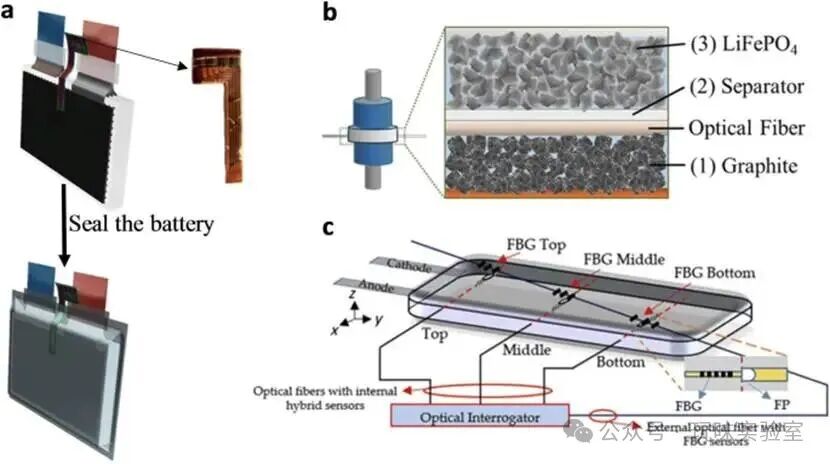
Internal Structure of the Battery and Arrangement of Fiber Sensors
The above image shows the internal structure of the battery and the monitoring scheme based on fiber sensors. Three FBG sensors (FBG Top, FBG Middle, FBG Bottom) are placed at different positions within the battery to monitor parameters such as strain and temperature in real-time. External fibers also integrate FBG and Fabry-Perot (FP) sensors to provide additional sensing capabilities.
3. State of Charge (SOC) and State of Health (SOH) EstimationTraditional SOC and SOH estimation methods mainly rely on electrical parameters such as battery voltage and current。However, recent studies have shown that non-electrical parameters of the battery, such as internal strain and temperature, have a nonlinear relationship with SOC and SOH, which can be used for more accurate estimation。FBG sensors can simultaneously measure these non-electrical parameters。For example, some studies proposed combining electrical parameters with non-electrical parameters measured by FBG (wavelength shifts caused by strain and temperature) and using neural network models for precise estimation of lithium battery SOC。Another study proposed a SOC estimation framework that comprehensively considers internal strain and temperature of the battery, achieved through a parallel distributed FBG sensor implantation scheme。Additionally, real-time temperature and strain data obtained from FBG sensors can be used to construct a novel classifier tracking the maintenance index (CPMI) scheme for sustainable SOH monitoring and maintenance scheduling。
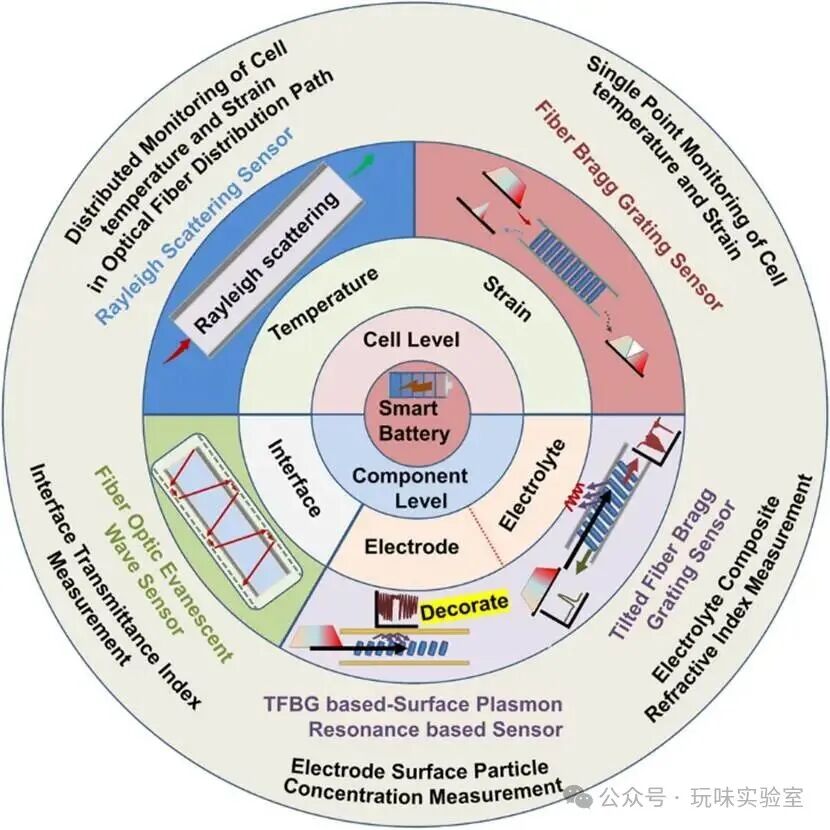
Various Sensing Technologies in Smart Batteries
The above image depicts various sensing technologies and their applications in smart batteries. Among them, Fiber Bragg Grating (FBG) sensors are used for single-point monitoring of battery temperature and strain by measuring the reflected light of specific wavelengths to determine changes in physical quantities. Tilted Fiber Bragg Grating (TFBG) can be used to measure the refractive index of the electrolyte and the concentration of particles on the electrode surface. This indicates that FBG and its variants play a core role in battery monitoring.
4. Monitoring of Microscopic Changes Inside the BatteryIn addition to macroscopic temperature and strain, FBG sensors can also be applied to monitor more microscopic changes inside the battery. For example, Tilted Fiber Bragg Grating (TFBG) can be used to measure the refractive index of the electrolyte, thereby understanding the changes in electrolyte composition during the battery degradation process。
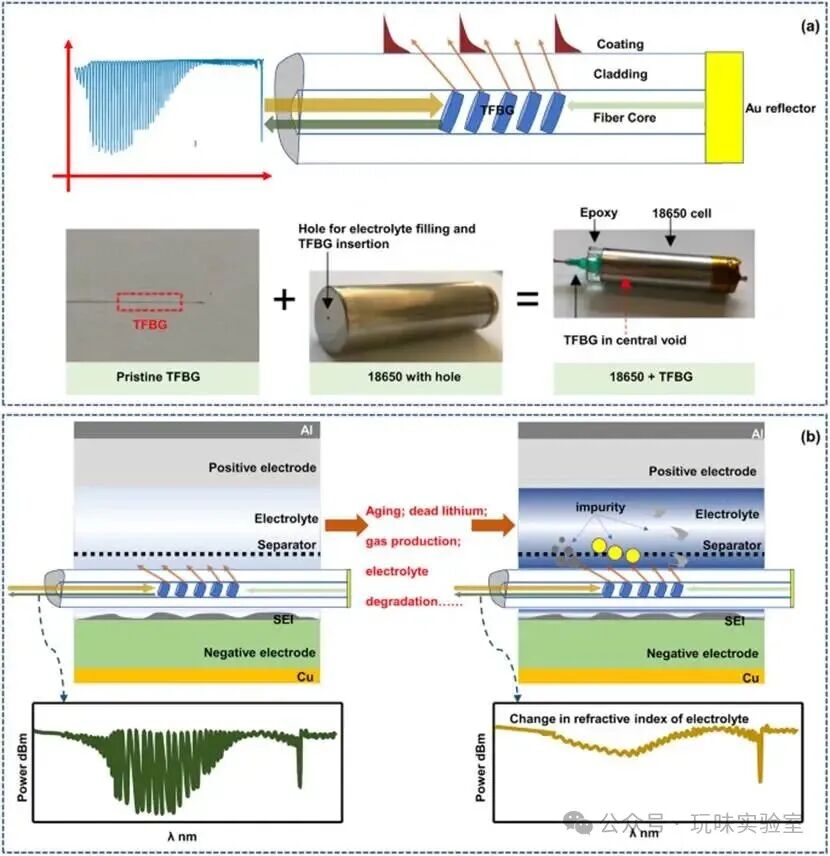
Integration of FBG in 18650 Batteries and Its Sensing Principle
The above image shows the integration of FBG in 18650 batteries and its sensing principle. Figure (a) illustrates the manufacturing and structure of the sensor integrated into the 18650 battery, where TFBG is inserted into the hole at the center of the battery for electrolyte filling and TFBG insertion. Figure (b) explains the sensing principle based on battery degradation, reflecting changes in the refractive index of the electrolyte by monitoring the spectral response of TFBG, thereby assessing the health and degradation state of the lithium-ion battery.
Advantages and Challenges of FBG Sensors FBG sensors have significant advantages in monitoring lithium-ion batteries, including:
- High Sensitivity: Capable of detecting minute changes in temperature and strain.
- Electromagnetic Interference Resistance: Fiber optic sensors are unaffected by electromagnetic interference, making them suitable for use in electrochemical environments.
- Small Size and Lightweight: Easy to integrate into battery cells or packs, and can even be embedded inside the battery with minimal impact on battery performance.
- Distributed Sensing Capability: Multiple FBG sensors can be connected in series on a single fiber for multi-point monitoring, providing more comprehensive battery status information.
- Corrosion Resistance and Long-term Stability: Glass fiber materials have good chemical inertness, allowing them to operate for extended periods in harsh environments.
However, FBG sensors also face some challenges. For instance, there may be cross-sensitivity between temperature and strain, meaning that temperature changes can also cause wavelength drift in strain sensors, and vice versa。To address this issue, researchers have developed various methods, such as using two FBG sensors with different temperature or strain sensitivities, or combining them with other types of sensors for decoupled measurements。Additionally, the cost of FBG sensors and the complexity of embedding them during battery production are obstacles that need to be overcome for large-scale applications3。Future research will focus on optimizing sensor design and integration schemes to enhance their reliability and cost-effectiveness in lithium-ion battery monitoring。
In summary, FBG sensors, with their unique advantages, provide a powerful tool for real-time, precise, multi-parameter monitoring of lithium-ion batteries, which is crucial for improving battery safety, optimizing performance management, and extending service life。As technology continues to advance, FBG sensors are expected to play an increasingly important role in smart battery systems。
References
https://doi.org/10.1515/phys-2018-0091
https://doi.org/10.1007/s41918-019-00060-4
https://doi.org/10.1007/s40820-024-01374-9