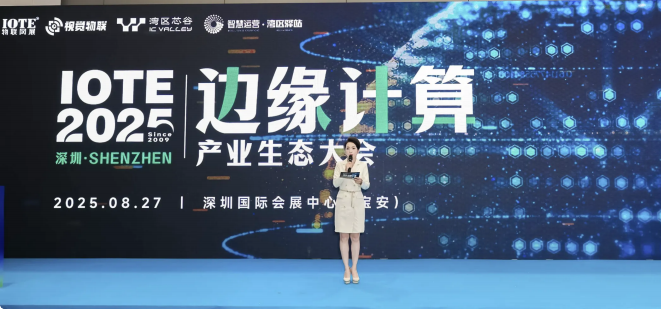
Recently, our technical team was invited to attend the 2025 Deep Edge Computing Industry Ecosystem Conference, bringing back cutting-edge insights from the industry. The conference pointed out that edge computing is facing “implementation difficulties, high costs, and fragmentation” as three major challenges, while the rise of open source large models is providing new ideas for breaking through these issues.
The open source large models significantly reduce application costs and improve algorithm performance, making multi-form edge applications possible. Market data is equally exciting: the compound annual growth rate of China’s edge computing market is expected to reach 21.7% over the next three years, with the market size expected to exceed 130 billion yuan by 2026.
In terms of industrial ecology, the process of localization is accelerating. Open source HarmonyOS has become the mainstream operating system, with companies like Deep Open Harmony and National Open Harmony developing core products based on it; in the chip sector, domestic manufacturers like Rockchip are building a self-controllable technological foundation.
Although large models lower the technical threshold, the core competitiveness of the industry still lies in a deep understanding of vertical fields and data accumulation. Currently, edge computing terminals are still primarily based on CV algorithms, and large models have not yet formed a large-scale implementation. Future trends show two major directions: the combination of large and small models will become the optimal solution for edge intelligence, allowing for flexible selection based on scene requirements; edge computing boxes with built-in storage functions will become a necessity, better meeting local data processing needs.
During the conference, our technical team particularly visited AI company Gongda, whose AI training platform has achieved full-process automation from data management to edge deployment, and supports one-click optimization migration for mainstream domestic NPU chips, solving the long-standing performance bottleneck issue.
The industry is transitioning from “large model frenzy” back to “pragmatic scene implementation”. Small models, due to their low resource consumption and easier deployment, have clear advantages in segmented scenarios, and edge computing is entering a more rational and practical stage. Our company will actively follow technological trends, focus on vertical scenarios, and promote the creation of value through edge intelligence in the real world.

About Us
Chengdu Lizhiyuan Technology Co., Ltd. is an innovative technology enterprise relying on Chengdu University of Technology and the Chengdu Institute of Mountain Hazards and Environment, Chinese Academy of Sciences. The company is headquartered in the Chengdu University of Technology Science and Technology Entrepreneurship Park, with its R&D base located in the Duoyuan International Headquarters No. 1 in Chenghua District. It focuses on the integrated application of advanced information technologies such as spatial information technology, the Internet of Things, big data, and artificial intelligence, and is committed to creating internationally leading geoscience intelligent engineering applications.The company was co-founded by relevant professional professors, doctors, and industry veterans, based on universities, with technological innovation as the leading force. It has achieved fruitful results in geological disaster monitoring and early warning, the intersection of artificial intelligence and earth sciences, geoscience real-scene 3D modeling technology, geoscience big data, GIS, and digital twin technologies, providing professional services for disaster prevention and mitigation, environmental protection, smart transportation, and smart cities.