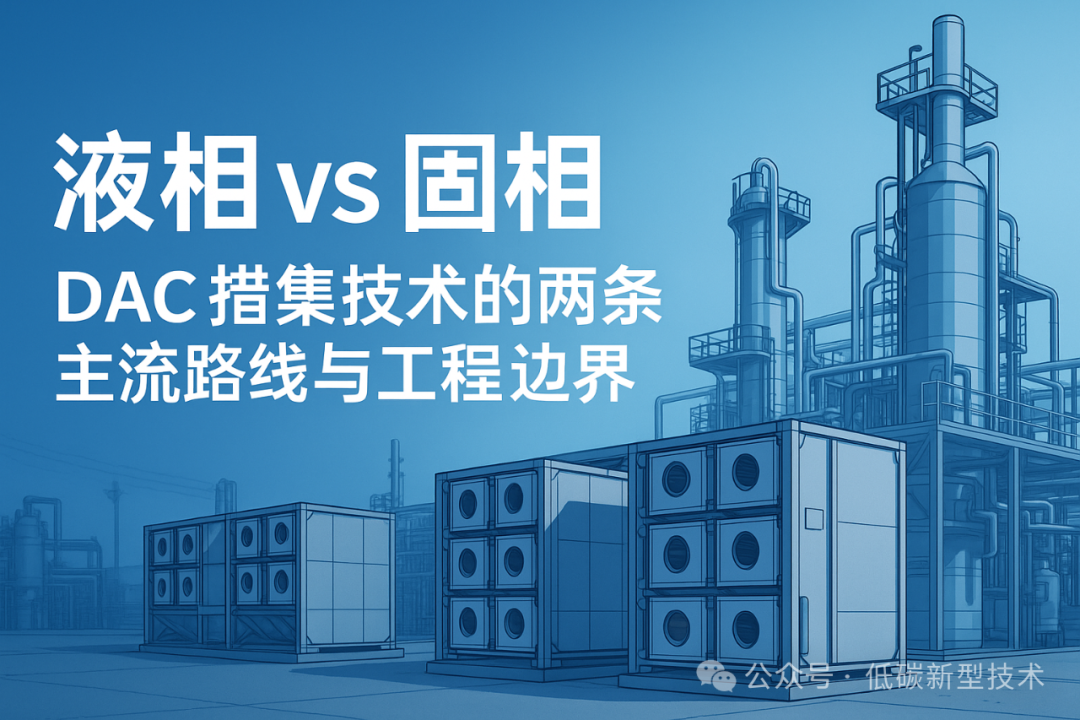
In the past two years, Direct Air Capture (DAC) has transitioned from conceptual demonstration to engineering practice. With significant fluctuations in energy prices in Europe and carbon neutrality goals evolving from “long-term commitments” to “project lists,” the technical pathways of DAC have increasingly clarified into two main lines:
-
Liquid Sorption
-
Solid Sorption
There are essential differences in process principles, energy consumption boundaries, engineering forms, and compatibility with downstream utilization methods. Understanding the engineering boundaries of these two routes helps to determine where the future main battlefield of DAC technology lies and assists companies in selecting a more suitable technology combination for their specific scenarios.
1. Capturing CO₂ from 420 ppm: Common Challenges of DAC
Compared to coal-fired flue gas and industrial exhaust, the concentration of CO₂ in the atmosphere is only about 420 ppm.This means that DAC must address three engineering challenges simultaneously:
-
Large Airflow: To capture enough CO₂, a large volume of air must be processed, and the fans and ducts themselves consume significant energy.
-
High Affinity Adsorbents: The adsorbents need to have sufficiently high selectivity and affinity for low-concentration CO₂.
-
Reversible Regeneration: Adsorbents must be able to release high-purity CO₂ at low cost and minimize performance degradation.
Liquid and solid DAC employ two completely different technical approaches: one relies on traditional chemical engineering systems, while the other originates from materials science and interfacial chemistry.
2. Liquid DAC: The “Chemical Plant Route” Based on Strong Alkali Solutions
Liquid DAC centers around solutions like KOH, NaOH, and MEA, allowing CO₂ to react with strong alkalis through gas-liquid contact, effectively “dissolving” it into the liquid, and then using a high-temperature or chemical cycling process to “squeeze” CO₂ out of the solution.
Taking the typical KOH-Ca cycle as an example:
-
Absorption Stage: Air passes through a large contact tower, where CO₂ reacts with KOH to form K₂CO₃.
-
Conversion Stage: K₂CO₃ reacts with Ca(OH)₂ to produce CaCO₃ precipitate.
-
Regeneration Stage: CaCO₃ is calcined at 700–900℃, releasing CO₂ and generating CaO.
-
Cycling Stage: CaO reacts with water to produce Ca(OH)₂, which is recycled back to the front end.
Engineering Characteristics
Advantages:
-
Fast absorption reaction kinetics, suitable for handling large airflows;
-
Process approach is similar to traditional flue gas decarbonization, with a mature chemical industry foundation;
-
A single unit has the potential to achieve a scale of 100,000 to even 1 million tons/year.
Significant Shortcomings:
-
Requires high-temperature calcination,resulting in high thermal consumption (generally 7–9 GJ/t CO₂);
-
Large equipment size, high civil engineering and corrosion resistance requirements, leading to heavy CAPEX burden;
-
Process primarily operates continuously, not suitable for frequent start-stop operations;
-
Requires stable, low-cost heat sources (waste heat, natural gas), imposing high site condition requirements.
From an engineering perspective, liquid DAC resembles a new chemical facility rather than a “standardized product”.
3. Solid DAC: The “Modular Route” Based on Interfacial Chemistry
Solid DAC utilizes amine-functionalized materials, MOFs, porous resins, zeolites, and carbon-based materials, introducing amine groups or other functional groups on solid surfaces to enable reversible bonding of CO₂ with these functional groups.
A typical reaction can be simplified as:
R–NH₂ + CO₂ ↔ R–NH–COO⁻ + H⁺
Process Pathway
-
Adsorption Stage: Ambient air passes through modules filled with adsorbents, where CO₂ is fixed on the material’s surface or within its pores.
-
Regeneration Stage: CO₂ is desorbed from the adsorbent through low-temperature heating (60–100℃) or reduced pressure, yielding high-purity CO₂.
-
Cooling and Cycling: After cooling, the adsorbent re-enters the next adsorption cycle.
Engineering Characteristics
Advantages:
-
Low regeneration temperature,with thermal consumption typically at 3–5 GJ/t CO₂;
-
Easy to create modular units such as containerized or skid-mounted systems, allowing flexible deployment;
-
Short startup and shutdown times, compatible with renewable power sources like photovoltaics and wind power;
-
High purity CO₂ output, facilitating direct entry into downstream synthesis, fuel, or electrochemical conversion units.
Challenges primarily lie in materials:
-
Amine groups may deactivate under high temperatures and oxygen environments;
-
Some materials are sensitive to humidity, requiring effective moisture management in engineering;
-
Adsorption capacity, cycle life, and cost are still under continuous optimization.
However, this also means that solid DAC is still in a phase of continuous iteration and performance improvement.
4. Energy Consumption and Engineering Boundaries: High-Temperature Concentration vs Low-Temperature Electric Drive
If DAC is viewed as a “low-concentration CO₂ concentrator,” then the core constraints are energy consumption and thermodynamic thresholds.
In comparison:
| Indicator | Liquid DAC | Solid DAC |
|---|---|---|
| Regeneration Temperature | 700–900℃ (primarily calcination) | 60–100℃ (low-temperature desorption) |
| Typical Thermal Consumption | 7–9 GJ/t CO₂ | 3–5 GJ/t CO₂ |
| Main Energy Form | Steam / Gas / Waste Heat | Electricity / Low-grade Heat |
| Process Operation Mode | Continuous, Heavy Equipment | Modular, Start-Stop Capable |
| Site Adaptability | Close to Chemical Parks, Power Plants | Near Renewable Energy or End Applications |
It can be seen that:
-
Liquid DAC is more like “adding a set of equipment where there is waste heat and a chemical foundation”;
-
Solid DAC is more suitable as a “modular device,” used in conjunction with photovoltaics, wind power, and waste heat from electrolyzers.
As the proportion of renewable electricity continues to rise, what is more readily available is electricity rather than high-grade steam, making low-temperature electric-driven solid DAC more adaptable in energy structure.
5. Coupling with Downstream Utilization: Which is More Suitable for Entering the PtX System?
The true value of DAC lies not only in “emission reduction” but in whether the captured CO₂ can be transformed into valuable molecules: such as CO₂ electrolysis to produce CO, methanol, methane, long-chain fuels, or high-value-added chemicals, which is supported by a complete Power-to-X (PtX) industrial chain.
From the perspective of coupling with PtX:
-
Liquid DAC, due to its need for stable continuous operation and high-temperature regeneration, is sensitive to fluctuations in operating conditions and is more suitable for coupling with large chemical processes, coal chemical projects, or oil and gas field CCUS projects;
-
Solid DAC, being electric-driven, flexible in start-stop operations, and scalable, is more easily integrated with PEM electrolyzers and green methanol/methane units to form “distributed PtX micro-factories.”
In a typical PtX scenario: photovoltaics → electrolysis → green hydrogen → CO₂ capture → synthesis of methanol/methane/fuels, solid DAC has higher synergy with the entire chain in terms of energy consumption structure, module size, and operation mode.
6. Eplus’s Perspective: The Key to DAC is Not “How Much is Captured” but “Where is it Connected and Where Does it Go”
From Eplus’s engineering practice, we increasingly feel that:
The real issue with DAC is not “how much CO₂ can be captured,” but “where this CO₂ connects and where it flows,” which refers to its interface position within the entire energy and chemical system.
If we break down the future low-carbon system:
-
Upstream is renewable electricity and electrolysis equipment;
-
Midstream is DAC and CO₂ purification;
-
Downstream is methanol, methane, liquid fuels, chemicals, or electrochemical conversion units.
In this chain, we focus on three aspects:
-
Coupling Ability with Renewable Energy: Can it operate stably under power fluctuations? Can it utilize “excess electricity”?
-
Size Matching and Modularity with Electrolysis and Synthesis Equipment: Can it form a natural ratio with electrolyzers of 10 Nm³/h, 30 Nm³/h? Can it scale up like “building blocks”?
-
Overall Role in PtX Economics: Can the capture cost be absorbed through the value of downstream products (green methanol, e-methane, etc.)? Can it transform from a “cost center” to a “value entry point”?
Based on these considerations, Eplus’s technical layout is more inclined towards: solid DAC coupled with electrochemical conversion, viewing DAC as “a standard interface of a modular PtX system” rather than an isolated emission reduction device.
This does not deny the value of liquid DAC in certain centralized, traditional industrial scenarios with abundant waste heat, but from the perspective of system design in the new energy era, we believe:
The combination of solid DAC + modular electrolysis + synthesis units will be the mainstream engineering solution replicable in more regions and scenarios in the future.
7. Conclusion: Two Routes, Each with Its Destination
Based on the above analysis, a rough engineering boundary judgment can be made:
-
Liquid DAC: More suitable for centralized, heavy chemical scenarios, connected after large industrial installations and CCUS projects, following the “large device + waste heat utilization” route;
-
Solid DAC: More suitable for distributed, renewable energy-dominated scenarios, serving as a modularly expandable “carbon source entry” in the PtX system, deployed in synergy with electrolysis and synthesis devices.
In the context of the “dual carbon” goals and profound changes in the energy structure, DAC will not have only one path, but the “era mission” of the two main lines has gradually become clear:
-
Liquid resembles an extension of the old industrial system;
-
Solid appears as a key building block in the new energy system.
How to connect this building block with electrolysis, synthesis, and energy storage into a practical, replicable system will be the true competitive focus of DAC in the next stage.

 Eplus Energy Technology (Shanghai) Co., Ltd.
Electro Power Cell Energy Technology (Shanghai) Co., Ltd.🌐 Official Website: www.electropowercell.net📧 Email: [email protected]📱 WhatsApp: +86 136 8167 1402
We are committed to building a system platform for “hydrogen energy – carbon capture – green fuels,” transitioning energy from physical transformation to logical construction, and promoting the replicability of the entire chain from “electricity to hydrogen” to “electricity to liquid.”