How should NPN or PNP sensors be connected to PLCs or other devices? Actually, there is no need to memorize; understanding the concept of circuit allows you to connect them by referring to diagrams. Issues such as connecting sensors to devices, devices to devices, whether to connect the common terminal to positive or negative, whether to use internal or external power supply, etc., can all be viewed from the perspective of whether a circuit can be formed. A basic circuit is: current flows out from the positive terminal of the power supply, passes through the load, and then returns to the negative terminal of the power supply. If control is needed, a switch must be added to the circuit, but it is important to note that NPN and PNP type switches have a direction; the current can only flow if the direction is correct, thus forming a circuit. If there is no load in the circuit, it is equivalent to directly short-circuiting the power supply, which can cause sparks or smoke. The following examples will help further understand the concept of a circuit.Example 1: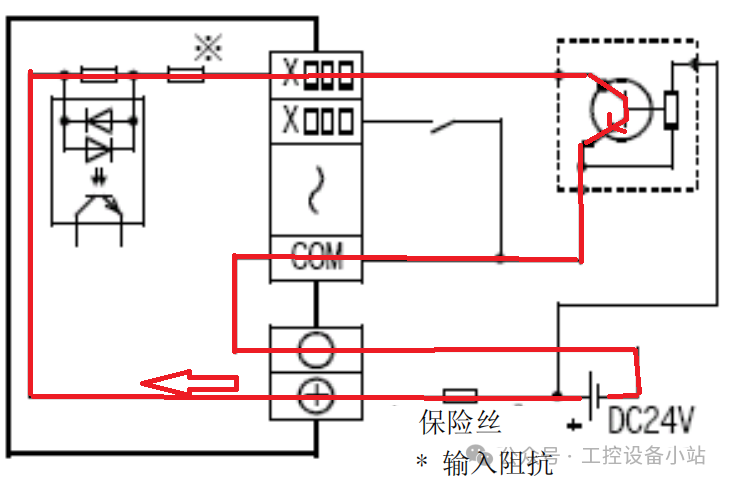 The left side of the above image is the PLC part, and the right side is the NPN type switch, using an external DC24V. The input impedance is equivalent to the load of the circuit, and the direction of the arrow indicates the direction of current flow, thus forming a circuit.Example 2:
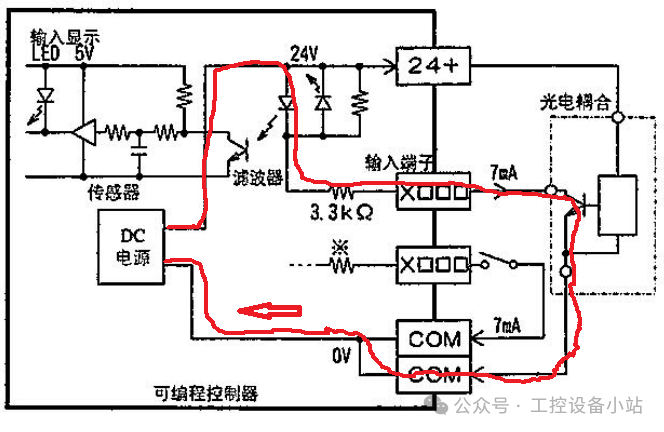 This image also shows an NPN switch, but it uses the internal power supply of the PLC.Example 3:
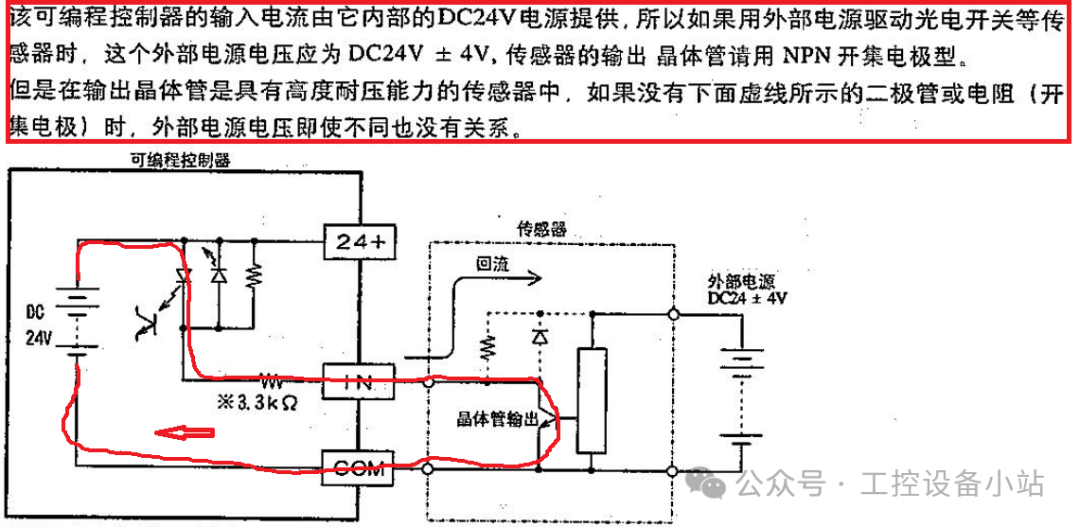 This situation involves using two power supplies. Some PLCs do not have the 24V+ lead out, and when the NPN sensor requires power, an external 24V power supply must be provided. Common open-collector NPN sensors have three wires, and the wire connecting to the external 24V- and the common terminal is the same. The text in the red box in the image above is very important.Example 4:
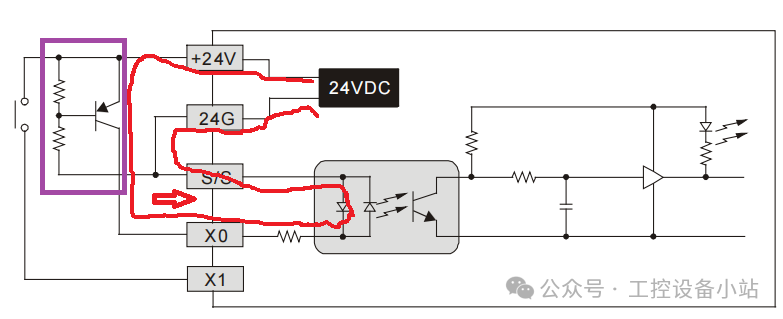 The purple box in the above image shows a PNP sensor, which forms a circuit using the internal power supply.
The best explanation of fate is: when you face a situation, the behavior you exhibit according to your past character and logic is fate. If your behavior deviates significantly from your past character habits when the situation occurs, this is called fortune. Therefore, fortune is change, and fate is a constant.
— Jung