In the field of autonomous driving, the detector technology of LiDAR (Light Detection and Ranging) is undergoing significant transformation. The once mainstream Linear Avalanche Photodiodes (APD) are gradually being replaced by more advanced Single Photon Avalanche Diodes (SPAD) and Silicon Photomultiplier (SiPM), both of which are redefining the boundaries of long-range detection with their extremely high sensitivity.
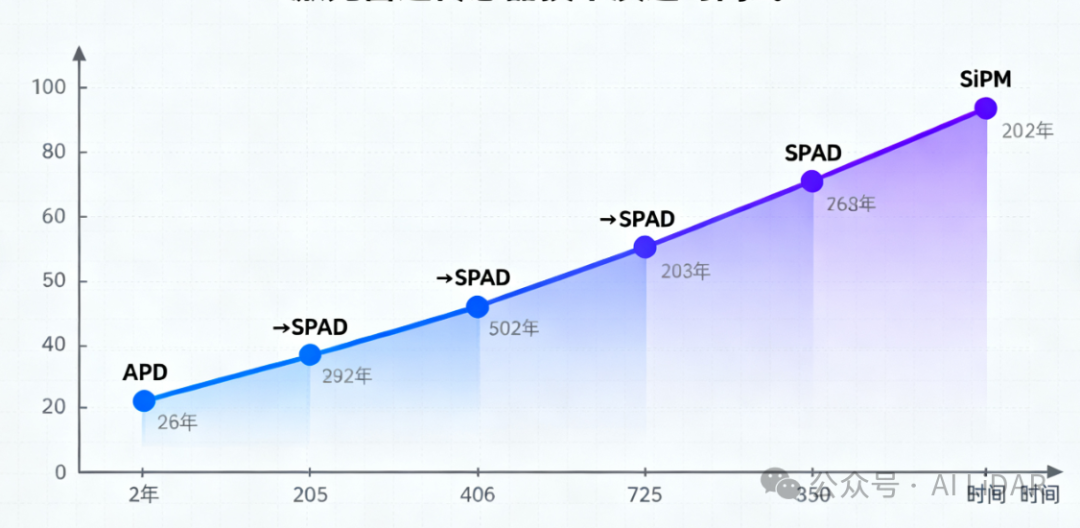
To help you quickly grasp the core changes, the table below outlines the key differences among APD, SPAD, and SiPM detectors.
| Feature Comparison | Linear Avalanche Photodiode (APD) | Single Photon Avalanche Diode (SPAD) | Silicon Photomultiplier (SiPM) |
|---|---|---|---|
| Operating Mode and Sensitivity | Linear amplification mode with low gain (typically around 100 times), unable to detect single photons. | Geiger Mode, with extremely high gain (up to 10⁶ times), capable of single photon detection. | Composed of a large number of micro SPAD units in parallel, essentially an array of SPADs, also capable of single photon detection. |
| Detection Distance Advantage | Limited by gain and sensitivity, difficult to achieve detection beyond 200 meters. | Extremely high sensitivity allows for detection distances of 200-250 meters or even further. | Similar to SPAD, high sensitivity supports long-range detection. For example, ON Semiconductor’s SiPM solution reportedly reaches over 300 meters. |
| Applicable Wavelengths | Mature technology covering multiple bands such as 905nm and 1550nm. | Currently mainly based on silicon semiconductor technology, only suitable for near-infrared bands like 905nm. | Similar to SPAD, based on silicon technology, primarily applied in the 905nm band. |
| Integration and Cost | Traditional discrete devices. | Can be manufactured using CMOS technology, facilitating integration with processing circuits, helping to reduce costs and improve integration. | Uses custom technology, requiring dedicated readout ASIC chips, making integration more challenging than SPAD. |
🔭 Leap from APD to Single Photon Detection
Although APD, SPAD, and SiPM are all based on the “avalanche effect”, their operational areas and performance are fundamentally different.
- APD operates in linear mode with limited gain, unable to respond to extremely weak light signals, which limits its detection distance.
- SPAD and SiPM operate in Geiger mode; once a photon strikes, it triggers a self-sustaining avalanche multiplication, producing a large and easily detectable electrical pulse, thus capable of capturing signals at the single photon level. This allows them to “see” objects that are extremely far away or have very low reflectivity, which APD cannot detect.
It is important to note that SiPM is essentially an array composed of thousands of micro SPAD units in parallel. The core difference between the two lies in the technology and integration method: SPAD uses standard CMOS technology, making it easy to integrate complex circuits; while SiPM uses custom technology, achieving extreme performance but requiring external dedicated chips (ASIC) for operation.
🌐 Technology Choices and Market Landscape
The choice of technology route profoundly impacts the market landscape. Industry leaders such as Hesai Technology and RoboSense widely adopt the architecture of VCSEL (Vertical-Cavity Surface-Emitting Laser) laser + SPAD (or SiPM) detector + one-dimensional rotating mirror in their products. This combination strikes a good balance between performance, cost, and reliability, driving the mass production of LiDAR in the OEM market.
According to S&P Global Mobility, as of 2023, Chinese LiDAR suppliers have dominated the global market, with RoboSense and Hesai Technology being the market leaders.
🔬 Special Challenges of 1550nm Wavelength
Although SPAD and SiPM perform excellently in the 905nm band, they currently face physical bottlenecks at the 1550nm wavelength, which is crucial.
- Eye Safety: 1550nm lasers are largely absorbed by the cornea and lens before reaching the retina, allowing for much higher permissible emission power compared to 905nm lasers, enabling 1550nm LiDAR to achieve longer detection distances while ensuring eye safety.
- Material Limitations: The detection efficiency of silicon-based SPAD and SiPM drops sharply beyond 900nm, which is determined by the physical properties of silicon material itself. Therefore, at the 1550nm band, only APDs made from special materials (such as germanium-silicon or III-V semiconductors) can be used. Although these APDs are less sensitive than SPAD/SiPM, they are currently the only viable detector option for 1550nm wavelength LiDAR.
📈 Future Technology Outlook
The detector technology of LiDAR is still rapidly evolving, mainly focusing on two directions:
- Expansion of SPAD Arrays: Through advanced packaging technologies such as 3D stacking, the scale of SPAD arrays is becoming larger, with more pixels and smaller pixel spacing, while the integrated processing circuits are also becoming more complex, which will continuously enhance the performance of LiDAR and reduce costs.
- Evolution of 1550nm Detectors: Although the 1550nm band is currently dominated by APD, research and development have not stopped. For example, AMF in Singapore is developing a germanium-silicon APD array to improve detector performance at this wavelength.
I hope the above information helps you understand the current status and trends of LiDAR detector technology.