In the previous entrepreneurial story, Gu Ge, the founder of Xi’an Zhongxing Measurement and Control Company, did not study a major related to sensors in university, nor did he have any experience related to sensors after graduation. This raises the question: why did he choose to start a business in the sensor field? Not only the audience would ask this, but also Gu Ge’s university classmates would have the same question.
To be honest, due to Gu Ge’s economic background and work experience, it was impossible to consider larger projects.
With work experience or a technical background, designing steel rolling machinery would be the most suitable. However, one person cannot accomplish this alone, and there is no funding to hire staff. Finding partners is also difficult, as most people with a technical background are reluctant to leave stable jobs in state-owned enterprises to start a business, which rules that option out.
Operating a business could also involve manufacturing sealing rings, which come in many varieties, or standard fasteners like bolts and nuts. However, this also requires significant capital, and there are no supply channels, making sales even more challenging.
There was even a whimsical idea to produce “branded vinegar,” packaging high-quality grain vinegar from rural Shaanxi. While others sell a bottle of vinegar for 0.5 yuan, we could sell it for 3 yuan with good advertising, but it still requires a large amount of money for packaging and brand promotion.
There were also thoughts of starting a smaller business, such as making insoles or artistic insoles to sell as art pieces in three-star hotels and above. Later, there was an idea to create cotton pads for toilet seats to address hygiene and coldness issues in winter. However, these ideas were all dismissed by family members.
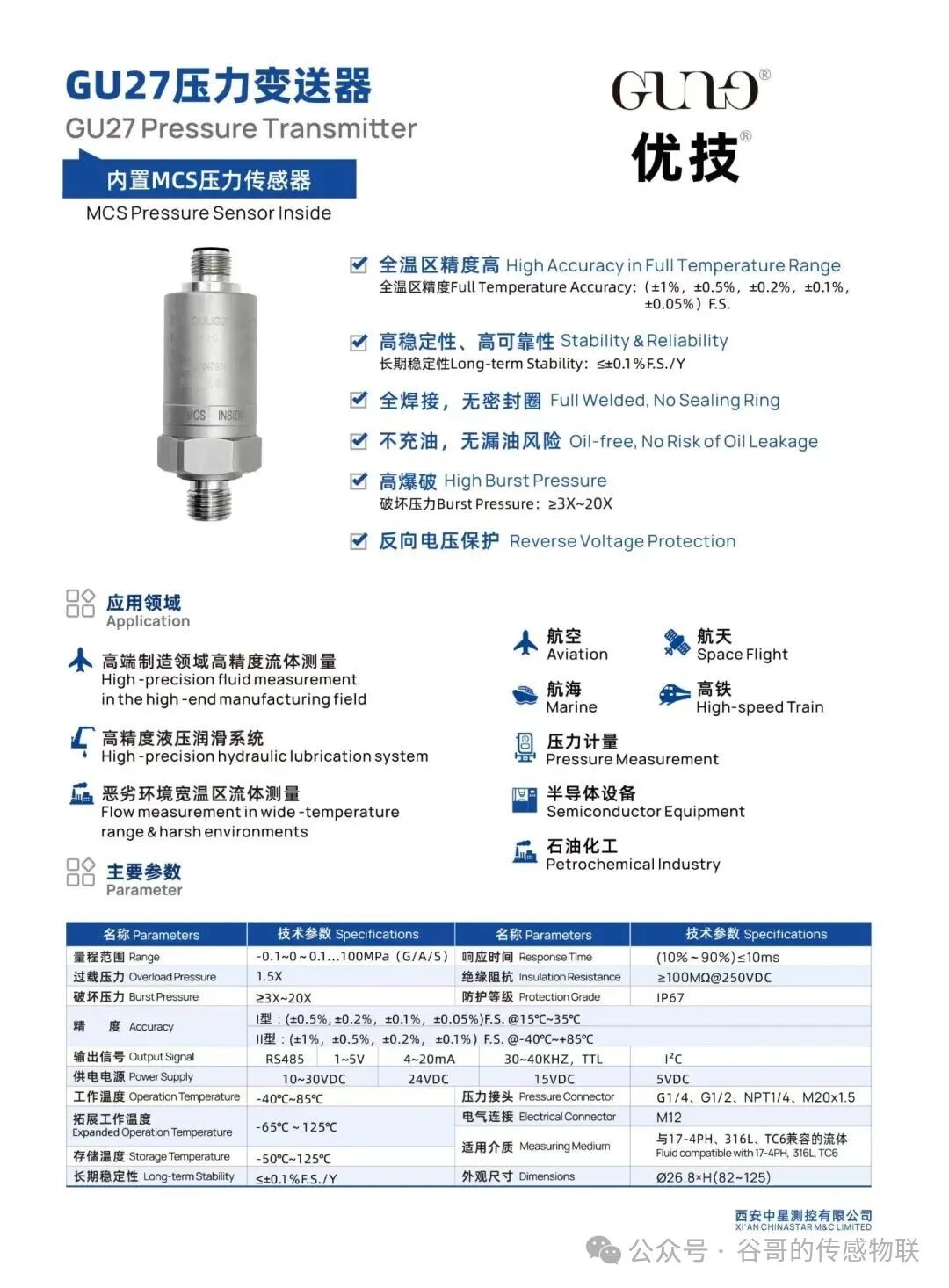 One day, by chance, while having tea with a teacher from Northwestern Polytechnical University, the teacher took out a small black plastic item with four yellow pins underneath. “What is this?” Gu Ge asked earnestly. “This is a pressure sensor produced by Motorola in the USA! It can measure air pressure,” the teacher replied. Gu Ge then asked, “How much is this worth?” “Over 800 yuan,” the teacher casually answered. “This small thing is so expensive?” Gu Ge was astonished.
It is worth noting that after working in a state-owned enterprise for over a decade, Gu Ge’s salary was only around 160 yuan, making this small pressure sensor worth more than five times his monthly salary, indicating a high technological content. “Are pressure sensors used in large quantities?” Gu Ge asked again. The teacher replied, “We only bought five to measure the pressure in the ducts of ventilation machinery. Although this sensor is small, without it, our entire project would not be feasible.”
The next day, Gu Ge rode his old bicycle to the Xinhua Bookstore in the city, searching for books on sensors. At that time, there were very few books on sensors at the Xinhua Bookstore. After searching for over an hour, he finally found a book titled “Sensor Technology Handbook” in a corner.
Upon returning home, he spent over a week reading through the handbook. Although he did not understand most of the theories, it did not hinder his understanding of the functions and roles of various sensors. He also learned about the role of sensors in automation, recalling the photoelectric switches and proximity switches he encountered while working in the state-owned enterprise, which are also simple forms of sensors. He realized that sensors are the foundation of future industrial automation. Little did he know that 30 years later, a large number of intelligent sensors would permeate every corner of the national economy, serving as the basis for intelligence and digitization.
 Immediately, he took action and conducted market research. Gu Ge randomly selected four or five different sensor models from the handbook, wrote them down on a piece of paper, and noted different quantities needed for each sensor model. Over the next month, Gu Ge rode his old bicycle from the electronic building on Chang’an South Road to the electronic building opposite the old zoo in the eastern suburbs, from the electronic market on Labor South Road to the electromechanical market at Yuxiangmen, scouring the streets on both sides of Lianhu Road in Xi’an. He did not miss a single shop or stall selling electrical and electronic products in the city, presenting his list of sensor procurement models to each store.
Disappointingly, the responses were all the same: “No,” “I’ve never seen this product,” “We don’t sell this product.” They had no idea about the prices either. A few merchants took down the model numbers and said they would wait for a call, but weeks later, there was still no news.
The normal business logic is that where there is a buyer, there is a seller; without buyers, there are no sellers. It seems that the sensor business is very difficult to operate. Gu Ge’s thoughts at that time were: First, sensors must be the direction of future development. In the long run, this will not be wrong; it is just that the current demand is low, making it a promising industry. Second, it is suitable for those with technology but no capital, and the expectation of making money is not very high. The sensor industry is just right for those with money who do not have the technology to overlook this scale, while most people with technology and no money are unwilling to start a business.
Third, sensors have high technological content, are small in size, and light in weight, making it a business that relies on intelligence rather than physical labor, which fits Gu Ge’s personal situation.

With a firm decision made, he began preparing to borrow money to start his business.