The AI Agent represents a core form of evolution in the field of artificial intelligence, transitioning from “tool-based applications” to “autonomous entities.” Its essence lies in leveraging large models, multimodal perception, tool ecosystems, and closed-loop decision-making systems to achieve full-link automation of intelligent systems through “goal input – autonomous planning – execution feedback – continuous optimization.” Compared to traditional AI’s “passive response,” AI Agents possess core advantages of proactive cognition, dynamic adaptation, and collaborative operation, reshaping the intelligent forms across various industries.

1. Core Definitions and Essence Analysis
1. Dual Definitions in Academia and Industry
– Academic Definition: An intelligent entity that possesses three core capabilities: environmental perception, autonomous decision-making, and action execution. It can acquire environmental information through sensors, act upon the environment through actuators, and continuously optimize behavioral strategies through feedback mechanisms. This is a key carrier for the evolution of artificial intelligence from “weak intelligence” to “strong intelligence.”
– Industrial Definition: A digital system centered around large models that integrates modules for tool invocation, memory management, and task planning. It can understand human natural language instructions, autonomously decompose complex goals, allocate resources, execute specific tasks, and dynamically adjust strategies based on results. It can be viewed as a “digital employee with autonomous working capabilities.”
2. Core Differences from Traditional AI and Large Models (Three-Dimensional Comparison Table)
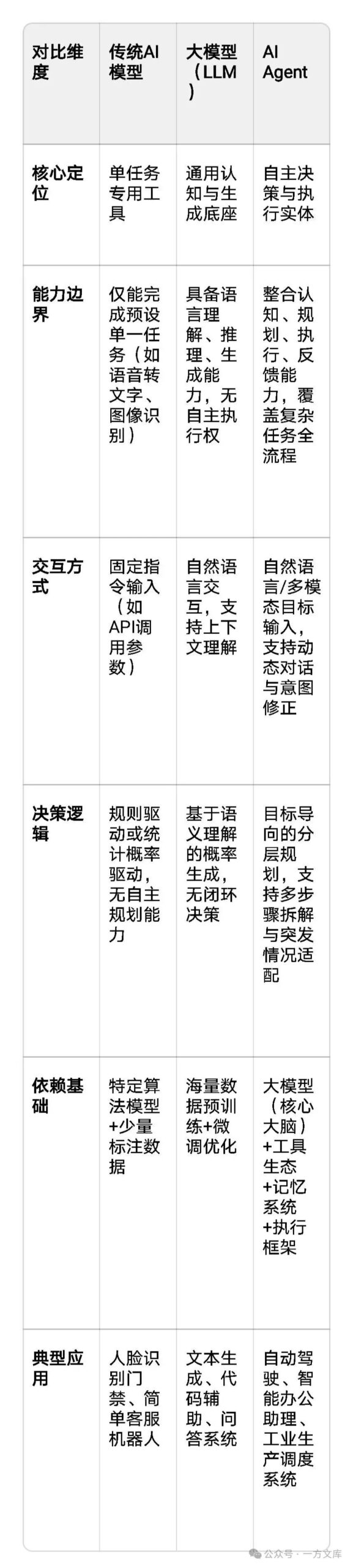
3. Core Essence: “Agent = Large Model + Decision System + Action Capability” The essence of AI Agents is the combination of “cognitive ability” and “execution ability”—the large model provides the “cognitive foundation” for language understanding, logical reasoning, and knowledge storage, while the decision system, tool ecosystem, and memory module endow it with the ability for “autonomous action,” ultimately achieving the closed-loop value of “what you think can be done.”
2. Core Technical Architecture: Five Major Modules Supporting Full-Link Autonomous Capability
The technical architecture of AI Agents exhibits characteristics of “layered progression and module collaboration,” consisting of five major modules. Each module is both independent and deeply coupled, collectively supporting autonomous decision-making and execution capabilities.
1. Cognitive Core Module: Large Model-Driven “Intelligent Brain”
– Core Function: Responsible for goal understanding, semantic parsing, logical reasoning, and knowledge invocation. It serves as the “decision center” of the AI Agent, determining the upper limit of its cognitive capabilities.
– Technical Support:
– Base Models: General large models (GPT-4, LLaMA 3, Wenxin Yiyan) provide cross-domain cognitive capabilities, while vertical domain large models (medical, financial) provide professional knowledge support;
– Enhancement Technologies: RAG (Retrieval-Augmented Generation) improves knowledge accuracy and timeliness, Chain of Thought (CoT) and Tree of Thought (ToT) optimize complex reasoning capabilities, and multimodal large models (GPT-4V, Gemini) support understanding of multi-source information such as text, images, and voice.
– Key Metrics: Intent recognition accuracy, complex reasoning correctness, cross-domain knowledge transfer capability, multimodal information fusion efficiency.
2. Task Planning Module: “Decomposition and Scheduling Hub” for Complex Goals
– Core Function: Decomposes complex goals input by humans (e.g., “develop a marketing plan for a product in Q3 and execute it”) into executable sub-tasks, plans execution order, and dynamically adjusts steps to solve the “how to do it” problem.
– Technical Support:
– Planning Algorithms: Hierarchical Task Planning (HTN), Goal Decomposition Tree, Reinforcement Learning-based Planning (RL-based Planning);
– Dynamic Adaptation: Real-time adjustment of planning paths based on environmental feedback (e.g., sub-task execution failure), supporting sub-task reordering and resource reallocation;
– Constraint Handling: Considers constraints such as time, cost, and resources (e.g., “marketing plan budget not exceeding 100,000 yuan”), ensuring planning feasibility.
– Typical Process: Goal reception → Semantic parsing → Sub-task decomposition → Priority sorting → Execution path planning → Dynamic adjustment.
3. Memory Management Module: “Storage and Invocation System” for Historical Information
– Core Function: Stores historical data from task execution processes, user preferences, environmental information, and knowledge graphs, providing contextual support for decision-making and ensuring continuity and consistency of actions.
– Memory Layering and Technical Implementation:
| Memory Type | Stored Content | Technical Support | Application Scenarios |
| Short-term Memory (Working Memory) | Current task sub-steps, real-time environmental data, temporary interaction information | Memory caching, context window management | Information invocation during real-time task execution (e.g., “outline of the report being drafted”) |
| Long-term Memory | User preferences, historical task records, domain knowledge graphs, rule systems | Vector databases (Milvus, Pinecone), relational databases | Personalized decision-making (e.g., “adjust report style based on user past habits”), knowledge reuse |
| Episodic Memory | Complete records of specific events (e.g., “execution results and issues of the Q2 marketing plan in 2024”) | Event graphs, time-series databases | Experience reuse, problem tracing and review |
– Key Technologies: Memory retrieval optimization (e.g., rapid matching based on semantic similarity), memory forgetting mechanisms (eliminating invalid information to free storage resources), memory update strategies (real-time synchronization of new data).
4. Multimodal Perception Module: “Input Interface” for Environmental Interaction
– Core Function: Acquires multidimensional information from the external environment, transforming unstructured data (images, voice, video, sensor data) into structured information understandable by the model, providing data support for decision-making.
– Perception Dimensions and Technical Support:
– Text Perception: Natural Language Processing (NLP) technology, achieving intent recognition, keyword extraction, and sentiment analysis;
– Visual Perception: Computer Vision (CV) technology, such as object detection, image segmentation, and OCR recognition (adapting to documents and scene images);
– Voice Perception: Speech Recognition (ASR), Text-to-Speech (TTS), and voiceprint recognition technologies;
– Sensor Perception: Interfaces with industrial sensors and IoT devices to acquire time-series data such as temperature, humidity, and equipment operating parameters;
– Multimodal Fusion: Integrates multi-source data (e.g., “text instructions + image references + sensor data”) through cross-modal attention mechanisms and feature alignment technologies, enhancing environmental cognition accuracy.
5. Tool Execution and Collaboration Module: “Output Interface” for Task Implementation
– Core Function: Transforms decision results into concrete actions by invoking external tools and collaborating with other agents/humans to complete actual tasks, serving as the core support for the AI Agent’s “implementation capability.”
– Two Core Capabilities:
– Tool Invocation Capability:
– Tool Types: API interface types (e.g., ERP systems, CRM systems, email tools, payment interfaces), software application types (e.g., Excel, Photoshop, CAD), hardware control types (e.g., industrial robots, autonomous vehicles, smart home devices);
– Technical Support: Tool registration and description (defining tool functions, parameters, and return formats through JSON Schema), tool selection algorithms (matching optimal tools based on task requirements), automatic parameter filling (generating tool invocation parameters based on context), error handling (retrying after tool invocation failure, switching to alternative tools).
– Collaborative Interaction Capability:
– Human-Machine Collaboration: Supports human intervention, instruction correction, and permission approval (e.g., complex decisions requiring human confirmation), and synchronizes feedback on execution progress;
– Multi-Agent Collaboration: Achieves division of labor and cooperation among multiple specialized agents through agent communication protocols (e.g., Agent Communication Language) (e.g., in supply chain scenarios, inventory agents, logistics agents, and sales forecasting agents work together);
– Cross-Scenario Collaboration: Adapts to multi-environment switching (e.g., from office systems to production systems, from online platforms to offline devices), maintaining continuity in task execution.
3. Core Capability Dimensions: Six Key Capabilities Defining Competitiveness
The core competitiveness of AI Agents is reflected in three aspects: “autonomy, intelligence, and adaptability,” specifically broken down into six key capabilities, each supporting one another and collectively determining the application boundaries and implementation effects of the agent.
Typical Capability Evolution Path
1. Basic Level: Achieves simple planning and tool invocation for single tasks (e.g., “automatically generate weekly reports and send emails”);
2. Intermediate Level: Supports complex task decomposition and multi-tool collaboration (e.g., “develop marketing plans → generate copy → deploy on platforms → data statistics → optimization”);
3. Advanced Level: Possesses cross-scenario collaboration, multi-agent linkage, and autonomous experience reuse capabilities (e.g., “full-link scheduling in supply chains: predict demand → adjust inventory → arrange logistics → connect production → synchronize sales”);
4. Ultimate Level: Possesses general intelligence, can adapt to new scenarios without human intervention to achieve complex goals, realizing the form of “strong intelligence.”
4. Full-Scenario Application Implementation Analysis (by Industry + Scenario Breakdown)
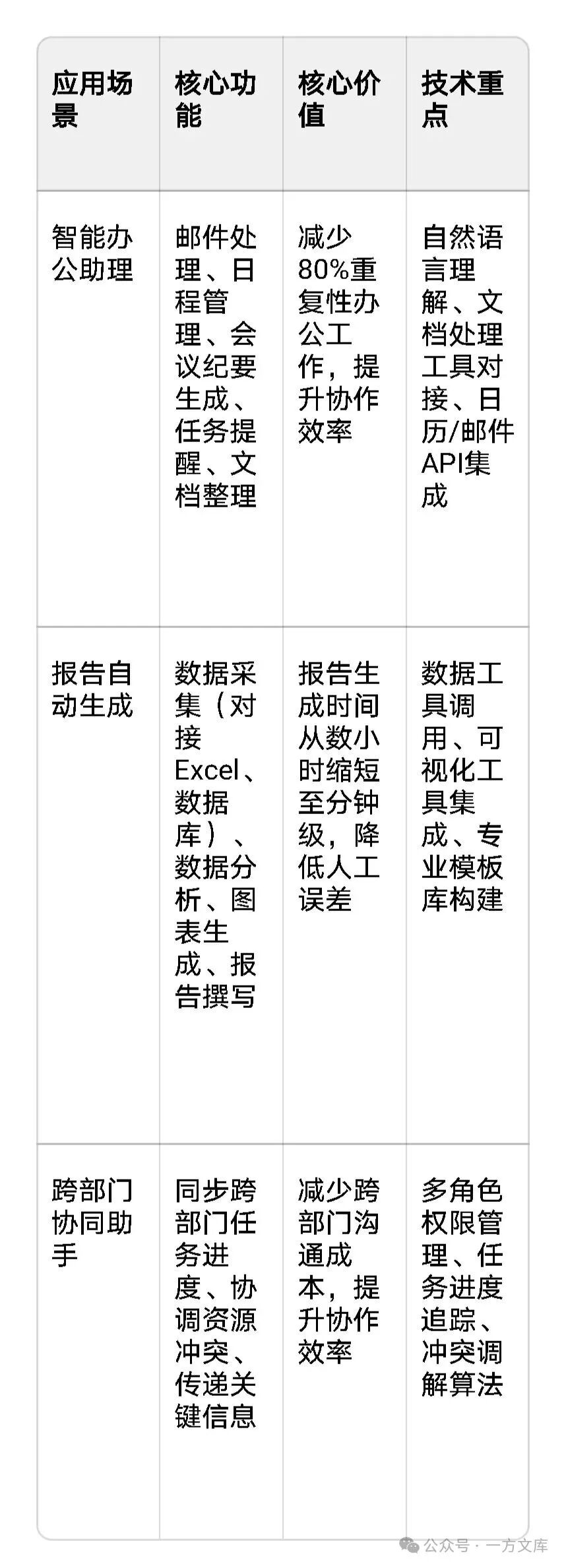
The application of AI Agents has penetrated general scenarios and vertical industries, with the core implementation logic being “replacing repetitive labor, optimizing complex processes, and enhancing decision-making efficiency.” The following presents structured application scenarios, core values, and technical focuses categorized by industry:
1. General Office Scenarios
2. Vertical Industry Scenarios (Deep Breakdown of Five Key Industries)
(1) Industrial Manufacturing Industry
– Core Application Scenarios:
– Production Scheduling Agent: Monitors production line data in real-time, dynamically adjusts production plans, optimizes equipment utilization and capacity allocation;
– Equipment Maintenance Agent: Monitors equipment status through sensor data, predicts fault risks, automatically generates maintenance work orders, and schedules maintenance resources;
– Quality Inspection Agent: Combines machine vision and sensor data to detect product quality in real-time, identify defects, and trace the root causes of problems.
– Core Value: Production efficiency increased by 20%-30%, equipment failure rate reduced by 40%, quality inspection accuracy improved to over 99%;
– Technical Focus: IoT device integration, time-series data processing, industrial software (e.g., MES, ERP) integration, edge computing adaptation (low latency requirements).
(2) Financial Industry
– Core Application Scenarios:
– Intelligent Investment Research Assistant: Automatically collects industry data, analyzes financial reports, generates research reports, and assists in investment decisions;
– Customer Service Agent: Answers customer inquiries 24/7, handles transactions (e.g., transfers, loss reporting), and recommends personalized financial products;
– Risk Control Agent: Monitors transaction data in real-time, identifies fraudulent activities and credit risks, and automatically triggers alerts and risk control measures.
– Core Value: Investment research efficiency increased by 50%, customer service response time reduced to seconds, risk control misjudgment rate reduced by 30%;
– Technical Focus: Financial data compliance processing, professional knowledge graph construction, high-concurrency transaction data processing, permission level management.
(3) Healthcare Industry
– Core Application Scenarios:
– Diagnostic Assistance Agent: Integrates medical record data, imaging data, and test results to provide preliminary diagnostic suggestions and treatment plan references;
– Patient Management Agent: Reminds patients to take medication and follow-up, monitors chronic disease data (e.g., blood sugar, blood pressure), and synchronizes feedback to doctors;
– Medical Research Agent: Automatically retrieves academic papers, analyzes clinical data, and generates research reports, accelerating drug development and clinical research.
– Core Value: Diagnostic accuracy in primary healthcare institutions increased by 30%, patient follow-up compliance increased by 50%, research cycles shortened by 40%;
– Technical Focus: Medical data privacy protection (e.g., federated learning), multimodal medical data fusion (imaging + text + tests), medical knowledge graph construction, compliance adaptation (e.g., FDA, NMPA standards).
(4) Supply Chain and Logistics Industry
– Core Application Scenarios:
– Demand Forecasting Agent: Accurately predicts product demand based on historical sales data, market trends, and policy changes;
– Inventory Management Agent: Dynamically adjusts inventory levels to avoid stockouts or overstocking, automatically generates replenishment orders;
– Logistics Scheduling Agent: Optimizes transportation routes, matches optimal logistics resources (e.g., vehicles, warehouses), tracks logistics status in real-time, and handles exceptions (e.g., delays, damages).
– Core Value: Demand forecasting accuracy increased to over 90%, inventory costs reduced by 25%, logistics transportation efficiency increased by 30%;
– Technical Focus: Time-series forecasting algorithms, geographic information system (GIS) integration, logistics API integration, multi-agent collaborative scheduling.
(5) Cultural and Tourism Industry
– Core Application Scenarios:
– Intelligent Itinerary Planning Assistant: Generates personalized itinerary plans based on user preferences (e.g., budget, interests, time), connecting flight, hotel, and scenic ticket bookings;
– Scenic Area Intelligent Guide: Provides real-time voice guidance, route navigation, crowd warnings, and emergency assistance services;
– Cultural and Tourism Marketing Agent: Analyzes user profiles, generates personalized marketing copy, automatically posts to social media and short video platforms, tracks marketing effectiveness, and optimizes.
– Core Value: User itinerary planning time reduced by 80%, tourist satisfaction in scenic areas increased by 40%, marketing conversion rate increased by 20%;
– Technical Focus: Multi-platform API integration (tourism services, payments, maps), user preference modeling, real-time data processing (crowd flow, weather).
5. Core Technical Challenges and Breakthrough Paths
1. Four Core Technical Challenges
– Challenge 1: Insufficient Robustness in Complex Task Planning
Current AI Agents struggle with multi-constraint and multi-variable complex tasks (e.g., cross-industry full-process scheduling), often resulting in incomplete sub-task decomposition and non-optimal execution paths, with limited adaptability to unexpected situations.
– Challenge 2: Lack of Compatibility and Standardization in Tool Ecosystems
The tool interface formats vary across different industries and scenarios, lacking a unified tool description and invocation standard, leading to high costs and poor compatibility for AI Agents to interface with tools, making large-scale implementation difficult.
– Challenge 3: Balancing Efficiency and Accuracy in Memory Management
As task complexity increases, the volume of memory data grows exponentially. Ensuring memory retrieval efficiency while filtering out invalid information and avoiding memory confusion is a current core technical bottleneck.
– Challenge 4: Security and Compliance Risks
AI Agents possess autonomous execution rights, which may lead to risks such as unauthorized operations, data breaches, and decision errors, especially in sensitive industries like finance and healthcare, where compliance and security are challenging to guarantee.
2. Technical Breakthrough Paths
– Path 1: Strengthening Logical Reasoning Capabilities in Task Planning
Integrating the advantages of symbolic AI and large models through a hybrid architecture of “large model understanding + symbolic system planning” to enhance the logicality of complex task decomposition; introducing reinforcement learning and human feedback (RLHF) to optimize dynamic adjustment strategies.
– Path 2: Promoting Standardization of Tool Ecosystems
Establishing a unified tool description language (TDL) and interface protocol, building an open-source tool market to support AI Agents in automatically identifying and adapting to various tools; developing tool encapsulation technologies to reduce the costs of interfacing with non-standardized tools.
– Path 3: Optimizing the Layered Architecture of Memory Management
Employing a layered storage strategy of “short-term memory + long-term memory + episodic memory,” combining vector databases and knowledge graphs to enhance memory retrieval efficiency; introducing attention mechanisms and memory priority algorithms to achieve automatic filtering of invalid memories.
– Path 4: Building a Security and Compliance System
Designing a permission level management module to clarify the operational boundaries of AI Agents; introducing an audit log system to record all decision-making and execution behaviors, supporting traceability; employing federated learning, differential privacy, and other technologies to protect sensitive data security.
6. Industry Ecosystem and Development Trends
1. Industry Ecosystem Structure (Four Core Participants)
– Core Technology Providers: Provide large model foundations (e.g., OpenAI, Google, Baidu), AI Agent development frameworks (e.g., LangChain, AutoGPT, LangGraph), and tool ecosystem platforms (e.g., API markets);
– Industry Solution Providers: Develop vertical domain AI Agent solutions based on general technology foundations, combined with industry scenario needs (e.g., production scheduling agents in industrial manufacturing, diagnostic assistance agents in healthcare);
– Hardware Support Providers: Provide computing power support (e.g., NVIDIA GPUs, dedicated AI chips), sensors, and execution devices (e.g., industrial robots, IoT devices) to ensure the perception and execution capabilities of AI Agents;
– Users and Regulators: Enterprises and individual users are the core scenarios for application implementation, while regulators are responsible for formulating industry standards and compliance requirements to regulate the development of AI Agents.
2. Three Core Development Trends
– Trend 1: From General AI Agents to Industry-Specific AI Agents
General AI Agents struggle to meet the specialized needs of vertical industries. In the future, they will develop towards “industry deepening,” leading to the emergence of specialized products such as medical agents, financial agents, and industrial agents, equipped with professional knowledge and scenario adaptation capabilities.
– Trend 2: Multi-Agent Collaboration Becomes the Mainstream Form
The capabilities of single AI Agents are limited. In the future, “agent clusters” will form, completing complex tasks across industries and scenarios through multi-agent division of labor and collaboration (e.g., full-link scheduling in supply chains, smart city management).
– Trend 3: Lightweight and Edge Deployment Popularization
With technological optimization, lightweight AI Agents will adapt to edge devices (e.g., industrial sensors, smart homes, mobile terminals), reducing computing power dependence, achieving low-latency, localized deployment, and expanding the boundaries of application scenarios.
3. Industry Evolution Stages (Four-Stage Division)
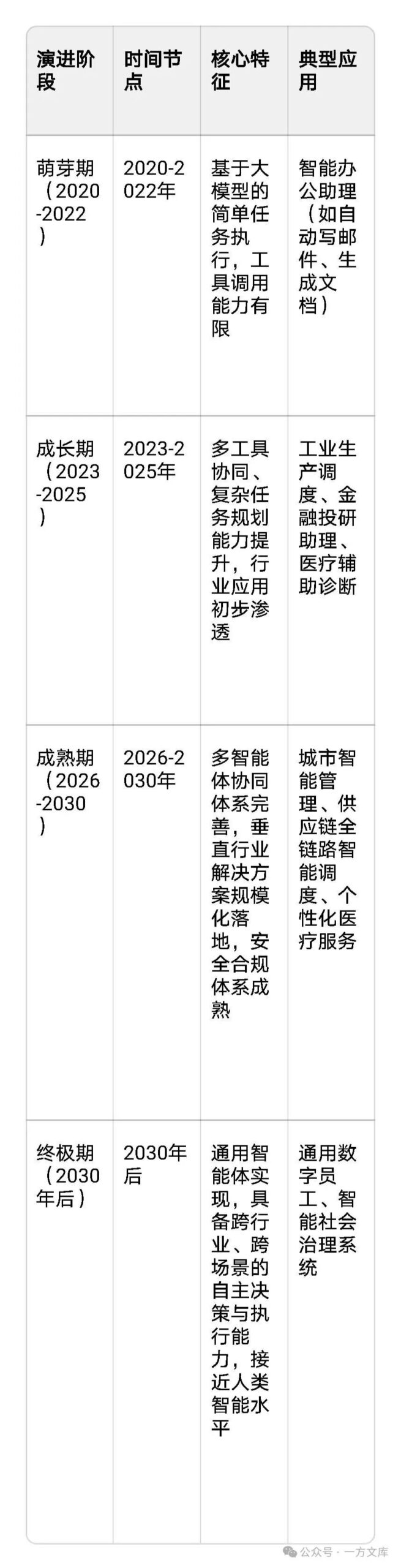
Evolution Stage | Time Node | Core Features | Typical Applications
7. Conclusion: Core Value and Future Outlook of AI Agents
The core value of AI Agents lies in “upgrading artificial intelligence from a ‘passive tool’ to an ‘active partner.'” Through autonomous and intelligent closed-loop capabilities, they significantly enhance production efficiency, reduce labor costs, and optimize decision quality, driving various industries from “partial intelligence” to “comprehensive intelligence.” Its essence is the deep integration of large models, tool ecosystems, and decision systems, a necessary product of the development of artificial intelligence technology to a certain stage.
In the future, AI Agents will evolve towards “specialization, collaboration, and lightweight” directions, continuously breaking through bottlenecks in complex task planning, tool standardization, and security compliance; in applications, they will penetrate deeply from general scenarios to vertical industries, forming an intelligent ecosystem where “everyone has a digital employee, and everything has an intelligent assistant.” At the same time, the development of AI Agents will also face social challenges such as ethics, privacy, and employment, requiring a collaborative advancement of technological innovation and regulatory norms to ensure that they empower social development while maintaining safety and ethical boundaries.
As the next generation of core forms in the field of artificial intelligence, AI Agents are reconstructing the interaction between humans and machines, the production modes of enterprises, and the service forms of society. Their development potential and industrial value are immeasurable, becoming a core engine driving the high-quality development of the digital economy.