In the first three quarters of 2025, the global ADC drug market has reached $12.1 billion, a year-on-year increase of 25%, and it is expected to exceed $16 billion for the entire year. Since the launch of DS-8201 in 2019, the ADC field has entered an “accelerated mode”, on the journey from billions to hundreds of billions, there are both the joy of technological breakthroughs and the concerns of market differentiation. In this wave driven by science and propelled by capital, Chinese pharmaceutical companies are transforming from “followers” to “co-runners” and even “leaders”.
Sales of newly listed ADC drugs over the years
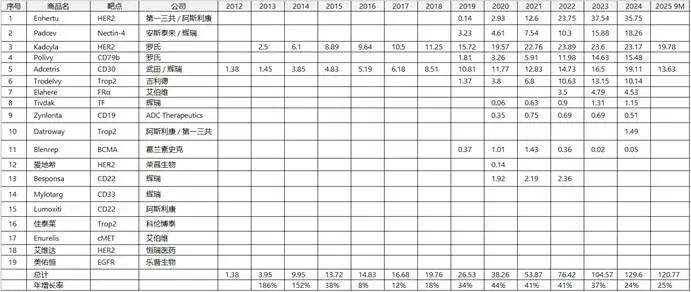
From Billions to Hundreds of Billions: The Rapid Growth of the ADC Market
In 2023, the market first broke through the $10 billion scale, and by the first three quarters of 2025, it has achieved $12.1 billion in sales, with an annual growth rate stable at over 25%. The ADC market is expanding at an astonishing speed, marching towards the $100 billion scale. Behind this rapid growth are continuous technological innovations, product iterations, and the ongoing expansion of clinical applications.
Looking back at the key data of the ADC market in recent years, 2023 was a significant milestone, with the outstanding performance of several heavyweight ADC products driving the market size to cross the $10 billion mark for the first time, marking the official transition of ADC from an emerging field to a mainstream treatment method. Entering 2024, the pace of market growth has not slowed down, with continuous clinical breakthroughs and the expansion of indications further consolidating ADC ‘s position in the field of cancer treatment. By 2025, despite the many uncertainties in the global economic environment, the ADC market still maintains a strong upward momentum, having already achieved $12.1 billion in sales in the first three quarters, and based on this trend, the annual sales are expected to set a new historical high.
Several star products have played a key role in this market growth. For example, Enhertu, developed jointly by Daiichi Sankyo and AstraZeneca, is the first HER2 targeted ADC drug, which has quickly become a market favorite due to its excellent efficacy in various cancers such as HER2 low-expressing breast cancer, gastric cancer, and lung cancer. In 2025, Enhertu is expected to exceed $5 billion in sales, rewriting the treatment landscape for HER2 related cancers and setting a benchmark for the application of ADC drugs in other cancer types. Padcev, developed in collaboration between Astellas and Pfizer, targets Nectin-4 and has shown good therapeutic effects in areas such as urothelial carcinoma, steadily increasing its sales and becoming another important pillar product in the ADC market.
As clinical research continues to deepen, ADC drugs are evolving from being targeted “anti-cancer weapons” for specific cancers to becoming “platform drugs” with potential for pan-cancer treatment. Many ADC products have shown positive efficacy signals in clinical trials across different cancer types, expanding the applicability of ADC. From common cancers such as breast cancer and lung cancer to hematological tumors like lymphoma and leukemia, ADC is gradually penetrating various fields of cancer treatment. This trend of pan-cancer application not only brings new treatment hope to more patients but also greatly expands the potential scale of the ADC market, making the $100 billion market scale no longer an unattainable dream, but a reality expected to be achieved in the coming years.
The Competition Among Giants: The Competitive Landscape of ADC Products
In the booming wave of the ADC market, the product landscape is characterized by a flourishing and fiercely competitive atmosphere. Enhertu is undoubtedly the most dazzling star product, with sales expected to exceed $5 billion in 2025, firmly sitting at the top of the ADC sales chart. Its success not only provides a new treatment standard for HER2 positive and HER2 low-expressing cancer patients but also sets a new benchmark for the entire ADC field.
Roche’s Polivy has a solid position in the treatment of diffuse large B-cell lymphoma (DLBCL). As a targeted CD79b ADC drug, Polivy was approved for marketing in 2019 for the treatment of relapsed or refractory DLBCL patients who have received at least two prior treatment regimens. Subsequently, in April 2024, Polivy was approved for use in combination with rituximab, cyclophosphamide, doxorubicin, and prednisone (R-CHP) for first-line treatment of DLBCL patients, a milestone approval that became the first new therapy for first-line treatment of DLBCL approved by the FDA in nearly 20 years. Clinical studies have shown that Polivy combined with the R-CHP regimen significantly improves the complete remission rate and progression-free survival of patients, enhancing their long-term prognosis. In terms of market performance, Polivy has seen rapid sales growth, with expectations to exceed $2 billion in 2025, further consolidating its leading position in the DLBCL treatment market.
In addition to HER2 and CD79b targets, other targets such as Trop2 and Nectin-4 have also attracted the attention of many pharmaceutical companies, showing strong development potential. For example, Trop2 is a transmembrane glycoprotein that is highly expressed in various solid tumors, making it one of the popular targets for ADC drug development. Gilead’s Trodelvy is the first approved Trop2 ADC drug, demonstrating good efficacy in the treatment of triple-negative breast cancer and metastatic non-small cell lung cancer. The Datroway developed by AstraZeneca and Daiichi Sankyo has also emerged in the Trop2 ADC field, having been approved in January 2025 in the United States for the treatment of adults with unresectable or metastatic HR-positive, HER2-negative breast cancer who have previously received chemotherapy and endocrine therapy, and in June for patients with EGFR mutation-positive advanced or metastatic NSCLC who have previously received systemic therapy (including EGFR-targeted therapy), further expanding the application range of Trop2 targeted ADC drugs.
The representative product targeting Nectin-4 is Padcev, developed in collaboration between Astellas and Pfizer, primarily used for the treatment of locally advanced or metastatic urothelial carcinoma patients. Padcev achieves precise targeting of tumor cells by conjugating anti-Nectin-4 monoclonal antibodies with microtubule-disrupting agents MMAE. Clinical studies have shown that Padcev demonstrates good safety and efficacy in the treatment of urothelial carcinoma, significantly improving patients’ quality of life and survival, and its sales have been steadily increasing year by year, becoming an important component of the ADC market.
With the emergence and development of more ADC products targeting different targets, the product landscape is shifting from a “single-pole dominance” represented by Enhertu to a “multi-pole competition”. In this process, target differentiation and clinical advantages have become key factors for companies to stand out in fierce competition. Products with unique targets or significant clinical advantages in specific indications often gain larger market shares and commercial success. Companies are also continuously exploring new combination therapies by using ADC drugs in combination with other anti-cancer drugs such as immunotherapy agents and small molecule targeted drugs to further enhance treatment efficacy and expand the application scenarios and market potential of their products.
The Rise of Chinese Power: From “Bringing In” to “Going Out”
In recent years, Chinese ADC companies have emerged in the global biopharmaceutical field, achieving a remarkable transformation from early technology introduction and imitation innovation to independent research and development and going international, leaving a profound “Chinese mark” on the ADC track.
Kelun-Biotech is one of the leading companies in the Chinese ADC field, with its developed Trop2 ADC sacituzumab govitecan (sac-TMT) showing excellent efficacy in the treatment of multiple cancers. At the 2025 ESMO conference, the clinical research results were impressive, significantly improving median progression-free survival and objective response rates compared to the chemotherapy group in the phase 3 studies for the treatment of EGFR mutation-positive non-small cell lung cancer and locally advanced or metastatic hormone receptor-positive, HER2-negative breast cancer.
LePu Biotech’s independently developed EGFR ADC drug MRG003 has made significant breakthroughs in the treatment of nasopharyngeal carcinoma, receiving multiple recognitions such as BTD in China and the United States. In the phase 2 studies for the treatment of nasopharyngeal carcinoma, different cohorts showed good efficacy and safety, and it is also exploring combination therapy with PD-1 monoclonal antibodies.
Baillie-Tianheng stands out in the dual antibody ADC technology field, with its developed EGFR×HER3 dual antibody ADC drug iza-bren (BL-B01D1) achieving breakthrough progress in lung cancer treatment, with two research results reported at the 2025 WCLC. In combination with osimertinib for first-line treatment of EGFR mutation-positive non-small cell lung cancer, the objective response rate reached 100%; significant progress was also made in patients receiving monotherapy, and phase III registration studies have been initiated in China, with priority review by the CDE for the treatment of recurrent or metastatic nasopharyngeal carcinoma.
Yingensheng Biotech has established four major ADC technology platforms, with its core product DB-1303 achieving the primary endpoint of PFS in phase III clinical trials for HER2-positive unresectable or metastatic breast cancer, and DB-1311 showing good preliminary efficacy in the treatment of heavily pre-treated castration-resistant prostate cancer in phase I/II clinical trials, while DB-1317 has been registered for phase I studies.
The achievements of these Chinese ADC companies mark the transition of the Chinese ADC industry from “following innovation” to “source innovation”, from “catching up” to “co-running” and even leading in some areas, achieving a leap forward.
The rise of Chinese pharmaceutical companies has greatly enriched the global ADC pipeline. According to statistics, as of May 2024, Chinese companies occupy over 40% of the global pipeline for ADC drug development. Many innovative Chinese ADC products have entered clinical trial stages, injecting new vitality into the global ADC drug development and providing more treatment options and possibilities. In terms of local innovation ecology, the success of Chinese ADC companies has also played a positive demonstration and driving role. On one hand, it has attracted more capital, talent, and research resources to gather in the ADC field, promoting the improvement and development of the industrial chain; on the other hand, it has stimulated the innovation enthusiasm of other domestic biopharmaceutical companies, creating a good innovation atmosphere and promoting the continuous optimization and upgrading of the entire local innovation ecology.
Chinese ADC companies also face many challenges in international market competition. The approval standards for drugs in the international market are strict, and clinical trial requirements are high, requiring Chinese companies to invest more time and funds to meet these requirements. In the international market, many well-known international pharmaceutical companies have already occupied a certain market share, and Chinese companies need to put in more effort in brand building and market promotion to break through market barriers. With the heat of the ADC track, global R&D competition is becoming increasingly fierce, and Chinese companies need to continuously innovate and maintain technological leadership to remain competitive. Opportunities and challenges coexist, and as the R&D strength of Chinese ADC companies continues to improve and products gradually mature, the international market’s recognition of Chinese innovative ADC products is also increasing. Some companies have already pushed Chinese ADC products to the international market through cooperation with international pharmaceutical companies and product licensing, and are expected to gain greater development space in the international market in the future.
Challenges and Breakthroughs: Thoughts on the Future Development of ADCs
Although the prospects for the ADC track are bright, there are also many challenges hidden behind its vigorous development, which test the stability of the industry.
The phenomenon of target homogeneity in the ADC field is becoming increasingly serious, becoming a major constraint on the sustainable development of the industry. From the perspective of the R&D pipeline, popular targets such as HER2 and Trop2 have attracted a large number of companies to cluster around them. For example, in the case of the HER2 target, there are numerous HER2 ADC drugs in the R&D stage globally, with fierce competition domestically, and this highly concentrated target layout makes market competition exceptionally intense. As more products targeting the same site are launched, market saturation gradually increases, and the competitive pressure faced by companies also grows. If a product targeting the same site gains an advantage in clinical efficacy, safety, or price, other products targeting the same site will face significant market pressure and may even risk being eliminated from the market.
The issue of drug resistance is a key problem that urgently needs to be solved in the clinical application of ADC drugs. Many patients develop resistance after receiving ADC treatment for a period, leading to decreased treatment efficacy or even failure. The mechanisms of resistance are complex and diverse, involving downregulation of target protein expression or loss of antigen expression in tumor cells, making it difficult for ADC drugs to recognize and bind to target cells; defects in endocytic pathways prevent ADC drugs from entering cells; and after ADC drugs enter tumor cells, impaired lysosomal function or reduced lysosomal proteolytic activity leads to ineffective degradation of ADC drugs. Taking T-DM1 treatment for HER2 positive breast cancer as an example, some patients may experience downregulation of HER2 expression during treatment, leading to ineffective action of T-DM1 and resulting in resistance. The emergence of this resistance not only limits the long-term efficacy of ADC drugs but also brings great trouble to patients’ treatment.
The high R&D and production costs are also a major challenge faced by the ADC industry. The R&D of ADC drugs involves the design and optimization of multiple key components such as antibodies, linkers, and cytotoxic drugs, which are technically challenging and have long R&D cycles, requiring substantial financial and human resources. From antibody screening and modification to linker design and synthesis, and the selection and optimization of cytotoxic drugs, each step requires repeated experiments and validation, consuming a lot of resources. In the production phase, the production process of ADC drugs is complex, and quality control requirements are strict, further increasing production costs. According to statistics, an ADC drug requires an average investment of hundreds of millions of dollars from R&D to market launch, and the high costs put immense pressure on many companies during commercialization. If the market price of the product is set too high, patient accessibility will be affected; if priced too low, companies will struggle to recoup costs and achieve profitability. In the face of these challenges, companies need to explore coping strategies in R&D strategies, technological breakthroughs, and commercialization models. In terms of R&D strategies, companies should avoid blindly following popular targets, strengthen research on tumor biology, and explore new targets, focusing on rare tumor targets or unique targets for specific tumor subtypes to gain a differentiated competitive advantage and meet the special needs of patients.
Technological breakthroughs are key to solving resistance issues and enhancing the performance of ADC drugs. Companies should increase investment in new conjugation technologies, linker design, and cytotoxic drug development, optimize drug structural performance, develop stable and efficient linkers, and new cytotoxic drugs, and research bispecific or multispecific ADCs to overcome resistance issues.
Innovating commercialization models is also crucial. Companies can strengthen cooperation with medical institutions and health insurance departments, optimize pricing strategies, conduct pharmacoeconomic studies, and collaborate with medical institutions to accumulate clinical data to aid promotion; they can also expand into international markets, collaborate with international pharmaceutical companies, and license products to reduce risks in single markets.
Conclusion
The golden age of ADC has arrived; it is not only an innovation in drug form but also a leap in treatment concepts. From billions to hundreds of billions, from single-target to multi-target, from multinational pharmaceutical companies leading to the rise of Chinese innovation, this track is reshaping the cancer treatment landscape at an unprecedented speed. In the future, those who can continue to innovate and strategically position themselves in this triple game of technology, capital, and market are likely to dominate the $100 billion market. The story of ADC has just begun.
References: Compiled from public information
Scan the QR code to join the Pharmaceutical Circle WeChat group