Industrial-grade AI Humanoid Robots and Wafer Handling Robots
Also featuring a live demonstration of remote-controlled dexterous hands
At the “Smart Manufacturing” exhibition area of Foxconn Technology Day HHTD25, the highlight is the robots and AI applications. For the first time, industrial-grade AI humanoid robots, wafer handling robots, remote-controlled dexterous hands, and service humanoid robots are showcased. Additionally, the operation of AI robots in precision assembly workstations based on digital twins is shared, demonstrating how AI helps robots “train”.
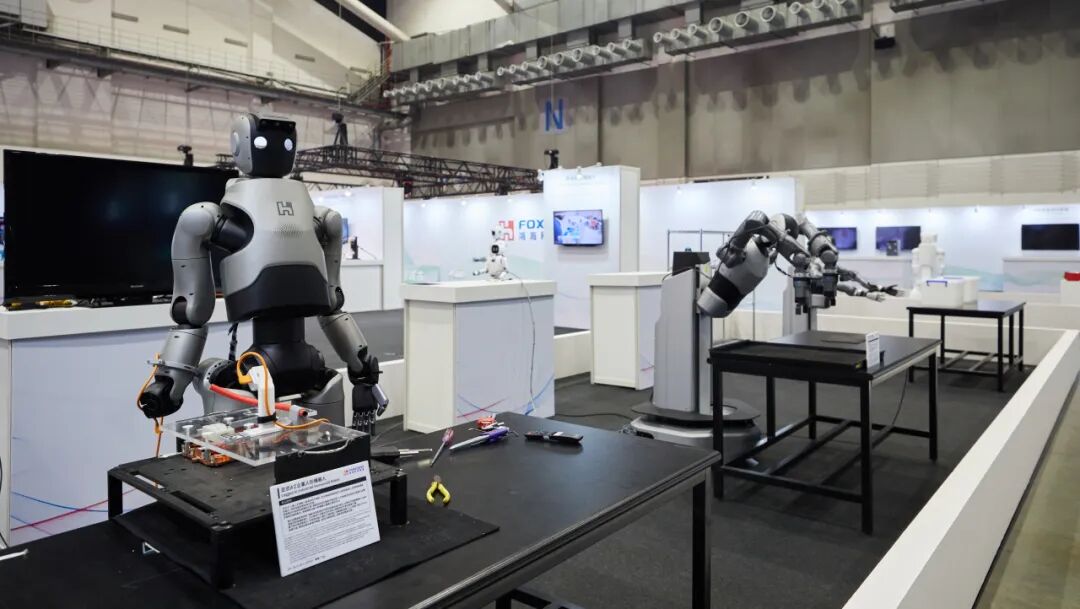
Foxconn’s industrial-grade AI humanoid robots developed in deep collaboration with NVIDIA, including wheeled robots, feature high mobility efficiency, long endurance, and simple maintenance, making them particularly suitable for long-term operations in flat production line environments; another type is legged robots, capable of climbing stairs and overcoming obstacles, with movements closer to humans, suitable for complex factory terrains.
The live demonstration at Technology Day showcased real production line requirements, including dual-hand interface panel handling, expanding the operational range with a tilted torso; dual-hand collaboration for transporting larger objects, using a mobile chassis and torso lift to extend the operational range; even executing high-precision screw locking tasks, demonstrating dexterous hand control capabilities, even when screw holes are obstructed by pipes, the robot can use one hand to move the pipe aside and use the other hand to lock the screw in place. These tasks were previously highly reliant on manual labor, which not only involved high repetition and labor intensity but also risked precision due to fatigue. Now, with robot assistance, operations can be stable 24/7, improving efficiency and significantly reducing long-term operational costs.
Behind the operation of the robots, a complete technical layout must first exist within the NVIDIA Omniverse libraries ecosystem! We utilize the open-source robot simulation framework NVIDIA Isaac Sim to test and train robots in a highly realistic virtual environment, significantly shortening development time. Specifically, the robot’s “brain” is based on the Isaac GR00T N1 open architecture visual-language-action (VLA) model—using GR00T-Teleop to collect data in virtual space, GR00T-Mimic to automatically convert human demonstration actions into robot trajectories, and GR00T-Gen to randomly generate variables such as lighting and background to enhance environmental adaptability; all training is completed in parallel at scale in the Isaac Lab, far exceeding traditional methods in efficiency.
Smart Manufacturing Highlight – Wafer Handling Robot SHR-F20
Another highlight of smart manufacturing is the wafer handling robot SHR-F20. Specifically designed to handle wafer carrier transport and loading/unloading in semiconductor factories, these actions previously relied on manual labor, but now can be fully automated with the SHR-F20 robot, saving time and reducing the risk of errors. The robot’s biggest feature is its autonomous navigation and safety design.
Combining laser SLAM and QR code technology, it can accurately locate within the factory, moving flexibly without being affected by complex spatial environments. Equipped with diagonal dual radars, side radars, and front visual sensors, it can achieve 360-degree environmental detection, avoiding collisions with people or equipment, ensuring high safety.
The design of the SHR-F20 robotic arm is also very flexible, allowing for the addition of 2D or 3D vision, as well as interchangeable grippers and storage modules. This means it is not just a fixed-function robot, but can be flexibly adjusted according to different application needs, whether transporting various carriers, precise alignment, or handling more complex operational scenarios, it can easily adapt.
Another “remote-controlled dexterous hand” serves as an example of human-robot interaction, allowing direct experience of the dexterous hand’s control feel through a designed remote control mechanism at HHTD. In front of the camera, computer vision is used to analyze hand posture, converting hand movements into real-time signals for the dexterous hand. This year, Foxconn has completed the development of the first dexterous hand, which features a joint direct drive design, with 4 fingers, 16 degrees of freedom, weighing only 1 kilogram, yet capable of carrying 5 kilograms.
Smart Manufacturing Highlight – “AI Robot Precision Assembly Workstation”
Another major highlight of smart manufacturing is the “AI Robot Precision Assembly Workstation” based on digital twins, where the robots in the workstation act like automated masters that can think for themselves and train, specifically responsible for high-precision assembly of parts. Through digital twin technology, they first “train” in the virtual world. AI conducts reinforcement learning in the virtual environment, continuously trying different assembly methods to discover the smoothest actions and shortest assembly times. Once training is complete, the results are directly synchronized back to the real production line, allowing the robots to operate accurately upon deployment, requiring almost no manual adjustments.
At the same time, Foxconn also showcased a factory-wide visualization operation system built on NVIDIA Omniverse libraries, covering three key scenarios: overall construction of new factories, automated production line design, and data center energy management, creating an integrated intelligent decision-making hub from planning, simulation to operational maintenance. Its core value lies in the ability to validate and continuously optimize the entire manufacturing system in a virtual environment, whether for new construction or factory renovation.
From factory layout, production line configuration to energy strategies, all decisions can be repeatedly simulated in the digital twin space, significantly reducing the need for rework after physical construction, greatly shortening factory construction cycles, and lowering trial-and-error costs.
Next-generation manufacturing operation systems can synchronize real-time production line data to the virtual environment, achieving dynamic visualization, remote monitoring, and feedback control. Management personnel, regardless of their location, can grasp equipment status, production capacity performance, and anomaly alerts in real-time, and simulate response strategies in the virtual space, quickly deploying them to the real production line.
This is also Foxconn’s core competitive advantage in the global expansion of smart manufacturing.
END
“Like” and “See” to let more people see