◎ Chen Ming, Reporter Deng Zhen
From assisted driving to robotics, LiDAR is ushering in a new turning point for large-scale applications.
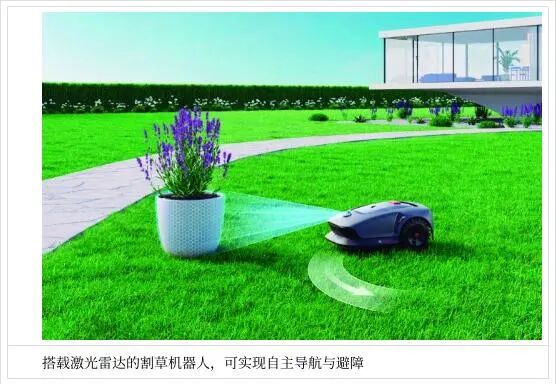
Recently, several leading LiDAR companies disclosed their semi-annual reports, showing that the sales volume of robotic business is “running wild,” experiencing explosive growth. For example, Hesai Technology’s LiDAR products for the robotics sector increased by 743.6% year-on-year in the second quarter, while RoboSense saw a year-on-year growth of 631.9%. Among them, lawn mowing robots have become the first segment to achieve large-scale implementation of LiDAR, with leading manufacturers accelerating their entry and gradually extending to multiple scenarios such as delivery, warehousing, and cleaning.
Industry insiders indicate that the explosion of lawn mowing robots is a result of the combination of technological upgrades and the release of demand, with their scale and the accelerated mass production of humanoid robots forming a new incremental market. As the penetration rate of the assisted driving market steadily increases, the robotics business is expected to become a growth pole with more imaginative potential than assisted driving.
Concentration of Orders in the Robotics Sector
Currently, the orders for LiDAR in the robotics field mainly come from vertical applications such as lawn mowing, unmanned delivery, and warehousing. Among them, the lawn mowing robot sector has shown the most remarkable performance in the first half of the year.
“The shipment volume of lawn mowing robots is very large.” Hesai Technology’s CFO Fan Peng told Shanghai Securities Journal that this year, Hesai launched the JT series LiDAR designed for the lawn mowing robot market, achieving a cumulative delivery of over 100,000 units in less than five months, “This is the first time in our history that we have delivered 100,000 LiDAR units, which took us a full five years to achieve previously.” Fan Peng stated that within the next year, Hesai will supply 300,000 LiDAR units to Keting Technology’s lawn mowing robots, nearly six times its robot business delivery volume in the second quarter.
“We can be sure that lawn mowing robots are currently one of the most certain tracks.” RoboSense’s Marketing Director Xie Tiandi said in an interview with Shanghai Securities Journal. Recently, RoboSense announced a partnership with Kuka Technology to supply 1.2 million LiDAR units for its lawn mowing robots over the next three years; at the same time, in the first half of the year, the company secured exclusive partnerships with several global top 5 manufacturers, with order volumes exceeding seven figures. Regarding the orders from Kuka Technology, Xie Tiandi stated: “We are continuously delivering.”
The effectiveness of order releases is also directly reflected in financial data. The financial report shows that RoboSense achieved revenue of approximately 460 million yuan in the second quarter, a year-on-year increase of 24.4%; among them, the sales volume of robotic products reached 34,000 units, a year-on-year increase of 631.9%. Hesai Technology achieved revenue of 710 million yuan in the second quarter, with net profit exceeding 40 million yuan; the delivery volume of products in the robotics field was 49,000 units, with an increase of 743.6%.
Why Did Lawn Mowing Robots Lead the Surge?
Several interviewees indicated that the surge in the lawn mowing robot segment is a result of the “dual approach” of technological iteration and demand release.
“LiDAR can solve the three core needs of robot mobility: positioning, navigation, and obstacle avoidance.” Fan Peng stated that after the competition in the automotive assisted driving market, the technological iteration of LiDAR has accelerated significantly. Unlike the automotive industry, which emphasizes long-distance detection, robots focus more on 360-degree omnidirectional perception and autonomous path planning capabilities; at the same time, due to generally low movement speeds, the requirements for ranging performance are relatively low, while reliability is emphasized more.
In this context, lawn mowing robots are the first to meet the “conditions for large-scale application”—outdoor use, slow movement speed, high precision requirements for positioning and obstacle avoidance but moderate ranging requirements, and current LiDAR products can fully cover these performance requirements. “This process mainly involves delegating automotive-grade capabilities, concentrating our existing platform technology on one or two products, refining, improving, scaling up, and then making it affordable for everyone to use,” Fan Peng said.
Northeast Securities automotive analyst He Xiaohang told Shanghai Securities Journal that early lawn mowing scenarios faced pain points such as signal attenuation due to rain and fog, and low reflectivity of lawns; with technological iteration and upgrades, these pain points have been largely resolved; meanwhile, the advantages of LiDAR’s strong perception capability and precise positioning have been amplified, leading many lawn mowing robot manufacturers to actively adopt and accelerate their use.
The demand side is equally strong. Xie Tiandi analyzed that there is enormous upgrade potential for traditional lawn mowing machinery. “Globally, there are about 250 million courtyards with lawn mowing needs, with traditional lawn mowing machinery exceeding 100 million units, and nearly 30 million new units sold each year, of which only about one million have been upgraded to fully automatic lawn mowing robots.”
Xie Tiandi stated that currently, lawn mower companies are not only focusing on the performance of individual sensors but also on the “overall stability of the solution.” In the actual implementation process, LiDAR serves as the core perception entry of the product, and also leverages scene data for reverse input, accelerating its own technological updates, forming a virtuous cycle of technological and application collaborative evolution.
Accelerated Expansion into New Tracks
Beyond lawn mowing robots, LiDAR manufacturers are accelerating their expansion into new certain tracks.
Recently, RoboSense has intensively announced partnerships with a number of embodied intelligence partners including Yushu, Lingbao CASBOT, Titan Tiger Robot, and Yuejiang Technology; almost simultaneously, Hesai announced deep cooperation with consumer-grade embodied intelligence companies Weita Power and Tsinghua-affiliated startup Xingdong Era to jointly explore new scenarios for embodied intelligence.
“Now is the stage for seizing technology.” Xie Tiandi bluntly stated that RoboSense’s future layout will focus on the perception system of robots, and the company is currently developing related algorithms for hand-eye coordination, with the next step being to run through the complete path from “seeing—planning—executing.”
In He Xiaohang’s view, the demand for LiDAR in the broader robotics segment is also on the rise. “We predict that, like lawn mowing robots, pool cleaning robots and snow removal robots, which also belong to courtyard robots, are expected to provide incremental demand; in addition, drones, floor cleaning robots, and embodied intelligence robots are also potential application scenarios for LiDAR.”
Currently, leading companies’ LiDAR products have penetrated multiple robotic application scenarios such as delivery, cleaning, agriculture, and surveying. For example, RoboSense has expanded into North America’s leading delivery platforms and partners such as Meituan, New Stoneware, and White Rhino in unmanned delivery. Hesai has secured large orders for agricultural robot solutions from Agtonomy and Alpha Werke in the field of agricultural automation. Tudatong also disclosed in late August that it has expanded its business scope, obtaining large-scale orders from companies such as Jiushi Intelligent, Kusa Technology, and Yushi Technology, covering logistics, sanitation, and handling fields.
“All robots that need to navigate and position in three-dimensional space and interact with the physical world cannot do without LiDAR,” Fan Peng stated. “From a long-term perspective, the robotics business is bound to be a more promising strategic layout than the automotive business.”
 Da Jia Tian Xia, as a management institution supporting the development of small and micro enterprises, adheres to a mutually beneficial and win-win work attitude, providing professional corporate financing consulting services to a wide range of clients, while continuously offering various investment and financing, industry information, legal regulations, and other latest news to all online users.