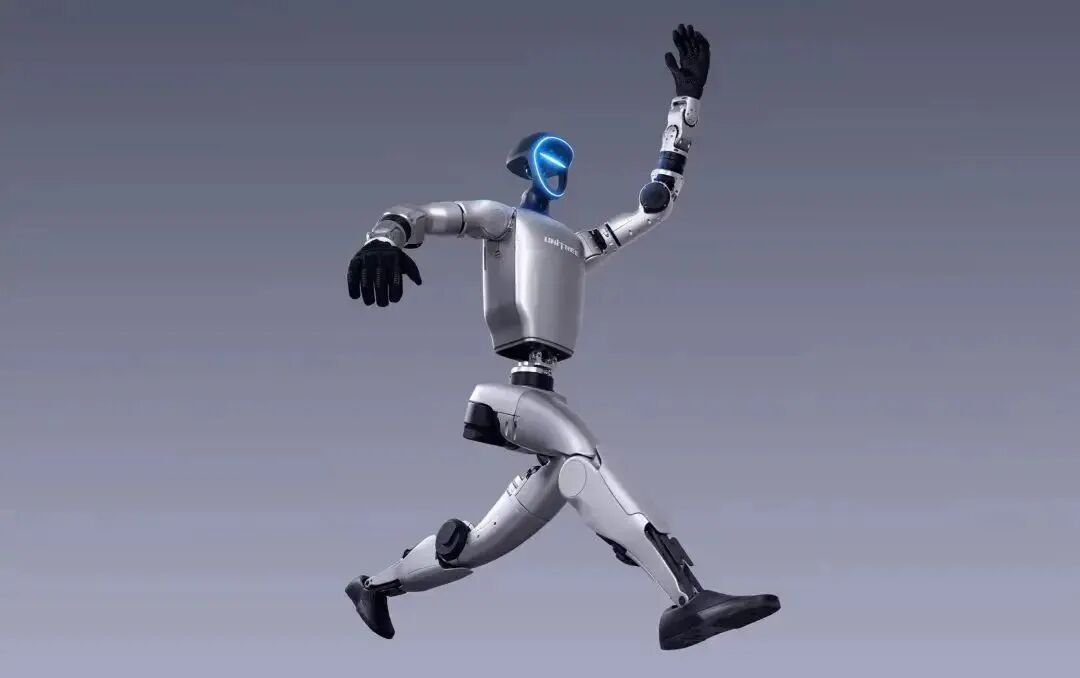
Currently, AI robots are experiencing explosive growth, and their continuous evolution relies on a powerful “cooling heart.” With the practical application of large models like NVIDIA’s GB200, which have hundreds of billions of parameters, traditional air cooling technology can no longer meet the demands and has reached its physical limits. At this time, immersion liquid cooling technology is redefining the construction of AI infrastructure with its revolutionary cooling efficiency, especially becoming a key technology supporting high-density, high-performance robot clusters.01 Thermal Crisis
Modern AI robots’ computing power cores, particularly the GPU chips responsible for visual recognition and autonomous decision-making, are experiencing a continuous rise in power consumption, surpassing the limits of traditional cooling solutions. For example, NVIDIA’s H100 chip has a power consumption of 700W, while the next-generation B200 chip is expected to exceed 1000W. Traditional air cooling technology encounters bottlenecks when dissipating 800W at a single point, and when robot clusters operate, the thermal load generated by a single cabinet can exceed 50kV. The issues caused by high temperatures are not just performance degradation; when the chip temperature exceeds 70℃, for every 10℃ increase, its reliability decreases by half. In Tesla’s autonomous driving tests, chip frequency reductions caused by high temperatures have led to a 23% increase in decision-making delays, which directly relates to driving safety.
02 Liquid Cooling Technology
The revolutionary breakthrough of immersion liquid cooling lies in its complete transformation of the heat dissipation path, immersing the heat-generating electronic components directly in an insulating cooling liquid. This allows for zero-distance contact between the liquid and the chip surface, achieving a heat removal efficiency of up to 98%. The physical advantages of this method are very clear; the thermal conductivity of liquids is 25 times that of air, and the volumetric heat capacity is 1000 to 3500 times that of air, with the convective heat transfer coefficient increased by 10 to 40 times.
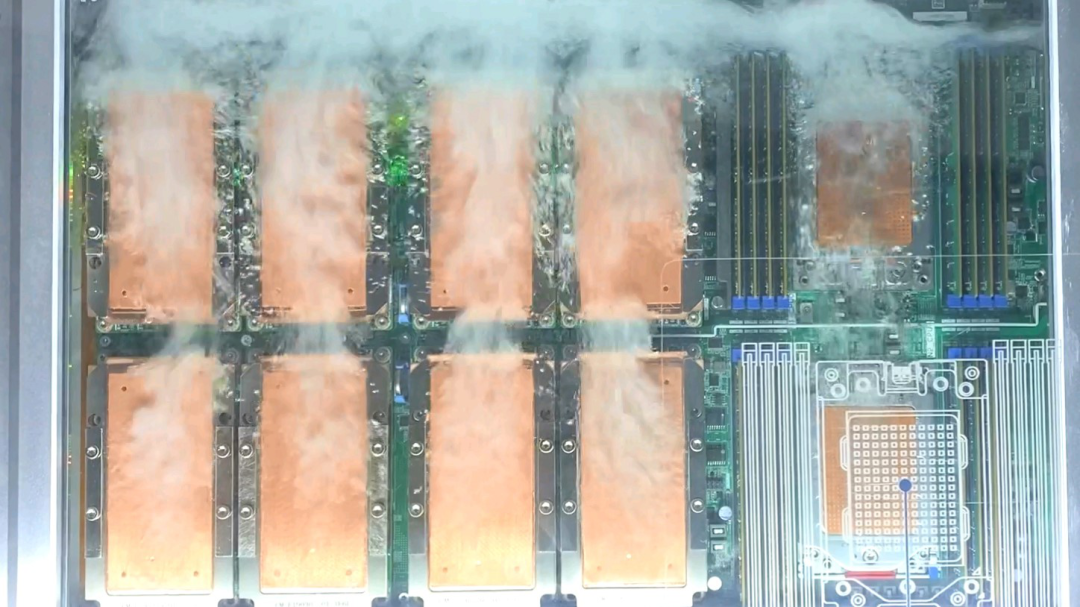
In the field of AI robots, this technology has already demonstrated significant application value. For example, Tesla has integrated its micro liquid cooling system into the electronic control unit (ECU) of its autonomous driving system, ensuring that its Full Self-Driving (FSD) chip can operate at full load even under a heat flux density of 200 watts per square centimeter. Even when the external environment temperature reaches 50℃, the chip temperature can remain stable within a safe range of 70℃.
For mobile robots deployed at the edge, modular immersion cooling solutions have also emerged. For instance, the Cirrus Mk1 two-phase immersion workstation launched by Antec has a cold plate the size of a palm but can handle thermal loads of up to 300W, reducing the energy usage efficiency (PUE) of the AI computing unit onboard mobile robots to 1.02, cutting carbon emissions by nearly half.
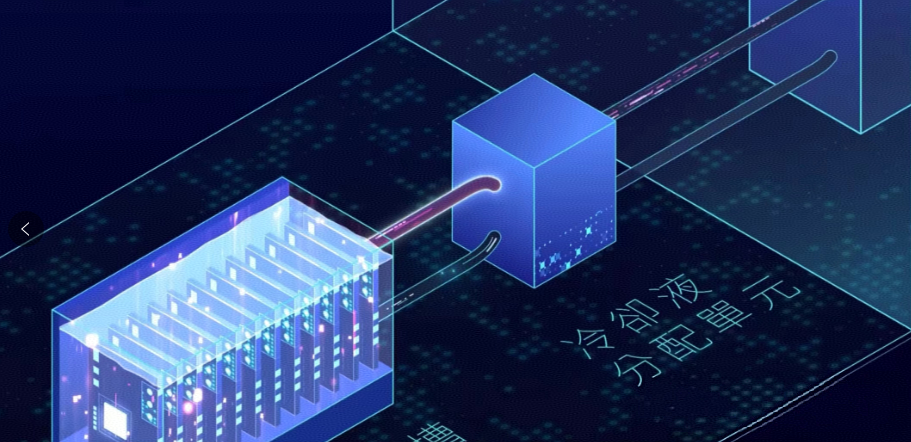
The cooling liquid, as the core technology of immersion liquid cooling, has long been monopolized by international giants like 3M. Now, domestic companies such as Unified Petrochemical have developed immersion cooling oils that have made significant breakthroughs. Their products feature low viscosity characteristics (only 5cSt, below the industry average), greatly accelerating the heat exchange process; the heat transfer coefficient reaches 0.14W/(m·K), which can stabilize the chip temperature between 50 and 70℃; its breakdown voltage is as high as 360kV, effectively eliminating the risk of short circuits; even in extremely cold environments of minus 40℃, it can maintain good fluidity.
In terms of cost control, Juhua Co., Ltd. and other companies have made progress in fluorinated liquid technology, raising the thermal conductivity to over 30W/(m·K), with prices reduced by 40% compared to imported products. Huakun Zhenyu’s Tianji HC6000 liquid cooling solution uses domestic cooling liquids to achieve a PUE below 1.1, with energy-saving effects exceeding 70%.
Immersion liquid cooling technology is evolving from a mere cooling method to a more intelligent and comprehensive thermal management system. The “dual circulation” phase change immersion system developed by Lenovo in collaboration with Tsinghua University precisely controls the cavity temperature through an external single-phase heat exchanger, doubling the efficiency of boiling heat transfer, with a system PUE as low as 1.035. Notably, advancements in heat recovery technology are also significant. Antec’s intelligent temperature control module can automatically adjust the thermal path based on environmental temperature: in normal temperature environments, heat is directly discharged outdoors; in cold climates, heat is prioritized for heating; in high-temperature environments, closed-loop internal circulation cooling is activated. This system has improved the heat recovery rate of data centers to 80%, providing a comprehensive energy solution for applications such as robot charging stations.
03 Future Challenges
Despite the broad prospects, the popularization of immersion liquid cooling technology in the AI robot field still faces some challenges. First is the optical path sealing issue: the refractive index of the cooling liquid (e.g., fluorinated oil is about 1.3) differs from that of air, which can lead to the failure of traditional optical modules, necessitating the development of new airtight packaging technologies. Secondly, there is a controversy over the delivery model: currently, the mainstream is integrated delivery (overall delivery of servers, cabinets, and pipelines), while decoupled delivery (separating equipment from cabinets) is more conducive to scaling but requires a unified interface standard. Finally, there is the choice of cooling liquid material routes: fluorinated liquids have excellent performance but are costly; synthetic hydrocarbons (e.g., Shell’s products have been certified by Intel) do not contain PFAS (per- and polyfluoroalkyl substances), making them more environmentally friendly; organic silicon (e.g., used by Japan’s KDDI for edge computing) has stronger corrosion resistance.
Looking ahead, as single-chip power consumption approaches 2000W, immersion liquid cooling will become a rigid foundation supporting powerful AI computing power. Several key trends are emerging: the cooling medium itself is continuously innovating, for example, Unified Petrochemical’s next-generation phase change immersion liquid aims to further improve cooling efficiency by 50%, and Shell’s bio-based cooling liquid has also been certified by Intel; application scenarios are accelerating from cloud data centers to edge robots and autonomous driving terminals, with micro cold plate technology allowing mobile devices to benefit from liquid cooling; globally, standardization is becoming a focus of competition and cooperation, with China’s three major operators actively promoting the goal of large-scale application of liquid cooling technology in over 50% of data center projects by 2025.
When robot clusters can still operate efficiently in high-temperature environments, and autonomous driving systems can still make precise decisions under extreme conditions—immersion liquid cooling technology is silently yet crucially reshaping the physical foundation of AI. This revolution in cooling technology not only provides machines with an efficient “cooling bloodline” but also offers a lasting and stable power source for the continuous evolution of the entire intelligent world.
-END-