In the field of AI, the discussion on “how to build agents” is intensifying. The two leading teams, Cognition, known for “Devin,” and the emerging giant Anthropic, have published seemingly opposing viewpoints titled “Do Not Build Multi-Agents” and “How We Build Multi-Agent Research Systems” respectively. However, a deeper analysis reveals that the core ideas of both are surprisingly consistent: The choice between single-agent and multi-agent systems is not ideological; the core is to match the most suitable tool for specific tasks.
Editor’s Note:
-
Cognition is a startup focused on AI application layer development, known for launching the world’s first AI programmer, “Devin.”
-
Anthropic is an AI research company founded by former members of OpenAI and is one of the giants in the generative AI field, with its Claude series of large models being on par with GPT and others.
1. Basic Definitions and Classifications of AI Agents
Before delving into the controversy, it is essential to clarify the core concept: AI agents are systems that use large language models (LLMs) as reasoning engines, responsible for leading the application control process. Based on architectural design, they are mainly divided into two types: single-agent and multi-agent.
Single-Agent: Focused Independent Worker
Single agents operate in a single process mode, akin to a highly focused worker, leading from task initiation to completion. They maintain a continuous chain of thought (memory) and action (tool usage), ensuring that each decision is based on all past information.
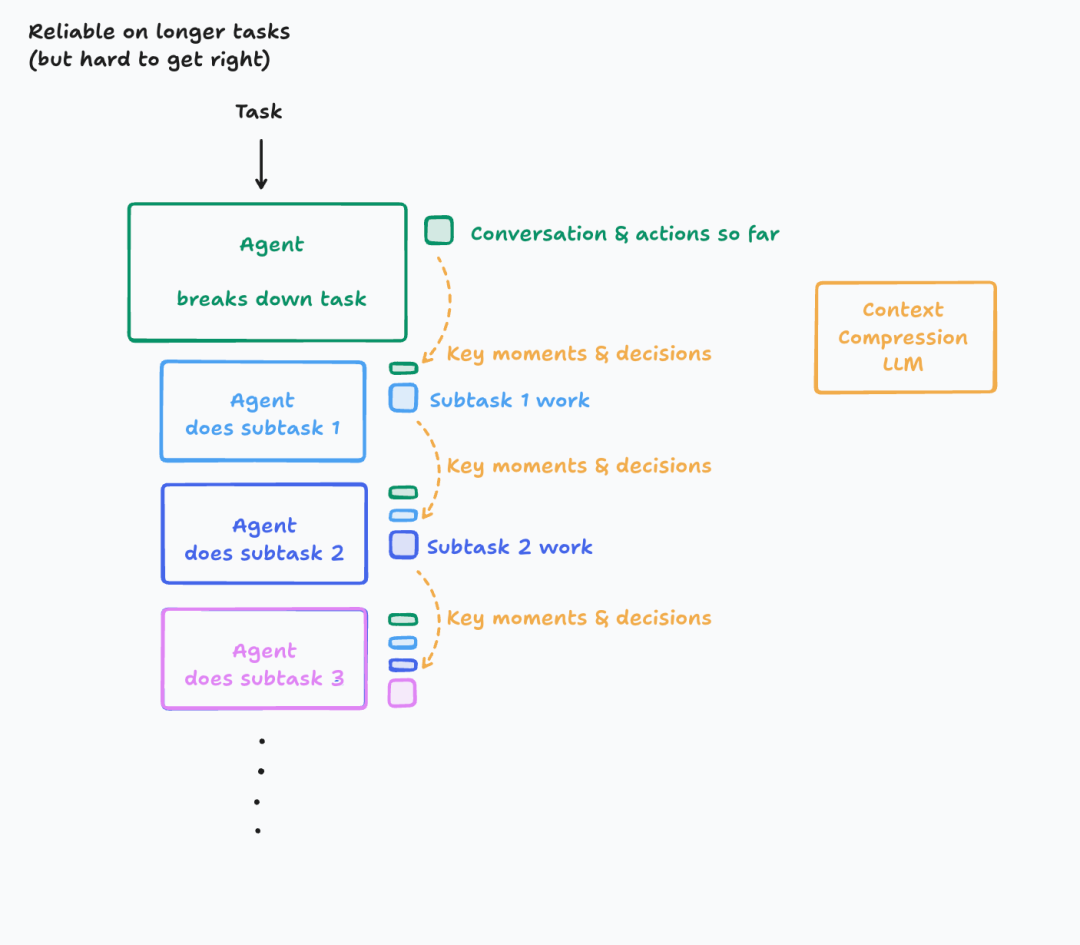
Its core features include:
-
Sequentiality: Actions are executed in order, moving to step B only after completing step A.
-
Contextual Unity: Maintains a complete dialogue history, allowing new steps to access all past information and tool outputs.
-
State Consistency: Early decisions directly and comprehensively affect subsequent actions without the need to transfer information across entities.
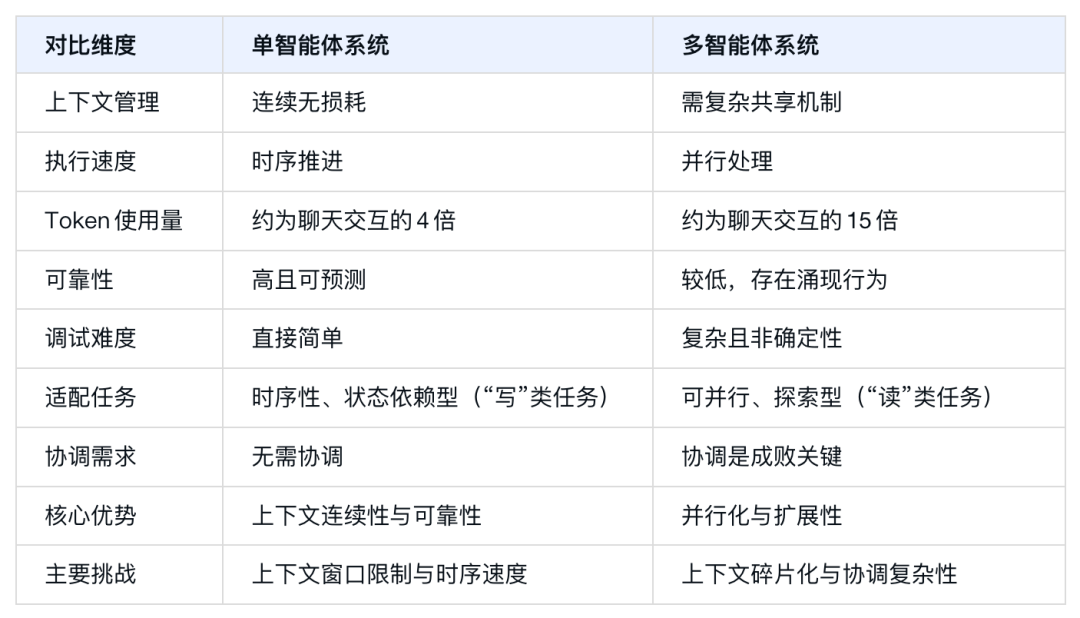
The advantages of single agents are quite clear: continuous context without loss, simple and easy to debug and maintain systems, and clear traceability of execution paths and decision trajectories. However, the drawbacks are also prominent: sequential bottlenecks prevent parallel task processing, contextual window limitations may lead to errors and information loss, token usage can be redundant, and they are limited by the capabilities of a single model.
Multi-Agent: A Collaborative and Efficient Professional Team
The multi-agent architecture resembles a collaborative team, typically where a leading agent breaks down the core goal into sub-tasks, which are then assigned to multiple working agents for parallel execution. In addition to this coordinator-worker model, there is also a cluster model that completes tasks through peer collaboration without a leader, incorporating some features of both single and multi-agent systems.
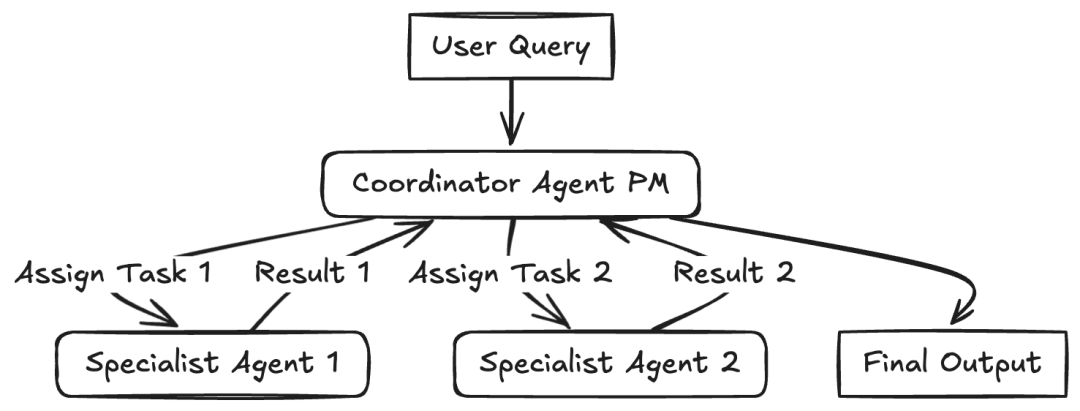
Its core features include:
-
Parallel Execution: Multiple agents can simultaneously handle different sub-tasks.
-
Task Delegation: The leading agent is responsible for breaking down goals, assigning tasks, and synthesizing results.
-
Distributed Context: Each agent only holds a subset of the total information as its context.
The core advantages of multi-agents lie in: parallel exploration of multiple paths to reduce latency, supporting specialized division of labor for specific tasks, and the ability to tackle complex multidimensional problems. However, challenges cannot be ignored: difficulties in cross-agent context sharing, improper coordination can lead to redundant labor or decision conflicts, and higher token consumption. Data from Anthropic shows that the token usage of its multi-agent system is 15 times that of standard chat interactions.
2. Cognition’s Position: Why Oppose Multi-Agent Architecture
Cognition clearly states in “Do Not Build Multi-Agents” that multi-agent architecture is not the ideal choice for building reliable AI agents, with its core argument revolving around context engineering.
Context Engineering: The Core of Reliable Agents
Cognition views context engineering as the core of agent development, considering it a higher-dimensional practice that goes beyond prompt engineering. It requires automatically providing appropriate information to agents in dynamic systems, which is the primary task for building reliable AI agents. In the technological stage of 2025, even the most advanced large models cannot effectively complete tasks without complete context, and multi-agent architecture inherently has flaws in context management.
Core Flaws of Multi-Agent Architecture
Cognition reveals the fragility of multi-agents through the case of “building a Flappy Bird clone”: the leading agent breaks the task into “build a moving game background with green pipes and collision boxes” and “build a bird that can move up and down,” but the two sub-agents may misunderstand the task, producing a Super Mario-style background and a bird that does not meet the requirements, ultimately leading to integration failure.
This issue stems from the violation of two core principles:
-
Complete context trajectory must be shared, not isolated information. Simply passing the original task to sub-agents is far from sufficient; tool calls, decision details, and other aspects in multi-turn dialogues can affect task understanding, and multi-agents struggle to achieve complete context sharing.
-
Actions imply decisions, and conflicting decisions lead to poor outcomes. Sub-agents cannot perceive each other’s progress, making it easy to act based on conflicting assumptions, such as adopting vastly different visual styles, ultimately leading to incompatible results.
Better Alternative Solutions
Cognition believes that the optimal solution following the above principles is to adopt a single-thread linear agent, ensuring decision consistency through continuous context. For long tasks that lead to context window overflow, specialized LLM models can be introduced to compress actions and dialogue history into key details, events, and decisions. Cognition even optimizes this compression process through fine-tuning smaller models to support longer-duration tasks.
Cautious Attitude Towards the Future of Multi-Agents
Cognition does not completely deny the long-term potential of multi-agents but believes that the technological level of 2025 has not yet solved the core problem of cross-agent context transfer. Currently, the decision-making of multi-agents is too decentralized, and insufficient context sharing leads to high system fragility. Their team judges that this issue may be naturally resolved as single-thread agents improve their communication capabilities with humans, at which point the parallel efficiency of multi-agents can truly be unleashed.
3. Anthropic’s Practice: The Value and Breakthroughs of Multi-Agent Systems
Anthropic has demonstrated the unique value of multi-agent architecture in specific scenarios by creating a multi-agent research system. Its research system adopts a coordinator-worker model, where the leading agent plans the research process, and sub-agents search for information in parallel, successfully achieving performance breakthroughs in complex research tasks.
Core Advantages of Multi-Agent Architecture
Anthropic’s practice has validated the irreplaceability of multi-agents in three types of scenarios:
-
Adapting to Open-Ended Research Tasks: The steps of complex research are difficult to hard-code in advance and need to be dynamically adjusted based on intermediate discoveries; the parallel exploration capability of multi-agents perfectly matches this need.
-
Achieving Efficient Information Compression: Sub-agents can process their context windows in parallel while exploring different dimensions of the problem, then summarize key information for the leading agent, significantly improving information extraction efficiency.
-
Breaking Through the Capability Boundaries of Single Agents: Just as human society achieves exponential progress through collective wisdom, multi-agents can integrate the advantages of specialized division of labor to complete tasks that single agents find difficult to cover.
Internal evaluations show that the multi-agent system, with Claude Opus 4 as the leading agent and Claude Sonnet 4 as sub-agents, outperformed the single-agent Claude Opus 4 by 90.2% in research tasks. For example, when identifying all board members of companies in the S&P 500 information technology sector, the multi-agent system successfully completed the task through parallel searches by breaking down the task, while the single agent, due to its sequential processing method, could not cover such a large search breadth, resulting in incomplete answers.
Moreover, the multi-agent architecture can effectively improve token usage efficiency. In the BrowseComp evaluation, token usage alone explained 80% of the performance difference; multi-agents provide more reasoning resources for complex tasks through distributed context windows.
Engineering Challenges and Solutions
Anthropic admits that multi-agents face high token consumption (15 times that of standard chat) and complex coordination issues, but they have achieved large-scale applications through targeted engineering optimizations:
-
Refined Prompt Engineering: This includes teaching the leading agent to delegate tasks accurately to avoid redundant labor by sub-agents; dynamically adjusting the number of sub-agents and tool calls based on query complexity; guiding agents to adopt a “broad to narrow” search strategy, exploring the global context before focusing on details.
-
Optimizing Tool Design and Selection: Providing agents with clear heuristic rules for tool usage, such as prioritizing matching user intent and preferring specialized tools over general ones; using tools to test agents’ rewriting of tool descriptions, reducing task completion time by 40%.
-
Innovative Evaluation Systems: Combining automated evaluations with LLMs as judges (scoring based on factual accuracy, citation accuracy, etc.) and manual testing, balancing evaluation scale and coverage of edge cases.
-
Ensuring Reliability in Production Environments: Addressing state-accumulating errors through persistent execution, error retries, and checkpoint mechanisms; simplifying debugging through full-link tracing; avoiding interruptions to running agents during updates through rainbow deployments.
Applicable Boundaries and Future Directions
Anthropic has clarified the applicable scenarios for multi-agents: high-value, parallelizable tasks with information exceeding their context windows, requiring integration with multiple complex tools. However, scenarios like coding, which rely heavily on contextual consistency and high task relevance, are still not ideal for multi-agents.
Their future direction focuses on optimizing asynchronous execution; the current model where the leading agent synchronously waits for sub-agents to complete has bottlenecks, and asynchronization will allow agents to collaborate in real-time and dynamically generate sub-agents, but new challenges such as result coordination and state consistency need to be addressed.
4. Consensus and General Principles: Core Guidelines for Agent Construction
Despite differing positions, Cognition and Anthropic are highly consistent on the core principles of agent construction, forming a common practice guide for the industry:
-
Context engineering is paramount. Regardless of the architecture chosen, dynamically maintaining the correct information at the right time is key to reliable decision-making for agents, requiring systematic design that goes beyond simple prompt engineering.
-
The distinction between “reading” and “writing” tasks is more important than architecture choice. “Reading” tasks (research, analysis, information gathering) are easier to parallelize and more suited for multi-agents; “writing” tasks (code generation, content creation, document editing) are prone to coordination issues when parallelized, making them more suitable for single agents; mixed tasks should separate reading and writing phases at the architectural level.
-
Reliable agents require a complete toolchain. Relying solely on excellent models is far from sufficient; durable execution infrastructure (to handle failures), observability tools (for debugging), and scientific evaluation systems (to measure core metrics) are also necessary.
-
Balancing economic feasibility with model evolution. The high token consumption of multi-agents requires matching task value with cost; at the same time, the rapid iteration speed of models should not lead to overly complex designs, leaving room for simpler solutions in the future.
5. Conclusion
The choice of architecture for AI agents is fundamentally a matching problem between task characteristics and technical capabilities. Single agents, with their contextual continuity and reliability, excel in sequentially dependent “writing” tasks; multi-agents, with their parallelization and scalability, become the optimal solution for complex “reading” research tasks.
Cognition’s warnings reveal the inherent challenges of multi-agents in context management and coordination, reminding the industry to avoid blind following; Anthropic’s practices demonstrate that through refined engineering design, multi-agents can achieve performance breakthroughs in specific scenarios. The consensus between the two points to the industry’s direction: No matter how the architecture is chosen, context engineering, task adaptation, toolchain construction, and economic feasibility are core considerations for agents transitioning from prototype to production.
As model capabilities continue to improve and engineering technologies mature, the boundaries between single and multi-agents may further blur, but the core logic of “choosing the right tool for the task” will remain unchanged. Future agent systems may well be hybrid architectures that integrate the advantages of both, dynamically switching modes at different task stages to ultimately achieve more efficient and reliable intelligent collaboration.