By 2025, general artificial intelligence is no longer a distant science fiction concept but the core engine driving industrial transformation. In this intelligent revolution ignited by large models, the information-dense and logically rigorous finance industry stands at the crossroads of paradigm shift. As model capabilities evolve rapidly, how to translate them into real business value becomes a common challenge faced by all financial institutions.
Recently, a report released by Alibaba Cloud systematically addresses this issue. The report points out that AI Agents are not only the best form for implementing large models but will also open a new chapter in financial business innovation and upgrades.
Dual-Driven: Policy and Technology Co-Writing a New Chapter for Financial AI
The intelligent transformation of the finance industry is not a castle in the air but is rooted in the dual fertile ground of policy guidance and technological breakthroughs. The report begins by clarifying that this transformation is driven by two major forces.
On the policy level, from the “14th Five-Year Plan” outline to the Central Financial Work Conference, the state continues to emphasize the importance of digital and intelligent transformation for financial institutions. In 2024, the action plan jointly issued by the People’s Bank of China and several ministries, titled “Promoting High-Quality Development of Digital Finance,” further elevates this strategy, explicitly requiring the enhancement of financial service convenience and competitiveness through intelligent transformation. This provides an unprecedented macro environment and development momentum for the application of financial AI.
On the technology level, generative AI is experiencing explosive growth. The report summarizes several key trends:
- Leap in Cognitive Abilities Driven by the “Scaling Law,” the logical reasoning, code generation, and tool invocation capabilities of large models have reached astonishing levels, laying the foundation for handling complex financial tasks.
- Multimodal Fusion AI has expanded from pure text processing to end-to-end multimodal capabilities that can understand images and audio, opening up imaginative spaces for scenarios such as digital customer service and marketing material generation.
- Rise of Open Source Power Chinese open-source models represented by Qwen and DeepSeek have demonstrated strong competitiveness globally, greatly accelerating technological innovation and application popularization, validating the “Metcalfe’s Law” of the open-source ecosystem.
- Jevons Paradox of Computing Power Demand The report keenly points out that the improvement in large model efficiency has not reduced computing power consumption; rather, it has spawned more complex intelligent applications, stimulating a greater demand for computing power, akin to the phenomenon in the 19th century where improved coal efficiency stimulated greater energy demand.
It is under the dual drive of policy and technology that the finance industry has welcomed a turning point from partial trials to deep penetration across all scenarios.
Why Are Agents the “Best Form” for Implementing Large Financial Models?
If large language models (LLMs) are a “brain” with extensive knowledge, then AI Agents are “digital employees” with complete working capabilities. The report clearly states that Agents are the best form to carry the capabilities of large models and solve complex financial scenarios.
A complete AI Agent consists of four core components:
- Planning After receiving complex tasks, it can autonomously decompose them into a series of executable sub-tasks and formulate action strategies. For example, breaking down “analyze Company A’s recent financial report and assess its debt repayment risk” into steps such as “find the financial report, extract key financial indicators, invoke risk assessment models, generate analysis reports,” etc.
- Memory It possesses both short-term and long-term memory capabilities. Short-term memory is used to understand the context of conversations, while long-term memory can store user preferences, historical interactions, and other information to provide personalized services.
- Tools The “hands” of the Agent. It can invoke external APIs, databases, plugins, and other tools to obtain real-time information or perform specific operations, greatly expanding its capability boundaries. For example, invoking market interfaces to obtain the latest stock prices or connecting to internal risk control systems for compliance checks.
- Action Converts planning and tool invocation into actual outputs and operations to complete the final task.
The rigor, logic, and compliance requirements of financial business make it difficult for a single LLM to meet the demands. However, through the collaborative work of these four components, Agents can perceive the environment, make autonomous decisions, invoke tools, and execute actions, perfectly aligning with the finance industry’s need for precision, efficiency, and reliability. They are no longer simple Q&A robots but intelligent agents capable of deeply participating in business processes.
Agent Implementation Practices in Three Core Areas
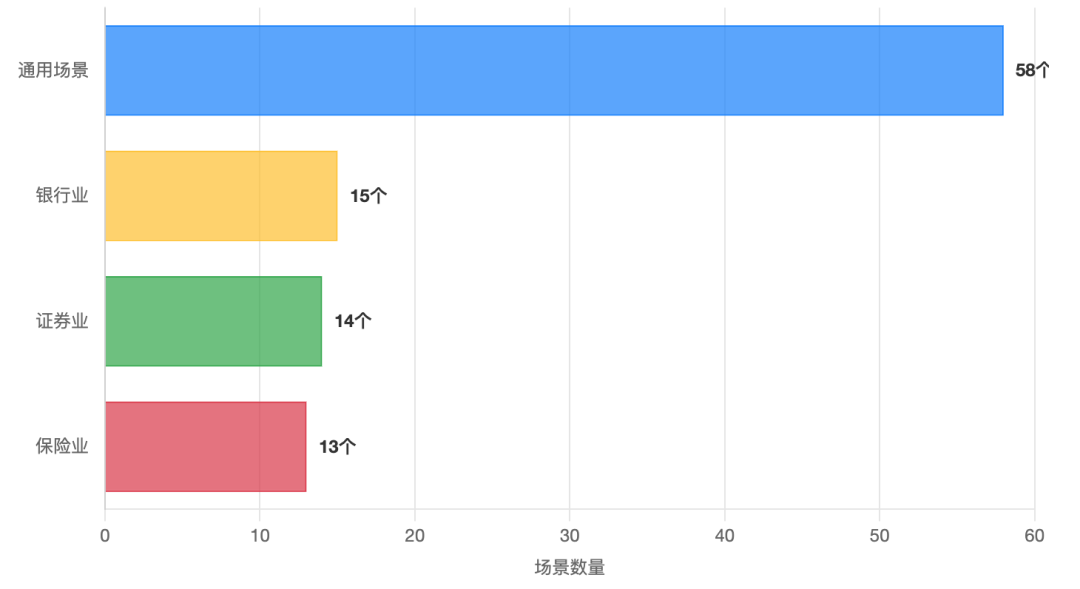
The core value of the financial industry Agent panorama lies in its systematic sorting of specific application scenarios for AI Agents across various financial fields. The report depicts over 100 typical practices, covering banking, securities, insurance, and multiple general fields, showcasing a panoramic view of AI empowering finance.
Alibaba Cloud’s Application Scenario Distribution in the Financial Industry Agent Panorama
Banking: From Credit Approval to AI-Native Mobile Banking
The banking business process is complex, and the data volume is enormous, making it a natural soil for Agent applications. The report lists several scenarios such as credit, risk control, and AI-native mobile banking.
- Intelligent Credit Approval Agent Traditional credit approval is time-consuming and labor-intensive. The Agent can automatically complete the collection and verification of pre-loan materials, conduct intelligent assessments by invoking credit and risk control models, and generate approval recommendation reports. This not only improves approval efficiency several times but also reduces human operational risks through standardized processes.
- Corporate Client Analysis Agent Facing complex corporate clients, the Agent can integrate multi-source data such as business registration, judicial, public opinion, and financial reports to form a 360-degree client profile, providing deep insights for account managers to assist in marketing decisions and risk identification.
- AI-Native Mobile Banking The future mobile banking will no longer be a mere pile of functional menus. Through the built-in “Wealth Manager Agent,” users can make requests in natural language, such as “Help me analyze my recent holdings, which funds are underperforming?” or “I want to make a 50,000 yuan one-year investment, recommend a few low-risk products.” The Agent will understand the intent and directly guide the user to complete the operation, achieving the ultimate experience of “service finding people.”
Securities Industry: Empowering Research, Investment Advisory, and Investment Banking
The securities industry is a typical representative driven by information, with practitioners needing to process vast amounts of information daily. The emergence of Agents is liberating them from tedious data processing.
- Intelligent Research Agent This is one of the highest value applications of Agents. The research Agent can monitor global market news, company announcements, and research reports 24/7, and automatically generate morning reports, comments, and even drafts of in-depth research reports based on the logical framework set by analysts. The collaboration between China Merchants Bank and Alibaba Cloud has achieved expert-level reasoning capabilities in this field.
- Intelligent Investment Advisory Agent Facing a large number of retail investors, the Agent can generate personalized asset allocation suggestions based on clients’ risk preferences, investment goals, and market views, continuously track market changes, and provide dynamic rebalancing reminders, making professional wealth management services more accessible.
- IPO Document Writing Agent In investment banking, the workload for writing issuance materials such as prospectuses is enormous. The Agent can assist in information collection, data organization, compliance verification, and draft checking, significantly improving the efficiency of investment banking teams.
Insurance Industry: Restructuring Products, Underwriting, and Claims
The digital transformation of the insurance industry has long faced pain points such as product homogeneity and lengthy underwriting and claims processes. Agents provide new solutions to these challenges.
- Insurance Product Design Agent By analyzing vast amounts of user data and market demand, the Agent can assist actuaries in quickly designing more personalized and competitive insurance products, even achieving dynamic pricing tailored to individual needs.
- Intelligent Underwriting Agent The Agent can automatically interpret medical examination reports, identify medical images, and quickly provide underwriting conclusions based on customer health disclosures. This not only shortens the waiting time for insurance applications but also enhances the accuracy and consistency of underwriting.
- Intelligent Claims Agent Users only need to upload photos of claims materials, and the Agent can automatically recognize receipt information, determine liability scope, and calculate compensation amounts, achieving second-level compensation for simple cases and greatly improving the customer claims experience.
MoA Architecture and Enterprise-Level “World Model”
If the “panorama” showcases the breadth of applications, the report’s reflections on future technical architecture reveal its depth. The report proactively proposes an enterprise-level large model architecture called MoA (Mixture-of-Agents).
This is no longer a simple model relying on a single general large model but a complex ecosystem with clear divisions of labor and collaborative evolution:
- A powerful general base model Typically a MoE (Mixture of Experts) architecture model with hundreds of billions or trillions of parameters, serving as the “brain” and technical foundation of enterprise intelligence, providing strong general capabilities and reasoning abilities.
- N small to medium-sized domain models Specialized Agents trained for specific business scenarios (such as research, risk control, customer service). These models absorb general knowledge from the base model through “model distillation” technology and inject exclusive domain data, thus maintaining professional capabilities while reducing reasoning costs for rapid responses.
- An enterprise-level data flywheel This is the essence of the MoA architecture. The data accumulated by various Agents in business scenarios (such as user instructions, tool invocation records, result feedback) will feed back into the model system. This high-quality labeled data will enhance the capabilities of the base model through reinforcement learning (RLHF) and will also be used for re-distillation and fine-tuning of domain models.
Enterprise-level large model MoA (Mixture-of-Agents) architecture and data flywheel schematic diagram
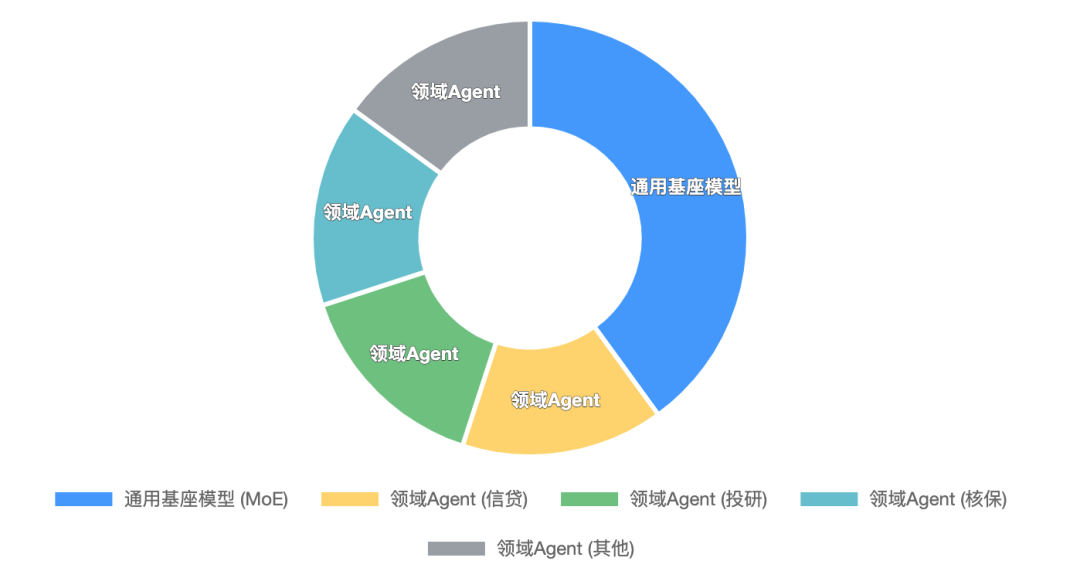
Through this closed loop, the MoA architecture builds a “data flywheel” capable of self-evolution and continuous learning. As the data accumulated by Agents becomes richer, the base model will gradually evolve into an enterprise-level “world model” that deeply understands the business logic, customer behavior, and even industry knowledge of the enterprise. This is not only an upgrade of traditional business processes but also provides infinite possibilities for financial institutions to explore new business models.
From “+AI” to “AI+”: The Inevitable Path for Financial Institutions
Alibaba Cloud’s financial industry Agent panorama is not just a checklist of application scenarios but also a guide for the intelligent transformation of finance. It clearly indicates the development path from the present to the future.
AI Agents are the “nuclear weapon” that ignites the productivity revolution in the financial industry. The future of financial institutions should not merely settle for the “+AI” model of using AI as an efficiency tool but should bravely move towards the “AI+” era, where AI is at the core of reconstructing business processes, service models, and business logic.
This intelligent revolution, which began at the turn of the year, is writing an unprecedented paradigm shift in the history of financial technology. For every financial institution, building an Agent system that aligns with its strategy and creating its own “data flywheel” will no longer be a choice but a mandatory question that determines its competitiveness for the next decade. The wave of transformation has arrived, and only those who actively embrace it can stand at the forefront.
There are many application scenarios, which is beneficial for Alibaba Cloud. #AlibabaCloud #Finance #Agent