 This article is compiled by Semiconductor Industry Insights (ID: ICViews) from iot-analytics.
The IoT chip market is undergoing significant transformation.
While many semiconductor companies are focusing on developing AI chips for nearly 12,000 data centers worldwide, the chips powering over 20 billion IoT devices globally are also experiencing major innovations.
Prediction 1: Edge AI Integration into IoT Chips to Accelerate Development
Integrating edge AI into IoT devices will initiate a significant shift towards hardware with AI capabilities.
Currently, most IoT devices lack the built-in computing power required to run AI workloads. Despite the growing demand for local inference to improve latency, resilience, bandwidth efficiency, and privacy, the majority of the 21 billion IoT endpoints deployed still rely on external processing or simple rule-based logic. This gap between demand and capability lays the groundwork for transformation in 2026.
NPU and AI-capable cores are entering mainstream IoT design. Manufacturers are expanding edge AI across all levels of IoT. In recent years, only a small fraction of IoT products (typically industrial gateways, advanced cameras, and high-end modules) have integrated neural network processors (NPU) or low-power AI accelerators. Now, manufacturers are beginning to promote these capabilities to a broader range of device categories. New IoT system-on-chips (SoCs) are designed with lightweight NPUs, vector extensions, and AI cores similar to digital signal processors (DSP) to support tasks such as anomaly detection, small model vision, local audio intelligence, and state monitoring, which can be performed directly on the device.
IoT Analytics predicts that 2026 will see the first wave of IoT devices equipped with edge AI acceleration technology. By then, shipments of AI-enabled chipsets will expand to sensors, IoT connectivity modules, industrial PCs, and mid-range gateways, which previously lacked any device-side AI inference capabilities.
More complex SoC designs are driving the demand for AI-ready tools. AI features are influencing the design priorities of IoT chips. Integrating neural network processors (NPU) and AI modules into IoT chips increases design complexity, particularly regarding thermal budgets, validation, memory bandwidth, and security. Consequently, IoT chip suppliers are increasingly relying on electronic design automation (EDA) tools optimized for AI computational analysis, reusable intellectual property (such as low-power NPU and secure enclaves), and mature processes optimized for mixed workloads (compute + connectivity + security). These demands are emerging across various fields, including consumer, industrial, automotive, and energy IoT.
IoT Analytics expects that by 2026, AI-aware EDA processes and off-the-shelf AI IP subsystems will be more widely adopted in IoT chip development. These tools and IP modules will reduce design complexity and lower the barrier to adding small model inference capabilities to mass-market IoT devices.
Edge AI is becoming a key differentiator for IoT OEM manufacturers. Device manufacturers are linking AI with functional innovation. As hardware with AI capabilities becomes more prevalent, device manufacturers are beginning to view local inference as a competitive advantage, enabling features such as privacy-preserving analytics in smart home devices, real-time defect detection in industrial sensors, or offline wake word detection in consumer electronics.
IoT Analytics predicts that 2026 will be a turning point for IoT OEM manufacturers, transitioning from pilot phases in early 2025 to large-scale product portfolio updates, marketing these products as IoT devices empowered by edge AI. This shift will accelerate the transition from basic telemetry devices to endpoint devices that support local inference for device-side decision-making.
Prediction 2: The Share of Chipset-based and RISC-V IoT Chips Will Increase
Modularization and RISC-V are becoming increasingly popular in the IoT space.
Over the past two years, rising cost pressures, higher integration requirements, and the demand for more flexible architectures have influenced the design of IoT semiconductors. These trends have prompted suppliers to shift towards modular design approaches (such as chiplets) and open instruction set architectures (ISA) (such as RISC-V). As these trends continue, the groundwork laid indicates that by 2026, there will be significant growth in chipset-based and RISC-V-based IoT chips.
In new designs, chiplets are replacing single-chip system-on-chips (SoCs). Industry dynamics from 2024-2025 indicate that single-chip SoCs will significantly transition to partitioned modular designs. Chiplet architectures will separate computing, storage, and I/O functions into smaller chips that can be produced on different process nodes and connected via high-bandwidth interfaces. This reduces mask costs, improves yields, and allows targeted upgrades without redesigning the entire SoC. Recent examples include Tenstorrent and BOS Semiconductors launching Eagle-N, a chiplet-based AI accelerator for automotive systems; and Intel announcing a multi-node, chiplet-based SoC for software-defined vehicles.
IoT Analytics expects that by 2026, the application of chiplets in IoT, automotive, and AI chipsets will significantly increase. Companies will shift from early custom chiplet designs to more widespread use of standardized computing, connectivity, and security chiplets. This modular approach will reduce engineering workloads, shorten development cycles, and lower non-recurring engineering costs for AI, automotive, and IoT SoCs.
RISC-V is helping to create customized low-power IoT chips. As manufacturers seek flexibility, lower licensing costs, and the ability to customize CPUs for specific devices, RISC-V is rapidly advancing in the IoT space. Its open modular instruction set architecture (ISA) enables companies to build differentiated processors without relying on a closed IP ecosystem. This drives rapid experimentation and commercial deployment in areas such as wearables, microcontrollers, and low-power edge devices.
IoT Analytics expects that the RISC-V architecture will further expand into low-power IoT edge devices, edge AI processors, and automotive subsystems by 2026. Growth will be strongest in markets prioritizing supply chain autonomy and deeper architectural control to customize CPU cores for specific edge and automotive workloads.
Prediction 3: More IoT Chip Designs Will Consider Carbon Emissions
The application of the RISC-V architecture in the IoT space is rapidly growing. With the introduction of regulations such as the EU Corporate Sustainability Reporting Directive (CSRD) and increasing customer expectations, sustainability requirements are becoming increasingly specific for semiconductor suppliers, and carbon emissions transparency is becoming essential. Carbon emissions tracking is increasingly viewed as a core constraint in IoT design, now discussed alongside power consumption, performance, area, and cost (PPAC), rather than as a standalone reporting item.
Carbon emissions metrics have become part of the semiconductor design workflow. Developments in 2024-2025 indicate that carbon emissions data is beginning to be integrated into daily engineering workflows. Some EDA suppliers have incorporated emissions data into early architectural trade-off analyses. For example, in May 2025, U.S.-based EDA, hardware, and IP supplier Cadence joined the Sustainable Semiconductor Technologies and Systems (SSTS) project at imec in Belgium, aiming to directly integrate process and supply chain emissions data into design environments, allowing engineers to compare carbon emissions impacts just as they would compare power, performance, and area (PPA) metrics. IP suppliers are also expanding their deliverables to include sustainability metadata and lifecycle assumptions, enabling integrators to pass carbon emissions estimates to system-level simulations and procurement stages.
IoT Analytics predicts that by 2026, carbon emissions metrics will be more widely integrated into IoT semiconductor design workflows. EDA and IP suppliers will incorporate emissions data into early assessments for PPAC, allowing engineers to consider carbon emissions impacts in regular architectural trade-offs.
IoT chip manufacturers are improving carbon emissions reporting standards. Foundries and chip suppliers are generally enhancing the granularity of sustainability reporting, making it easier for original equipment manufacturers (OEMs) to incorporate carbon emissions impacts into component selection. IoT Analytics predicts that by the end of 2030, connected IoT devices will reach 39 billion units, making accurate collection of sustainability reporting details crucial for the entire IoT ecosystem, and IoT semiconductor companies are beginning to take action.
In June 2024, Germany-based semiconductor design and manufacturing company Infineon expanded the carbon footprint disclosure scope of its MCUs and connectivity devices to cover materials, manufacturing, and logistics, allowing OEMs to focus not only on operational energy efficiency but also on their embedded carbon emissions when evaluating products. In April 2025, Taiwan-based chip foundry TSMC committed to joining the Science Based Targets Initiative (SBTi) and providing node-level carbon footprint data while actively encouraging its suppliers to adopt renewable energy.
IoT Analytics expects that by 2026, major wafer foundries and IoT chip suppliers will accelerate the transition to standardized, auditable carbon emissions information disclosure. Chiplet companies will shift from decentralized sustainability reporting to structured product-level and node-level information disclosure, which will be directly imported into OEM procurement tools. This enables procurement teams to compare embedded carbon emissions with pricing, performance, and qualification data, making the selection of carbon emissions-sensitive components a routine part of IoT design.
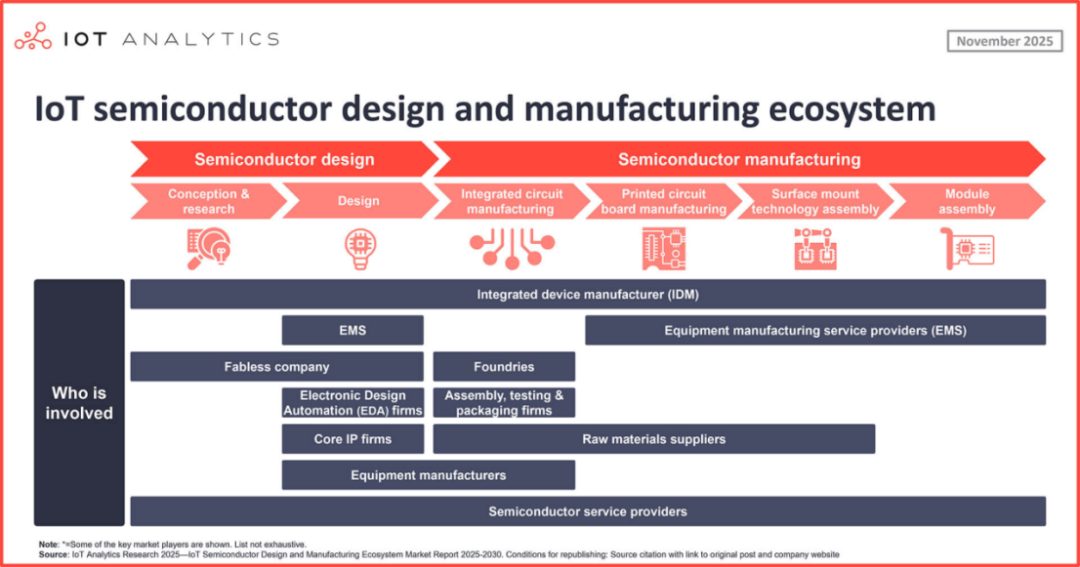
As shown in the figure above, semiconductor design and manufacturing encompasses six major stages from concept and research to module assembly. IoT Analytics categorizes these stages into ten types of stakeholders. IoT chips follow the same value chain steps as other semiconductor chips. The “2025-2030 IoT Semiconductor Design and Manufacturing Ecosystem Market Report” focuses on the three stages where IoT chips are actually specified and produced: IoT EDA, IoT SIP, and IoT foundries.
IoT EDA. Companies providing software tools for designing chips and modules for IoT terminals and gateways. This includes register transfer level (RTL), simulation, validation, synthesis, design for testability (DFT), packaging, and printed circuit board (PCB) tools used for IoT microcontroller units (MCUs), connectivity integrated circuits (ICs), sensors, and system-on-chips (SoCs).
Software IP for IoT (SIP). Refers to companies that license reusable intellectual property (IP) modules for IoT chips; for example, CPU and MCU cores, NPUs, security elements, and interconnect IP. Revenue is derived solely from IP used in IoT terminal or gateway SKUs.
IoT Wafer Foundries. Companies manufacturing wafers and advanced packaging for IoT terminal and gateway chips. This includes mature and advanced process nodes, embedded non-volatile memory, RF and analog processes, as well as system-in-package (SiP) or 3D IC packaging for IoT modules.
Prediction 4: More IoT Devices Will Be Produced Locally
Countries are investing in local semiconductor manufacturing along the IoT value chain.
As part of a broader strategy to secure technology supply chains and reduce geopolitical risks, governments are intensifying efforts to promote local semiconductor production.
By 2026, the manufacturing, packaging, and assembly of IoT chips will increasingly be completed within regional ecosystems rather than concentrated in a single area.
Governments are tightening control over semiconductor supplies, including IoT chips. Initially, national semiconductor policies focused on cutting-edge logic chips, but recent initiatives indicate that governments are expanding regulatory scope to include key components of IoT devices such as microcontrollers, connectivity chipsets, security elements, and sensor-grade silicon chips. These initiatives indicate that IoT silicon chips are no longer viewed as mere commodities but as critical components of national digital infrastructure.
IoT Analytics expects that by 2026, more regulatory measures targeting IoT-grade semiconductors will be introduced. Countries are investing in the development of domestic IoT chip production.
In recent years, countries have launched large-scale industrial plans to fund domestic manufacturing capability building.
United States — The CHIPS and Science Act allocates $52.7 billion to promote domestic manufacturing and R&D. Additionally, the government has expanded funding for semiconductor production companies such as Intel, TSMC, and Samsung.
China — China is promoting domestic chip manufacturing through the Big Fund policy and aims to narrow the technology gap by 2030.
Japan — The Japanese government has committed to invest approximately $65 billion by 2030 to expand its semiconductor and AI industries, supporting domestic wafer fabs and R&D collaborations.
South Korea — South Korean officials announced a $19 billion support plan to strengthen its chip supply chain and enhance the competitiveness of small and medium-sized enterprises in 2024.
European Union — The EU is guiding investments under the EU Chips Act to achieve localization of production, secure raw material supplies, and establish technological sovereignty among member states.
IoT Analytics expects that by 2026, many new and expanded domestic and regional wafer fabs focusing on IoT-related semiconductor processes (such as mature node logic, analog, embedded non-volatile memory, and RF) will begin producing or gradually achieve commercially viable mass production. As these capacities come online in the coming years, chiplet suppliers and countries will be better positioned to build a more autonomous regional core IoT component supply chain.
Prediction 5: IoT Chip Design Will Heavily Rely on AI
AI is becoming a core component of the IoT chip design workflow. Over the past two years, EDA suppliers have been working to integrate AI into both front-end and back-end design processes, providing semiconductor teams with new methods to automate labor-intensive tasks, validate constraints, and identify issues earlier. These capabilities are particularly important for IoT chips, which face strict limitations in power consumption, area, and cost, leaving little room for design iterations.
AI is gradually permeating all aspects of the semiconductor design process. Developments between 2024 and 2025 indicate that AI is beginning to assist the entire design process rather than being limited to isolated tools. In July 2025, Siemens Digital Industries Software, a business unit of the German industrial automation company Siemens, released a suite of AI-enhanced tools covering the entire process from schematic capture to physical implementation, including features such as verification automation, constraint analysis, and early defect detection. These tools are designed to support semiconductor and PCB design, which is crucial for integrating RF, sensor, and computing functions into the constrained sizes of IoT suppliers.
IoT Analytics expects that by 2026, AI-assisted verification, constraint checking, and layout optimization techniques will be more widely adopted, especially among IoT design teams building edge AI chipsets, connected SoCs, and mixed-signal devices. As these AI-driven EDA workflows mature, they will help teams shorten iteration cycles, reduce implementation errors, and address the increasing complexity of integrating RF, sensor, and computing in compact IoT devices.
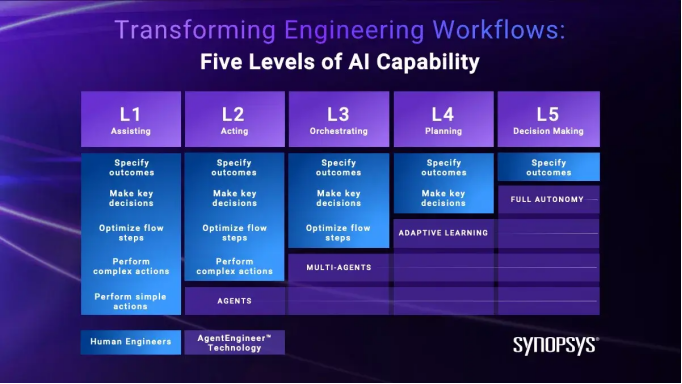
EDA companies are planning pathways to autonomous design agents. Suppliers are also developing roadmaps for AI systems whose capabilities extend beyond generating code or suggesting optimizations. For example, Sassine Ghazi, CEO of U.S.-based EDA software company Synopsys, outlined a roadmap in March 2025, where current generative AI design tools will evolve into fully autonomous multi-agent design systems. These “agent engineers” are expected to support IP integration, advanced packaging, process node selection, and lifecycle management, all of which directly impact IoT chips, as IoT chips increasingly integrate digital logic, RF, power management, and sensing functions into a single package.
IoT Analytics expects that early forms of intelligent agents will enter the IoT chip development workflow by 2026, primarily as workflow assistants coordinating existing EDA tools to execute tasks such as verification, IP integration, and physical design exploration. These systems will be able to automate routine steps, propose constraints and layout schemes, and manage multi-tool design processes, while engineers still retain control over architectural choices, final approval decisions, and safety-critical validations.
Prediction 6: IoT Security Design Will Become an Indispensable Element
IoT security design is becoming a mandatory requirement in the global market. Security design has shifted from best practices to regulatory expectations, and this shift has particularly significant implications for IoT. IoT devices operate in widely distributed and resource-constrained environments (such as factories, homes, vehicles, and energy systems) and cannot rely on traditional boundary security protections. Their longer lifecycles, remote deployments, and continuous connectivity make hardware-level protection crucial for security, reliability, and compliance. These realities are prompting suppliers to integrate more robust chip-level security features into the IoT value chain.
Compliance requirements are driving the evolution of IoT security architectures. Regulatory frameworks such as the EU Cyber Resilience Act, the U.S. National Institute of Standards and Technology (NIST) post-quantum roadmap, and the United Nations Economic Commission for Europe (UNECE) R.155 and R.156 increasingly require devices to have verifiable hardware protection measures before sale. For IoT suppliers, this means that hardware roots of trust, secure boot, and identity authentication based on physically unclonable functions (PUF) are no longer optional but prerequisites for certification in industries such as industrial automation, automotive, healthcare, and smart homes.
IoT Analytics expects that by 2026, high-end IoT microcontrollers (MCUs), connectivity chipsets, security elements, and edge AI processors will more widely adopt hardware-enforced security baselines. As regulatory requirements become stricter, hardware roots of trust, secure boot, and anti-tamper identity will become standard entry conditions for the high-end IoT market. In low-cost IoT devices, security measures will still focus on lighter software layers, such as secure boot and secure operating system support, rather than relying entirely on hardware security guarantees.
Suppliers are building tools to ensure long-term compliance for IoT devices. As compliance requirements become stricter, suppliers are redesigning chip architectures and investing in compliance tools to help IoT device manufacturers meet lifecycle compliance obligations. For example, U.K.-based IoT cybersecurity company Crypto Quantique is automating secure configuration, certificate lifecycle management, and vulnerability tracking, which are crucial for IoT original equipment manufacturers (OEMs) since devices may need to be deployed for 10 to 20 years without physical access. Meanwhile, U.S.-based semiconductor design and manufacturing company Qualcomm is standardizing secure boot processes, generating signed software bill of materials (BSM), and integrating monitoring mechanisms to help suppliers maintain long-term compliance across deployed device fleets.
IoT Analytics expects that by 2026, an end-to-end compliance ecosystem supporting secure configuration, certificate management, software bill of materials maintenance, and vulnerability monitoring throughout the device lifecycle will be more widely adopted. Regulated industrial, medical, and automotive market IoT OEMs are increasingly combining internal security capabilities with external compliance-as-a-service platforms to meet long-term regulatory obligations without having to build all tools in-house.
Post-quantum cryptography is making its way into IoT hardware. The rise of quantum computing has heightened the urgency of post-quantum cryptography, especially for IoT devices that will operate for decades and are difficult to replace. The U.S. National Institute of Standards and Technology (NIST) has issued guidance on transitioning to post-quantum cryptography (PQC) by 2035, prompting semiconductor suppliers to embed quantum-safe algorithms (such as module lattice-based key encapsulation mechanisms (ML-KEM)) into hardware. Infineon’s EAL6 certified PQC hardware (TEGRION security controller) exemplifies the rapid transition of these capabilities from roadmap concepts to commercial products.
IoT Analytics expects that driven by the demand for long lifecycles in energy infrastructure, industrial automation, automotive gateways, and connected medical devices, 2026 will see the first pilot implementations of PQC-supported security modules in high-value IoT chips. Currently, the application of PQC is still limited to high-end devices, but as suppliers begin preparing for the NIST 2035 migration timeline, PQC is expected to become an important design consideration.
*Disclaimer: This article is the original work of the author. The content reflects their personal views, and our reposting is solely for sharing and discussion purposes, not representing our endorsement or agreement. If there are any objections, please contact us.
The “2025 AI PC Industry Research Report” has been released.
To help players across the hardware layer, software layer, model layer, and terminal layer in the PC field better understand the current development status and future trends of the AI PC industry, Semiconductor Industry Insights has released the “2025 AI PC Industry Research Report”.
The report mainly analyzes the macro environment of the AI PC industry, the AI PC industry chain, user research analysis, product evaluation, and future development trends.
The user research covers first-tier cities in China such as Beijing, Shanghai, and Shenzhen, collecting over a thousand valid samples from end users and store sales personnel. The research content includes user basic information, AI PC awareness, product function preferences, and judgments on future industry development trends.
The product evaluation focuses on Lenovo ThinkPad X9 14 (Intel) and Lenovo Xiaoxin Pro16c AKP10 (AMD), analyzing dimensions such as the comparison of different quantization sizes of the same model, comparison of different parameter scale models of the same model, and comparison of different inference devices on the same machine.
Report acquisition:
1. Report price: Paper version 599 yuan / copy
2. Purchase method: Please scan the code to fill out the report purchase intention form.
3. Report consultation:
WeChat ID: icviews2 or Joy8432211
Report directory: