
Decoding the hardcore black technology behind the “chip” foundation of the intelligent computing era.Author | Yunpeng Editor | Mo YingToday, represented by DeepSeek, domestic large models have made a strong breakthrough, igniting a wave of large model deployment and AI application development. According to public data forecasts, in the next three years, the annual compound growth rate of inference computing power will reach nearly four times that of training computing power, and the scale of computing power will exceed that of training computing power in three years. The inference side focuses more on the balance of performance, efficiency, and cost. How to efficiently integrate AI inference with business scenarios is one of the key focuses of the industry at present.At the RISC-V China Summit, which just opened today, the young startup in the domestic chip design field, Zhihe Computing, unveiled the concept of “Unified Computing and AI” and publicly shared the progress of its self-designed high-performance RISC-V CPU core research and development, and released the “Archimedes” series of unified computing and AI products, aiming to use high-performance unified computing and AI chips based on the RISC-V architecture to solve the efficient integration of general computing and AI-enhanced computing, thereby truly integrating AI into the actual business of enterprises.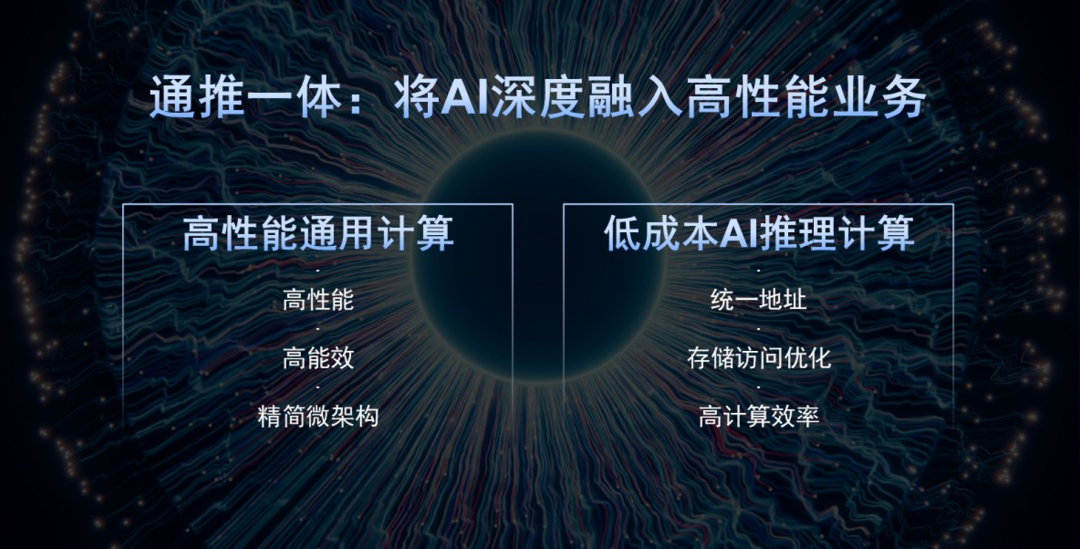 Performance indicators have achieved a “breakthrough ceiling” in terms of compatibility and comprehensive support for ecological standards, showing us the enormous potential of RISC-V in the field of high-performance computing.At the product launch, Chip East and Dr. Meng Jianyi, CEO of Zhihe Computing, had an in-depth exchange, further exploring and discussing RISC-V technology and ecology.Beyond product technical innovation, the high-performance RISC-V CPU core from Zhihe Computing and the unified computing and AI product may be more significant in that it has shown the entire industry a “lighthouse product” built on RISC-V, inspiring the industry to work together to climb the hill and injecting new momentum into the development of the RISC-V chip ecosystem.01.AI Inference Era RISC-V Creates Infinite Possibilities for a New Generation of Computing ChipsCurrently, with the rapid development of edge AI, how to deploy larger, higher quality, and more effective models on chips for inference, and how to bring inference capabilities from the cloud to applications? There are still many issues to be resolved, from performance and energy efficiency to cost.
 In this industry context, the advantages of RISC-V are becoming increasingly prominent. According to Meng Bo, RISC-V represents a change in the mode of technological iteration; compared to x86 and Arm’s “Inside-Out” approach, RISC-V is more “Outside-In”.In simple terms, RISC-V improves architecture more from the perspective of demand, allowing it to align more closely with application needs. Developers do not even need to understand CPU design to improve software, which is one of its outstanding advantages.For chip manufacturers and developers, RISC-V serves as a computing architecture foundation. In the AI era, the types of computing are more complex, and the open-source nature of RISC-V allows for flexible customization based on demand, similar to how many excellent engineering machines are built on the same tracked chassis.The high-performance CPU core from Zhihe Computing and the unified computing and AI RISC-V chip provide the industry with a new choice, demonstrating that chip products built on open-source and openness can also possess competitive power in high-performance computing, comparable to the two major ecosystems.Today’s RISC-V is giving rise to infinite possibilities for a new generation of computing chips.02.Racing to Join the “High-Performance Club” Breaking the RISC-V Performance Ceiling Collaborative Innovation from Chip Architecture to Software AlgorithmsClearly, the development direction of RISC-V is clear, but the path to practice is certainly not easy. If viewed from the past perspective, RISC-V may still only have lit a few stars in the computing power starry sky.According to Meng Bo, technological innovation is fundamental to the development of RISC-V; truly creating better and more cost-effective RISC-V products is the hard truth, akin to the question of “which came first, the chicken or the egg?”Just as today’s Arm chips can compete with x86 in many scenarios because the gap in computing power between the two is narrowing, while Arm’s energy efficiency and cost-effectiveness are higher, enterprises naturally choose solutions that are more beneficial for cost reduction and efficiency improvement.The core essence of the RISC-V ecosystem’s development is still to produce good products and form advantages in cost-effectiveness. This is a “spiral upward” process: once the chip is well-made, software can be ported and optimized, the ecosystem can grow, and in turn, feed back into hardware design, thus forming a virtuous cycle of spiraling upward.
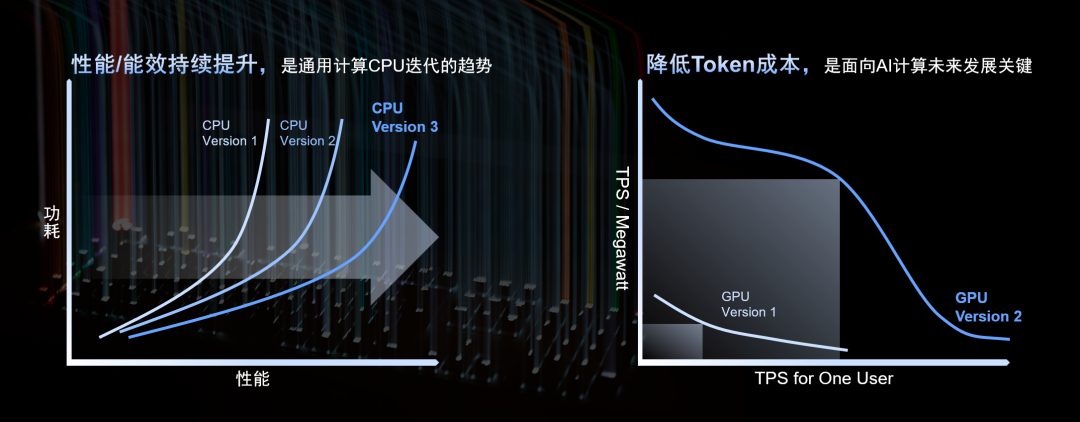
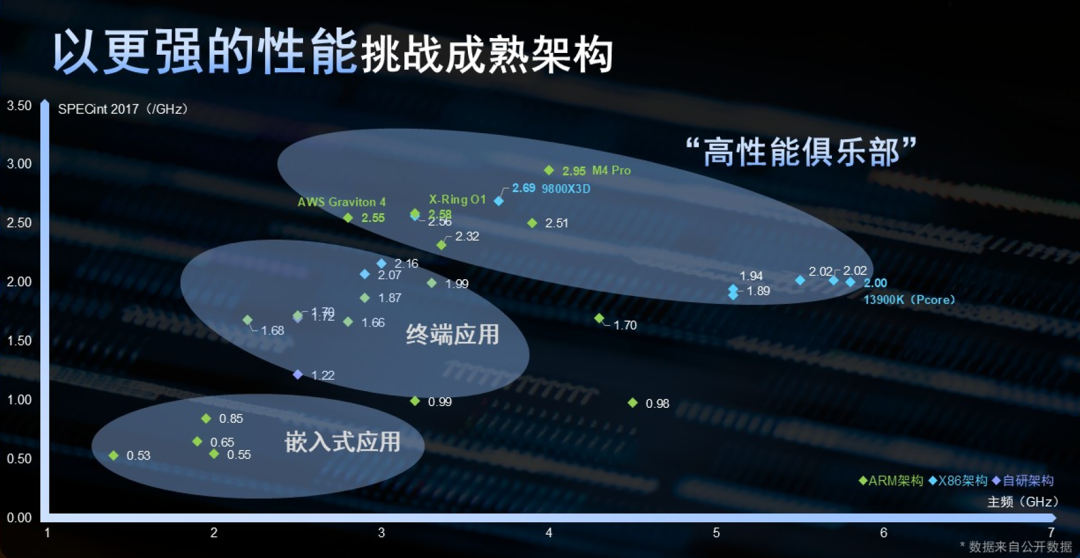 From IoT, embedded systems to terminal application scenarios, and now about to gain entry into the “high-performance club”, RISC-V’s growth is evident, and the industry is eagerly awaiting benchmark products.The unified computing and AI chip from Zhihe Computing efficiently integrates general computing and AI acceleration capabilities into a single chip, which is undoubtedly a bold attempt, with the core goal of balancing high-performance general computing and low-cost AI inference computing.In terms of high-performance general computing, from microarchitecture design to performance and energy efficiency improvements, every 0.1GHz increase in frequency is filled with challenges; in terms of low-cost AI inference, from unified addressing, storage access optimization to improvements in computational efficiency, every link of technological innovation is crucial.Specifically, Zhihe Computing has created an agile and efficient performance analysis and optimization platform to support architectural innovation: enhancing the modular architecture and scalability of the toolchain and microarchitecture to achieve agile iteration of software and hardware, thus quickly evaluating the benefits brought by new extensions generated by the RISC-V architecture.
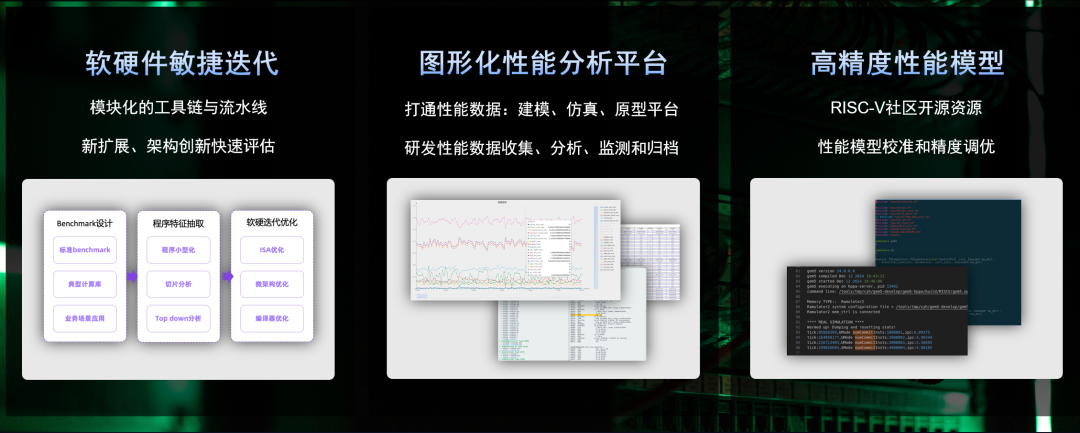 At the same time, Zhihe Computing has established a unified graphical performance analysis platform, which connects the data and analysis processes from modeling to RTL simulation to prototype platforms, significantly improving the efficiency of analysis and optimization. Coupled with model precision tuning, it can provide important decision support for processor architecture and microarchitecture design.Moreover, the rapid iteration of RISC-V processor hardware also demands efficiency in PPA (Performance, Power, Area) iteration optimization. To this end, Zhihe Computing has streamlined the development process system across software, architecture, design, synthesis, and physical implementation, achieving rapid evaluation of the costs and benefits of new extensions and new functionalities in terms of PPA.It can be said that a series of underlying technological innovations have laid a solid foundation for the application of RISC-V architecture CPUs in high-performance computing.Based on significant optimizations in performance and PPA, Zhihe Computing has further enhanced the compatibility of the core, which is crucial for building an ecosystem based on it. It has achieved full compatibility with the RVA23 Profile, supporting 123 official RISC-V extensions, and further iterated on compatibility enhancement technologies.
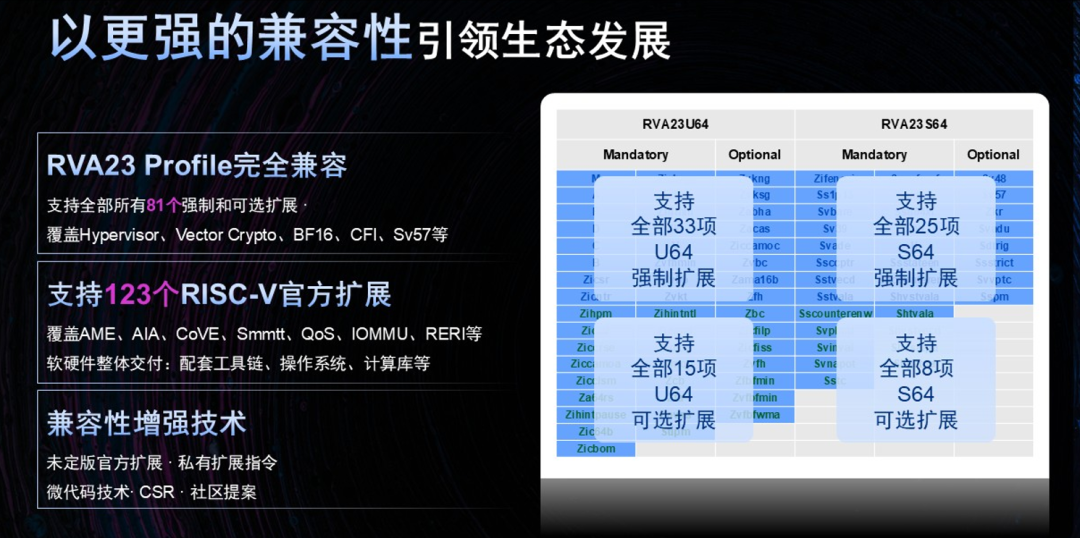 In terms of full system compatibility between hardware and software, the CPU core has achieved a 100% support rate for two key sub-items of the overall specifications of the RISC-V system platform, and a 97% support rate for one key sub-item. At the SoC and upper software stack levels, it also natively supports dozens of RISC-V platform specifications and extensions.In practical application scenarios, Zhihe Computing has achieved impressive results through a series of instruction enhancements and extensions, pipeline architecture optimizations, and software algorithm improvements.
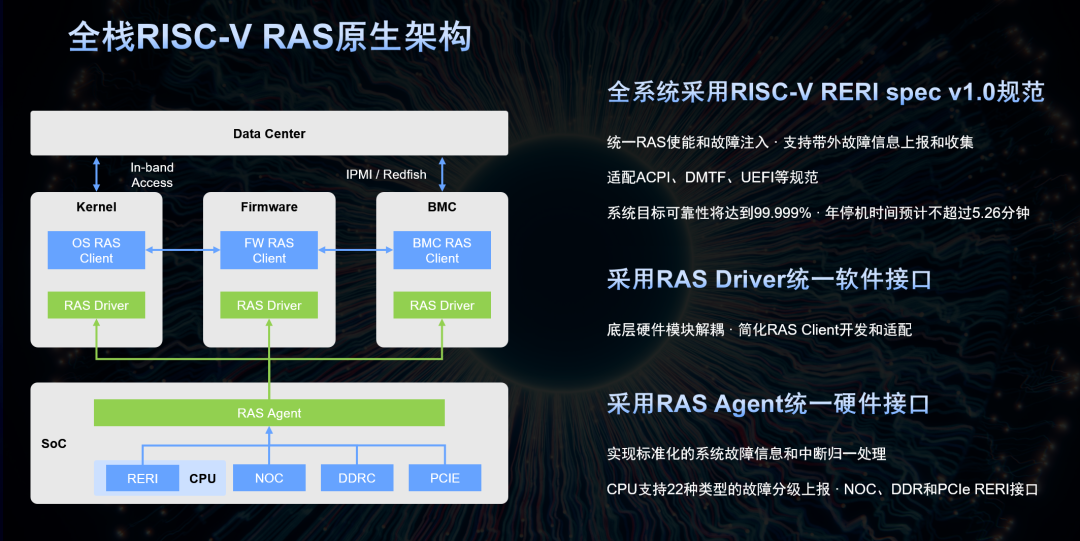
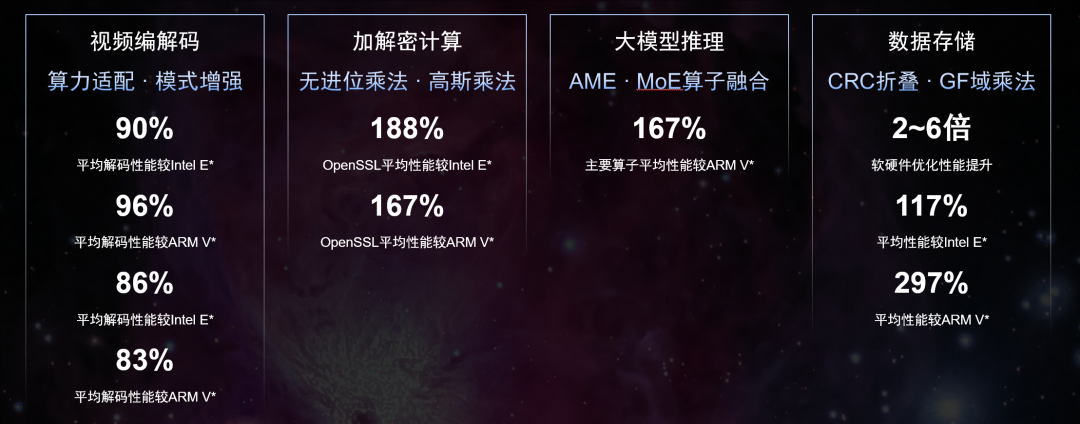 According to measured data, in video encoding and decoding, Zhihe Computing has achieved an average encoding and decoding performance of x264 and x265 reaching 80% to 90% of Intel EMR and ARM V2, thanks to a series of technological innovations combined with software algorithm improvements.In terms of encryption and decryption computing, Zhihe Computing has achieved average performance for typical OpenSSL applications reaching 1.6 times that of ARM V2 and 1.8 times that of Intel EMR. In large model inference, the CPU from Zhihe Computing, by supporting operator fusion for MoE models, can achieve average performance of over 1.6 times that of ARM V2.For low-cost AI inference computing, Zhihe Computing is focusing on developing the AME hybrid computing architecture, which is also a solution promoted by Qualcomm, Alibaba DAMO Academy, Zhihe Computing, and Him Computing.In terms of data storage, Zhihe Computing has optimized multiple technologies, ultimately improving the performance of compression, decompression, and data verification by 2 to 6 times compared to before optimization.Additionally, this processor adopts a full-stack RISC-V RAS native architecture, and its entire hardware and software platform supports the RISC-V RERI specification. Through collaboration with partners on the core, firmware, and BMC, Zhihe Computing will establish a complete RAS pathway from the underlying hardware to the data center control end, jointly providing a full-system RISC-V RAS native architecture solution.
 In terms of security, Zhihe Computing’s processor adopts a high-performance hardware and software system security platform based on CoVE, with the core supporting the latest security features such as MPT, CFI, secure debugging, and pointer masking; on the software side, Zhihe Computing has developed supporting firmware and a complete security software stack.It can be seen that from chip architecture to upper-level algorithms and software innovations, Zhihe Computing has truly enabled this processor to balance general computing and AI acceleration capabilities, giving it the potential for application and implementation in high-performance computing, while breaking the performance ceiling of RISC-V chips, undoubtedly bringing great confidence to the industry.03.Debut Amazes the Industry, Running at Chinese Speed The Growth of the RISC-V Ecosystem Requires Industry CollaborationThe young Zhihe Computing has aimed at the direction of unified computing and AI chips since its inception, and has quickly achieved phased results through the efforts of its team.To achieve this goal, akin to “climbing the North Slope of Everest,” Zhihe Computing has assembled a luxurious team:Chairman Professor Yan Xiaolang is a leading figure in China’s integrated circuit field; as the CEO, Dr. Meng Jianyi, a leader in the domestic RISC-V industry, is the rotating president of the China RISC-V Working Group and former vice president of Alibaba Pingtouge; recently joined Zhihe Computing,CTO James Jiang has nearly 30 years of experience in the chip field, previously serving as the project leader for the Yitian project at Alibaba Pingtouge.It is understood that the company’s core R&D leaders and key R&D personnel have about 20 years of industry experience, previously holding key positions at Alibaba Pingtouge, Intel, AMD, MediaTek, Broadcom, and Zheku.It can be said that a strong core R&D and management team is the key support for winning battles.As dark horse startups like Zhihe Computing carve out a new feasible path for unified computing and AI in the high-performance computing field, and as more and more RISC-V chip startups actively compete and innovate technologies, the RISC-V ecosystem will inevitably grow faster.Whether in speeches or in discussions with Meng Bo, we can clearly feel that Zhihe Computing is not merely trying to “show off muscles”; they are more focused on demonstrating the technological innovations based on RISC-V and the in-depth thinking behind industry and technological development.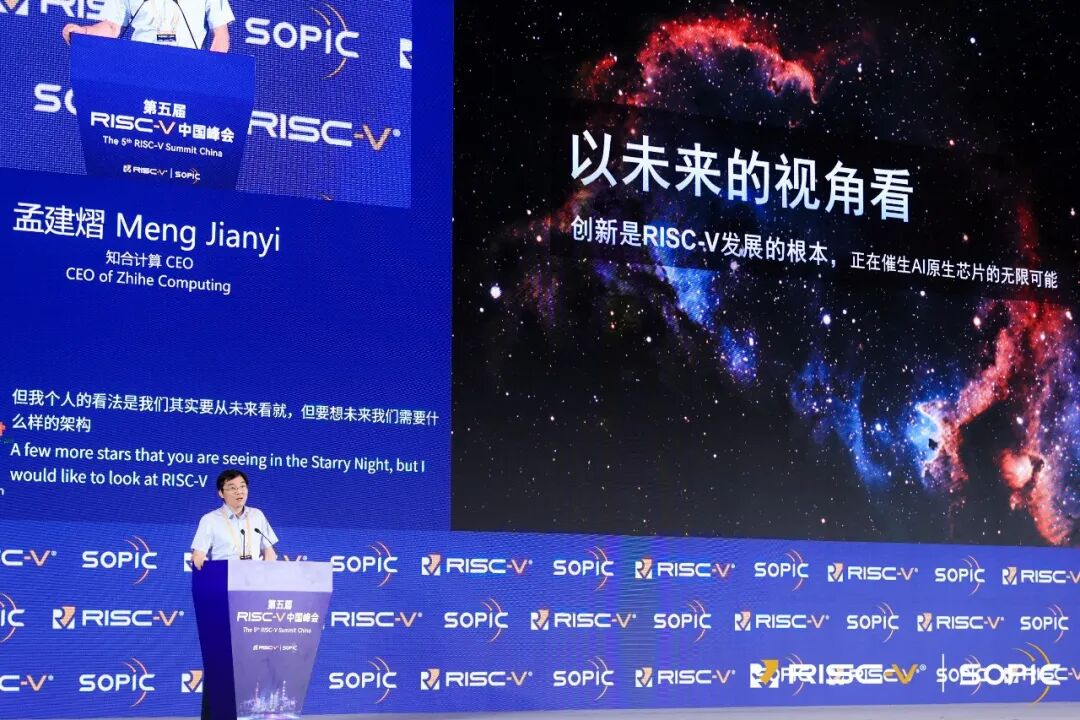
▲ Dr. Meng Jianyi speaking at the RISC-V China Summit
On the challenging road to high performance, there is a company that, through solid underlying technological innovations, has raised the performance ceiling of RISC-V to a new height and shared the stories behind it with players in the domestic track, instilling greater confidence in the industry and encouraging more active participation in promoting the construction of the RISC-V ecosystem, which is truly commendable.Of course, this is not something that can be achieved by one or two companies in a short time. It is understood that during the development of high-performance RISC-V chips at Zhihe Computing, they collaborated with several leading cloud vendors based on the actual needs of application scenarios and maintained deep cooperation with numerous partners in the IP domain.The successful implementation of an excellent chip is inevitably the result of joint efforts across the industry.Regarding the future of RISC-V, the team at Zhihe Computing is full of confidence. Meng Bo made a vivid analogy: if x86 occupies a few major islands, then the future of RISC-V may be a vast ocean. In his view, “a tripartite division of the world” is an inevitable trend, likely to be realized within the next 5 to 10 years.04.Conclusion: RISC-V High-Performance Computing Emerges China’s AI Computing Power Industry is Charging ForwardThe announcement of Zhihe Computing’s high-performance RISC-V CPU core has injected a booster into the development of the RISC-V ecosystem, also allowing the industry to see the enormous potential of RISC-V in accelerating application implementation in high-performance computing.Today, domestic AI computing power demand continues to grow, with structural changes in computing power demand and inference computing power growth far exceeding expectations. The Chinese AI computing power industry is constantly facing new opportunities and challenges, with many excellent enterprises solving computing power problems through technological innovation, accelerating the industrialization of AI.As the RISC-V ecosystem continues to improve and more excellent products emerge, the new computing power foundation of the AI era is gradually being solidified. RISC-V is transitioning from the past “scattered stars” to the “starry sea” of the AI era.