Author:Giordana Francesca Brescia Translation: Joyce Proofreading: Mike
This article is based on the Creative Commons text sharing agreement:https://creativecommons.org/licenses/by-sa/4.0/
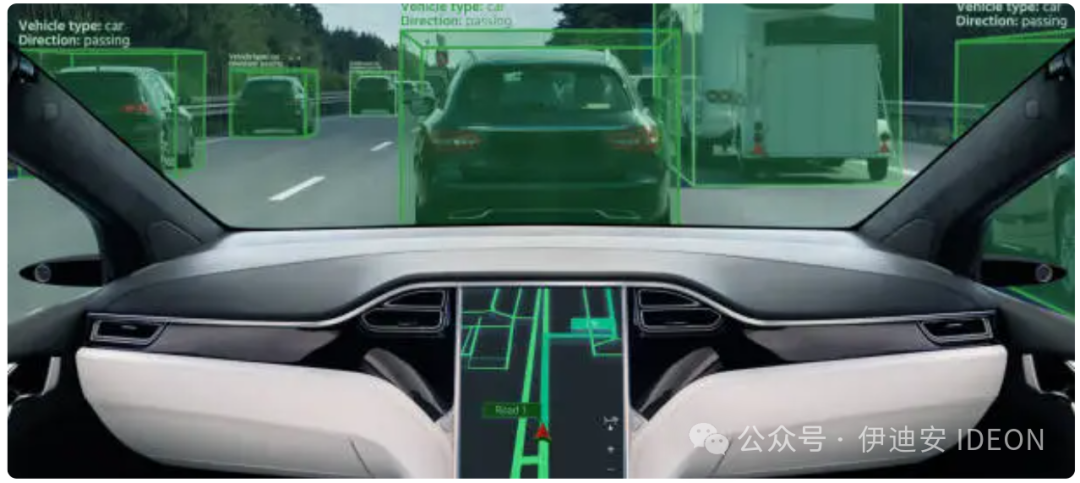 Artificial intelligence in the automotive sector is changing the way we interact with vehicles and the surrounding world, redefining the concept of mobility. This transformation, from traditional vehicles to intelligent autonomous driving systems, is driven by an increasing number of applications that leverage the power of AI to enhance the driving experience and optimize vehicle operations, as well as the proliferation of advanced technologies.Technologies such as computer vision, edge computing, machine learning (ML), and neural networks are considered key elements in the development of autonomous driving systems.These elements, when combined, can optimize safety and integrate increasingly advanced driver assistance features.Artificial Intelligence in the Automotive SectorIn recent years, AI has become an indispensable component in the development of safer, more efficient, interconnected, and autonomous vehicles. Its integration into the automotive industry paves the way for revolutionary innovations.Key applications include advanced driver assistance systems (ADAS), advanced perception systems, machine learning, real-time data analysis, autonomous driving, engine control and optimization, predictive maintenance, and advanced infotainment.All these advancements enhance vehicle safety and efficiency, providing greater convenience and personalization for drivers.Autonomous driving is one of the main goals in the automotive industry.It requires the integration of various AI components that enable vehicles to perceive their surroundings, make real-time decisions, and take appropriate actions. Autonomous vehicles are equipped with various sensors, such as cameras, radar, and LiDAR, to collect data about the environment, which is processed through advanced algorithms for object recognition, predicting the behavior of pedestrians and other vehicles, and planning optimized routes.AI can analyze vast amounts of data from sensors integrated into the vehicle in real-time, helping to avoid collisions and reduce the likelihood of road accidents.The combination of automation and AI can enhance user experience through advanced customization, such as automatically adjusting internal parameters based on driver preferences, environmental conditions, or traffic situations. In this context, the concept of edge computing is also gaining popularity. Processing data directly in the vehicle reduces the need for continuous communication with centralized cloud platforms and ensures a quick response to changing road conditions.What are the Most Important AI Technologies in Automotive Applications?Automakers are integrating advanced technologies to design vehicles with highly complex AI capabilities, with the ultimate goal of achieving full autonomy, allowing vehicles to operate without human intervention, thereby enhancing the perceptual safety of vehicles and pedestrians on the road.AI is being applied in various ways in the automotive sector. One of the most notable applications is computer vision, which can recognize objects such as road signs, vehicles, and pedestrians. This technology uses deep learning algorithms to learn object recognition by analyzing millions of images. Computer vision is crucial for autonomous driving capabilities as it allows vehicles to “see” their surroundings and make quick, safe decisions.Another area of AI application is ADAS, which provides safety features such as lane keeping, automatic emergency braking, and parking assistance. Machine learning and deep learning form the basis of predictive driving systems, enabling vehicles to anticipate and respond to the behavior of other vehicles, thus preventing dangerous situations. For example, gesture and facial recognition systems can monitor drivers for signs of fatigue and alert them when necessary.Artificial neural networks are another technology used to analyze data from various sensors and apply predictive models.They provide continuous learning capabilities and allow vehicles to improve their performance over time based on past experiences.Thanks to the development of neural networks, vehicles can now process large amounts of data in real-time, managing complex scenarios such as navigating intersections or driving on busy roads.Another interesting aspect is the processing of in-vehicle data.With advanced microprocessors (MPUs) used for edge computing, vehicles can process large amounts of data without the need for continuous connection to a central server.The benefits in terms of reduced information transmission latency and improved reliability of driving operations are evident.The implementation of AI sensors has become an integral part of modern vehicles. They collect and analyze various data in real-time to provide information about the vehicle’s status and the surrounding environment. Advanced sensors combined with powerful machine learning algorithms analyze and interpret data in real-time, adapting to changing conditions and making autonomous decisions. For example, they can detect obstacles, monitor traffic conditions, and even predict potential vehicle failures to enhance safety and reliability. In this way, AI systems can identify obstacles on the road, predict potential hazards, and improve navigation, making driving increasingly safe.For these reasons, autonomous driving is one of the most ambitious applications of AI in today’s automotive sector. Autonomous vehicles combine sensors, computer vision algorithms, and machine learning to navigate safely and autonomously, with companies like Tesla and Uber experimenting and developing these technologies with the aim of making autonomous driving a reality in the near future.AI can also enable advanced predictive maintenance by continuously monitoring vehicle conditions to predict when maintenance is needed, thereby reducing downtime and repair costs while enhancing vehicle lifespan and reliability.In addition to safety, AI is transforming the driving experience into a highly personalized one. Intelligent infotainment systems in modern vehicles utilize AI to suggest routes based on driver preferences, providing a personalized and intuitive experience, offering tailored entertainment, and even adjusting vehicle settings for optimal comfort. AI can analyze driver preferences to recommend music, navigation routes, and points of interest.The Role of MCUs in VehiclesMicrocontrollers (MCUs) are key components in the digital transformation of the automotive industry. They support the implementation of advanced technologies and enhance the performance and safety of modern vehicles.On a functional level, they ensure the capability for real-time management and processing of data.In the context of autonomous vehicles, they are crucial for the operation of sensors and actuators that enable vehicles to perceive and interact with their surroundings.With advanced MCUs, autonomous driving systems can continuously monitor traffic conditions, detect obstacles, and make critical decisions in fractions of a second, thereby improving road safety and mobility efficiency.Moreover, integrating AI with MCUs opens up new possibilities for data processing and machine learning within the vehicle. MCUs can run ML algorithms to identify patterns in the data collected by sensors, allowing vehicles to adapt to new and unexpected situations. The ability to learn and adapt is a key factor in developing fully autonomous vehicles that can operate under various road and environmental conditions.
 Vehicle concept on a circuit board (Source: Adobe Stock)
In addition to autonomous driving, MCUs are also used in other critical systems in modern vehicles, such as infotainment systems, engine management, and advanced safety systems. For example, in infotainment systems, they can integrate complex functions such as GPS navigation, voice control, and smartphone connectivity. In engine management systems, MCUs optimize vehicle performance by adjusting various parameters based on driving conditions, helping to reduce fuel consumption and emissions.Predictive maintenance also benefits from MCUs, which use data analysis to predict failures and technical issues before they occur, providing significant advantages in maintenance costs, safety, and overall reliability.Renesas Electronics Smart Automotive AI SolutionsRenesas Electronics is a global leader in MCU and advanced automotive solutions.The company produces technologies such as MCUs and ADAS processors aimed at enhancing the safety and efficiency of next-generation vehicles.By acquiring Reality Analytics Inc. (Reality AI), its product offerings have expanded into the AI domain, with Reality Analytics Inc. being a provider of AI and TinyML solutions for advanced sensing. The technology developed by Reality AI can deeply analyze sensor signals, optimizing the response time and efficiency of in-vehicle MCUs and MPUs.A key product from Renesas Electronics is the RH850/U2B MCU, which supports a wide range of vehicle safety and automation applications.This MCU features hardware accelerators and an integrated AI co-processor for processing and implementing deep learning algorithms directly on the device.The next-generation 28nm RH850/U2B automotive control MCU series achieves speeds of up to six cores × 400 MHz, including support for virtualization and quality of service. The RH850/U2B incorporates the latest hardware support technologies to enable the integration of multiple ASIL-D software partitions within a single ECU. At the same time, it ensures interference-free operation between concurrently running applications to meet ASIL-D ISO 26262 standards.To enhance real-time control performance, the RH850/U2B is partially equipped with the ASIL-D compliant DR1000C, a RISC-V based parallel co-processor IP with vector extension capabilities, making it well-suited to meet upcoming requirements such as the EU7 emissions regulations in Europe.Motor/generator control is a key technology in the electrification trend of all types of vehicles.Renesas Electronics’ complete traction inverter control integrated solution includes a standalone high-performance motor control accelerator IP (EMU3S) that can flexibly combine with multiple dedicated motor control timer architectures (such as GTM v4.1 and TSG3). The integrated RDC3X motor position sensor interface offers the potential to reduce bill of materials (BOM) costs by eliminating the need for external RDC chipsets that are typically required.
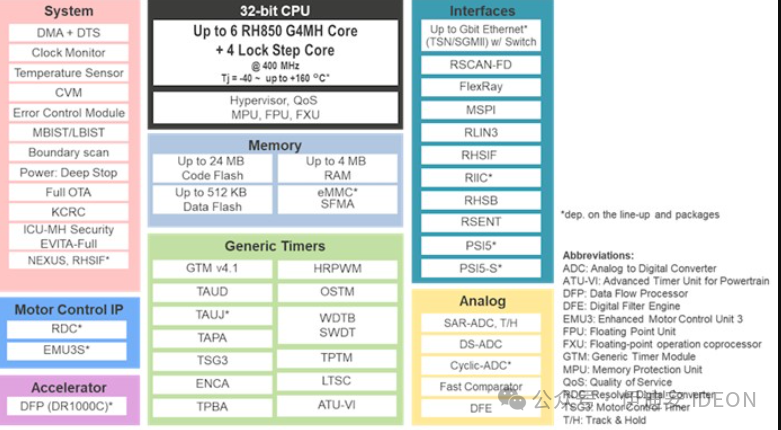 RH850/U2B MCU Block Diagram (Source: Renesas Electronics)
Main Features:
- 400 MHz speed, up to 6+4 (LockStep) RH850 G4MH CPUs
- Top performance-to-power ratio
- Up to 24 MB flash memory
- Up to 4 MB RAM
- RISC-V based MIMD high-performance embedded vector processor
- Embedded EMU3S (Embedded Motor Control Unit), RDC3X (Position Sensor Interface), and TSG3 (Motor Timer) for field-oriented traction motor (inverter) control
- Up to 5 × ADC (12-bit), up to 158 channels, including 6+6+0+0 track and hold inputs
- Up to 10 × DS-ADC with digital filtering engine
- GTM v4.1 vehicle motion timer
- High-temperature support: up to Tj = 160°C
- State-of-the-art interfaces
- Up to 2 × Gigabit Ethernet TSN, including switch functionality (RSwitch)
- CAN-FD, SPI, RHSB (MSC), RHSIF, SENT, LIN, UART, I2C, PSI5
- Serial flash interface
- eMMC
- Supports FuSa and safety
- Comprehensive support for security modules with EVITA
- ISO26262 ASIL-D
- A broad ecosystem supporting the latest standards in tools, hardware, and software domains
Renesas Electronics offers evaluation boards, such as the RH850/U2B 292-pin backplane, supporting all RH850/U2B series devices using the 292-pin package.This platform is used to evaluate the functionality and performance of Renesas Electronics’ 32-bit RH850 MCUs.It can be used standalone or in conjunction with the RH850 evaluation platform motherboard.
 RH850/U2B 292-pin backplane (Source: Renesas Electronics)
Reality AI Tools software helps optimize models for detecting specific signals, such as those emitted by oncoming vehicles or pedestrians.Reality AI Tools support engineers in generating TinyML/edge AI models based on advanced signal processing.Users can then automatically explore sensor data and functionalities to build optimized models. Reality AI Tools include analytical capabilities to identify sensors (or combinations of sensors) with the best performance, optimal locations, and cost-effectiveness. Other features include automatically generating component specifications, model functionalities, and ultra-compact efficient code optimization for smaller MCUs. The software uses AI to find the most cost-effective components and set minimum system component specifications, optimizing BOM. Automated monitoring can also reduce data collection costs.
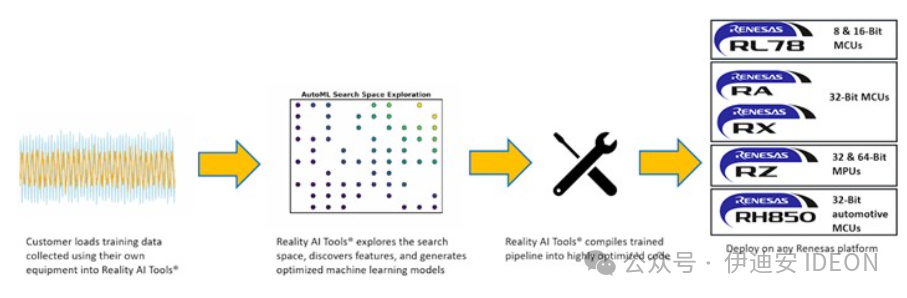 Using Reality AI Tools to automatically explore sensor data and generate optimized models (Source: Renesas Electronics)
The software easily integrates Reality AI Tools with firmware builds. Reality AI Tools support Arm Cortex M, R, and A processor architectures from all major manufacturers, as well as Linux and Windows, and many non-Arm architectures.Automotive Edge with NXP Semiconductors TechnologyNXP Semiconductors stands out with its computer vision and radar processors, as well as connectivity solutions. Its BlueBox edge computing platform is a complete autonomous driving solution that integrates advanced hardware and software, supporting in-vehicle AI applications while reducing reliance on the cloud. The BlueBox 3.0 solution represents a flagship innovation, serving as an autonomous driving development platform that includes components such as the S32G processor for managing vehicle networks and the S32V vision processor for image processing. This technology enables a 360° view around the vehicle, detecting obstacles and pedestrians in real-time.NXP also offers the eIQ ML software environment, a platform optimized for developing ML models for automotive applications.With a complete suite, the company can develop specific models for object recognition, collision prediction, and other driving assistance features.The eIQ ML solutions are designed for scalability, allowing them to support complex AI applications in autonomous vehicles.Xilinx’s ApproachRecently acquired by AMD, Xilinx is known for its use of field-programmable gate arrays (FPGAs) in automotive and industrial applications. FPGAs provide flexibility and high performance, capable of processing complex data in real-time, which is crucial for ADAS systems that require rapid and accurate responses to ensure the safety of vehicles and their occupants. FPGAs and programmable SoCs are widely used in the automotive industry to enable advanced AI applications, combining high performance and flexibility, making them ideal for ADAS, autonomous driving, and infotainment.Xilinx FPGAs are particularly well-suited for applications requiring significant real-time computing power, as they are easy to program and offer unique flexibility compared to traditional processors.The Xilinx Versal AI Core series includes components capable of integrating machine learning and deep learning into vehicles, based on processors that can handle data from multiple sources (including radar and LiDAR) to provide a detailed and low-latency view of the surrounding environment. Versal technology has been implemented in several autonomous driving projects to support the parallel data processing required for identifying moving objects and obstacles, based on neural networks that can continuously learn and adapt to different traffic conditions.AI is profoundly changing the automotive industry, with applications ranging from autonomous driving to advanced safety systems. The modern solutions being developed are transforming the concept of mobility, making vehicles safer, more efficient, and more interconnected.Advanced sensor technologies, in-vehicle data processing, and ML systems enable vehicles to interact with the outside world and adapt in real-time to changing conditions.By leveraging technologies such as FPGAs, edge computing MPUs, and neural networks, automakers can design vehicles equipped with highly complex AI capabilities, aiming for fully autonomous mobility and highly personalized user experiences.