In October 2020, the research groups of Frank C. Schroeder at Cornell University and Joshua A. Baccile at the University of Tennessee published a collaborative research paper titled “Deep Interrogation of Metabolism Using a Pathway-Targeted Click-Chemistry Approach” in J. Am. Chem. Soc., developing a click chemistry enrichment strategy named DIMEN (Deep Interrogation of Metabolism via Enrichment), which enables high-throughput and high-sensitivity targeted metabolomics analysis through alkyne-labeled metabolite probes and solid-phase azide resin, discovering three novel nematode-derived metabolites.
The core challenge in metabolomics is the vast number of metabolites present in biological systems, their structural diversity, and the difficulty in detecting many low-abundance signaling molecules. Traditional untargeted metabolomics generates large amounts of data that are difficult to interpret, while targeted approaches may miss structurally novel molecules.Click chemistry technology, as a powerful bioorthogonal reaction technique, has been widely used in protein studies but has rarely been applied to deeply explore metabolic networks.
This study specifically developed the DIMEN pathway-targeted click chemistry enrichment strategy, with the core goal of specifically enriching and identifying all metabolites derived from specific precursors in complex biological metabolite samples, thereby greatly enhancing detection sensitivity.DIMEN utilizes chemically modified metabolite precursors (as shown in Figure 1(c) as ascr#3-YNE), ensuring that they remain recognizable and metabolically active in the organism after the introduction of the alkyne group. Subsequently, a highly specific and efficient bioorthogonal reaction, the copper-catalyzed azide-alkyne cycloaddition, is employed to incubate the metabolized samples with solid-phase azide resin (ACER resin), allowing all alkyne-tagged probe-derived metabolites (PDMs) to be covalently captured onto the resin. After enrichment, PDMs are released through chemical cleavage using trifluoroacetic acid (TFA), resulting in each PDM carrying a unique triazole ring linker. This linker not only improves the ionization efficiency of the metabolites but, more importantly, generates a diagnostic reporter ion during the MS/MS process to confirm that the detected PDMs are derived from the probe ascr#3-YNE. The core workflow includes feeding with alkyne probes, conversion to PDMs, click chemistry enrichment, and LC-HRMS/MS detection (as shown in Figure 1(d)).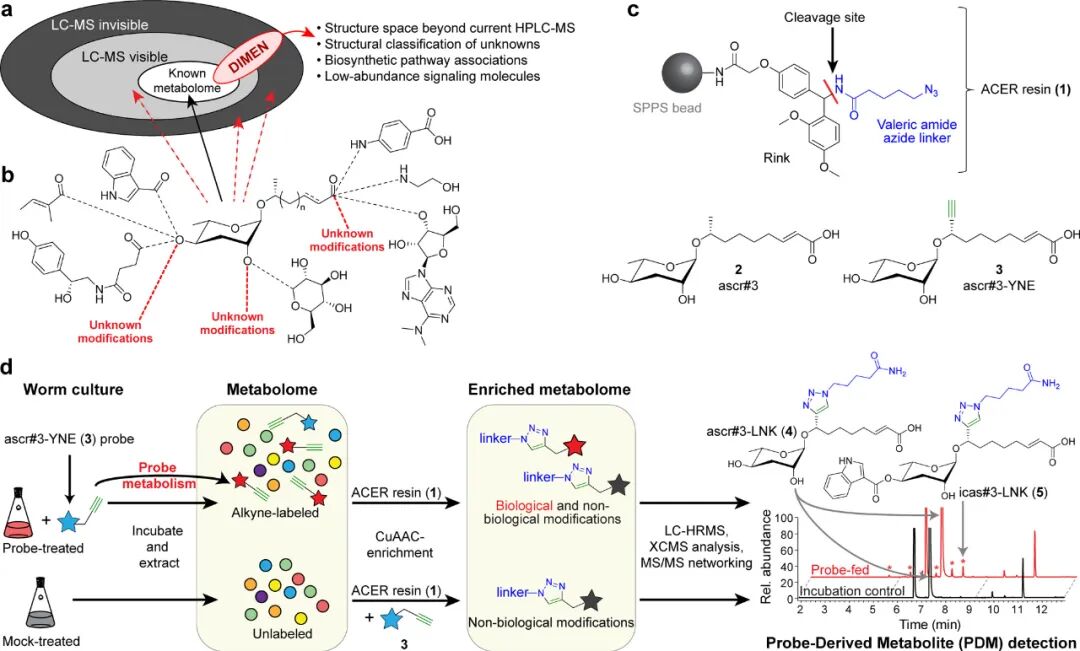
Figure 1 Development of DIMEN
Using this strategy, the research team conducted DIMEN analysis on nematode cultures treated with ascr#3-YNE to derive the molecular network shown in Figure 2(a), which includes three types of molecules listed in Figure 2(b): non-enzymatic oxidation products representing biotransformation [O]-asce#3-LNK, known nematode-derived metabolites icas#9-LNK, and novel metabolites ascr#3-Ala-LNK. The blue node representing ascr#3-LNK in the molecular network was further analyzed, prioritizing the identification of the three largest subgroups in the MS/MS network, revealing amino acid conjugates, phosphorylated derivatives, and fucosylated derivatives. The enrichment and ionization effects of PDM-LNK derivatives were generally better, with a signal-to-noise ratio gain exceeding two orders of magnitude compared to the PDM-YNE precursors (as shown in Figure 2(c)).
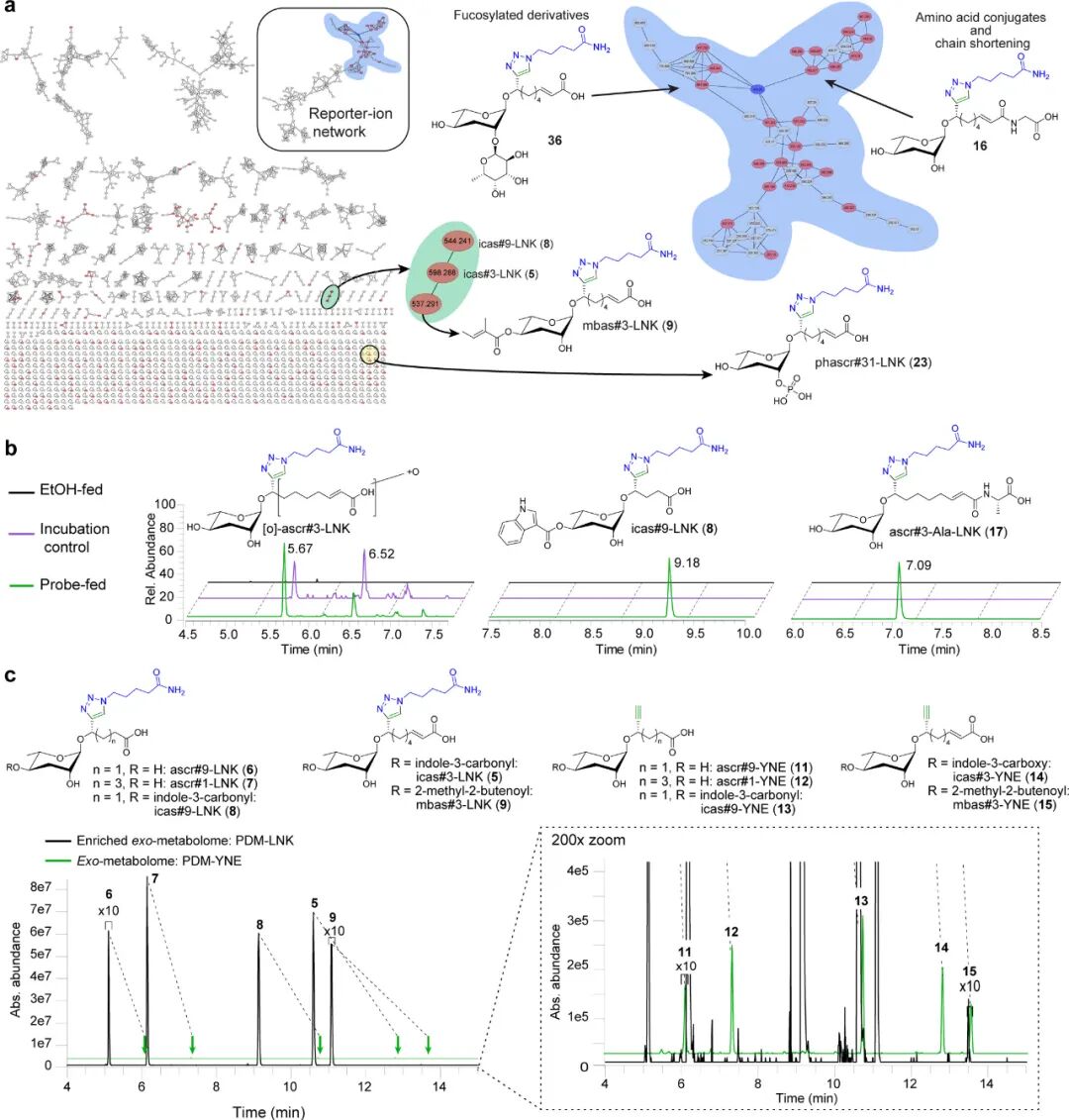
Figure 2 DIMEN analysis of nematodes fed with ascr#3-YNE
The research team analyzed the MS/MS fragments of amino acid conjugates such as ascr#3-Ser-LNK. Using the daf-22 mutant as a negative control, they found that these compounds were present at very low levels in wild-type nematodes, but accumulated significantly in the peroxisomal β-oxidation deficient mutant acox-1.1, revealing a direct link between nematode signaling and amino acid metabolism. Finally, the structure of the representative molecule ascr#10-Phe was verified through synthesis.
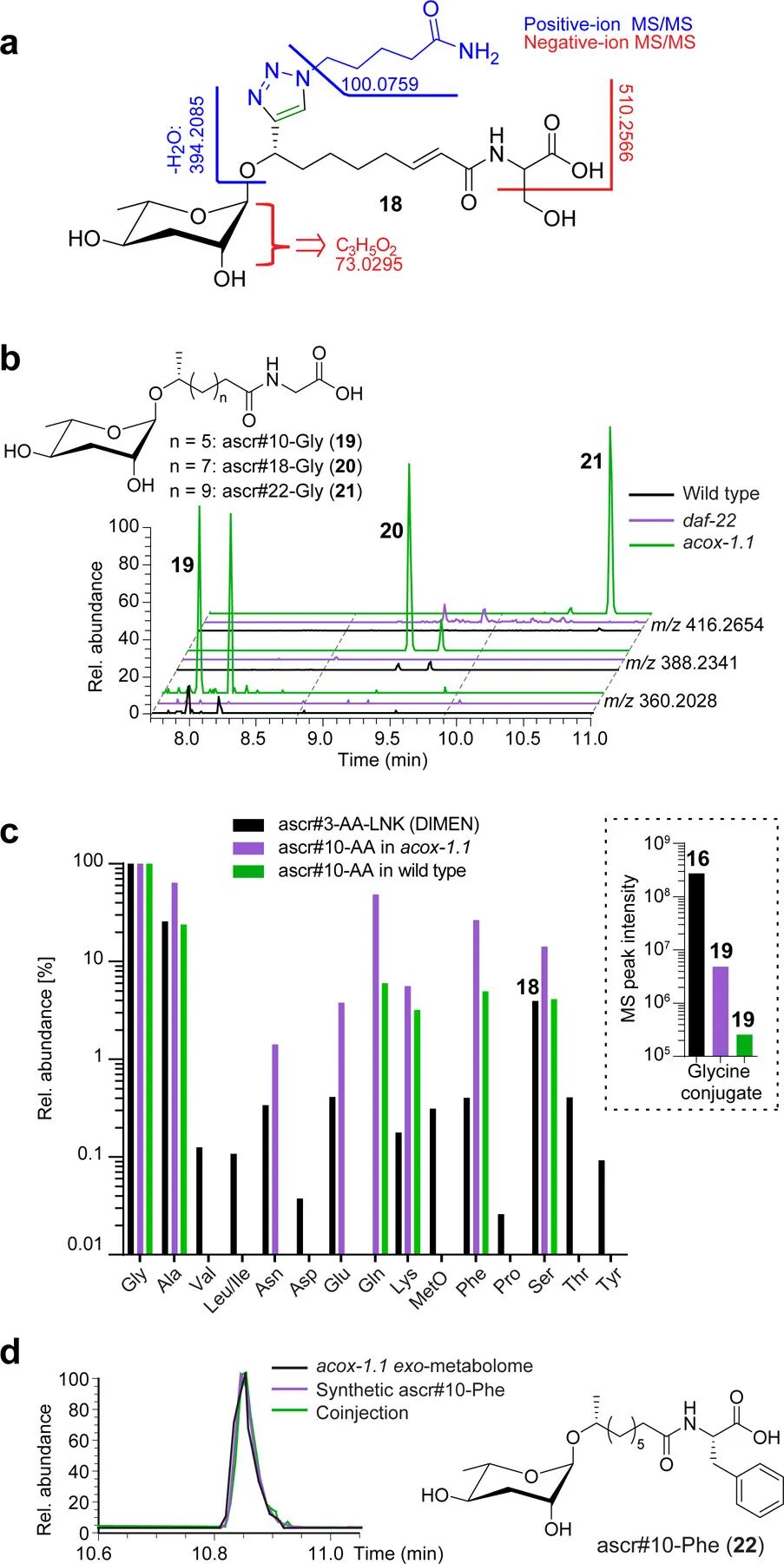
Figure 3 PDM generated from amino acid linkage of ascr#3-YNE
In identifying phosphorylated derivatives of nematode metabolites, the research team discovered a series of new molecules phosphorylated at the 2′-position of the nematode sugar (as shown in Figure 4(c)), which were abundant in nematode excretions but overlooked due to the absence of typical nematode fragments in the negative ion MS/MS spectra. Quantitative analysis in Figure 4(f) indicated that the proportion of phosphorylated derivatives significantly increased during the starvation stage of larvae, suggesting a potential special role in energy stress response. The research team also identified glycosides formed by ascr#3 with fucose and its methylated derivatives, finding that the yield of these compounds depended on nutritional conditions, decreasing during starvation, indicating that these compounds may mediate hunger-related metabolic responses.
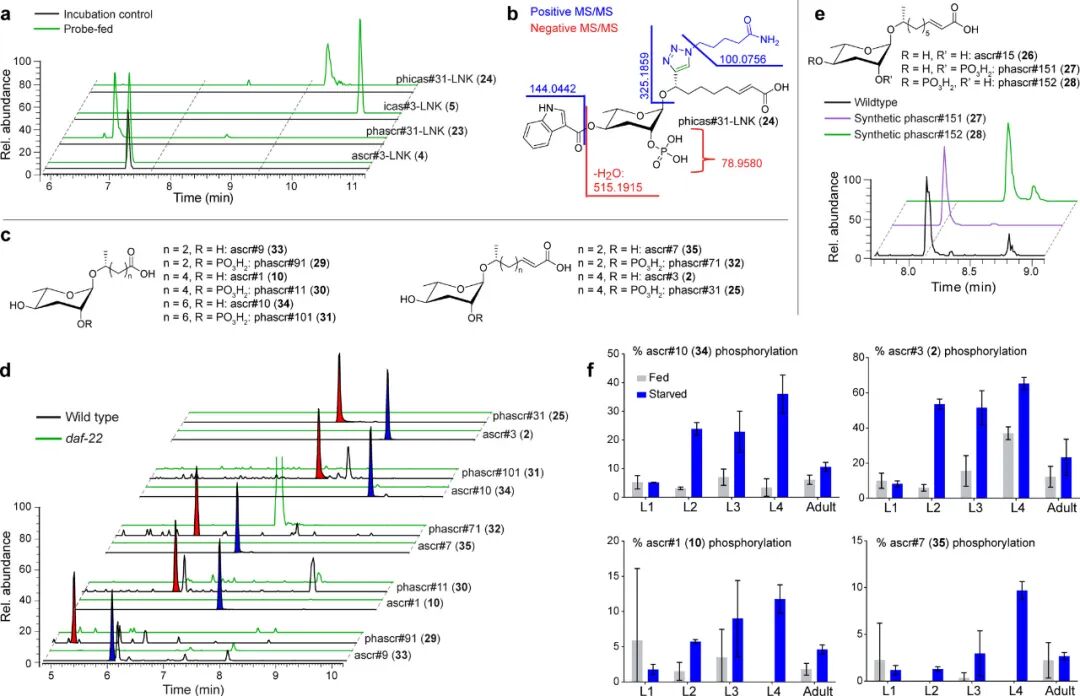
Figure 4 Identification of phosphorylated PDMs
The team also preliminarily applied DIMEN to Escherichia coli, using alkyne-labeled fatty acids (C18-YNE) as probes, successfully enriching metabolites shortened by β-oxidation, demonstrating the applicability of DIMEN in different biological systems.
In summary, this study provides evidence for a broad metabolic network beyond the existing biochemical models of Caenorhabditis elegans and highlights the potential of click chemistry-based enrichment and labeling methods in revealing hidden metabolites and biosynthesis across different biological systems.
Editor: Yang Tengao
Reviewer: Wang Jitong
Please click the end of the push to “Read the original text” to view the article
Author Information

Frank C. Schroeder
Professor, Boyce Thompson Institute
and Professor, Department of Chemistry and Chemical Biology, Cornell University
Education
Postdoc, Harvard University Medical School
Postdoc, Cornell University
PhD, University of Hamburg
Diploma, University of Hamburg
Research interests
Professor Frank C. Schroeder’s research investigates biogenic small-molecule signaling through comparative metabolomics and chemical biology. His lab identifies the structures, biosynthesis, and functions of novel metabolites in nematodes and microorganisms, with applications in drug discovery and parasite control.
Joshua A. Baccile
Assistant Professor, Department of Chemistry, University of Tennessee
Education
B.S. in Chemistry at SUNY Cortland (2011)
PhD in Chemical Biology at Cornell University (2017)
PostDoc California Institute of Technology (Caltech) in Prof. David Tirrell’s lab
Research interests
Professor Joshua A. Baccile’s research develops chemical tools to study small-molecule biosynthesis and engineers artificial proteins to create functional soft materials, integrating approaches from chemical biology and protein engineering.