 This article is compiled by Semiconductor Industry Review (ID: ICViews) from The Register.Arm and RISC-V have something to say.
Do you remember when high-performance computing seemed to be dominated by the x86 architecture? Ten years ago, nearly 90% of the TOP500 supercomputers (the strongest supercomputers ranked twice a year by academia) were based on Intel processors. Today, that percentage has dropped to 57%.
Intel once dominated the high-performance computing field, but its influence is waning. Today, other processors are rapidly rising.
Since Cray introduced vector processors in the mid-1970s (which excel at performing single operations on large datasets), the development of supercomputing has undergone waves of evolution.
Later, reduced instruction set computing (RISC) architectures emerged, such as the 64-bit DEC Alpha, IBM POWER, Sun/Fujitsu SPARC, SGI MIPS, and HP PA-RISC chips. Each architecture has unique performance characteristics. Their simpler instruction sets enable fast instruction decoding and pipelining, making them more suitable for general applications than vector-based systems.
 The Arrival of Commodity Clusters
The challenge for RISC is economic viability. The cost of chips produced in small batches is much higher than that of general-purpose chips like x86. NASA recognized this early on and began using Intel chips in its Beowulf supercomputer clusters back in 1994. It turned out that running inexpensive chips in parallel could achieve performance close to or even comparable to dedicated hardware while significantly reducing costs.
Intel’s ASCII Red continued this work in 1997, becoming the first teraFLOPS workstation dedicated machine using 9,152 Pentium Pro processors.
While Intel gained market share, the importance of GPUs has become increasingly prominent. NVIDIA’s CUDA technology, launched in 2006, transformed graphics processors into general-purpose computing units, significantly enhancing the processing speed of parallel data workloads.
According to Addison Snell, CEO of market analysis firm Intersect360 Research, “The trends in artificial intelligence and the development of hyperscale computing have truly opened opportunities for CPU architectures outside of x86. A significant portion of the high-growth users in the market are chasing accelerators, especially NVIDIA’s GPUs, which has indeed driven the development of many architectures.”
However, these GPUs still require CPUs to handle some workloads.
These CPU-intensive loads include job scheduling, workflow management, I/O, and scalar operations that are difficult to parallelize. “For example, calculating an average, right? The GPU won’t be faster than Arm or x86 chips in this regard,” explained Karl Freund, founder and chief analyst at Cambria-AI Research. “So, when you finish a layer of computation and want to calculate the average across nodes, let Arm handle that.”
Both Intel and AMD’s x86 chips have rapidly evolved, surpassing RISC chips in the market and increasingly collaborating with GPUs to handle heavy parallel computing tasks. For instance, in 2012, the Titan supercomputer at Oak Ridge National Laboratory achieved 17.6 petaflops of computing power by combining AMD Opteron processors with NVIDIA K20 GPUs, topping the TOP500 list.
NVIDIA’s dominance in the high-performance computing (HPC) GPU space stems from its complete and tightly integrated hardware and software solutions.
“NVIDIA’s greater advantage lies in software,” said Steve Conway, senior analyst at Intersect360 Research. “They invested early in managing the massive software that is CUDA.”
He stated that this technology stack is the company’s true moat. The company has invested heavily, enabling not only existing commercial developers to use it but also future generations of developers in universities, thereby building this moat.
 AMD’s High-Performance Computing Strategy
AMD has demonstrated significant potential in both CPU and GPU domains. Its EPYC architecture for servers and embedded systems helped Oak Ridge National Laboratory reclaim the top spot in 2023, with its Frontier server featuring 9,472 AMD CPUs and 37,888 AMD Instinct GPUs (AMD’s data center GPU brand).
AMD’s Milan, Genoa, and Turin EPYC processor series continuously enhance chip density, leading to more significant victories. In November, the El Capitan supercomputer at Lawrence Livermore National Laboratory retained its dominance in the supercomputing field with a combination of AMD EPYC and Instinct processors.
Simon McIntosh-Smith, director of the Bristol Supercomputing Center, is very optimistic about AMD. “AMD’s competitiveness is increasing. Their hardware is excellent and on par with NVIDIA. Their traditionally weaker area is software,” he said, calling for increased investment in software.
 Arm’s Gradual Path from Mobile to Exascale Computing
Despite AMD’s significant progress in the competitive x86 high-performance computing (HPC) market, surpassing Intel, Arm is also a strong contender in this field. The Mont-Blanc project, initiated by the Barcelona Supercomputing Center in 2011, validated the effectiveness of Arm architecture in experimental clusters in Europe. This was one of the earliest experiments to apply Arm architecture to high-performance computing machines.
Nearly a decade later, in 2020, Arm deployed the Fugaku supercomputer at the RIKEN Center for Computational Science in Japan, which can be considered Arm’s greatest achievement to date. This supercomputer, with a performance of 442 petaFLOPS, topped the TOP500 list.
A year later, in 2021, Arm introduced vector processing into its Neoverse data center processor design, launching the Neoverse V1 CPU, which features scalable vector extensions.
Arm’s collaboration with NVIDIA has provided it with a significant strategic foothold in the high-performance computing (HPC) field. This partnership, announced in 2021, led to the birth of the Grace chip, an NVIDIA chip based on Arm architecture, which NVIDIA later combined with the Hopper GPU to create the Grace Hopper superchip.
Over 40 supercomputing projects have announced support for Grace Hopper, including Germany’s Jupiter system, which has just become Europe’s first exascale system, achieving a computing speed of 1 exaFLOPS.
Research has also shown that Arm chips have high energy efficiency. For example, a 2023 benchmark for AI systems found that Arm chips can save about 25% to 30% of energy compared to comparable x86 chips.
The Bristol Supercomputing Center has also chosen the Arm architecture, with its first Isambard supercomputer launched in 2018. Today, its Isambard-AI supercomputer, based on NVIDIA Grace Hopper nodes, is the largest supercomputer in the UK, featuring over 5,500 Grace Hopper nodes.
NVIDIA seems poised to develop its own CPU architecture. The company has signed a 20-year IP licensing agreement with Arm and has indicated that it will use this IP to build its own cores, which may mean it will no longer use off-the-shelf Neoverse cores.
 Open Architecture Proposals
Despite Arm’s strong momentum, other competitors are also rising. One of them is RISC-V, which has a licensing strategy that is entirely different from Arm’s, as Arm operates on a fully free basis. RISC-V, developed by the University of California, Berkeley, is a completely open instruction set architecture that requires no licensing fees.
“This is a huge advantage,” said John Liddell, chief scientist and founder of Tactical Computing Lab (TCL). This veteran, who has worked at Cray and Silicon Graphics, has extensive experience in software development and hardware design. He now runs a small R&D company focused on new hardware and software development in high-performance computing and high-performance data analysis.
He stated, “If you want to customize an x86 processor for a specific scientific application, you need to get a license from Intel. Then you have to go through a very cumbersome process that costs billions of dollars.”
Of course, Arm processors are similar. But he noted that this is not the only advantage of RISC-V over x86. This long-established architecture also has many issues.
“x86 is a traditional architecture, and as such, it must support all the traditional instructions that x86 processors once had,” Liddell pointed out. Applications written in 1989 to run someone’s desktop accounting system still need to run on modern x86 chips inside TOP500 machines.
“RISC-V has abandoned that standard. They said it was crazy. Why don’t we start over, clear everything, wipe the slate clean, and do it right from the beginning?”
He explained that RISC-V’s design philosophy is to provide a base instruction set and then allow people to build their own optional extensions on top of it. This way, they can create custom chips tailored to their unique application needs.
McIntosh-Smith disagrees with this. He pointed out that there are reasons to purchase Arm licenses, many of which relate to more advanced tools.
He explained, “The quality and performance of free implementations cannot compare to the top Arm cores in Apple devices or any cloud platform. Open-source software cannot reach the cutting-edge level; they can only achieve textbook-level excellence but lack real competitiveness.”
He also noted that testing and validation suites require decades of investment. “RISC-V does not provide these for free,” he said. By the time you develop all of these, the advantages of a free open system may vanish.
 European Initiatives and Sovereignty
But Etienne Walter is very eager to discuss another advantage of RISC-V. He is the head of the European Processor Initiative (EPI), which was launched in 2018 to develop high-performance computing (HPC) accelerator technology using RISC-V. The initiative has 27 partners across 10 countries.
It employs a dual-architecture strategy: general-purpose processors use Arm architecture, while dedicated accelerators use RISC-V architecture. The latter includes a CPU based on the vector extension of the RISC-V instruction set architecture. EPI completed the tape-out of RISC-V accelerator test chips in 2021.
In addition to vector accelerators derived from research at the Barcelona Supercomputing Center, EPI is also focused on research into variable precision acceleration and tensor accelerators.
The European Policy Initiative (EPI) has now concluded and has passed the baton to the “Digital Autonomy Based on RISC-V” (DARE) project, which started in March this year. This project has a budget of 240 million euros and consists of 38 partners from 13 countries.
The initiative is coordinated by the Barcelona Supercomputing Center and is expected to last until 2030. It will develop general-purpose processors, vector accelerators, and artificial intelligence processing units.
Why bother doing all this? Perhaps a quick glance at U.S. foreign policy is enough to illustrate the point. As political and economic ties unravel, the importance of sovereignty is becoming increasingly prominent.
“This is our focus. We must keep this concern in mind and prepare some possible solutions just in case,” Walter said, “Even though we know that Europe is not at the same level as the U.S., we cannot reach the same level in expertise and solutions.”
Conway understands the regional governments that recognize the increasing importance of high-performance computing for economic development, so they do not want to be subject to foreign powers. But there are also nuances. He finds it hard to imagine high-performance computing being completely autonomous.
“You rely on lithium from China or elsewhere, and advanced lithography technology from the Netherlands,” he said. “In this sense, even the U.S. cannot be completely autonomous at the processor level. Every country is talking about this issue as if it is a reasonable goal, but it may not be so in the short term.”
Arm took about a decade to build a powerful supercomputing platform with its chip designs. Launching a 64-bit processor in 2011 was not enough; it also needed the right software stack and validation ecosystem.
Now, RISC-V must do the same. “The ecosystem is not yet mature, or rather, it is not yet complete, that is for sure,” Walter said. “There is still a lot of work to be done to establish a stable and mature environment, but I have no doubt it will eventually happen. It is just a matter of time.”
How much time? The first phase of DARE, SGA-1, aims to create “a complete high-performance computing and artificial intelligence supercomputing hardware/software system developed entirely in Europe” within three years. After that, it also needs to persuade people to use it.
Snell is cautiously optimistic. “I think RISC-V does have significant potential in the next five years,” he said. “We believe it is currently only slightly behind Arm, and it really needs a leader to drive it forward.”
RISC-V has made some progress. In October, Meta acquired the RISC-V startup Rivos. This will give Meta its own CUDA-compatible hybrid CPU-GPU RISC-V architecture, while Meta currently relies on third-party chip suppliers. Reports indicate that Meta has also been internally developing its own RISC-V chips.
High-performance computing (HPC) processors have gone through a development cycle, initially characterized by a variety of proprietary chips coexisting, which gradually decreased with the popularity of general-purpose chips. Now, the situation seems to be reversing. There are currently several key manufacturers, and some are gearing up. Some hyperscale data center operators are independent markets in themselves and are working on some interesting projects. Microsoft has Maia, AWS has Inferentia and Trainium, and Google has TPU, all of which are custom ASIC chips.
Digging deeper, you will find even more fascinating developments. Cerebras has a wafer-scale engine that bypasses interconnect bottlenecks by integrating all functions into a single chip. Additionally, there are several silicon photonics projects aimed at reducing power consumption by implementing optical computing interconnects directly on the chip.
Due to the enormous funding involved, the pace of change in high-performance computing is slow. But with so many interesting options emerging today, and more solutions in the pipeline, the world of x86 is unlikely to remain dominant forever.
*Disclaimer: This article is the original work of the author. The content reflects their personal views, and we share it only for discussion and sharing purposes, not representing our endorsement or agreement. If there are any objections, please contact us.
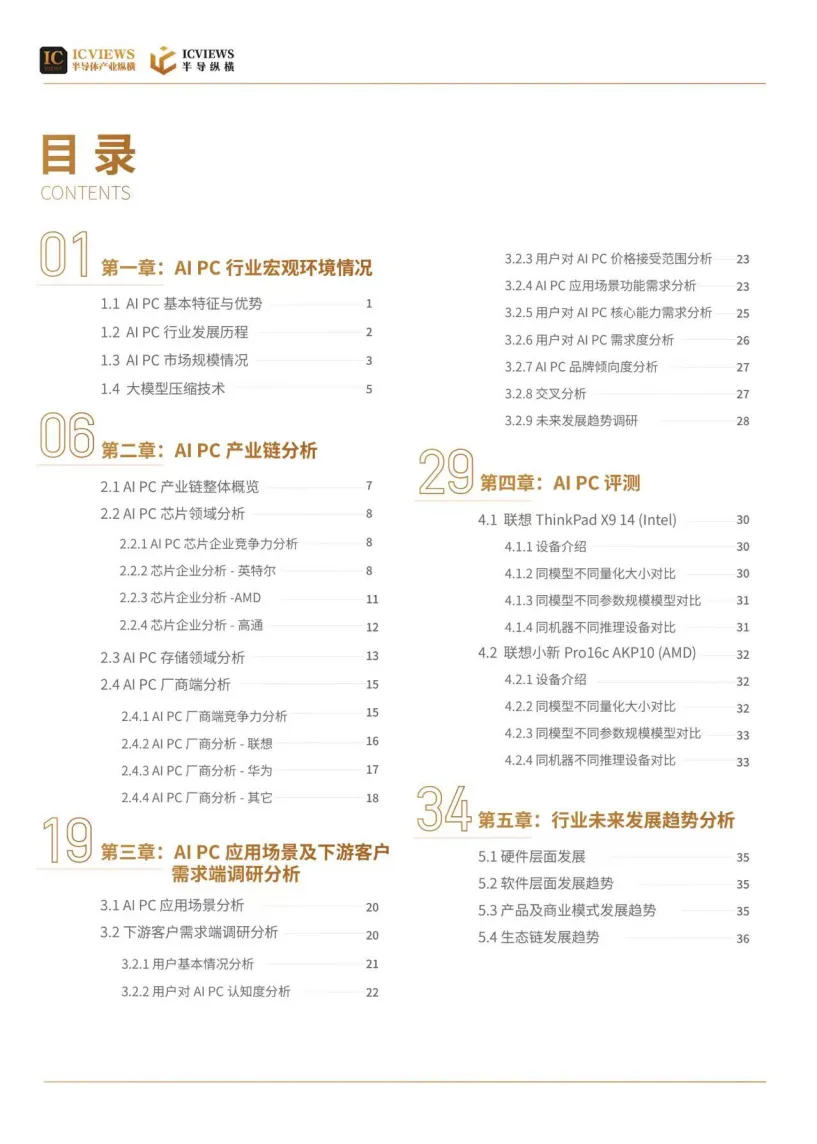
The “2025 AI PC Industry Research Report” is released.
To help players in the PC field across hardware, software, model, and terminal layers better understand the current development status and future trends of the AI PC industry, Semiconductor Industry Review has released the “2025 AI PC Industry Research Report”.The report mainly analyzes the macro environment of the AI PC industry, the AI PC industry chain, user research and analysis, product evaluation, and future development trends.The AI PC user researchcovers first-tier cities in China such as Beijing, Shanghai, and Shenzhen, collecting over a thousand valid samples from end users and store sales personnel. The research includes user demographics, AI PC awareness, product feature preferences, and industry future trend judgments.
The AI PC product evaluationanalyzes two major devices: Lenovo ThinkPad X9 14 (Intel) and Lenovo Xiaoxin Pro16c AKP10 (AMD), evaluating dimensions including comparisons of different quantization sizes of the same model, comparisons of different parameter scale models of the same model, and comparisons of different inference devices on the same machine.
Report acquisition:1.
Report price: printed version 599 yuan/book
2.Purchase method: scan the code to fill out the form for purchase

3.Report consultation:
WeChat IDicviews2 orJoy8432211
Report directory: