Reporter: Zheng Wei, Intern Jiang Yuxin
Editor: Chen Jie
Video Editor: Zhang Ying
“Can I try out the (robot dog)?” “How much is this (smart walking robot)? What about renting it? How much per day?” “Can I customize this robot dog?” “Can it be shipped to Malaysia?” “Let’s add each other on WeChat, and I’ll send you the shipping address!”…
More than a month after its opening, Southern Finance reporters entered the world’s first robot 6S store, established by Shenzhen Future Times Robot Co., Ltd. (abbreviated as Future Times), as if stepping into a bustling robot supermarket.
Consumers of different age groups flocked into this over 200-square-meter offline robot experience store on a work afternoon. “Since our opening, we have attracted nearly 70 robot brands to settle in, with a total foot traffic exceeding 30,000, including customers from 27 countries and regions,” said Lin Feng, founder and CEO of Future Times and manager of the robot 6S store.
Riding the wave of humanoid robots gaining popularity during the Spring Festival Gala, a series of robot products are gradually moving from laboratories to the forefront, entering commercial districts, and reaching consumers’ “doorsteps.” According to incomplete statistics from Southern Finance, cities like Shenzhen, Beijing, and Shanghai have seen various brands of robot flagship stores open. Among them, Shenzhen has recently welcomed two offline robot experience stores: Future Times and Yuxinqi.
Industry and market are two key factors influencing the selection of flagship store locations. As of June 30, 2025, Guangdong Province has approximately 178,000 robot-related enterprises, ranking first in the country. By the end of 2024, the permanent population of Guangdong Province is expected to reach 127.8 million, with a real-time population of 150 million.
“The robot industry has already entered a new stage aimed at consumers,” said Ren Yutong, executive vice president of the Guangdong Robot Association, to Southern Finance reporters. The recent trend of robot companies frequently entering urban commercial districts signifies that the industry is embracing the consumer market, and future challenges such as technological adaptability, market acceptance, and business model innovation need to be overcome to unlock a larger market for industry development. “The To C market still holds significant potential,” he added.
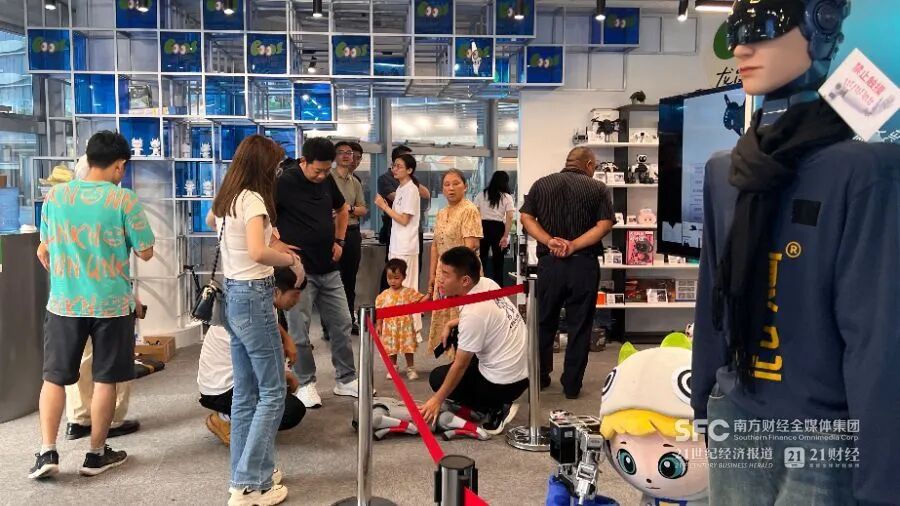
(On a work afternoon, the global first robot 6S store opened by Future Times continues to attract numerous consumers for experience and purchase, Zheng Wei/photo)

International Customers Flood into Robot Offline Experience Stores
“Currently, we mainly provide services such as robot operation, experience, and sales, allowing consumers to have close contact with cutting-edge robot products. The products available for experience operation in the store include robots and robot dogs from Yushu Technology, climbing assist robots from Kenjing, and chess-playing robots from Yuanluobo, among others,” said Ming Yao, manager of Shenzhen Yuxinqi Intelligent Robot Experience Hall, to Southern Finance reporters.
The Yuxinqi Intelligent Robot Experience Hall is another recently established offline robot experience store in Shenzhen, located in the Longhua District Yifang Tiandi Commercial Center. “The choice to open the flagship store in Shenzhen mainly considers that Shenzhen, especially Longhua District, has a relatively large youth population, and consumers have a high acceptance of emerging technology products like robots. On the opening day, the revenue exceeded 8,000 yuan,” Ming Yao stated.
Outside the experience hall, the reporter observed that the robot dog experience project offered by Yuxinqi is priced at 39 yuan for 15 minutes and 69 yuan for 30 minutes, while the robot experience project is priced at 89 yuan for 15 minutes. Additionally, various consumer-grade products such as drones, robot dogs, VR glasses, and chess-playing robots are available for sale in the store. During the interview, curious family consumers entered the store to inquire.
“The future potential of the To C market for the robot industry is still considerable. Opening up the To C market requires business model innovation, through offline experiences and application scenario demonstrations, allowing consumers to truly feel and use various robot products and technologies, which is conducive to further releasing the potential of the consumer market,” Ren Yutong stated.
It is worth noting that during the visit, Southern Finance reporters learned that foreign customers are also quite fond of this new type of offline robot experience store.
“Generally, local foot traffic is better on weekends. From Monday to Thursday, many foreign customers come in, such as those from Spain and the UK. They search for store information online and want to come in to learn about robot products. A few days ago, a foreign customer came in and inquired in detail about all our products, wanting to introduce them to their country,” Ming Yao mentioned.
Lin Feng also told Southern Finance reporters that since the opening over a month ago, the robot 6S store has received inquiries and consultations from customers from 27 countries and regions, “There are particularly many customers from the Middle East, as well as customers from European countries like Norway, the Netherlands, Italy, France, and Germany, as well as from the USA, Russia, and India. They are particularly interested in functional products, such as sanitation cleaning robots and educational programming robots.”
The dense establishment of the two offline robot experience stores, Future Times and Yuxinqi, is supported by the robot industry in Shenzhen and Guangdong, as well as the large consumer market.
When discussing the reasons for selecting Shenzhen as the flagship store location, Lin Feng candidly stated that they are attracted by Shenzhen’s “complete industrial chain and large market demand.” “Shenzhen has gathered a large number of robot enterprises. At the same time, Shenzhen is a ‘technology-crazy’ city, and consumers have a high acceptance of robot-related products. Currently, many areas in Shenzhen, such as Longgang, have introduced government procurement policies for robot products.”
In May of this year, Longgang District of Shenzhen released a series of policy measures, including the “Three-Year Action Plan for Accelerating the Creation of ‘AI Longgang’ (2025-2027)” and the “Three-Year Action Plan for Creating a Friendly Demonstration Zone for Embodied Intelligent Robots (2025-2027),” clearly stating that in the next three years, Longgang District will provide 10 billion yuan in funding support, covering all government funding investment areas such as hospitals, schools, and state-owned enterprises, vividly conveying the firm belief of “100 billion orders push AI.”
“Currently, Guangdong has formed a globally leading robot industry cluster, which can effectively achieve cost reduction and efficiency improvement and accelerate technological innovation through a complete supply chain system. At the same time, relying on the mature consumer market of over 100 million people in Guangdong Province, strong demand can continuously drive the rapid development of the robot industry,” Ren Yutong stated.
Data shows that in 2024, the export of robot-related products in Guangdong Province is expected to reach 45.74 billion yuan, a growth of 19.6%. The revenue of the intelligent robot industry is expected to reach 99.2 billion yuan, with the production of industrial robots exceeding 240,000 units (sets), a year-on-year growth of 31.2%, maintaining the first place in the country for five consecutive years, accounting for 44% of the national market total. During the same period, the permanent population of Guangdong Province is expected to be 127.8 million, with a real-time population of 150 million.
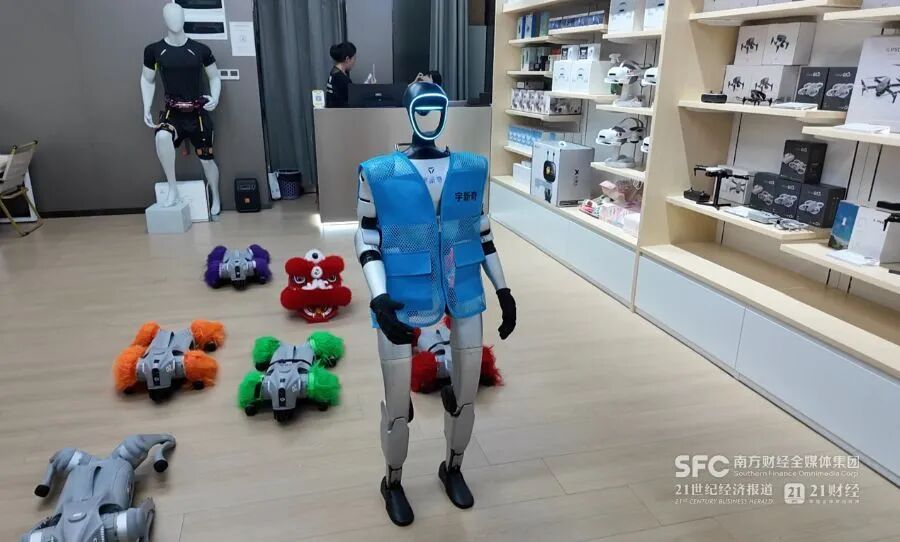
(In Shenzhen Yuxinqi Intelligent Robot Experience Hall, consumers can personally operate Yushu robots, Zheng Wei/photo)

Robots Embrace the Consumer Market
This experiment of robots “landing” from laboratories to urban commercial districts is not only happening in Guangdong. According to incomplete statistics from Southern Finance, this year, cities like Shenzhen, Beijing, and Shanghai have welcomed various brands of robot flagship stores.
In July, the world’s first “humanoid robot 4S center” was launched in Shanghai, integrating four core functions: display, service, sales, and scenario testing. In August, the world’s first embodied intelligent robot 4S store also opened in Beijing Yizhuang, gathering over 100 robot products from more than 40 robot companies nationwide.
Ren Yutong stated that the recent trend of robot companies frequently entering urban commercial districts signifies that the industry is entering a new stage of embracing the consumer market. “The robot industry has reached a new stage aimed at consumers, and the potential of the To C market is still considerable. In the future, products that provide emotional value, such as companion robots, as well as functional support devices like exoskeletons and medical assistance robots, are expected to achieve application breakthroughs first.”
From a national perspective, the consumer end of the robot market is also beginning to release positive growth signals. At the “E-TOWN Robot Consumption Festival” held in Beijing Yizhuang, the total sales of robot-related products and the local commercial district exceeded 330 million yuan, with over 190,000 robots and related products sold. During the same period, JD.com created a special area for the “E-TOWN Robot Consumption Festival,” driving the average daily sales of robots and AI categories across the site to exceed 10 million yuan, a 101.9% increase compared to the week before the event, with daily sales exceeding 10,000 units and total sales exceeding 170 million yuan.
At the same time, Ren Yutong mentioned that the consumer-grade robot market is still not fully mature and will need to overcome challenges such as technological adaptability, market acceptance, and business model innovation to open up greater space for industry development in the future.
“In the future, there are three major challenges to expanding the consumer-grade robot market. First, core technologies still need breakthroughs, especially the core components like sensors for humanoid robots have not yet reached commercial application levels. Second, societal acceptance of robot products still needs to be gradually improved. Third, the issue of product homogeneity needs to be addressed, as many related products on the market are concentrated in areas like floor cleaning and food delivery, while high-end emotional companionship and versatile home service markets still have gaps that need to be explored,” Ren Yutong stated.
Ming Yao also mentioned that the Yushu robots currently displayed in the store are mainly used for customer operation experience and outdoor performance demonstrations, and cannot yet perform specific functions. “In the future, we also hope that as Yushu continues to update and improve relevant technologies and motion functions, these robot products can have more usable features.”
When discussing how to further expand the robot consumer market in various regions, Ren Yutong suggested that companies should focus on improving the autonomy of core components to reduce costs and enhance product performance and stability. At the same time, they should strengthen the deep integration of robots and artificial intelligence, developing dedicated large models suitable for consumer-grade scenarios. Additionally, energy technology innovation should be strengthened, especially in long-lasting batteries and efficient energy management systems, to meet consumer demands for long-lasting electronic products.
“At the policy level, it is recommended to further increase R&D and market promotion subsidies, implement consumer purchase subsidy policies, support the construction of robot experience stores, encourage quality products to enter the market and stand out. At the same time, strengthen talent introduction incentives and support the establishment of innovation consortia to promote breakthroughs in quality products and technological innovation,” Ren Yutong stated.
Facing the gradually opening potential market, more entrants are eager to try.
“Basically, we have a large number of customers coming in every day for research and investigation. They may not come to experience or shop, but just to understand the situation and operational model of the store, wanting to imitate us,” Lin Feng has already sensed the urgency of market competition and revealed to Southern Finance reporters that Future Times is preparing to open its first overseas store.
SFC
Produced by 21 Finance Client, 21st Century Economic Report
Editor: Jiang Peipei, Zhang Jiayu, Intern Lin Zhiyi
Recommended Reads from 21st Century
Wahaha internal documents leaked! Zong Fuli may set up a separate company
Employees of Xibei face online violence, Jia Guolong held a meeting with 18,000 people overnight
Foreigners flocking to China