 Arduino Sensor: HS-S01A Infrared SensorArduino Sensor: HS-S02P Infrared Sensor (Obstacle Avoidance)Arduino Sensor: HS-S03P Ultraviolet SensorArduino Sensor: HS-S05P Sound SensorArduino Sensor: HS-F07P Active BuzzerArduino Sensor: HS-F02P Passive BuzzerArduino Sensor: HS-S08P Flame SensorArduino Sensor: HS-S09LB Raindrop SensorArduino Sensor: HS-S09PC Soil Moisture Sensor
Arduino Sensor: HS-S10P Mist Sensor
Arduino Sensor: HS-S11-L Gas Sensor
Arduino Sensor: HS-S20P Ambient Light Sensor
Arduino Sensor: HS-S21P Tilt SensorArduino Sensor: HS-S22P Grayscale SensorArduino Sensor: HS-S24P Digital Temperature SensorArduino Sensor: HS-S26A Temperature and Humidity SensorArduino Sensor: HS-S28P Potentiometer
Arduino Sensor: HS-S31P Touch Sensor
Arduino Sensor: HS-S37PS Water Level Sensor
Arduino Sensor: HS-S38P Human Body Sensor
Arduino Sensor: HS-S40P Hall Magnetic Sensor
Arduino Sensor: HS-S45P Barometric Pressure Sensor
Arduino Sensor: HS-S46P Weighing Sensor
Arduino Sensor: HS-S59P Slot Type Photoelectric Sensor
Arduino Sensor: HS-S70P Heart Rate and Blood Oxygen Sensor
Arduino Sensor: HS-S71P Thin Film Pressure Sensor
Arduino Sensor: HS-S72P Metal Detection Sensor
Arduino Sensor: Photoresistor Sensor
Arduino Sensor: Infrared Receiver Module
Arduino Sensor: Infrared Transmitter Module
Arduino Sensor: Clock Module
Arduino Sensor: Rotary Encoder Module
Arduino Sensor: Dual-axis Joystick Module
Arduino Sensor: Gyroscope Module
Arduino Sensor: Voice Broadcast Module
Arduino Sensor: Voice Recognition Control Module
Arduino Communication Module: Bluetooth Module
Arduino Power Module: Motor Driver Module
Arduino Power Module: DC Motor Fan Module
Arduino Power Module: Mini DC Gear MotorArduino Control Module: Mini Servo ModuleArduino Storage Module: SD Card Module
Arduino Control Module: Conductive Switch Module
Arduino Interaction Module: Button Switch ModuleArduino Control Module: Self-locking Button Module
Arduino Execution Module: Electromagnet Module
Arduino Execution Control: Water Atomization Drive ModuleArduino Detection Module: Ultrasonic ModuleArduino Positioning Module: Linear Laser Spotlight Module
Arduino Control Module: Relay Module
Arduino Recognition Module: IC Card Induction ModuleArduino Display Module: LED Light ModuleArduino Display Module: RGB Light ModuleArduino Display Module: Traffic Light ModuleArduino Display Module: RGB Strip Light ModuleArduino Display Module: RGB Ring Light ModuleArduino Display Module: One-digit Seven-segment DisplayArduino Display Module: Four-digit Seven-segment DisplayArduino Display Module: 8*8 Dot Matrix DisplayArduino Display Module: Electronic Ink ScreenArduino Display Module: OLED ScreenArduino Display Module: LCD Liquid Crystal DisplayArduino Display Module: TFT LCD Color Screen— Previous Recommendations —

01Basic Understanding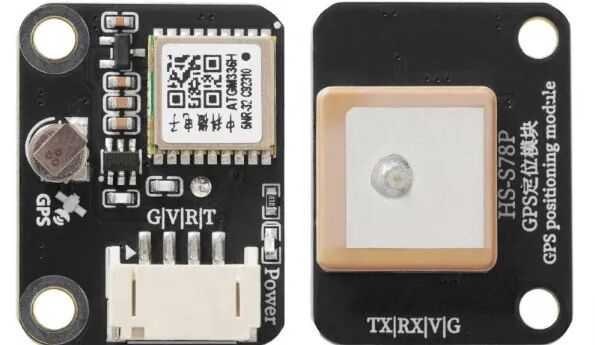 Model:HS-S78PName:GPS Positioning ModuleSeries:Positioning NavigationDescription:It is a full constellation positioning module based on the Zhongke Micro AT6558 low-power GNSS SOC single chip, with the core adopting the ATGM336H-5N solution. It supports six system GNSS signals and satellite enhancement systems including BDS (BeiDou), GPS, GLONASS, and is equipped with 32 tracking channels that can simultaneously receive multi-system signals for joint positioning. It features high sensitivity (acquisition -148dBm, tracking -162dBm), low power consumption (operating current ≤100mA), and compact size, allowing it to communicate with Arduino via serial without additional driver circuits, and can directly replace Ublox MAX series modules. It is suitable for in-vehicle navigation, handheld positioning, wearable devices, outdoor adventure equipment, etc., making it a core positioning component for Arduino IoT and mobile positioning projects.Usage Scenarios:Arduino in-vehicle navigation terminal (combined with TFT screen to display latitude, longitude, and travel trajectory), handheld outdoor positioning device (with lithium battery for portable outdoor positioning), wearable device positioning (such as prototype for children’s positioning watch), primary and secondary school science experiments (exploring satellite positioning principles, multi-system joint navigation logic, in line with the “Guidelines for General Education in Artificial Intelligence for Primary and Secondary Schools (2025 Edition)” practical requirements), logistics tracking devices (linked with GPRS module to upload cargo location in real-time), agricultural plant protection machine positioning (to assist in planning work routes).Disciplinary Integration:Physics,MathematicsGeographyInformation TechnologyEthical Education:Positioning data is sensitive personal information and must be transmitted securely to prevent leakage, reflecting data security awareness; the use of the module must comply with the “Personal Information Protection Law”, prohibiting illegal tracking of others’ locations; outdoor use should avoid enabling positioning in military restricted areas or sensitive regions, adhering to national security regulations; electronic waste disposal should focus on the classification and recycling of chips and antennas within the module to reduce pollution; positioning results must be presented objectively, without altering data for misleading scenarios (such as false navigation).Note: Images sourced from the internet, products are subject to actual purchases
02Technical Parameters
Operating Principle:
The core of the module consists of “ATGM336H-5N positioning chip + GNSS RF antenna + serial communication circuit”. The positioning process is as follows: Signal reception: The module receives RF signals transmitted by multi-system GNSS satellites (such as GPS 1575.42MHz, BDS 1561.098MHz) through the built-in antenna, with 32 tracking channels simultaneously capturing and tracking satellite signals; Data processing: The AT6558 chip demodulates and decodes the signals, extracting satellite ephemeris, timestamp information, and calculating latitude, longitude, altitude, speed, and positioning time data through multi-system signal fusion algorithms; Data output: The module outputs positioning data via serial (T/R pins) in NMEA-0183 standard protocol (such as GGA, RMC statements), with Arduino receiving and parsing the data, completing the “signal reception – data processing – result output” process.
Parameter Analysis:
G (GND): Power input negative
V (VCC): Power input positive
R (RX): Serial communication receive pinT (TX): Serial communication transmit pinCore Chip: ATGM336H-5N (based on AT6558 GNSS SOC single chip)Supported Satellite Systems: BDS (BeiDou), GPS, GLONASS, Galileo, QZSS, SBAS (WAAS/EGNOS/MSAS)Tracking Channels: 32 (simultaneously tracking multi-system satellites to enhance positioning stability)Positioning Accuracy: Horizontal positioning accuracy ≤2.5m (CEP, open environment), vertical positioning accuracy ≤5m (CEP)Satellite Acquisition Speed: Cold start ≤35 seconds, hot start ≤1 second, warm start ≤10 secondsSensitivity: Acquisition sensitivity -148dBm, tracking sensitivity -162dBm (can position in weak signal environments such as indoors near windows)Output Protocol: NMEA-0183 (default outputs GGA, RMC, GSA, GSV, VTG statements)Operating Current: Normal operating current ≤100mA (3.3V), sleep current ≤10μA (low power mode)Operating Temperature: -40℃~85℃ (industrial grade, suitable for high and low temperature outdoor environments)Data Update Rate: 1Hz~10Hz (configurable via AT commands, default 1Hz, i.e., outputs positioning data once per second)03Code Example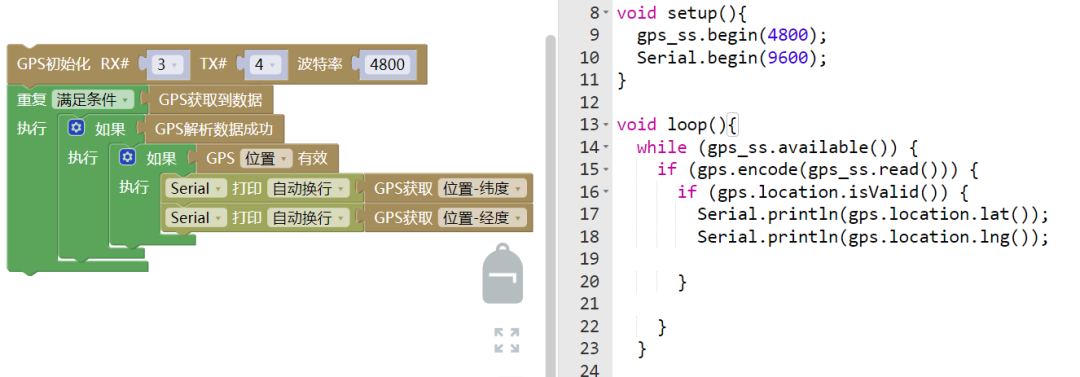
Connect pins RX\D3; TX\D4.
Note: Library needs to be loaded
04Safety Measures
1. Power Safety: Strictly supply power according to the module’s V pin requirements (3.3V), do not connect directly to Arduino 5V pin; if using a 5V power supply, a 1kΩ resistor must be connected in series for voltage division, or use a 3.3V voltage regulator module to prevent chip damage;
2. Wiring Specifications: The module’s R/T pins must be correctly connected to the Arduino’s simulated serial pins (module T→Arduino RX, module R→Arduino TX); reversing connections will prevent data reception; the module’s G pin must be securely grounded with Arduino GND, otherwise serial communication will be disrupted;
3. Signal Protection: The module’s antenna should be kept away from metal objects (metal can shield GNSS signals), and should not be placed close to strong electromagnetic interference devices such as motors and relays (distance ≥10cm); in weak signal environments, an external GNSS antenna can be connected to enhance reception;
4. Electrostatic Protection: The ATGM336H-5N chip is an electrostatic sensitive component; wear an anti-static wrist strap during operation, avoid direct contact with the chip and pins, and touch grounded metal to discharge static in dry environments;
5. Outdoor Use Safety: When carrying outdoors, the module should be fixed in an unobstructed position (e.g., on top of the device) to avoid vibrations causing loose connections; waterproofing is required in rainy weather (the module is not waterproof) to prevent rainwater from entering the module and causing short circuits;
6. Data Security: If uploading positioning data to the cloud, it must be transmitted via encrypted protocols (e.g., MQTTs), and plaintext transmission of latitude and longitude and other private information is prohibited; when storing positioning logs, access permissions must be set to prevent data leakage;
7. Debugging Safety: Confirm the power voltage (3.3V) before debugging, and test step by step; if there is no data on the serial port, first check the wiring (whether R/T is reversed), and whether the power is stable, rather than repeatedly powering on;
8. Compliance Use: The module is prohibited from use in military management areas and government sensitive areas, and must comply with national regulations regarding satellite positioning devices, and must not be used for illegal tracking.
05Expansion
Students can try the following methods:
1.GPS Track Recorder: Link with SD Card Module, OLED Screen, the module parses latitude and longitude in real-time, and the SD card stores positioning logs (including time and coordinates), with the OLED screen displaying the current location and the number of recorded trajectory points, suitable for outdoor adventure tracking;2. In-vehicle Navigation Terminal: Combine with 2.0-inch TFT Color Screen, Button Module, the TFT screen displays latitude, longitude, speed, and direction, with buttons to switch between “real-time positioning” and “historical trajectory” modes for simple in-vehicle navigation;3. Children’s Positioning Watch Prototype: Link with lithium battery and Bluetooth HC-05 Module, after obtaining positioning data, the module sends it via Bluetooth to a mobile app, which displays the child’s real-time location and alerts the phone when out of a safe range;4. Agricultural Plant Protection Positioning: Link with servo and water pump modules, plan the operation route of the plant protection machine based on GPS positioning data, and adjust the spray head angle and start the water pump when reaching specified coordinates for precise plant protection;5. Logistics Tracker: Link with GPRS module (such as SIM800L) and lithium battery pack, the module obtains positioning data every 30 seconds and uploads it to a cloud server via GPRS, allowing real-time location and transport trajectory of goods to be viewed on a computer;6. Positioning Alarm Device: Link with Relay and Buzzer Module, preset safe area latitude and longitude ranges, when the module detects the current location exceeds the range, the relay triggers an alarm light, and the buzzer sounds an alarm, suitable for theft prevention of valuable items. Follow the public account and add the customer service above, reply with the corresponding name to gain access to the following knowledge base reading permissions