

Abstract:An international team has developed micro robots that can self-organize into intelligent swarms using sound waves, exhibiting intelligent-like behavior. They are expected to be used in disaster exploration, pollution cleanup, and medical applications in the future. The related findings were published in the journal Physical Review X.
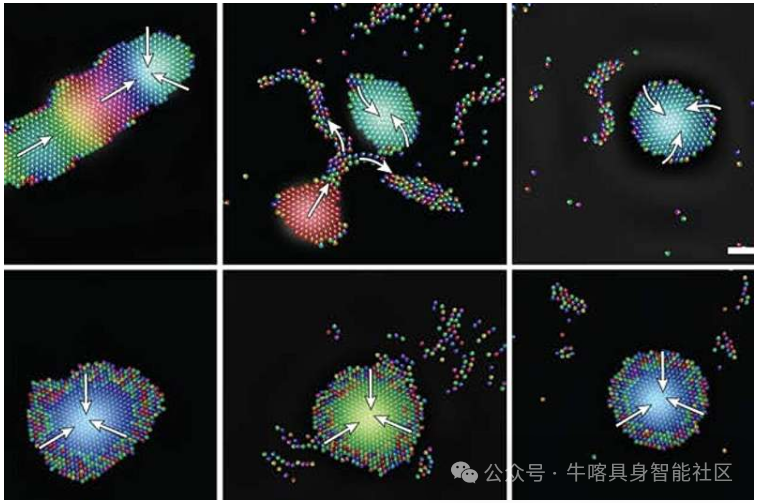
Micro Robots Self-Organize into Intelligent Swarms
Adrienne Berard from Penn State reports: Animals such as bats, whales, and insects have long used acoustic signals for communication and navigation. Now, an international team of scientists has drawn inspiration from nature to develop a model of micro robots—these robots can coordinate to form large groups through sound waves, exhibiting intelligent-like behavior.
Research Background and Application Prospects
Igor Aronson, the lead researcher and the Huck Chair Professor of Biomedical Engineering, Chemistry, and Mathematics at Penn State, states that this robotic swarm is expected to perform complex tasks in the future, such as exploring disaster areas, cleaning up pollution, and even conducting medical operations inside the body.
“Imagine a swarm of bees or midges,” Aronson explains, “they produce sound as they move, and the sound helps the group maintain cohesion, allowing many individuals to act as a single entity.” The related research findings have been published in the journal Physical Review X.
These sound-emitting micro robot swarms possess self-organizing capabilities and can navigate in confined spaces, reassembling even after deformation. Aronson points out that the swarm’s “emergent intelligence” could be used for tasks such as cleaning polluted environments in the future.
In addition to environmental applications, the robotic swarms may also play a role inside the body, such as delivering drugs precisely to disease sites. Their collective sensing ability aids in detecting environmental changes, and their “self-healing” capability (maintaining group functionality even when dispersed) makes them highly valuable in threat detection and sensing applications.
Technical Principles and Breakthroughs
In the study, the team developed a computer model to track the movements of the micro robots—each robot is equipped with an acoustic emitter and detector. The results show that acoustic communication allows individual robots to collaborate seamlessly, adjusting their shapes and behaviors based on the environment, similar to schools of fish or flocks of birds.
Although the robots in the paper are theoretical models (not physical devices), Aronson states that the collective intelligence observed in simulations may also occur in experiments with the same design.
“We never expected such simple robots to exhibit such high cohesion and intelligence,” Aronson says. “They are just very simple electronic circuits: each robot can move in a specific direction and is equipped with motors, miniature microphones, speakers, and oscillators. However, they can synchronize their oscillators with the group sound field frequency and move towards the strongest signal, thus forming collective intelligence.”
Significance for the Field of ‘Active Matter’
This discovery sets a new milestone for the emerging field of ‘active matter’ (which studies the collective behavior of self-driven microscopic organisms and synthetic agents, covering bacterial colonies, living cells, and micro robots). Aronson explains that this is the first time it has been confirmed that sound waves can be used as a means to control micro robots—previously, active matter particles were primarily controlled by chemical signals.
“Sound waves as a communication method are far superior to chemical signals,” Aronson points out. “Sound waves propagate faster and farther, energy loss is almost negligible, and the design is simpler. The robots can ‘hear’ and ‘find’ each other, thus achieving collective self-organization. Each individual is extremely simple, while collective intelligence and functionality arise from the most basic components and simple acoustic communication.”
Research Team
Other authors of the paper include Alexander Ziepke, Ivan Maryshev, and Erwin Frey from Ludwig Maximilian University of Munich.
For more information: Alexander Ziepke et al., “Collective Sensing and Control of Active Matter Systems Empowered by Acoustic Signals,” Physical Review X (2025), DOI: 10.1103/m1hl-d18s
ENDYale University Develops Simplified Robotic Wrist Mechanism: Sphinx Enhances Motion Efficiency in Unstructured Environments with Spherical DesignABB Partners with Regal Rexnord to Launch Certified 7th Axis TechnologyDesign Flaws in Humanoid Robots: How Flexible Structures and Mechanical Intelligence Overcome Energy Consumption and Adaptability BottlenecksCost and Safety Drive Increased Adoption of Robotic Technology: QNX Survey Reveals North American and Global Trends and Key ChallengesEU Humanoid Robots and Physical AI: Future Safety Challenges and ‘Design for Safety’ StrategiesBosch Partners with CARIAD: AI Autonomous Driving Software Stack to be Mass-Produced by 2026, Reshaping European Automotive Technology SovereigntyRed Wolf and Blue Wolf: AI-Driven Facial Recognition Technology Monitoring Palestinians—Operational Mechanisms, Deployment Status, and Human Rights Controversies Analysis75% Ceiling: Have Anthropic and OpenAI’s AI Models Reached the Performance Peak of Current Training Methods?

 Click “Read the original text” for more.