✅ Author Profile: A research enthusiast and Matlab simulation developer, skilled in data processing, modeling simulation, program design, complete code acquisition, paper reproduction, and scientific simulation.
🍎 Previous Review: Follow my personal homepage:Matlab Research Studio
🍊 Personal Motto: Seek knowledge through investigation; complete Matlab code and simulation consultation available via private message.
🔥 Content Introduction
Brushless DC Motors (BLDC) are widely used in industrial control, electric vehicles, aerospace, and other fields due to their high efficiency, high power density, long lifespan, and low maintenance. Accurate speed control is key to maximizing the performance of BLDC motors. This article delves into the speed control strategies for BLDC motors based on MATLAB/Simulink. First, it introduces the working principle, mathematical model, and control methods of BLDC motors. Next, it elaborates on advanced control algorithms such as Proportional-Integral-Derivative (PID) control, fuzzy PID control, and sensorless control based on observers, detailing their applications in BLDC motor speed control. Through the MATLAB/Simulink simulation platform, a comparative analysis of the dynamic response, steady-state performance, and disturbance rejection capabilities of the BLDC motor under different control strategies is conducted. The simulation results indicate that MATLAB/Simulink can effectively validate and optimize the BLDC motor control system, providing strong theoretical and technical support for practical engineering applications.
Keywords: Brushless DC Motor; Speed Control; MATLAB/Simulink; PID Control; Fuzzy PID; Sensorless Control
1. Introduction
As a new type of motor, the Brushless DC Motor (BLDC) combines the excellent speed regulation performance of DC motors with the advantages of brushless AC motors. Its rotor is made of permanent magnets, and the stator windings are powered by an electronic commutator, eliminating issues such as wear and sparks between brushes and commutators found in traditional DC motors, significantly enhancing the motor’s reliability and lifespan. With the rapid development of power electronics technology, microprocessor technology, and control theory, the application of BLDC motors is becoming increasingly widespread across various fields.
Precise speed control of BLDC motors is fundamental to their efficient operation. Traditional PID control is widely used in the speed control of BLDC motors due to its simple structure and ease of implementation. However, when the system experiences nonlinearity, uncertainty, or external disturbances, the performance of traditional PID controllers often fails to achieve optimal results. Therefore, researching more advanced and robust control strategies is crucial for enhancing the performance of BLDC motor control systems.
MATLAB/Simulink, as a powerful simulation tool, provides a convenient platform for the design, analysis, and validation of BLDC motor control systems. It allows for precise modeling of BLDC motors and their drive circuits, facilitates the implementation of various complex control algorithms, and visually displays the system’s dynamic response. This article aims to model and simulate the BLDC motor speed control system using MATLAB/Simulink, comparing the advantages and disadvantages of different control strategies to provide references for practical engineering applications.
2. Working Principle and Mathematical Model of Brushless DC Motors
2.1 Working Principle
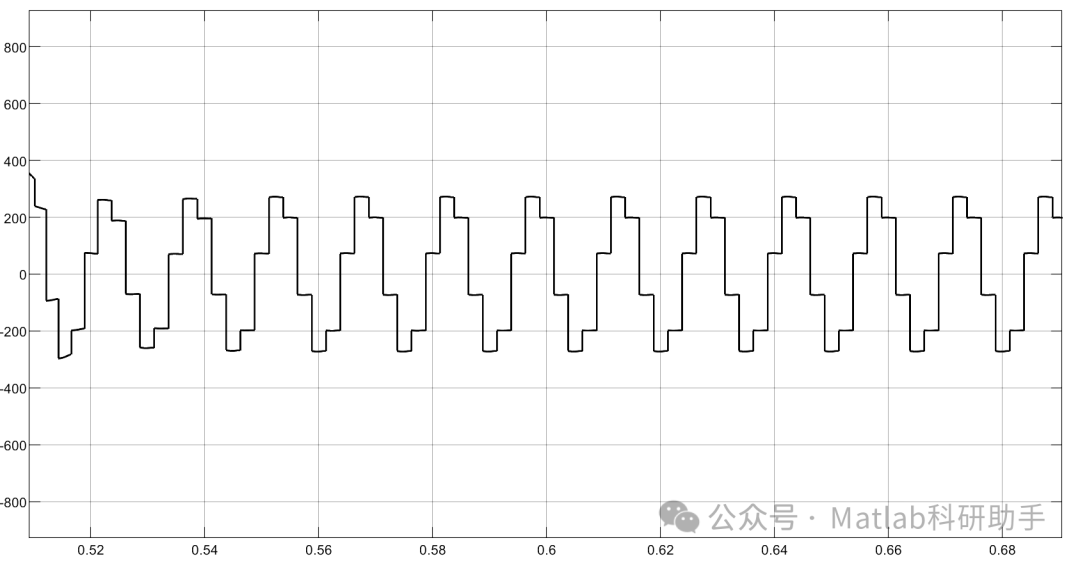
The working principle of BLDC motors is based on the principles of permanent magnet synchronous motors, where the rotor consists of permanent magnets, and the stator windings are powered by a three-phase inverter. To achieve smooth torque output, the current in the stator windings must be synchronized with the rotor magnetic field position. This is typically achieved through Hall sensors or sensorless techniques to detect the rotor position, allowing the controller to determine the on/off states of the inverter’s switching devices based on the position information, thus achieving commutation of the stator winding current. When the stator winding is energized, a rotating magnetic field is generated, which interacts with the magnetic field of the rotor’s permanent magnets, producing electromagnetic torque that drives the rotor to rotate.
2.2 Mathematical Model
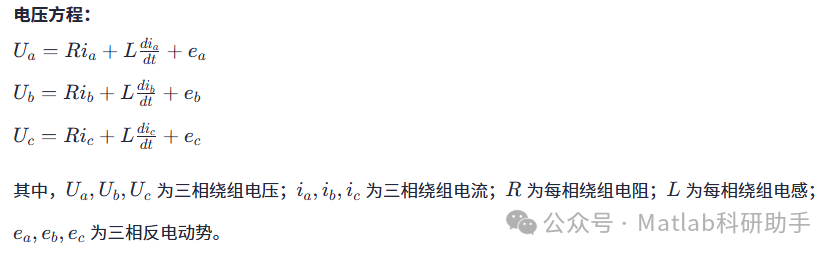
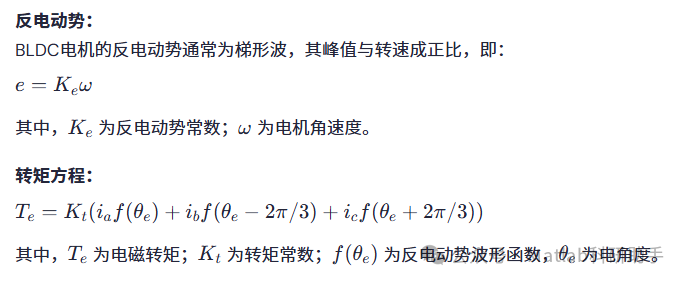
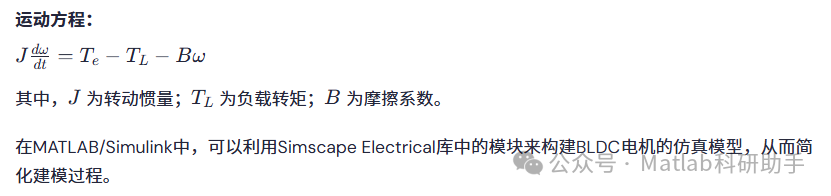
The mathematical model of the BLDC motor is the foundation for establishing the control system. In ideal conditions, assuming the magnetic field in the motor air gap is distributed as a rectangular wave and neglecting saturation effects, the voltage and torque equations of the BLDC motor can be expressed as:
3. BLDC Motor Speed Control Strategies
3.1 Traditional PID Control
The PID controller is a classic control algorithm composed of Proportional (P), Integral (I), and Derivative (D) components. Its control law can be expressed as:
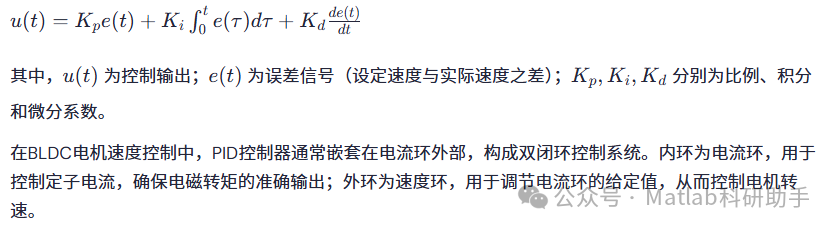
Tuning the parameters of the PID controller is crucial for system performance. Common tuning methods include the Ziegler-Nichols method and trial-and-error methods. Through MATLAB/Simulink simulation, PID parameters can be easily optimized to achieve good dynamic response, minimal overshoot, and fast response speed.
3.2 Fuzzy PID Control
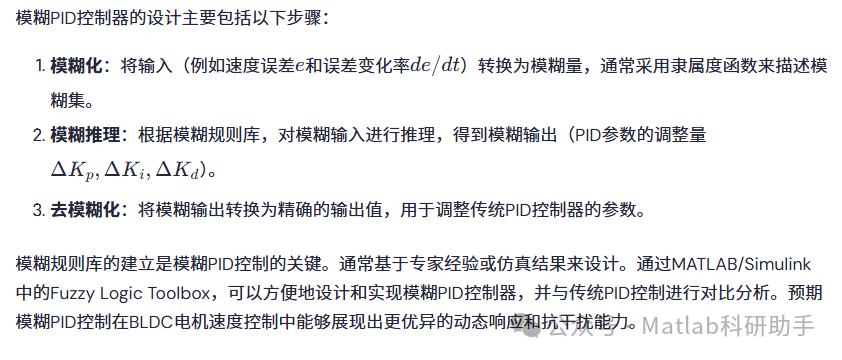
Once the parameters of a traditional PID controller are determined, they remain unchanged throughout the operation. However, the BLDC motor system experiences nonlinearity, time-variability, and external disturbances, making it difficult for a fixed-parameter PID controller to achieve optimal performance under different operating conditions. Fuzzy PID control combines the advantages of fuzzy logic control and PID control, allowing for adaptive adjustment of PID parameters based on the system’s operating state, thereby improving the robustness and adaptability of the control system.
3.3 Sensorless Control Based on Observers
In BLDC motor control, rotor position information is essential for commutation and speed control. Traditionally, Hall sensors are used to detect rotor position. However, Hall sensors increase system costs and size, reduce reliability, and may fail in harsh environments. Sensorless control technology estimates rotor position and speed, avoiding reliance on Hall sensors, offering higher cost-effectiveness and stronger robustness.
Common sensorless control methods include:
- Back EMF Method: Estimates rotor position by detecting back EMF. When the BLDC motor operates at high speeds, the back EMF is sufficiently large and easy to detect.
- Extended Kalman Filter (EKF): A nonlinear state estimation algorithm that can effectively estimate the rotor position, speed, and other state variables of the motor, maintaining good estimation accuracy even in the presence of noise and uncertainty.
- Sliding Mode Observer (SMO): The sliding mode observer is insensitive to parameter changes and external disturbances, providing robust estimates of rotor position and speed.
In MATLAB/Simulink, complex observer algorithms can be implemented using modules like Stateflow or S-function. By feeding back the rotor position and speed information output from the observer to the controller, sensorless speed control of the BLDC motor can be achieved. This significantly enhances system integration and reliability while reducing costs.
4. MATLAB/Simulink Simulation and Analysis
To verify the effectiveness of the aforementioned control strategies in BLDC motor speed control, we will build a simulation model in the MATLAB/Simulink environment.
4.1 Building the BLDC Motor Model
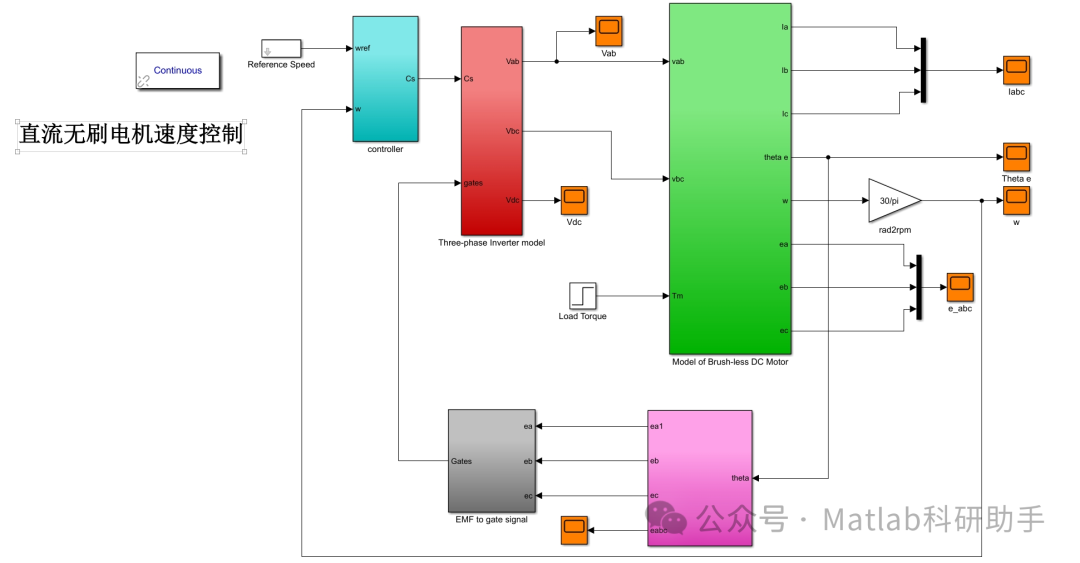
Using the “Brushless DC Motor” module from the Simscape Electrical library, the electrical and mechanical models of the BLDC motor can be quickly constructed. Various parameters of the motor, such as rated power, rated voltage, resistance, inductance, moment of inertia, friction coefficient, and back EMF constant, need to be set.
4.2 Building the Control System Model
a. Traditional PID Control System:
- Current Loop: Typically controlled using a hysteresis comparator or PWM control, adjusting the on/off states of the inverter switching devices to control the stator current.
- Speed Loop: Uses a PID controller to process speed error, with its output serving as the setpoint for the current loop.
- Commutation Logic: Generates switching signals for the three-phase inverter based on Hall sensor signals or rotor position estimated by the observer.
b. Fuzzy PID Control System:
- Introduces the Fuzzy Logic Controller module based on the traditional PID controller.
- Defines fuzzy sets and membership functions for inputs (speed error, error rate) and outputs (PID parameter adjustment).
- Writes a fuzzy rule base and uses the Rule Viewer for rule validation.
- Combines the output of the fuzzy controller with traditional PID parameters for adaptive adjustment.
c. Sensorless Control System:
- Constructs a rotor position observer based on the back EMF method, EKF, or SMO.
- Replaces Hall sensor signals with the rotor position and speed information output from the observer, inputting it into the commutation logic and speed controller.
4.3 Simulation Result Analysis
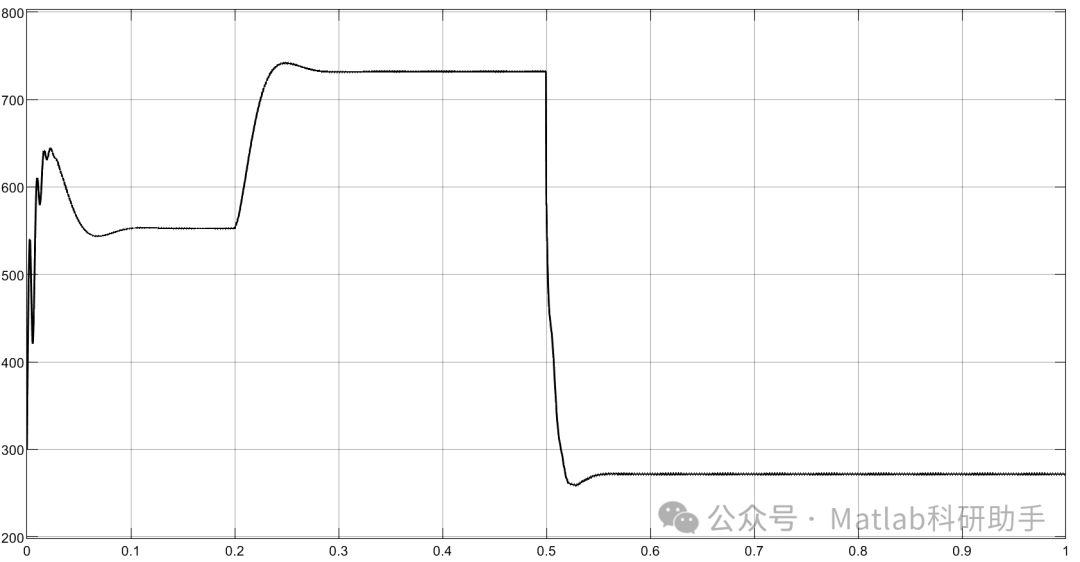
By setting different reference speeds and load torques, simulations of the BLDC motor speed control system under different control strategies are conducted.
Evaluation Metrics:
- Response Time: The time required for the motor to reach the set speed from a standstill.
- Overshoot: The percentage by which the motor speed exceeds the set speed.
- Steady-State Error: The difference between the motor speed and the set speed after stabilization.
- Disturbance Rejection Capability: The system’s ability to recover from load disturbances.
Expected Simulation Results:
- Traditional PID Control: With proper parameter tuning, it can achieve good speed tracking, but performance may decline under load changes or parameter perturbations.
- Fuzzy PID Control: Due to its ability to adaptively adjust PID parameters, it is expected to exhibit faster response speed, smaller overshoot, and stronger disturbance rejection capability under different operating conditions.
- Sensorless Control: In the absence of sensors, it can achieve speed control performance comparable to that of sensor-based control, especially in terms of cost and reliability advantages.
Through simulation curves, the performance of different control strategies can be visually compared based on the above metrics, thereby validating the strengths and weaknesses of various control methods.
5. Conclusion
This article provides an in-depth study of speed control for Brushless DC Motors based on MATLAB/Simulink. It introduces the working principle and mathematical model of BLDC motors and discusses various control strategies, including traditional PID control, fuzzy PID control, and sensorless control based on observers. The application of the MATLAB/Simulink simulation platform allows for effective modeling, analysis, and optimization of the BLDC motor control system.
The simulation results will demonstrate that, compared to traditional PID control, fuzzy PID control can significantly improve the dynamic response, steady-state accuracy, and disturbance rejection capability of the BLDC motor speed control system through adaptive adjustment of PID parameters. Additionally, sensorless control technology based on observers provides an effective solution to eliminate the cost and reliability issues associated with traditional sensors.
Future research can further explore more advanced intelligent control algorithms, such as neural network control and model predictive control, in the application of BLDC motor speed control, aiming for superior control performance. Moreover, applying simulation results to actual hardware platforms for validation is a key step in advancing BLDC motor control technology.
⛳️ Operation Results
🔗 References
[1] Ji Zhicheng, Shen Yanxia, Jiang Jianguo. A New Method for Simulation Modeling of Brushless DC Motor Systems Based on Matlab [J]. Journal of System Simulation, 2003, 15(12):6. DOI:10.3969/j.issn.1004-731X.2003.12.022.
[2] Yin Yunhua, Zheng Bin, Zheng Haoxin. A Modeling and Simulation Method for Brushless DC Motor Control Systems Based on Matlab [J]. Journal of System Simulation, 2008, 20(2):6. DOI:CNKI:SUN:XTFZ.0.2008-02-008.
[3] Zhang Jing, Zeng Xianyun. Modeling and Simulation of Fuzzy Control for DC Motor Speed Control System Based on MATLAB/SIMULINK [J]. Large Electric Machine Technology, 2002. DOI:CNKI:SUN:DJDJ.0.2002-03-003.
📣 Partial Code
🎈 Some theoretical references are from online literature; please contact the author for removal if there is any infringement.
👇 Follow me to receive a wealth of Matlab e-books and mathematical modeling materials.
🏆 Our team specializes in guiding customized MATLAB simulations in various research fields, helping to realize research dreams:
🌈 Various intelligent optimization algorithms improvement and application
Production scheduling, economic scheduling, assembly line scheduling, charging optimization, workshop scheduling, departure optimization, reservoir scheduling, 3D packing, logistics site selection, cargo location optimization, bus scheduling optimization, charging pile layout optimization, workshop layout optimization, container ship loading optimization, pump combination optimization, medical resource allocation optimization, facility layout optimization, visual domain base station and drone site selection optimization, knapsack problem, wind farm layout, time slot allocation optimization, optimal distribution of distributed generation units, multi-stage pipeline maintenance, factory-center-demand point three-level site selection problem, emergency supply material distribution center site selection, base station site selection, road lamp pole arrangement, hub node deployment, transmission line typhoon monitoring devices, container scheduling, unit optimization, investment portfolio optimization, cloud server combination optimization, antenna linear array distribution optimization, CVRP problem, VRPPD problem, multi-center VRP problem, multi-layer network VRP problem, multi-center multi-vehicle VRP problem, dynamic VRP problem, two-layer vehicle routing planning (2E-VRP), electric vehicle routing planning (EVRP), hybrid vehicle routing planning, mixed flow shop problem, order splitting scheduling problem, bus scheduling optimization problem, flight shuttle vehicle scheduling problem, site selection path planning problem, port scheduling, port shore bridge scheduling, parking space allocation, airport flight scheduling, leak source localization.
🌈 Machine learning and deep learning time series, regression, classification, clustering, and dimensionality reduction
2.1 BP time series, regression prediction, and classification
2.2 ENS voice neural network time series, regression prediction, and classification
2.3 SVM/CNN-SVM/LSSVM/RVM support vector machine series time series, regression prediction, and classification
2.4 CNN|TCN|GCN convolutional neural network series time series, regression prediction, and classification
2.5 ELM/KELM/RELM/DELM extreme learning machine series time series, regression prediction, and classification
2.6 GRU/Bi-GRU/CNN-GRU/CNN-BiGRU gated neural network time series, regression prediction, and classification
2.7 Elman recurrent neural network time series, regression prediction, and classification
2.8 LSTM/BiLSTM/CNN-LSTM/CNN-BiLSTM long short-term memory neural network series time series, regression prediction, and classification
2.9 RBF radial basis neural network time series, regression prediction, and classification
2.10 DBN deep belief network time series, regression prediction, and classification
2.11 FNN fuzzy neural network time series, regression prediction
2.12 RF random forest time series, regression prediction, and classification
2.13 BLS broad learning time series, regression prediction, and classification
2.14 PNN pulse neural network classification
2.15 Fuzzy wavelet neural network prediction and classification
2.16 Time series, regression prediction, and classification
2.17 Time series, regression prediction, and classification
2.18 XGBOOST ensemble learning time series, regression prediction, and classification
2.19 Transform various combinations of time series, regression prediction, and classification
Directions cover wind power prediction, photovoltaic prediction, battery life prediction, radiation source identification, traffic flow prediction, load prediction, stock price prediction, PM2.5 concentration prediction, battery health status prediction, electricity consumption prediction, water body optical parameter inversion, NLOS signal identification, subway parking precision prediction, transformer fault diagnosis.
🌈 Image processing aspects
Image recognition, image segmentation, image detection, image hiding, image registration, image stitching, image fusion, image enhancement, image compressed sensing.
🌈 Path planning aspects
Traveling salesman problem (TSP), vehicle routing problem (VRP, MVRP, CVRP, VRPTW, etc.), drone three-dimensional path planning, drone collaboration, drone formation, robot path planning, grid map path planning, multimodal transport problems, electric vehicle routing planning (EVRP), two-layer vehicle routing planning (2E-VRP), hybrid vehicle routing planning, ship trajectory planning, full path planning, warehouse patrol.
🌈 Drone application aspects
Drone path planning, drone control, drone formation, drone collaboration, drone task allocation, drone secure communication trajectory online optimization, vehicle collaborative drone path planning.
🌈 Communication aspects
Sensor deployment optimization, communication protocol optimization, routing optimization, target localization optimization, Dv-Hop localization optimization, Leach protocol optimization, WSN coverage optimization, multicast optimization, RSSI localization optimization, underwater communication, communication upload/download allocation.
🌈 Signal processing aspects
Signal recognition, signal encryption, signal denoising, signal enhancement, radar signal processing, signal watermark embedding and extraction, EMG signals, EEG signals, signal timing optimization, ECG signals, DOA estimation, encoding and decoding, variational mode decomposition, pipeline leakage, filters, digital signal processing + transmission + analysis + denoising, digital signal modulation, bit error rate, signal estimation, DTMF, signal detection.
🌈 Power system aspects
Microgrid optimization, reactive power optimization, distribution network reconstruction, energy storage configuration, orderly charging, MPPT optimization, household electricity.
🌈 Cellular automata aspects
Traffic flow, crowd evacuation, virus spread, crystal growth, metal corrosion.
🌈 Radar aspects
Kalman filter tracking, trajectory association, trajectory fusion, SOC estimation, array optimization, NLOS identification.
🌈 Workshop scheduling
Zero-wait flow shop scheduling problem (NWFSP), permutation flow shop scheduling problem (PFSP), hybrid flow shop scheduling problem (HFSP), zero idle flow shop scheduling problem (NIFSP), distributed permutation flow shop scheduling problem (DPFSP), blocking flow shop scheduling problem (BFSP).
👇