Translation adapted from: https://www.molecularist.com/2025/11/did-qualcomm-kill-arduino-for-good.html
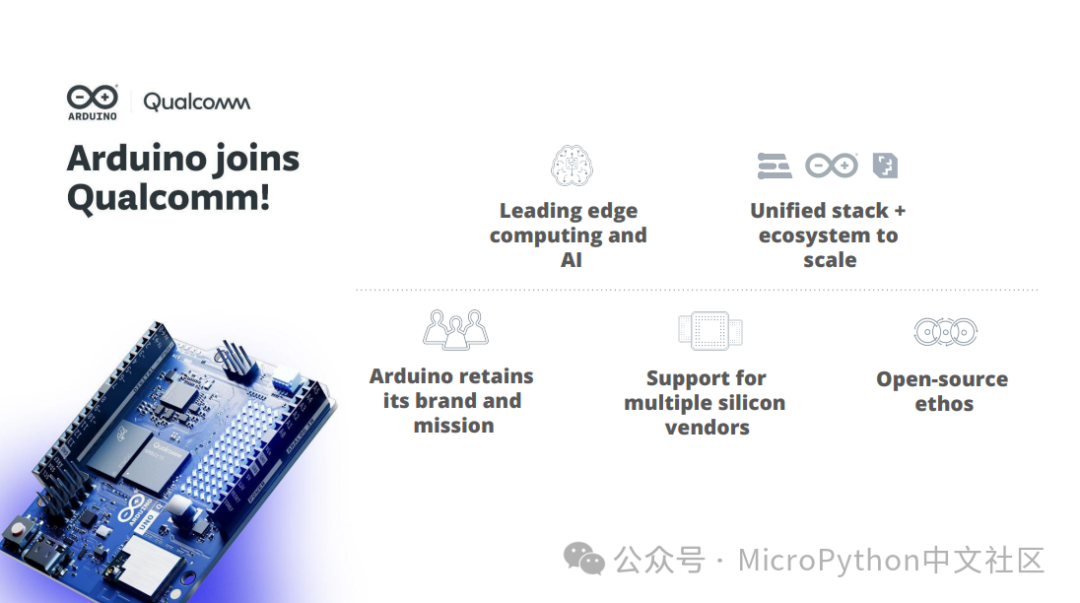
Six weeks ago, Qualcomm acquired Arduino. The maker community immediately worried that Qualcomm would stifle Arduino’s open-source spirit, which has been the universal language in the field of amateur electronics.
This week, Arduino released updated terms and a new privacy policy, evidently rewritten by Qualcomm’s lawyers. These changes confirm the community’s deepest fears: Arduino is no longer an open and shared platform. It is becoming another commercial platform.
The key issues are where Qualcomm went wrong and what might still be salvaged, based on discussions from various manufacturer forums and websites.
What has changed?
The new terms read like standard corporate jargon: mandatory arbitration, data integration with Qualcomm’s global ecosystem, export controls, and restrictions on the use of artificial intelligence. These terms would not raise eyebrows for any other SaaS platform.
But Arduino is not SaaS. It is the cornerstone of the maker ecosystem.
The most dangerous change is that Arduino now explicitly states that using their platform does not grant you any patent licenses. You cannot even argue that some form of license is implied.
This means that if you use Arduino tools, Arduino examples, or Arduino-compatible hardware to build projects, Qualcomm could potentially sue you for patent infringement.
There is a disconnect here that leaves makers confused. Arduino’s IDE is licensed under AGPL. Their CLI is licensed under GPL v3. Both licenses explicitly allow you to reverse-engineer the software. But Qualcomm’s new terms explicitly prohibit reverse engineering the “platform”.
What is the reality?
The community is trying to figure out Qualcomm’s true intentions. Are these terms just the result of poor legal work, with SaaS lawyers applying their standard templates to cloud services without realizing Arduino is different? Or is Qualcomm testing how far they can push before community backlash? Or is this the first step in locking down the ecosystem they just acquired?
Some point out that “platform” may only refer to Arduino’s cloud services (forums, Arduino Cloud, project center), and not the IDE and CLI that everyone actually uses.
If this is true, Qualcomm needs to clarify this with straightforward language. Because library maintainers may want to know if contributing to Arduino repositories will bring legal risks. Meanwhile, hardware manufacturers are questioning whether “Arduino compatible” can still be safely advertised.
Why Adafruit’s warning is importantAdafruit has been vocal about the dangers of this acquisition. Some believe Adafruit’s criticism is self-serving, given that they sell competitive hardware and promote CircuitPython. But this overlooks who Adafruit is.
Adafruit has long been a moral authority in open-source hardware. They have made a living by demonstrating that successful businesses can be built on open-source principles. When they raise the alarm, it is not about competition, but about principles.
They are not criticizing Qualcomm for acquiring Arduino. They are criticizing Qualcomm’s lawyers for fundamentally misunderstanding what they bought. The value of Arduino is not just because it is a microcontroller company. Its value lies in its public domain. You cannot treat a public domain with a corporate legal framework, or you will destroy it.
Adafruit understands this. Their entire business is built on this foundation. That is why their criticism carries weight.
Qualcomm seems to misunderstand this
Qualcomm may think they bought an IoT hardware company with a loyal user base.
They did not. They acquired the IBM PC of the maker community.
The value of Arduino has never been just hardware. Their boards have been outdated for years. Their value lies in the standard.
The Arduino IDE is the universal language for amateur electronics enthusiasts.
Millions of makers use it to learn, even if they later switch to other hardware. ESP32, STM32, Teensy, Raspberry Pi Pico—they are not Arduino hardware, but they all work with the Arduino IDE.
Thousands of libraries are “Arduino libraries”. Tutorials assume the use of Arduino. University courses teach Arduino. When you search for “how to read a sensor”, the answers come back in Arduino code.
This is the legal uncertainty that Qualcomm’s lawyers have just introduced into this ecosystem.
If Qualcomm’s lawyers start asserting control over the IDE, CLI, or core libraries with restrictive terms, they will poison the entire maker ecosystem. Even those who have never purchased Arduino hardware rely on the Arduino software infrastructure.
Qualcomm has not just acquired a company; they have acquired a public domain. And now they have inadvertently taken steps to undermine its value.
What should makers do?
There are already rumors that some are abandoning the Arduino environment. But alternatives to the Arduino IDE, such as PlatformIO and VSCode, are not user-friendly for beginners. If the Arduino IDE disappears, it will be a huge problem.
I remember the situation at the end of Hypercard. There were alternatives, but none were as simple. It was only when I picked up the Arduino IDE (a long story) that I started programming again, nearly 20 years later.
If the Arduino IDE runs into issues, whether it stagnates or becomes complicated, that simple entry point cannot be replaced. We will lose many potential new makers because the first step becomes too steep.
Expertise at Risk
But abandoning Arduino is not simple. The success of this platform relies on knowledge accumulated over two decades, such as countless Arduino tutorials on YouTube, blogs, and school courses; reliance on open-source libraries that are Arduino compatible; projects produced using Arduino tools; and university courses built around Arduino as a teaching platform.
All of this depends on Arduino remaining open and accessible.
If Qualcomm decides to stop supporting an open Arduino IDE, opting instead for a closed “Arduino Pro” platform, or if they start asserting patent rights, or if uncertainty leads contributors to abandon the ecosystem, all this knowledge will become isolated.
It would be like Wikipedia starting to charge. The value lies not just in the content, but in the trust that it remains accessible. The value of Arduino is not just in the code, but in maintaining trust in the public domain.
This trust has now vanished. Once lost, it is hard to regain.
Why this happened (but this does not excuse it)
Fairly speaking, Qualcomm’s people are doing what they are supposed to do.
When you acquire a company, you unify legal terms; add mandatory arbitration to limit the risk of class-action lawsuits; integrate data systems to comply with compliance and audit requirements; add export controls because you sell products to defense contractors; prohibit reverse engineering because it is in the template.
For most acquisitions, this is just good corporate hygiene. And as part of a large company, Arduino faces higher liabilities than when it was an independent entity.
But Qualcomm’s lawyers overlooked one thing: Arduino is not an ordinary acquisition. The community is not a customer base; it is a shared resource. You cannot apply a corporate-level SaaS legal framework to a shared resource, or you will destroy its value.
This is not malice, but a lack of understanding. But the result is the same. The community that once trusted Arduino no longer trusts it.
Understanding why this happened does not excuse it, but it may hint at what needs to happen next.
What should have happened and how it can still be salvaged
Qualcomm threw background-less legal documents at the community, leaving people to discover the contradictions on their own. This is how to destroy trust overnight.
Qualcomm should have announced these changes in advance. They should have given the community weeks, not hours, to understand what was going to happen and why. They should have used plain language explanations, not just legal documents.
Qualcomm can address this issue by clearly building an open ecosystem. They should clarify that these terms apply to Arduino Cloud services, while the IDE, CLI, and core libraries remain under existing open-source licenses.
We need specific commitments, such as which repositories will remain open, which licenses will not change, and what content will be protected from future acquisition decisions. Currently, we only have vague corporate jargon about “supporting the community”.
In fact, they could create some structural protections by placing the IDE, CLI, and core libraries in a foundation that Qualcomm cannot unilaterally control (think of the Linux Foundation model).
Finally, Qualcomm may want to establish some form of community governance, giving the community real representation and actual power over the tools they rely on.
The acquisition is complete. Legal integration may be unavoidable. But how it is done will determine whether Arduino survives as a public resource or merely becomes another Qualcomm subsidiary.
What comes next?
Arduino may be the toolkit that has introduced millions of enthusiasts to electronics. But that maker community has shaped Arduino into what it is today. Qualcomm’s acquisition has put this tradition into question. Whether due to legal confusion, corporate insensitivity, or intentional strategy, community trust has been broken.
The coming months will reveal whether this is a misstep or a strategy. If Qualcomm issues a clarifying statement, migrates the codebase to some governance mechanism, and clearly protects the open toolchain, there may still be hope. If they remain silent, or worse, if IDE development slows or licensing terms tighten further, then that will be a signal to seek alternatives.
The question is not whether the open individual electronics hobbyist community can survive, but whether Arduino can survive.