1. Mainstream Market Systems
1.1 Technical Positioning and Industry Status
In the field of humanoid robot main controllers, Embedded Linux and ROS (Robot Operating System) form a layered collaborative architecture: Embedded Linux serves as the foundational operating system with enhanced real-time capabilities, handling low-level functions such as hardware drivers, task scheduling, and resource management; ROS acts as a distributed robot development framework, focusing on algorithm implementation, module communication, and task coordination. According to a 2025 industry report, the market penetration of Embedded Linux in the robotics field has exceeded 78%, while the usage rate of ROS in open-source robot projects is as high as 92%.
1.2 Technical Architecture Comparison
|
Dimension |
Embedded Linux |
ROS |
|
Core Functions |
Hardware drivers, process management, real-time extension |
Modular development, communication mechanisms, algorithm libraries |
|
Typical Applications |
Main controller low-level control, sensor interface adaptation |
Motion planning, SLAM navigation, human-machine interaction |
|
Real-time Performance |
Requires optimization through PREEMPT_RT patch |
ROS2 introduces DDS to enhance real-time performance |
|
Ecological Support |
Cross-architecture hardware compatibility (ARM/x86/RISC-V) |
Over 5000 open-source packages |
2. In-depth Technical Implementation Analysis
2.1 Source Code Management and Compilation Process
2.1.1 Embedded Linux Build Solutions
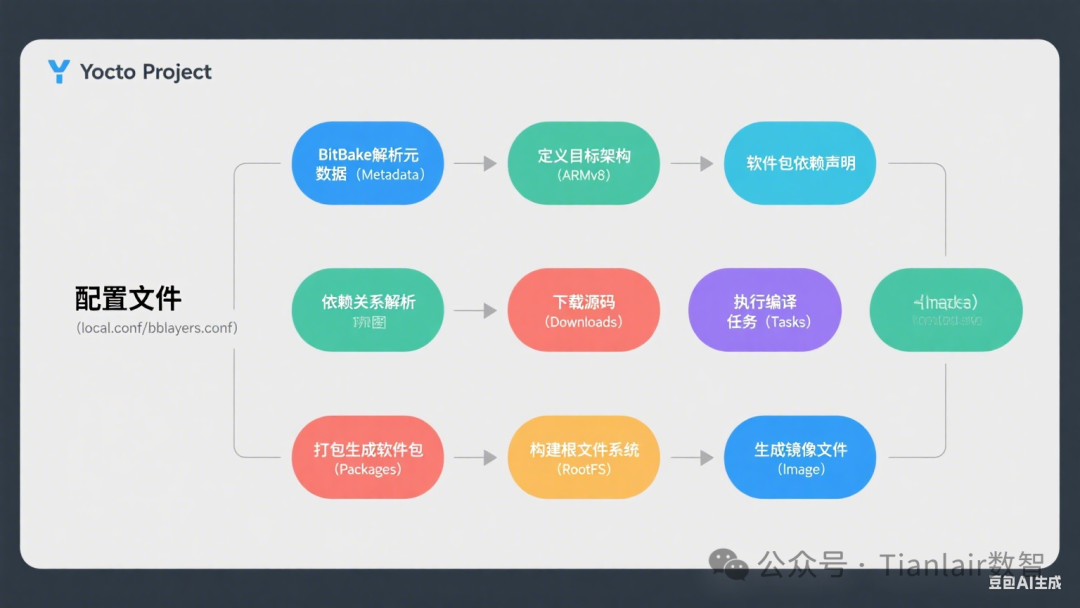
● Yocto Project: Uses the BitBake build system, supports custom hardware layer configuration, and defines target architecture (e.g., ARMv8) and package dependencies through the local.conf file. The compilation process is shown in Figure 1:
Flowchart
● Buildroot: A lightweight compilation toolchain that configures the kernel and root filesystem through the make menuconfig graphical interface, generating uImage and rootfs.tar image files.
2.1.2 ROS Development Toolchain
● ROS1: Uses catkin_make to build workspaces, supporting C++/Python mixed programming, compiling executable nodes and dynamic libraries.
● ROS2: Introduces the colcon build tool, using DDS (Data Distribution Service) as the communication middleware to achieve decentralized real-time communication.
2.2 System Debugging and Performance Optimization
2.2.1 Embedded Linux Debugging System
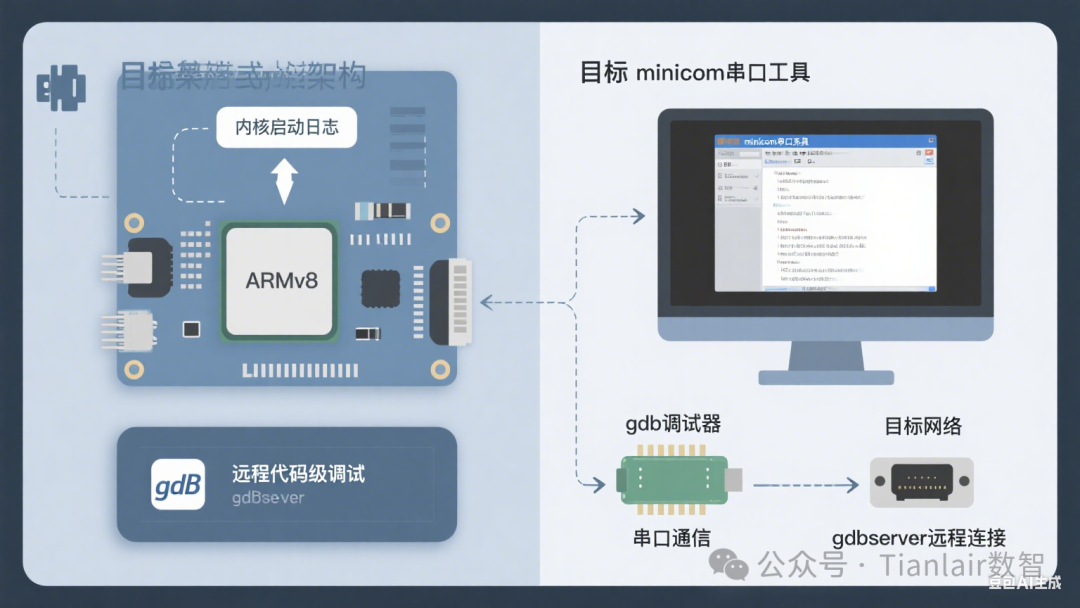
● Hardware-level debugging: Monitors kernel boot logs using the minicom serial tool, combined with gdbserver for remote code-level debugging (as shown in Figure 2).
● Real-time optimization: Kernel configuration: Enable CONFIG_PREEMPT_RT patch to reduce interrupt response time to microsecond level.
○ Resource scheduling: Limits CPU usage of critical processes through cgroups to ensure priority for motion control tasks.
2.2.2 ROS Debugging Toolchain
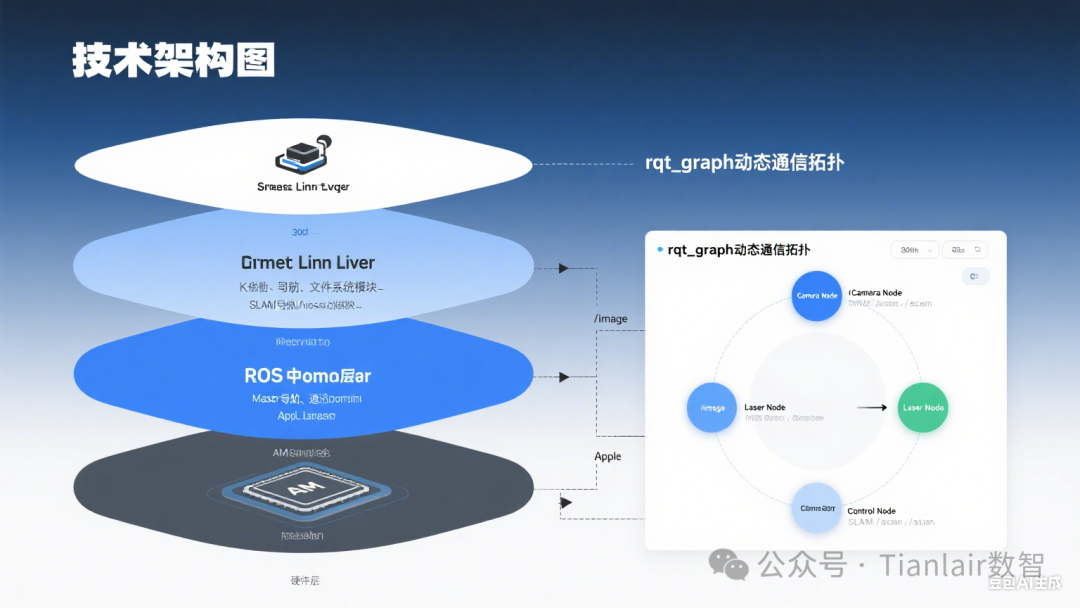
● Visualization tools: rqt_graph: Dynamically displays node communication topology (as shown in Figure 3).
○ rviz: 3D visualization of sensor data (e.g., LiDAR point clouds, camera images).
● Performance analysis: rostopic hz: Monitors topic publishing frequency to locate communication bottlenecks.
○ rosbag: Records/replays sensor data streams to assist algorithm iteration.
3. Comparison of Technical Solutions from Leading Companies
Competitive Parameters Table
3.1 Boston Dynamics Atlas
● Hardware Architecture: Custom x86-64 processor + FPGA co-processor, supports millisecond-level motion control response.
● Software Solution: Real-time operating system (RTOS) based on Embedded Linux + self-developed motion control middleware, achieving complex actions such as bipedal balance and dynamic jumping.
● Technical Features: Uses Model Predictive Control (MPC) algorithm to optimize gait, with joint control accuracy reaching 0.1°.
3.2 UBTECH Walker X
● Hardware Configuration: 41 high-performance servo joints + multi-sensor fusion (vision/force/IMU), supports walking speed of 3 km/h.
● Software Architecture: Embedded Linux + ROS2, integrating U-SLAM navigation and deep learning object recognition modules for autonomous interaction in home scenarios.
● Open Capabilities: Provides API interfaces and simulation platforms, supporting secondary development and functional expansion.
3.3 Comparison of Technical Solutions
|
Dimension |
Boston Dynamics Atlas |
UBTECH Walker X |
|
Motion Capability |
Dynamic balance, complex terrain adaptation |
Refined operation in home scenarios |
|
Development Threshold |
Closed system, requires a professional development team |
Open-source framework, supports rapid prototyping |
|
Cost Control |
Over one million dollars in R&D costs |
Commercially deployable, costs reduced by 60% |
4. Recommended Technical Solution: Embedded Linux + ROS Layered Architecture
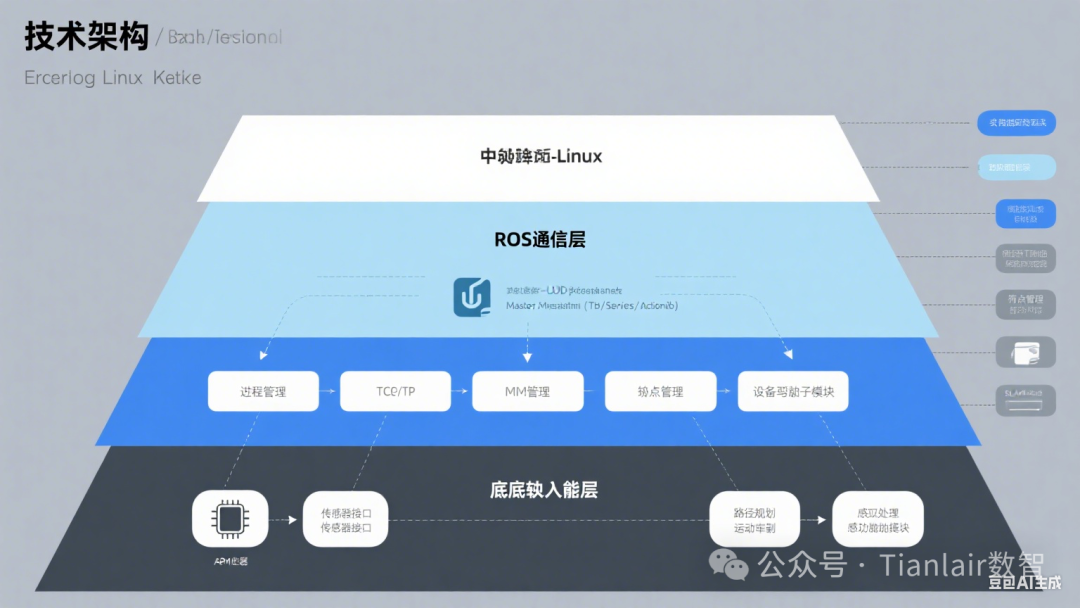
4.1 System Architecture Design
Technical Architecture Diagram
4.1.1 Hardware Layer
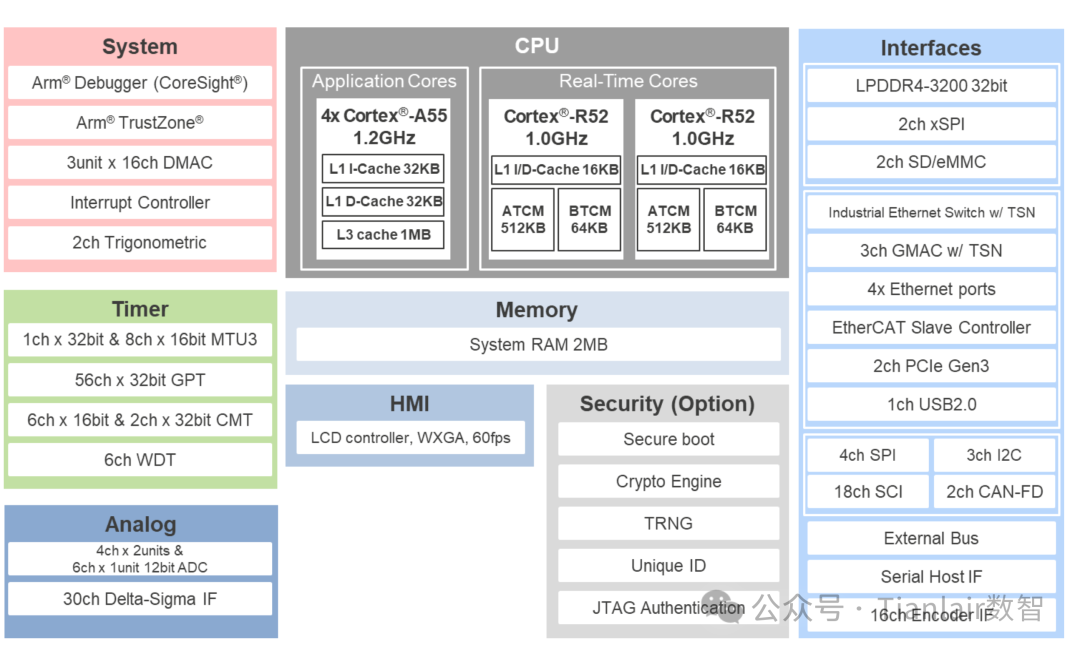
● Processor Selection: Recommended to use Nvidia Jetson AGX Orin (200 TOPS computing power) or Rockchip RK3588 (supports 8K video processing) to meet AI algorithm and real-time control requirements.
● Interface Adaptation: Achieved through Device Tree for plug-and-play of sensors (e.g., Intel RealSense D455) and actuators (e.g., Maxon EC motors).
4.1.2 Software Layer
● Real-time Enhancement: Embedded Linux kernel patched with PREEMPT_RT, task switching delay ≤ 10 μs.
○ ROS2 uses DDS communication to achieve deterministic data transmission, reducing end-to-end latency to below 5 ms.
● Functional Modules: Perception Layer: Uses depth_image_proc to process depth camera data, robot_localization for multi-sensor fusion positioning.
○ Decision Layer: Based on move_base for global path planning, actionlib manages task execution processes.
○ Control Layer: Drives servo motors through ros_control interface, gazebo simulation platform validates control algorithms.
4.2 Development and Deployment Process
1. Cross-compilation environment setup: Install Yocto build toolchain to generate embedded images containing ROS2.
a. Use scp or USB drive to flash the image to the target device.
2. Distributed system deployment: The main controller runs the ROS2 core node, while edge computing modules handle vision and other intensive tasks.
a. Start nodes using ros2 run, and achieve multi-node collaboration with ros2 launch.
4.3 Performance Optimization Strategies
● Communication Optimization: Use cyclonedds to replace the default DDS implementation, improving bandwidth utilization by 30%.
○ For high-frequency sensor data (e.g., IMU), use asynchronous communication to reduce CPU load.
● Resource Management: Manage service startup priorities through systemd to ensure critical processes (e.g., motion control) run with priority.
○ Use perf tool to analyze memory leaks and optimize algorithm execution efficiency.
5. Technological Evolution and Future Trends
5.1 Breakthroughs in Real-time Technology
● ROS2 DDS Enhancements: Supports QoS (Quality of Service) policies, configurable for reliable transmission and historical data retention, meeting the high reliability requirements of industrial robots.
● Edge Computing Integration: Offloads some AI inference tasks to edge devices (e.g., Jetson Nano), reducing the load on the main controller.
5.2 Expansion of Open-source Ecosystem
● M-Robots OS: The first open-source HarmonyOS robot operating system in the country, supporting multi-machine real-time collaboration and AI-native development, expected to achieve collective intelligence collaboration by 2026.
● ROS-Industrial: An extension framework for industrial scenarios, providing dedicated toolkits for PLC communication, motion control card drivers, etc.
5.3 Hardware Acceleration Solutions
● FPGA Collaborative Computing: Implements hardware acceleration of motion control algorithms on the Xilinx Zynq platform, reducing response time to microsecond level.
● Heterogeneous Computing Architecture: Combines CPU (general computing) + NPU (AI inference) + FPGA (real-time control) to optimize energy efficiency.
6. Conclusion
ROS typically runs on Linux systems, and it is recommended to use Embedded Linux as the foundational operating system, combined with ROS for robot function development. The Embedded Linux + ROS layered architecture has become the golden combination for robot main controllers: Embedded Linux provides stable underlying support and guarantees real-time performance, while ROS accelerates functional development through modular design and a rich toolchain. Through the technology stack combination of Yocto + ROS2, a full-process development from hardware adaptation to algorithm deployment can be achieved, meeting the high-performance requirements of industrial robots. In the future, with the integration of DDS communication, edge computing, and AI-native technologies, this architecture will further evolve towards high real-time, low power consumption, and strong scalability, supporting the deployment of next-generation intelligent robots in various scenarios.