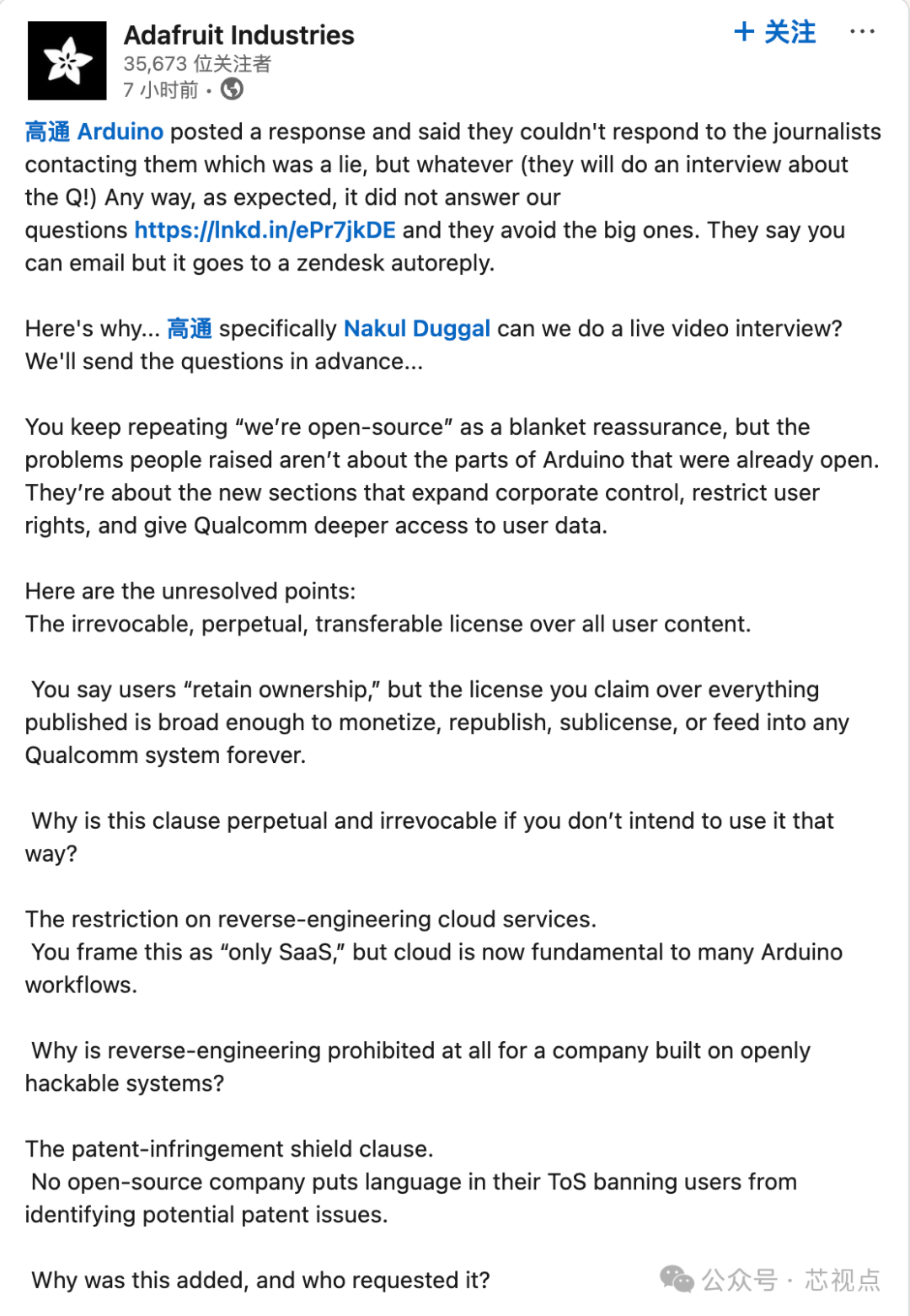
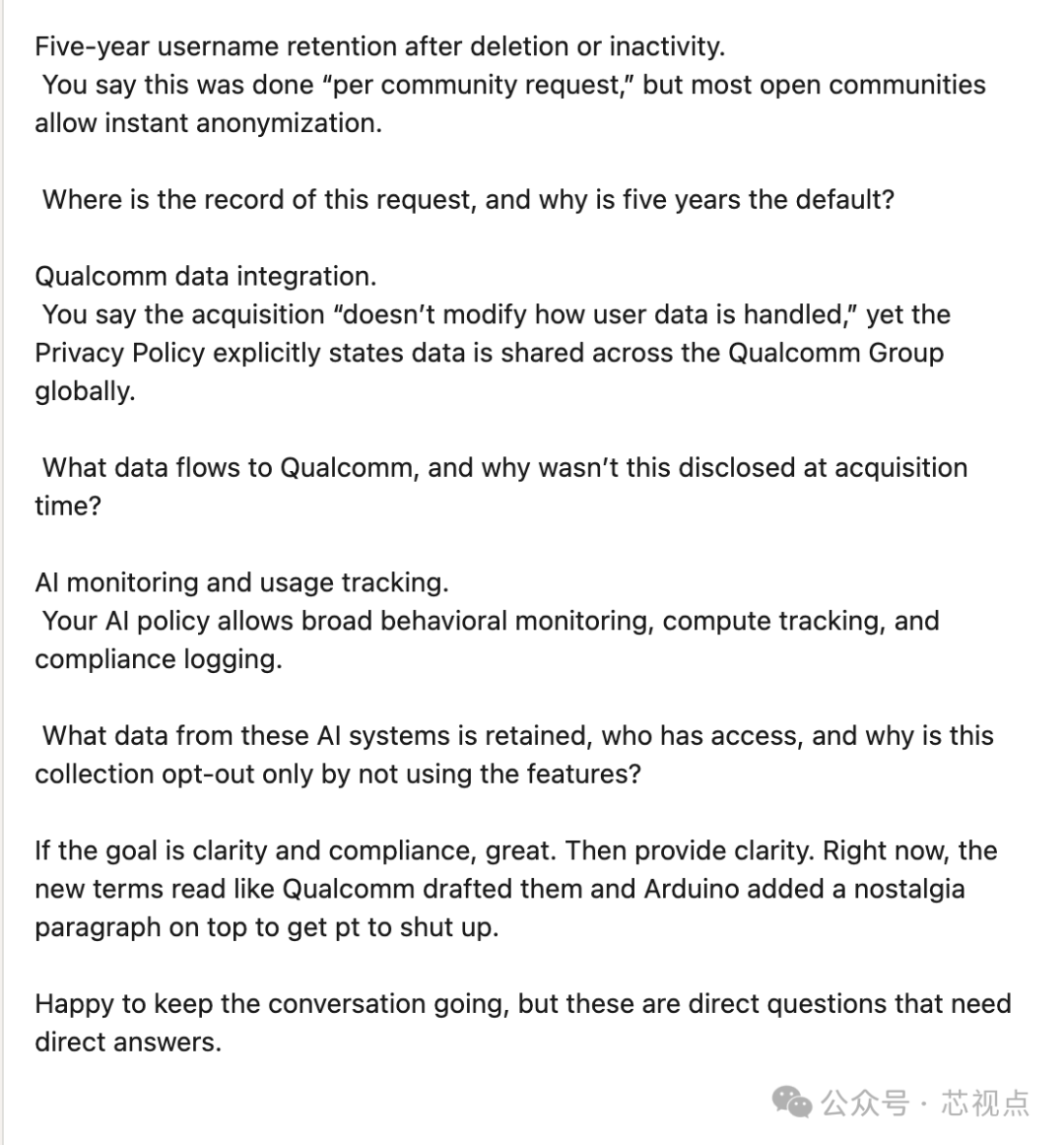
Qualcomm has quietly rewritten the service terms of Arduino, the programmable microcontroller and single-board computer manufacturer it recently acquired, provoking strong criticism from the maker community for gaining additional rights over user-generated content on its platform and prohibiting reverse engineering of what was once very open software.The amateur electronics supplier Adafruit issued a scathing critique on Microsoft’s business social network, which is rare on Microsoft’s site. Adafruit sharply assessed the modified terms and conditions of Qualcomm’s new subsidiary Arduino, stating, “These changes mark a clear break from the open hardware spirit that built this platform.”The New York-based open-source electronics supplier strongly opposes Arduino’s new privacy policy and terms and conditions. In its comments, Adafruit wrote:The new document introduces an irrevocable, permanent license for any content uploaded by users, extensive monitoring of AI functionalities, clauses preventing users from identifying potential patent infringements, retention of usernames for years even after account deletion, and integration of all user data (including data from minors) into Qualcomm’s global data ecosystem.If that weren’t concerning enough, reports also indicate:Users are now explicitly prohibited from reverse engineering the platform without Arduino’s permission, even attempting to understand how the platform works.Commenters on LinkedIn agreed with Adafruit’s assessment.“Nice to meet you, Arduino, rest in peace. Hello, RP2040 and ESP32, hope we have better luck in the future,” wrote Venky Raju, CTO of security company ColorTokens.“Qualcomm knows nothing about the maker space,” wrote circuit board design engineer Frank Delatore. “They are a greedy company that doesn’t care about the community that Arduino has built over the past decade.”Reactions on X were swift and fierce. “Arduino is done! Qualcomm ruined it,” wrote a user named EV_TRAPPER.“This is fucking terrible, but also expected,” Adrien barbeau-bot wrote. “Arduino was a major force in revitalizing the electronics hobbyist movement and the open-source hardware community. What a complete disaster.”For comparison, here is Arduino’s privacy policy and terms from 2020—this is the earliest version we found in the Internet Archive, but it is very close to the version from September of this year, just before Qualcomm’s acquisition of the company in October. Rupert Goodwins from The Register warned us days later that things would change—it seems his prediction has come true.Limor “Ladyada” Fried founded Adafruit Industries in 2005 in her MIT dorm room, and the company is still based in New York City. The Reg reported on the incident where the Microsoft Kinect Xbox controller was hacked, for which Adafruit offered a $2,000 bounty in 2010. Adafruit also produces its own open-source hardware, such as the Feather microcontroller mentioned last month on The Reg.Smart, programmable open-source hardware like this is not unique to Arduino; it simply opened up a market by making electronic components and microcontrollers easy to use without much expertise. Arduino was not the first organization to produce easy-to-use microcontroller boards and programming software.Another example is Wiring, a project initiated by Colombian developer Hernando Barragán in 2003. One of his inspirations was the Processing environment, a graphical programming and experimentation environment based on Java developed by Casey Reas. Wiring inherited the sketch-based development process of Processing but changed the programming language to C++.If Arduino users feel familiar with the term “sketch” in C++, there is a reason, as Barragán described in his book “The Untold History of Arduino.” In 2004, Barragán designed and described his “open-source programming framework for microcontrollers” Wiring while pursuing his master’s degree at the Interaction Design Institute Ivrea (IDII) in Italy. The framework was based on an easy-to-use C++ programming environment and combined with single-board hardware powered by the ATMega128 microcontroller.Barragán’s master’s degree advisor was Casey Reas and IDII associate professor Massimo Banzi. In 2005, Banzi, along with David Cuartielles and IDII student David Mellis, branched the open-source Wiring design, changing the hardware to use the smaller and cheaper ATMega8 chip.IDII closed in 2006. As IEEE Spectrum reported in 2011, Banzi, Mellis, and Cuartielles, along with Tom Igoe and Gianluca Martino (whose company Smart Projects SRL was responsible for manufacturing the boards), jointly launched the final system, the original Arduino. While it may seem to have disappeared now, Arduino’s old acknowledgment page did indeed pay slight homage to Barragán’s project:Arduino language syntax is based on Hernando Barragan’s Wiring language.This is not the first controversy Arduino has faced.In 2015, LWN reported on a trademark dispute between the American company Arduino LLC and the Italian hardware manufacturer, although they resolved their differences the following year.Adafruit co-founder Philip Torrone told The Register:Everything we are saying now is well-documented and covers a long history that the community is already familiar with. Arduino was created by the community, and Qualcomm/Arduino seems to have never really liked the community’s contributions. It feels like the story of Frankenstein: the monster calls out to its creator only to find that the creator has been replaced by a company that plans to dismantle it… I wonder if this monster is calling for Massimo or Hernando?The Register also contacted Arduino’s PR representative yesterday, but unfortunately, the person we needed to interview is on their way back to Europe from the U.S. and will not be available for our interview until the end of this week. We hope to reach out to them soon—if we can get in touch, we may revisit this topic in the near future.