Robotic chicken farming makes the feeding, activity, and resting of each chicken more scientific and reasonable; a single robot can precisely manage 160,000 chickens, replacing 24 workers… At the Nong Beibei Ecological Breeding Base in Chengjun Town, Fumian District, Yulin City, rows of intelligent chicken coops stand quietly amidst green mountains and clear waters, devoid of the noise typical of traditional farms, only the faint hum of machinery.
In the early morning, the chickens are “woken up” by the robot, which encourages them to have their “breakfast”; at night, the robot patrols, monitoring the status of the flock—any signs of distress or lethargy are identified as abnormalities; chickens that do not lay eggs or eat will be eliminated from the coop. This is a daily scene in the base’s “Automated Intelligent Breeding Ecological Demonstration Zone,” and a microcosm of the agricultural transformation and upgrading driven by artificial intelligence.
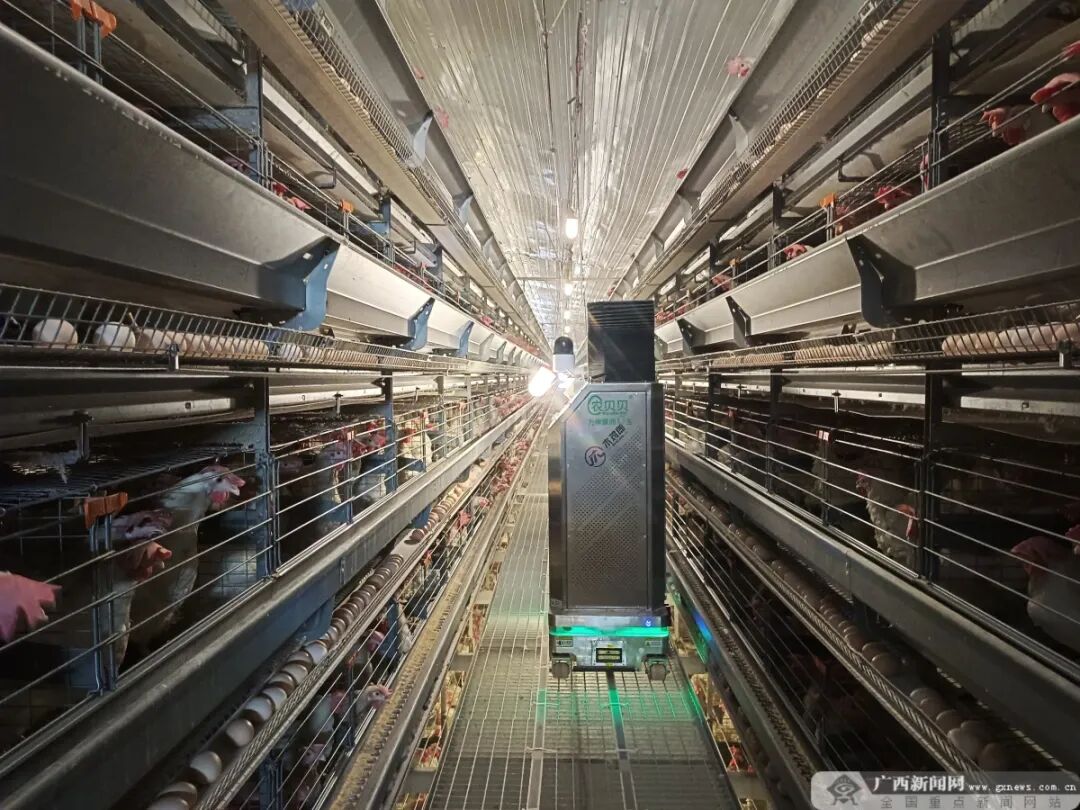
Robots inspecting the chicken farm. Source: Provided by the interviewed unit
“Behind the growth of every chicken is the resonance of algorithms and agriculture,” said Deng Shensong, chairman of Guangxi Nong Beibei Agricultural Technology Co., Ltd. The automated intelligent breeding system is achieved by introducing intelligent breeding robots, building a digital management platform, and utilizing technologies such as environmental monitoring systems and biosecurity barriers, to achieve intelligent control of temperature, humidity, and ventilation in the chicken coops, creating an optimal growth environment for the flock.
In another workshop, a central egg collection and sorting line imported from the Netherlands is operating at high speed, capable of sorting 60,000 eggs per hour. Through a fully automated process of cleaning, sterilizing, sorting, and packaging, fresh eggs are sent to markets across the country.
Robots inspecting the chicken farm. Source: Provided by the interviewed unit
How does intelligent application solve the challenges of egg sorting? Assistant to the chairman, Chen Guohua, explained: By using weight sensing and sonar technology, it can quickly distinguish double-yolk eggs, newly laid eggs, as well as broken and substandard eggs, achieving precise grading and quality control.
This intelligent production line, as precise as an “actuary,” allows the company to achieve a daily packaging volume of 480,000 eggs, with finished product quality control meeting standards for raw consumption. The QR code traceability system established by the company also allows consumers to scan and learn about the breeding process, inspection reports, and other information, enhancing product quality transparency and trust.
“We have integrated financial, production, and sales data chains through a digital platform system, achieving full business digital management,” Deng Shensong admitted. The application of artificial intelligence has brought fundamental changes to the company, “First, it is a revolution in efficiency. A scale that traditionally required 200 people to manage can now be completed by 30; secondly, it is a revolution in quality, with intelligent monitoring and identification achieving a 99% identification rate for dead or weak chickens, and the quality rate of eggs increasing from 93% to over 99%. Finally, it is a transformation of the industrial model, achieving deep integration of primary, secondary, and tertiary industries through a digital factory.”
From robot inspections to intelligent sorting, from cloud control to full traceability, Nong Beibei uses technology to break the stereotype of traditional farming as “extensive.” In the wave of artificial intelligence, this “tech chicken” is carrying the code for industrial upgrading, soaring towards a broader market.
Source:Guangxi Cloud – Guangxi Daily