With the acceleration of the global energy transition, hydrogen energy, as a clean and efficient secondary energy carrier, is receiving widespread attention. However, over 90% of hydrogen is still produced through traditional methods such as fossil fuel reforming, which is accompanied by significant carbon emissions. Solar-driven photocatalytic overall water splitting technology can directly convert solar energy into the chemical energy of hydrogen, making it one of the important pathways for achieving green hydrogen production.
In the field of photocatalytic water splitting, inorganic semiconductor materials (such as metal oxides, nitrides, etc.) have been widely studied due to their good stability and charge transport properties, but their narrow light absorption range and fast carrier recombination limit efficiency improvements. Organic semiconductor materials, on the other hand, have advantages such as tunable structures and strong visible light absorption, but their low carrier mobility and short exciton diffusion lengths restrict their performance in practical applications.
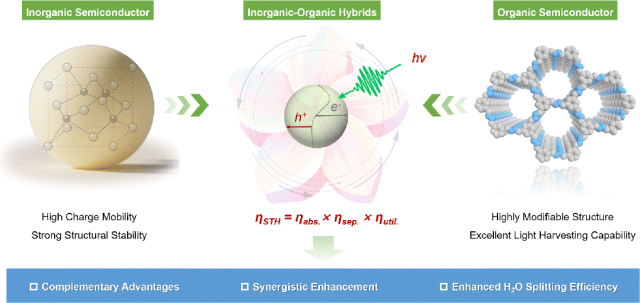
Fig. 1 Harnessing the integrated advantages of inorganic semiconductors and organic counterparts for the enhanced overall H2O splitting toward H2 production.
In recent years, the emergence of inorganic-organic hybrid photocatalysts has provided new ideas for solving the above bottlenecks. By combining the efficient charge transport capability of inorganic materials with the structural flexibility and photoelectric tunability of organic materials, hybrid systems exhibit significant advantages in light absorption, exciton dissociation, and charge separation. These materials not only enhance the overall efficiency of photocatalytic water splitting but also open new directions for catalyst design.
The core advantage of hybrid systems lies in the built-in electric field (IEF) and band alignment effects at their interfaces. When inorganic and organic components come into contact, a strong electric field is formed at the interface due to differences in work function and dielectric constant, promoting the directional separation and migration of photogenerated electrons and holes. Additionally, hybrid structures can provide more active surface sites, optimizing reaction kinetics.
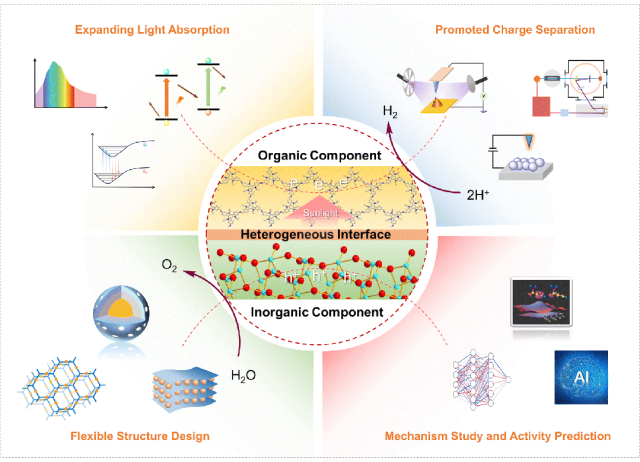
Fig. 2 Schematic illustration of the advantages of inorganic–organic hybrid photocatalysts for overall H2O splitting to produce H2 and O2 (taking titanium dioxide and covalent organic frameworks as examples).
In terms of synthesis methods, researchers have developed various strategies such as in-situ synthesis, physical mixing, mechanical ball milling, and surface functionalization to achieve precise control of interface structures. For example, constructing inorganic phases by in-situ growth on organic frameworks or enhancing interface bonding strength through covalent modification can improve the stability and charge transport efficiency of hybrid systems.
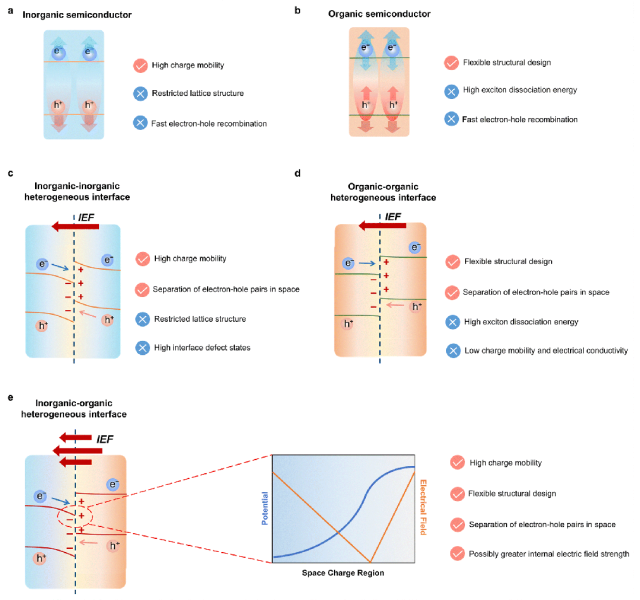
Fig. 3 Diagram illustrating the charge transfer kinetics in (a) inorganic semiconductors and (b) organic semiconductors. Comparison of charge transfer at the (c) inorganic–inorganic heterojunction, (d) organic–organic heterojunction, and (e) inorganic–organic heterojunction (The left side represents inorganic semiconductors, while the right side represents organic semiconductors. The right figure illustrates the distribution of the IEF potential and intensity in the space charge region).
Typical hybrid systems include one-dimensional linear polymers (such as polyaniline), two-dimensional covalent organic frameworks (COF) and their composite systems with inorganic semiconductors (such as TiO2, g-C3N4, BiVO4 and others. For example, the P10/BiVO4 hybrid system achieves a Z type charge transfer mechanism, realizing the simultaneous release of H2 and O2 without sacrificial agents; g-C3N4 based hybrid materials exhibit excellent activity and stability under visible light.
Despite significant progress in hybrid photocatalysts, their solar-to-hydrogen (STH) conversion efficiency is still generally below 5%, indicating a gap to commercial application. Future research needs to focus on expanding material systems, optimizing interface structures, deeply understanding carrier dynamics, enhancing system stability, and leveraging artificial intelligence and computational simulations to accelerate material design and optimization.
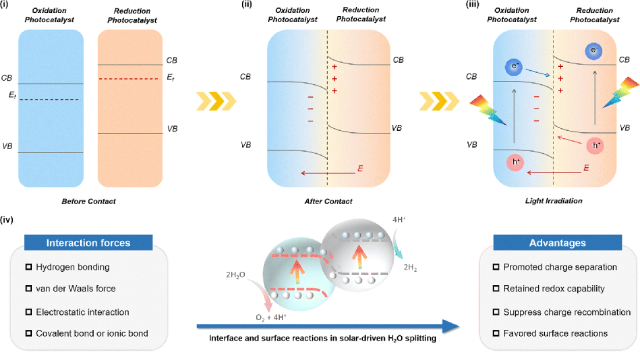
Fig. 4 The charge transfer processes in heterojunction (i) before and (ii) after contact, (iii) under light irradiation and (iv) surface reactions.
In summary, inorganic-organic hybrid photocatalysts serve as an important bridge connecting materials science and energy conversion, demonstrating enormous application potential. Through interdisciplinary collaboration and technological innovation, this platform is expected to provide feasible pathways for achieving low-cost, high-efficiency solar hydrogen production, contributing to the global carbon neutrality goals.
Original link:
https://pubs.rsc.org/en/content/articlelanding/2025/cs/d5cs00378d