Hello everyone, today I will introduce an article published in JACS titled “Examination of a Chimeric Bis-Electrophile for Selective DNA–Protein Cross-Linking and Mechlorethamine Reveals an Unknown Source of Nitrogen Mustard Cytotoxicity.” The corresponding author of this paper is Marc M. Greenberg from Johns Hopkins University, and the main research direction of the group is to understand the reactivity and structure of nucleic acids using organic chemistry, biochemistry, and molecular biology.

DNA-protein cross-linking (DPC) is an important cytotoxic lesion. Currently, there is a lack of exogenous inducing drugs that selectively produce such cross-links while bypassing DNA-DNA interstrand cross-links (ICL), making research on this in cells quite challenging. In this paper, the authors aim to explore the cytotoxic mechanism of DPC and develop a novel chemical probe that can selectively induce DPC rather than ICL, in order to study the biological effects and repair mechanisms of DPC in cells more clearly.
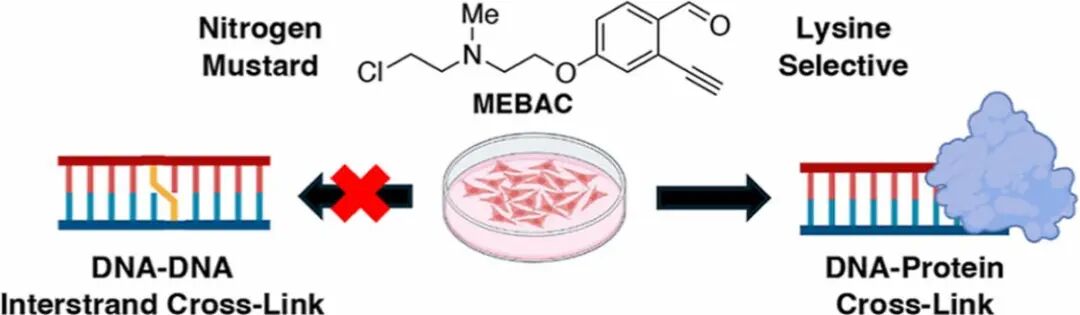
The authors designed and synthesized a chimeric bifunctional electrophile MEBAC (mechlorethamine benzaldehyde chimera), which fuses nitrogen mustard (2-chloroethylamine) and a lysine-selective reactive group (ortho-ethynylbenzaldehyde, EBA) to preferentially form DPC with protein lysine after DNA alkylation. This is the core and major breakthrough of this study.
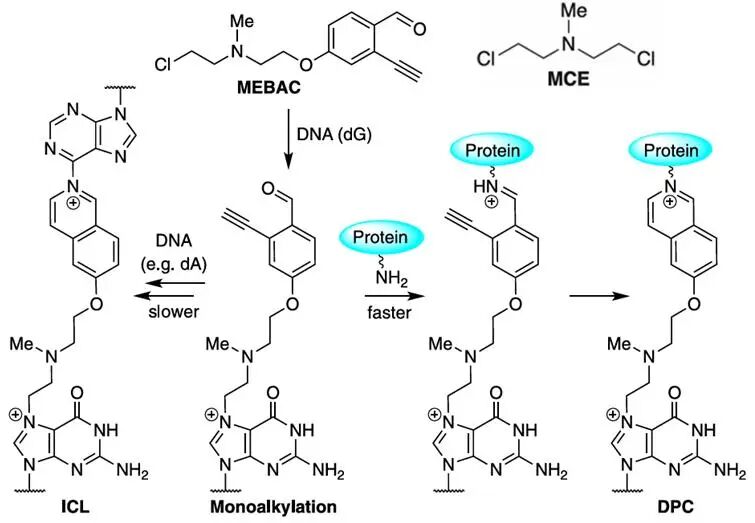
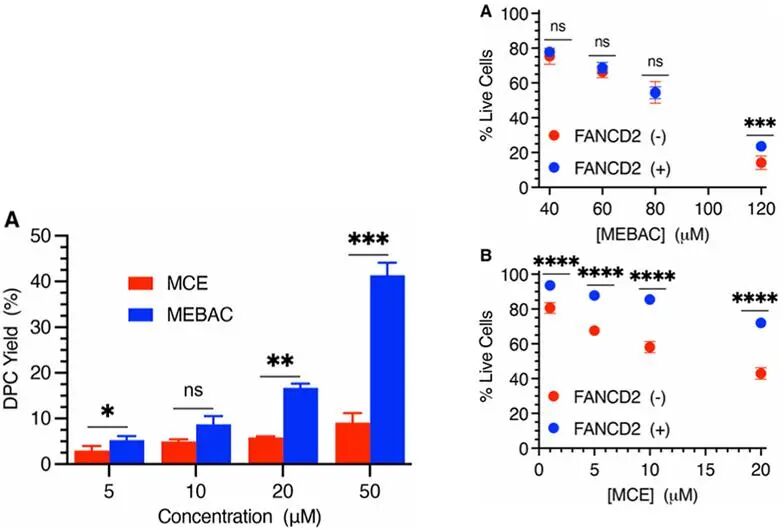
In the characterization phase, the authors compared the differences in DPC formation selectivity, cytotoxicity, and repair pathways between traditional nitrogen mustard compounds (such as mechlorethamine, MCE) and the synthesized MEBAC. The authors first evaluated the cross-linking efficiency and selectivity of MEBAC and MCE using recombinant nucleosome core particles (NCPs). MEBAC induced DPC in NCPs with an efficiency over 40 times greater than ICL, while the ratio of DPC to ICL produced by MCE was close to 1:1. Cell experiments further confirmed that MEBAC preferentially formed DPC in cells, with a significantly higher yield than MCE.
Subsequently, the authors found that MEBAC-induced DPC could be repaired by both SPRTN metalloprotease and the proteasome; inhibiting proteasome activity significantly increased the cytotoxicity of MEBAC. In contrast, DPC induced by MCE could only be repaired by SPRTN, with no effective intervention from the proteasome, thus inhibiting the proteasome had no effect on the toxicity of MCE. Additionally, FANCD2-deficient cells were sensitive to MCE, confirming that ICL induced by MCE activates the Fanconi anemia pathway; while MEBAC showed no difference in FANCD2 status at low concentrations, further indicating its predominance in DPC.
Finally, through proteomics analysis, the authors discovered that in cells treated with MCE, multiple cysteine-rich E3 ubiquitin ligases (such as ARIH1, RNF213, HECTD1) and 26S proteasome subunits (PSMD1, PSMD3) were cross-linked to DNA, while the cross-linking of these proteins was significantly reduced in MEBAC-treated cells. The cross-linking of these proteins may directly inhibit proteasome function or its recruitment, leading to the inability of MCE-induced DPC to be repaired through the proteasome pathway, thereby increasing cytotoxicity.
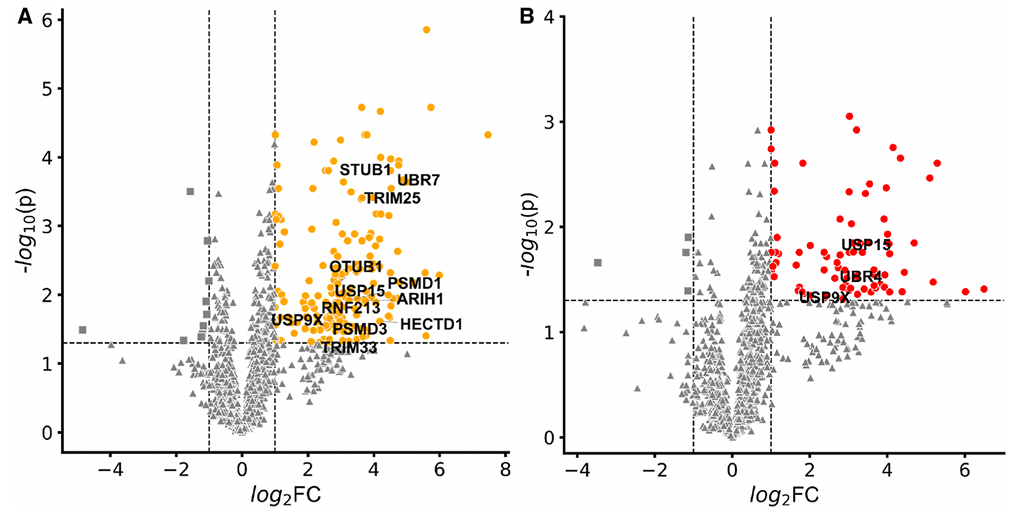
In summary, this paper developed a chemical probe that enriches DNA-protein cross-links and confirmed its specificity for forming DNA-protein cross-links through in vivo and in vitro experiments, revealing a cytotoxic mechanism that blocks self-DPC repair through cross-linking ubiquitination/proteasome-related proteins.
Author: FTY
Editor: MB
DOI: 10.1021/jacs.5c09293.
Original link: https://doi.org/10.1021/jacs.5c09293.