 Image source: J. Am. Chem. Soc.Introduction:
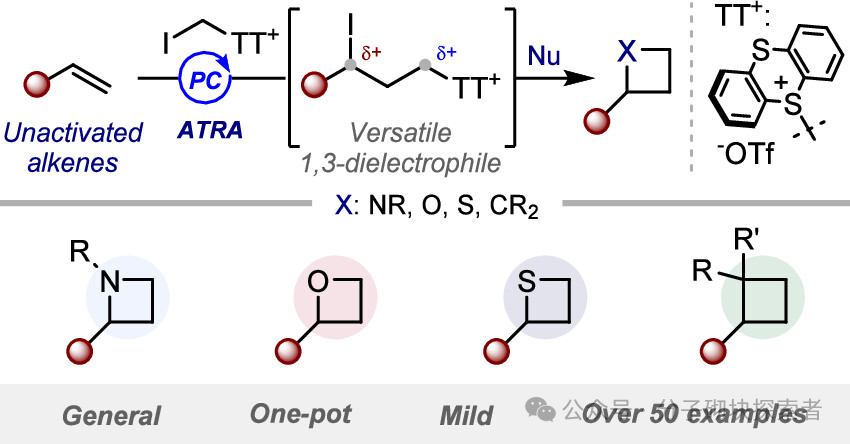
2-Alkyl substituted tetrahedral carbon rings and heterocycles are important structural motifs in pharmaceuticals and agricultural chemicals. However, existing synthetic methods primarily rely on the functionalization of a limited number of pre-made cyclic building blocks, making it difficult to cover a broad chemical space.Professor Mattia Silvi proposed a universal strategy that can convert readily available unactivated alkenes into 2-alkyl tetrahydrocarbon systems. Unlike the classical [2+2] cycloaddition reactions that cannot produce such products, this strategy activates the starting alkene through homologation to convert it into a transient 1,3-iodo-sulfonium intermediate, which then undergoes a series of nucleophilic substitutions to form the ring. The chemical multifunctionality of this intermediate allows for the control of substitution order, which is crucial for the precise synthesis of tetrahydrocarbons (azetidines, oxetanes, thietanes, and cyclobutanes). This transformation process, which tolerates various functional groups, is applicable to a wide range of alkenes (including complex structures), opening new pathways for the synthesis of pharmaceuticals and agrochemicals.
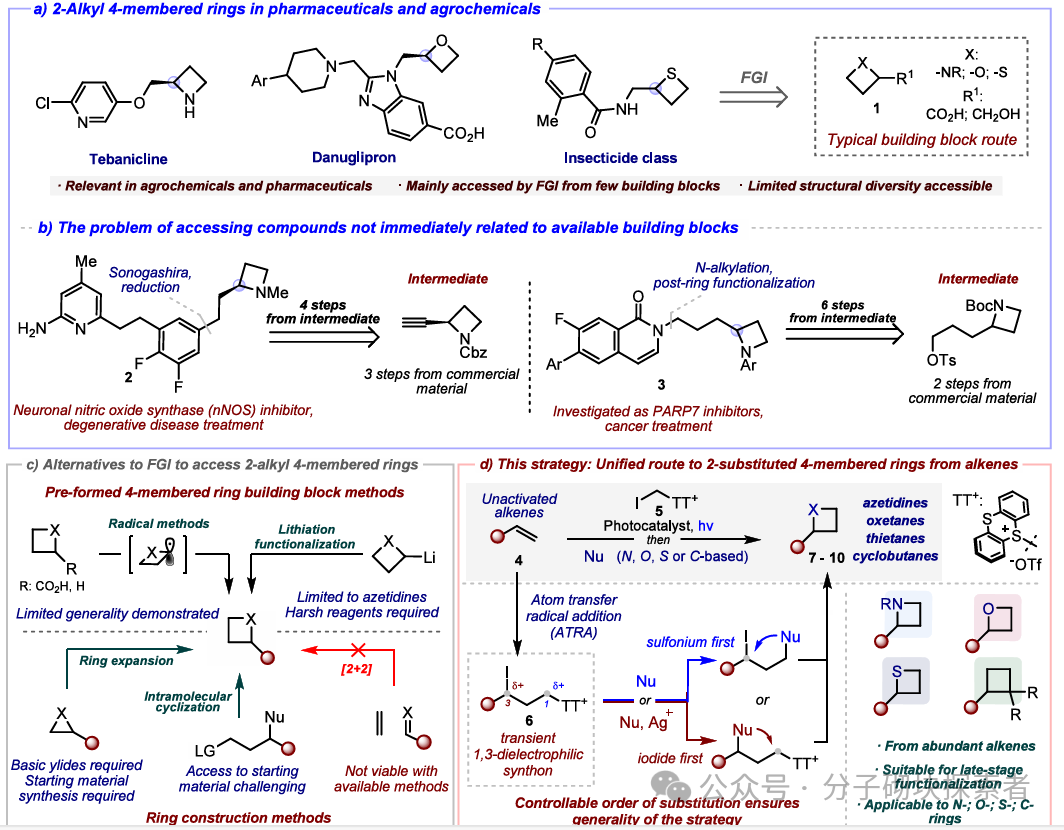
Image source: J. Am. Chem. Soc.
Researchers have begun to explore other methods to achieve the modular synthesis of 2-alkyl substituted tetrahydrocarbons from readily available pre-made cyclic building blocks, including lithiation-functionalization reactions—this method is only applicable to azetidines and requires harsh reagents—and radical reactions (above Scheme 1c). However, the latter is mostly suitable for simple substrates and is difficult to extend to all categories of tetrahydrocarbons. Relevant system studies are scarce, currently limited to the preparation of Giese adducts or styrene adducts. Furthermore, the product yields are generally moderate, reflecting the challenges of controlling high-tension tetrahydrocarbon radicals—these radicals have higher strain energy and lower stability compared to other carbon-centered radicals.
Alternative synthetic strategies for obtaining 2-alkyl substituted tetrahydrocarbons involve constructing cyclic cores through ring expansion reactions and intramolecular cyclization (below Scheme 1c). However, such strategies often require strong basic reagents and custom materials, making them difficult to obtain or cumbersome for structures of moderate complexity. Although [2+2] cycloaddition reactions can efficiently assemble readily available alkene precursors into tetrahydrocarbons, tetrahedral heterocycles containing only 2-alkyl substituents are likely outside the applicability of this strategy, possibly due to the difficulty of unsaturated systems like ethylene or formaldehyde participating in such reactions.
The author’s research group recently reported a novel alkene homologation electrophilic activation strategy that expands the known capabilities of thioether activation of double bonds. This strategy can convert simple unactivated alkenes into elusive forms of 1,3-dication synthetic intermediates (intermediate 6, Scheme 1d), thereby achieving an unconventional double substitution mode. Based on the accumulated research on constructing small ring systems from small molecular precursors, this paper reveals for the first time how to utilize this efficient activation mode to establish a unified strategy for synthesizing 2-alkyl substituted azetidines, oxetanes, thietanes, and cyclobutanes from bulk alkenes—providing a universal solution to the aforementioned synthetic challenges. As shown in Scheme 1d, through photocatalytic atom transfer radical addition (ATRA), unactivated alkene 4 reacts with iodomethyl thioether salt 5, and the resulting intermediate 6 is treated with suitable nitrogen, oxygen, sulfur, or carbon nucleophiles to achieve cyclization through a domino-type double substitution process. Intermediate 6 possesses unique multifunctionality due to the differing chemical properties of its iodine center and thioether center, making it possible to control the substitution order, ultimately ensuring the universality of the strategy (below Scheme 1d).
Image source: J. Am. Chem. Soc.
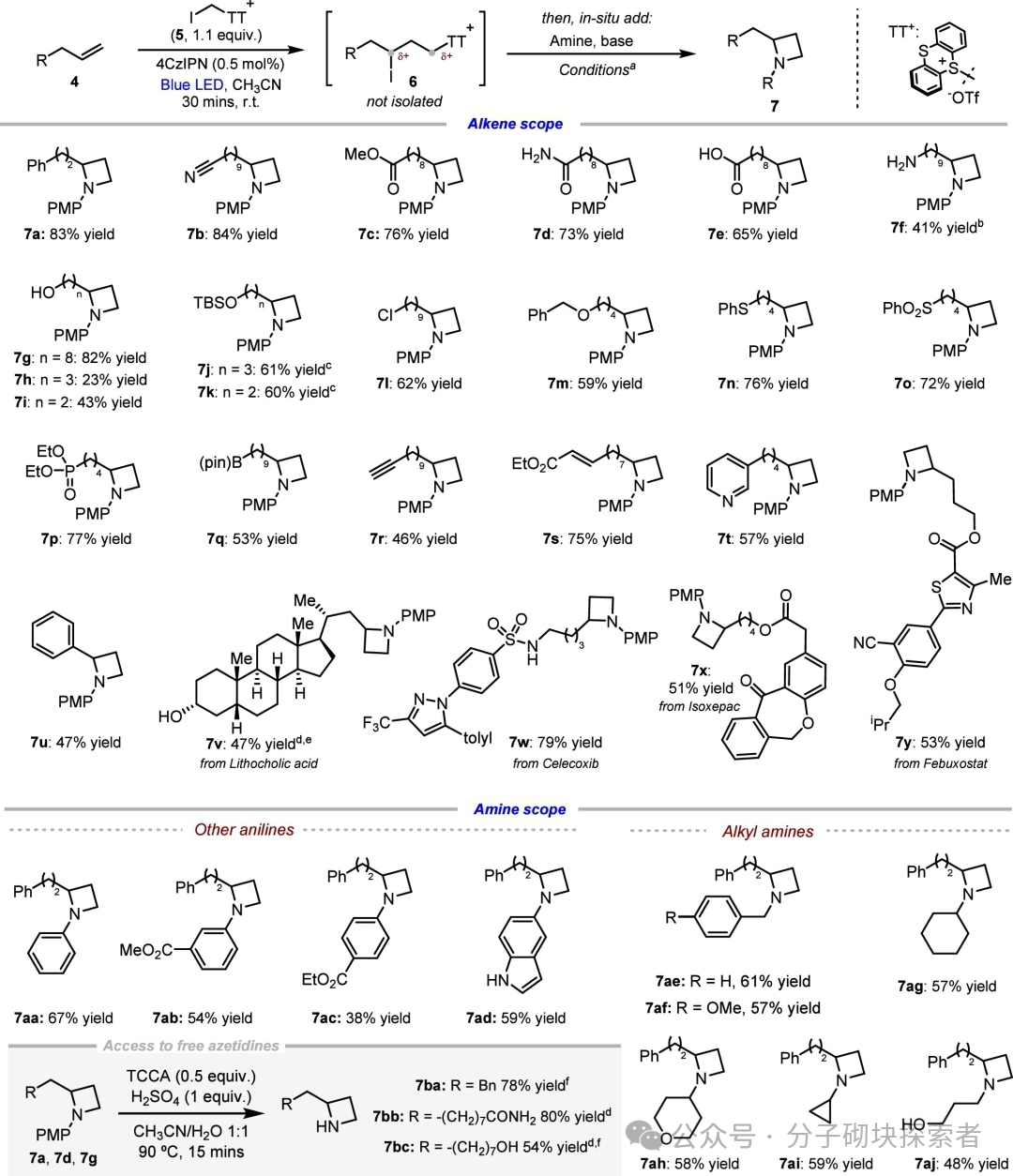
Image source: J. Am. Chem. Soc.
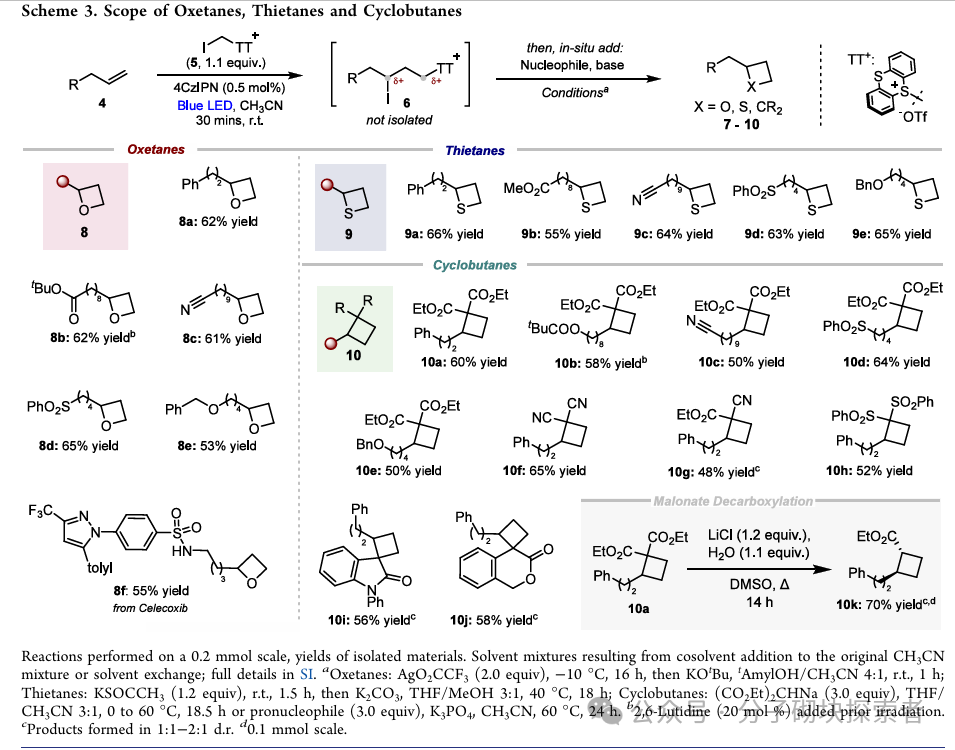
Image source: J. Am. Chem. Soc.
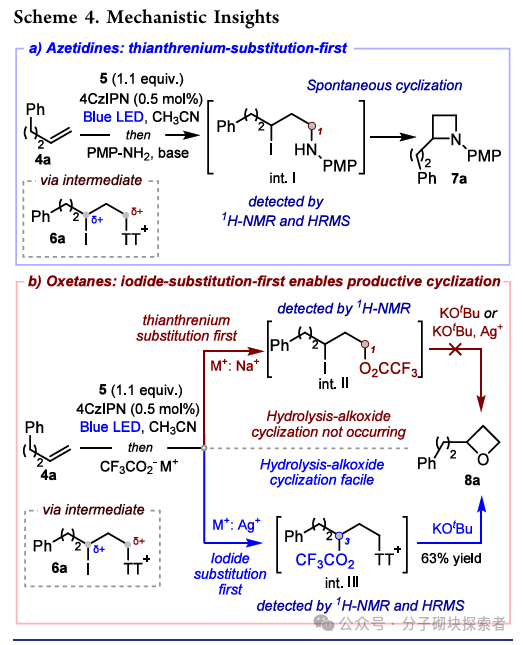
Image source: J. Am. Chem. Soc.
Conclusion:
A universal and unified synthetic strategy has been developed that can utilize readily available unactivated alkenes to prepare 2-alkyl substituted azetidines, oxetanes, thietanes, and cyclobutanes. The broad applicability of this strategy stems from the highly programmable reactivity of the iodine-sulfonium radical addition intermediate, which is formed through the reaction of alkenes with iodomethyl thioether salts under visible light photocatalysis. This method has a wide substrate applicability and excellent functional group tolerance, promising to significantly expand the structural diversity of obtainable products and open new opportunities for the design and development of pharmaceuticals and agrochemicals.
References:
A Unified Synthetic Approach to 2‑Alkyl Azetidines, Oxetanes, Thietanes and Cyclobutanes from Unactivated Alkenes
J. Am. Chem. Soc. 2025
https://doi.org/10.1021/jacs.5c11758