As the application of hydrogels in the biomedical field continues to expand, tissue-adhesive hydrogels (TAHs) have become a core focus of research. Unlike traditional adhesives, achieving efficient tissue adhesion must address multiple challenges posed by complex biological microenvironments. The design must consider key factors such as the dynamic wet environment in vivo, spatiotemporal controllable adhesion, and asymmetric interfacial interactions. These properties cannot be achieved through generalized strategies but require a customized design framework that integrates multi-scale engineering principles.
Recent studies have systematically integrated multi-scale design principles (including the microscopic mechanisms of physical/chemical interactions, molecular-scale modifications such as hydrophobic segments and topological entanglements, and macroscopic structural patterning) to achieve precise optimization of hydrogel adhesion performance. Driven by the intersection of polymer science, materials science, and biomedical engineering, the development of TAHs has shifted from enhancing single functions to the rational construction of multifunctional bioactive systems with multidimensional programmable adhesion.
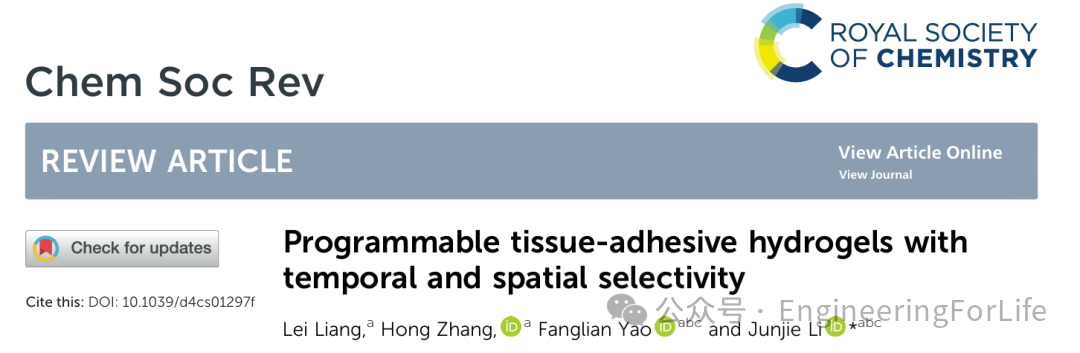
In this context, Professor Li Junjie’s team from Tianjin University and others have comprehensively reviewed the latest advancements in the field of TAHs, analyzing the key bottlenecks faced in clinical translation and proposing future directions to connect fundamental discoveries with practical biomedical applications. The related research results were recently published in “Programmable tissue-adhesive hydrogels with temporal and spatial selectivity” in Chemical Society Reviews.
Key points of this article:
(1) The authors first systematically review the recent advancements in transitioning TAHs from “single function enhancement” to “multidimensional programmable adhesion,” achieved through multi-scale design for instant adhesion on wet surfaces, spatiotemporal controllable bonding, and asymmetric interfacial adaptation.
(2) Secondly, the authors summarize spatiotemporal control strategies such as dynamic covalent/non-covalent chemistry, light-enzyme-redox cascade reactions, and bioorthogonal triggers, integrating multifunctional modules like antibacterial, antioxidant, drug release, and bioelectronic conduction to construct an integrated adhesion system with “instant sealing-demand degradation-bioactivity.”
(3) Then, the authors analyze the remaining bottlenecks in clinical translation, including the contradiction between wet bonding strength and toughness, risks of immune fibrosis, limited light penetration in deep tissues, and standardization of mass production and sterilization. They propose that future development should focus on a “material-device-surgery” closed-loop design, incorporating AI-assisted high-throughput formulation optimization, in vivo 3D printing, and wireless multi-field control of light, sound, and magnetism to bridge the gap from fundamental discoveries to universal clinical products, providing a general platform for postoperative hemostatic sealing, flexible bioelectronic adhesion, and regenerative medicine microenvironment construction.
References:
https://doi.org/10.1039/D4CS01297F
Source:EngineeringForLife
Disclaimer: The views expressed are solely those of the author and are for research purposes. The author has limited expertise; if there are any scientific inaccuracies, please leave comments below!