|
Title |
J. Eur. Ceram. Soc.: Lead-Free Relaxor Ferroelectrics Based on Bi0.5Na0.5TiO3 Achieve Excellent Energy Storage Performance through Equivalent High-Entropy Doping |
|
Research Background |
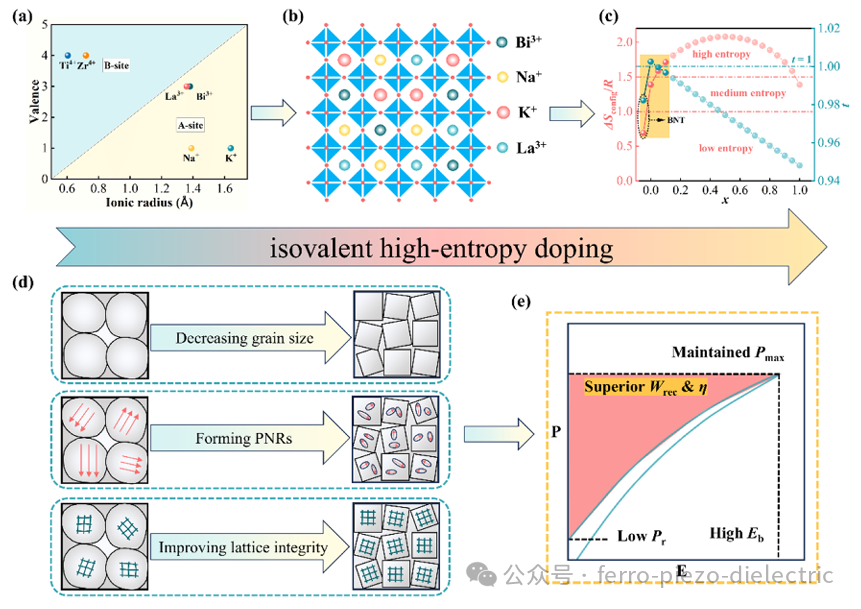
Dielectric ceramic capacitors are widely used in pulse power systems and hybrid electric vehicles due to their ultra-high power density, ultra-fast charge-discharge rates, wide operating temperature range, and low cost. However, their low energy storage density and efficiency limit miniaturization, lightweight design, and integration. The high-entropy strategy is recognized to improve the energy storage performance of dielectric materials, but the underlying mechanisms need further exploration. Bi0.5Na0.5TiO3 (BNT) based ceramics, as environmentally friendly lead-free candidates, exhibit high Pmax but low breakdown strength (Eb) and high remnant polarization (Pr), resulting in low recoverable energy density (Wrec) and efficiency (η). Previous studies have shown the potential of high entropy, but the performance is still far from meeting practical application requirements. |
|
Research Content |
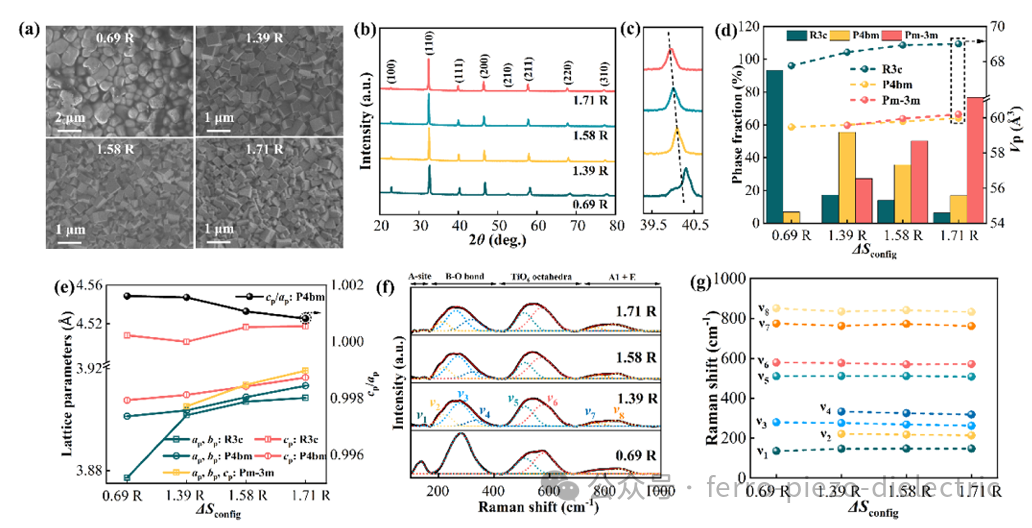
① A series of (Bi0.25La0.25Na0.25K0.25)Ti1-xZrxO3 (BLNKTZ) ceramics were prepared by equivalent doping of La/K and Zr, varying configuration entropy (ΔSconfig). ② Structural characterization showed that the increase in entropy led to grain refinement, phase transition to pseudo-cubic phase, formation of multi-phase polar nanoregions (PNRs), and improved lattice integrity.
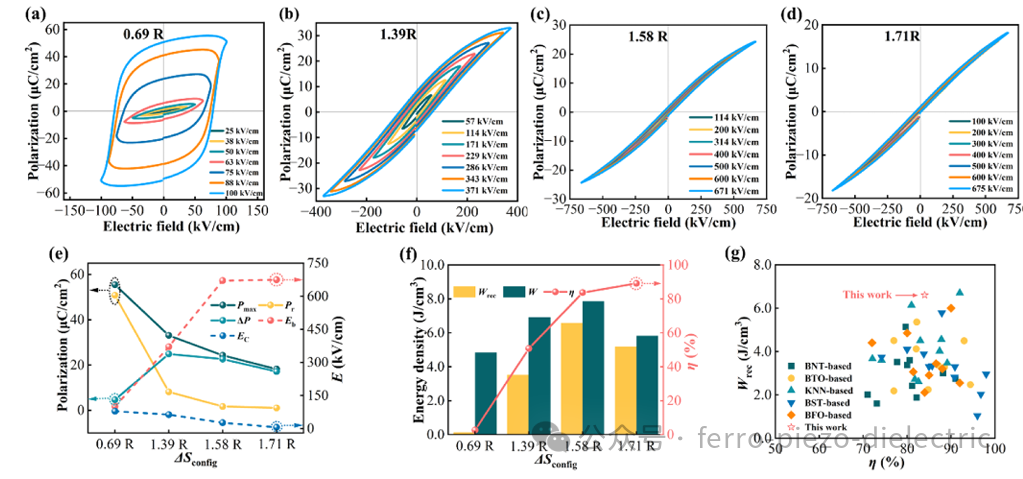
③ Electrical performance tests indicated that the P-E loops became thinner, and Eb significantly increased (from 100 kV/cm to 675 kV/cm), enhancing energy storage performance.
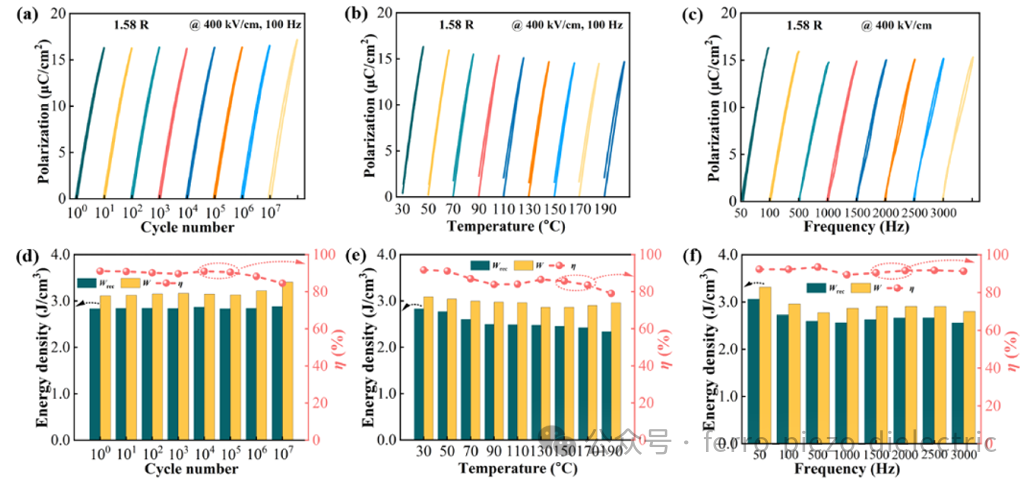
④ The optimal sample (x=0.05, ΔSconfig=1.58R) achieved Wrec=6.6 J/cm³ and η=84%, and tested for temperature/frequency stability.
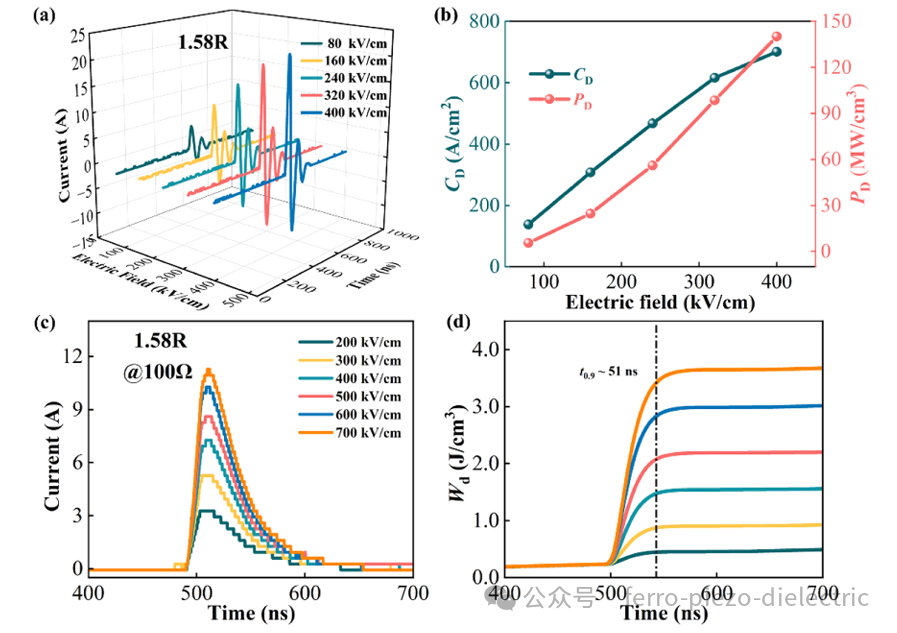
⑤ Charge-discharge performance showed high power density (129 MW/cm³) and fast discharge speed (51 ns), demonstrating excellent fatigue resistance.
|
|
Innovations |
① The equivalent high-entropy doping strategy avoids the valence state fluctuations caused by aliovalent doping, reduces structural defects, and improves lattice integrity and stability. ② By combining common advantages of high entropy such as multi-phase PNRs and ultra-fine grains, high Eb and linearized P-E loops are achieved, enhancing energy storage performance.
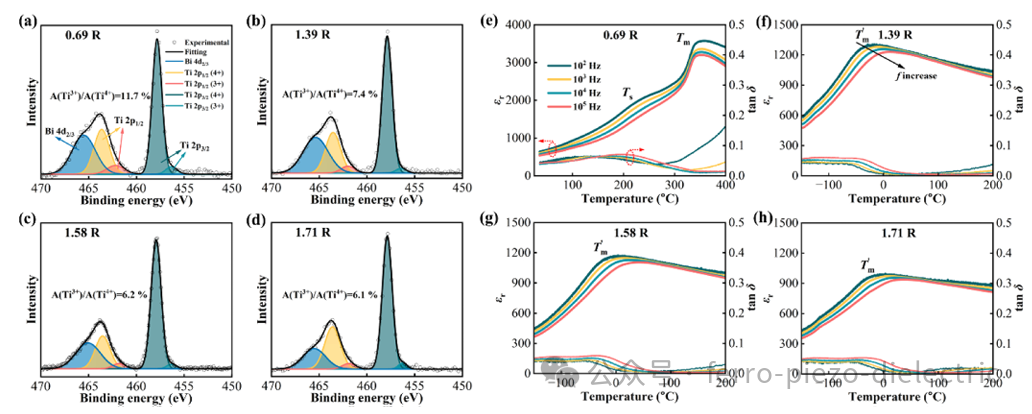
③ Doping with La³⁺ and Zr⁴⁺ reduces the concentration of oxygen vacancies, enhances metal-oxygen bonds, and improves structural stability and energy storage efficiency.
|
|
Paper Summary |
This study introduces La³⁺/K⁺ (equivalent to Bi³⁺/Na⁺) and Zr⁴⁺ (equivalent to Ti⁴⁺) into BNT-based ceramics through the equivalent high-entropy doping strategy, resulting in BLNKTZ ceramics. As entropy increases, grain size decreases (from 0.79μm to 0.31μm), polar phases decrease, multi-phase PNRs increase, lattice integrity improves, and oxygen vacancy concentration decreases. The optimal sample (ΔSconfig=1.58R) exhibits excellent energy storage performance: Wrec=6.6 J/cm³, η=84%, with outstanding temperature stability (30-100°C variation <12%), frequency stability (50-3000 Hz variation <6%), fatigue resistance (change <1.6% after 10⁷ cycles), high power density (129 MW/cm³) and fast discharge speed (51 ns). This work highlights equivalent high-entropy doping as a viable strategy, providing key insights for a wide range of material design. |
|
Original Article |
doi:10.1016/j.jeurceramsoc.2025.117837 |
Disclaimer: This article summarizes information based on publicly available data from relevant academic journals and is not original. It is intended for academic exchange and does not represent the views of this public account.