Focus Highlights
 South Korea Advances Development of Next-Generation Hydrogen-Powered Main Battle Tank China’s First Hydrogen-Powered Urban Train Completes Operational Testing Trump: Hydrogen Energy is Not Viable, After an Explosion, You Have to Look for People 70 Meters Away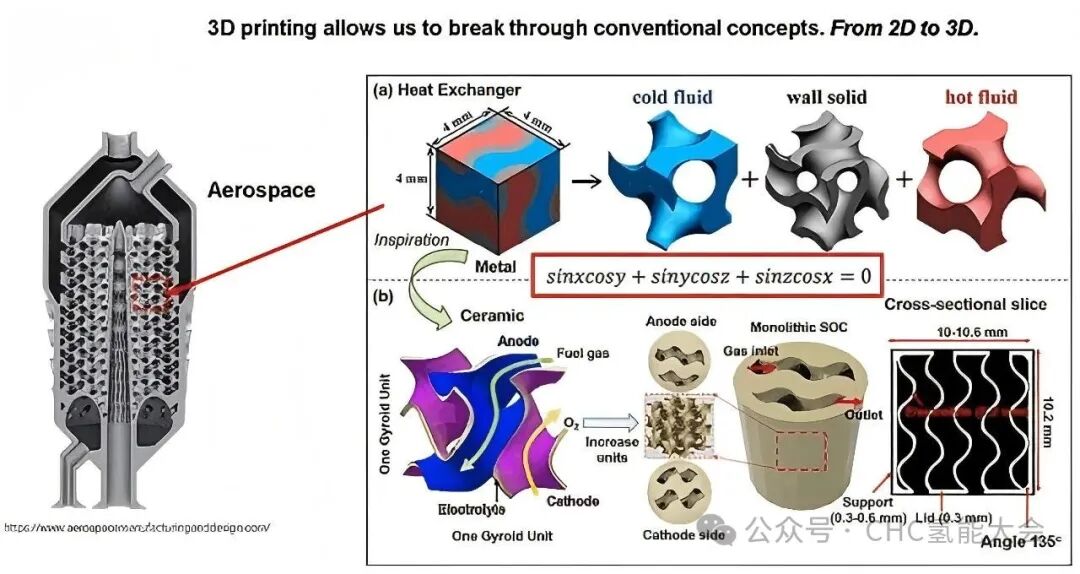
Over the past few decades, energy engineers have been developing various new technologies to provide more efficient and reliable power for electronic devices, robots, and electric vehicles. This includes Solid Oxide Batteries (SOCs), which are electrochemical devices that can operate in two different modes, either as fuel cells or as electrolyzers.
A fuel cell is a device that converts energy from specific chemicals into electrical energy through a chemical reaction. On the other hand, an electrolyzer is a technology that uses electricity to decompose water (H2O) or other molecules to produce hydrogen (H2) or other desired chemicals.
So far, most SOCs developed have been two-dimensional (2D), consisting of planar structures made up of stacked layers of different materials. However, this 2D design limits the extent to which the device can reduce size while increasing weight, as it relies on metal interconnects to facilitate energy flow and seal different components.
Researchers at the Technical University of Denmark have recently designed a new three-dimensional (3D) SOC featuring a periodic surface structure known as a gyroid. A paper published in the journal Nature Energy outlines these batteries, which can be manufactured using 3D printing, also known as additive manufacturing.
The paper’s corresponding author, Professor Vincenzo Esposito, told Tech Exploration: “Using rotational structures in heat exchangers has been shown to reduce weight, improve compactness, and enhance efficiency. We replaced metals with ion-conductive ceramics, thus realizing the 3D-SOC concept. The 3D-SOC is ideal for applications that require lightweight, compact, and stable solutions, such as in the aerospace and automotive industries.”
The monolithic 3D-SOC developed by Professor Esposito and his colleagues consists of three main components: a dense ceramic electrolyte, a porous fuel electrode, and a porous oxygen electrode. Like other SOCs, they can operate in two different modes, either as a fuel cell or as an electrolyzer.
Professor Esposito stated: “In fuel cell (SOFC) mode, the battery generates electricity using fuel gases such as H2, CH₄, and CO, commonly referred to as X to Power.”
“In electrolyzer (SOEC) mode, it produces fuel gases and O₂ by electrolyzing H₂O or CO₂, referred to as Power to X.”

To manufacture their 3D-SOC, the researchers first achieved their monolithic ceramic framework, which includes the electrolyte, seals, and support structures. The entire structure is produced using 3D printing technology.
Subsequently, they coated the fuel and oxygen electrodes onto the surface of the electrolyte. Finally, they co-sintered the electrolyte, fuel electrode, and oxygen electrode together, resulting in a fully functional monolithic 3D-SOC.
Dr. Zhipeng Zhou, the first author of the paper, explained: “Compared to traditional SOC stacking techniques, the manufacturing process of the 3D-SOC is extremely simplified. Traditional SOC stacking requires the integration of many components, including individual cells, metal interconnects, and sealants. In contrast, the 3D-SOC can be manufactured using only 3D printing, coating, and co-sintering processes.”
Compared to 2D-SOCs, the 3D devices developed by the researchers can be scaled up without the need for additional components, thereby reducing their overall weight. Furthermore, the new design provides greater space for the electrolyte while minimizing the size of the battery and maximizing its compactness.
Dr. Zhou stated: “The 3D-SOC is highly flexible and can be upgraded without metal interconnects, completely eliminating metal interconnects significantly enhances the stability of the SOC system and reduces costs.”
Professor Esposito, Dr. Zhou, and their colleagues’ recent work opens up exciting new possibilities for the manufacturing of 3D-SOCs. In the future, the devices they design could be further improved and deployed in various environments, particularly in the aerospace and automotive industries.
The paper’s corresponding author, Dr. Venkata Nadimpalli, stated: “Some examples include NASA’s Mars program and Airbus’s SOFC aircraft (HYLENA | Airbus).”
“From a scientific perspective, the 3D-SOC has fundamentally different structural characteristics compared to traditional SOC designs. Therefore, conclusions drawn from traditional SOCs may not apply to 3D-SOCs, as 3D-SOCs have different gas distribution and thermal transport properties.”
Professor Esposito, Dr. Zhou, and Dr. Nadimpalli hope their research will soon inspire other research teams to design similar 3D-SOCs that are compact, high-performance, and more scalable.
(Source: Technical University of Denmark, Global Hydrogen Network, New Energy Network Comprehensive)
Global Perspective
 Zero Profit in Q3! Thyssenkrupp New Era Abandons Unviable US Green Hydrogen Project Fortescue Secures 14.2 Billion RMB Loan to Revive Green Energy Plans Global Sales of Hydrogen Fuel Cell Vehicles Continue to Decline in the First Half of 2025
Bill Gates’ $645 Million Hydrogen-Powered Super Yacht is Up for Sale
Unsustainable! The World’s First Hydrogen Fund Cuts Its Portfolio After a 70% Drop
For more hydrogen energy news, please click below to follow our public account!
Encourage Us

Like Before You Leave