Go Language Enhances Embedded System Development Efficiency

Go Language Enhances Embedded System Development Efficiency

Embedded system development usually requires working in resource-constrained environments, such as devices with limited memory and computing power. In such scenarios, the choice of programming language is crucial. Go language (Golang) is becoming a powerful tool for embedded development due to its efficiency, simplicity, and support for concurrency. Today, I will introduce you to some … Read more


Practical Project: Smart Home System Design Based on STM32

Practical Project: Smart Home System Design Based on STM32

Click the above to follow us! The smart home system is quietly changing our lifestyle. This article will take you deep into how to use the STM32 microcontroller to create a simple smart home system. We will cover the entire process from hardware selection to software programming, allowing you to easily master this popular technology. … Read more

Unlocking C++ Embedded Development: A Complete Guide to HAL Design

Unlocking C++ Embedded Development: A Complete Guide to HAL Design

I. The “Unsung Hero” in Embedded Development – HAL In the vast realm of embedded development, there is a crucial role that often remains “behind the scenes” – the Hardware Abstraction Layer (HAL). It serves as a bridge connecting upper-level software applications with a diverse range of underlying hardware devices. For C++ embedded developers, a … Read more

Key Knowledge Points for STM32 Embedded Interviews

Key Knowledge Points for STM32 Embedded Interviews

I am Lao Wen, an embedded engineer who loves learning. Answer: Differences between STM32F1 and F4:Different cores: F1 has Cortex-M3 core, F4 has Cortex-M4 core; Different main frequencies: F1 has 72MHz, F4 has 168MHz; Floating-point operations: F1 has no floating-point unit, F4 has one; Functional performance: F4 peripherals are richer and more powerful than F1, … Read more

28 Key Points of Embedded STM32

28 Key Points of Embedded STM32

▼Click the card below to follow the public account ▼ 1. What are the differences between STM32F1 and F4? Answer: Refer to: STM32 Development – Introduction to STM32The cores are different: F1 is Cortex-M3, F4 is Cortex-M4; Different clock frequencies: F1 has a clock frequency of 72MHz, F4 has 168MHz; Floating point operations: F1 has … Read more

Summary of STM32 Embedded Interview Topics

Summary of STM32 Embedded Interview Topics

Scan to follow "Learn Embedded Together", learn together, grow together. 1. What are the differences between STM32F1 and F4? Different cores: F1 has Cortex-M3 core, F4 has Cortex-M4 core; Different clock frequencies: F1 has a clock frequency of 72MHz, F4 has a clock frequency of 168MHz; Floating-point operations: F1 has no floating-point unit, F4 does; … Read more

Common Buses: IIC, IIS, SPI, UART, JTAG, CAN, SDIO, GPIO

Common Buses: IIC, IIS, SPI, UART, JTAG, CAN, SDIO, GPIO

IIC IIC (Inter-Integrated Circuit) bus is a two-wire serial bus developed by PHILIPS for connecting microcontrollers and their peripheral devices. The I2C bus transmits information between the bus and devices using two lines (SDA and SCL), enabling serial communication between the microcontroller and external devices or bidirectional data transfer between the master and slave devices. … Read more

Embedded Hardware Communication Interface Protocol – SPI (III) Analog Interface Application

Embedded Hardware Communication Interface Protocol - SPI (III) Analog Interface Application

Simply completing the simulation SPI implementation for various interfaces is obviously not enough just by capturing the signal timing with an oscilloscope. Although the signal output by the microcontroller as the SPI master is easy to capture, the data sent by the slave (i.e., the timing of the master reading the MISO signal) requires finding … Read more

Using Logic Analyzer to View Software Simulated I2C Timing

Using Logic Analyzer to View Software Simulated I2C Timing

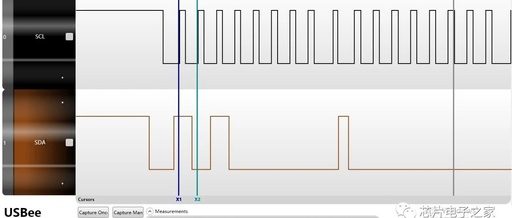
Click here to download the materials (3rd update) We are giving away materials, copy and reply with the following keyword to receive them Material Collection About Today’s Post IIC stands for Inter-Integrated Circuit, a simple, bidirectional, two-wire, synchronous serial bus designed by Philips Semiconductor in the early 1980s. Microcontrollers generally have hardware I2C, so why … Read more

Controlling JTAG with Raspberry Pi for Hardware Learning

Controlling JTAG with Raspberry Pi for Hardware Learning

Author: Hcamael@Zhidao Chuangyu 404 Laboratory Date: October 21, 2019 Recently, while working on a router, I accidentally bricked the CFE and discovered that I could recover it through JTAG, so I did some research on JTAG. Initially, I only wanted to recover the brick, without any intention of deep research. Brick Recovery Attempt A Singapore … Read more