AM Yidao Technology Sharing
Recently, Fraunhofer IWU (Fraunhofer Institute for Machine Tools and Forming Technology) and equipment manufacturer CR3D have jointly launched the WEAM technology, which will be showcased at Formnext.
It no longer relies on special conductive materials, but directly integrates standard industrial wires into 3D printed components.
AM Yidao believes this technology is worth paying attention to:
It represents a shift in additive manufacturing from “shape creation” (control of shape) to “functionality empowerment” (control of function), and then to “system creation” (integration).
This is another dimensional leap in 3D printing technology and applications.
What is WEAM?
WEAM, short for Wire Encapsulating Additive Manufacturing, is essentially a process route that replaces conductive paste with standard metal wire, allowing for direct wiring and encapsulation during the additive manufacturing process.
Traditional functional 3D printed parts typically follow a few methods:
Either the structure is printed first, followed by methods like inkjet or aerosol spraying to apply silver or copper paste to form circuits;
Or electronics are made first, then encapsulated or potting is used to seal them within a plastic structure.
A more advanced method is LDS/MID (Laser Direct Structuring), where a 3D structure is injection molded first, then the surface is activated with a laser, followed by electroplating copper circuits.
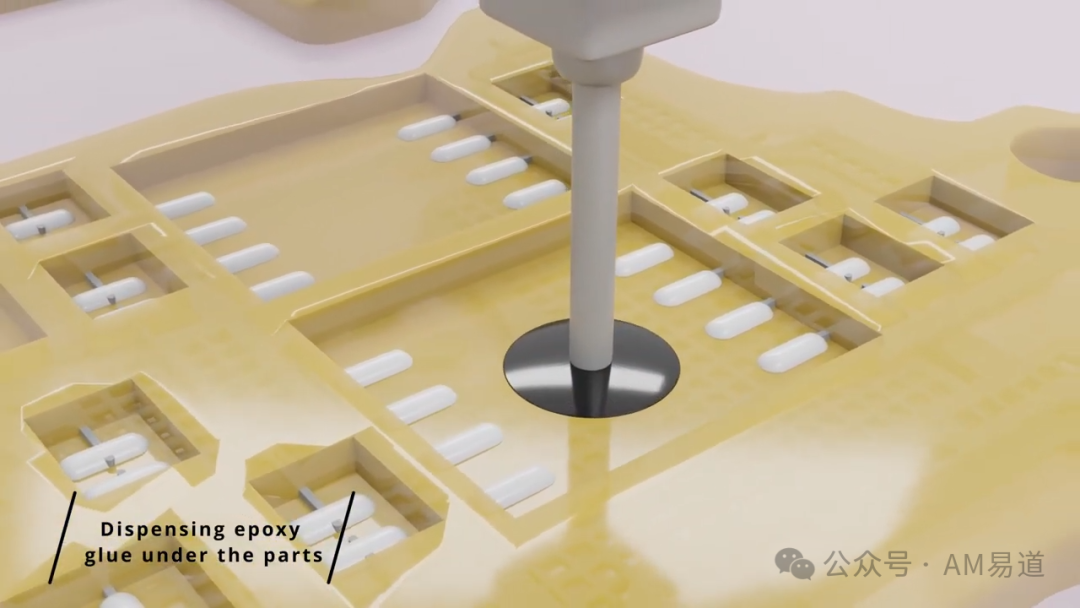
They all share a commonality:
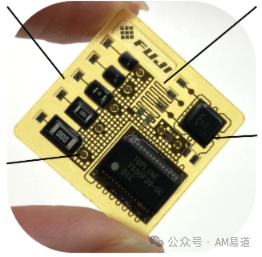
The conductive parts are usually thin layers formed by chemical or physical deposition, with limited thickness, current-carrying capacity, and mechanical robustness, and they are highly constrained by the process and material systems.
The WEAM route is the opposite:
It directly uses uniform alloy wires, which are the standard wires we commonly use.
First, the wires are embedded during the additive process, and then they are completely encapsulated with similar polymers.
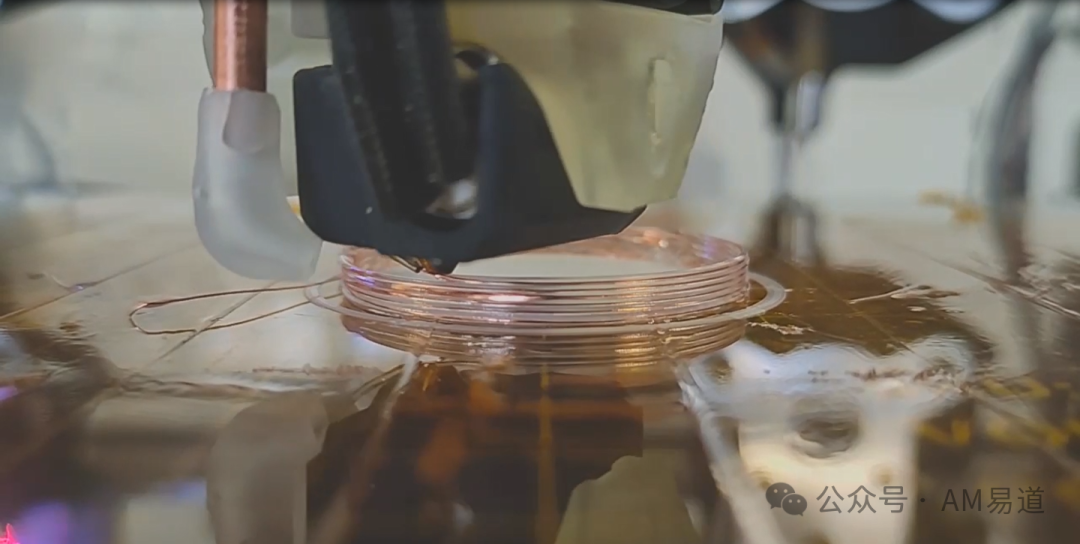
You can think of it as:
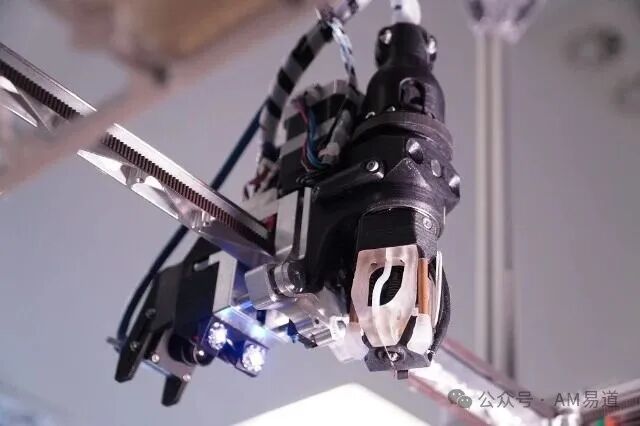
Moving the traditional wiring work of harness engineers in 2D/3D space to a rotating print head, combined with an FFF/FDM print head, printing plastic while simultaneously sewing in copper wires or other alloy wires.
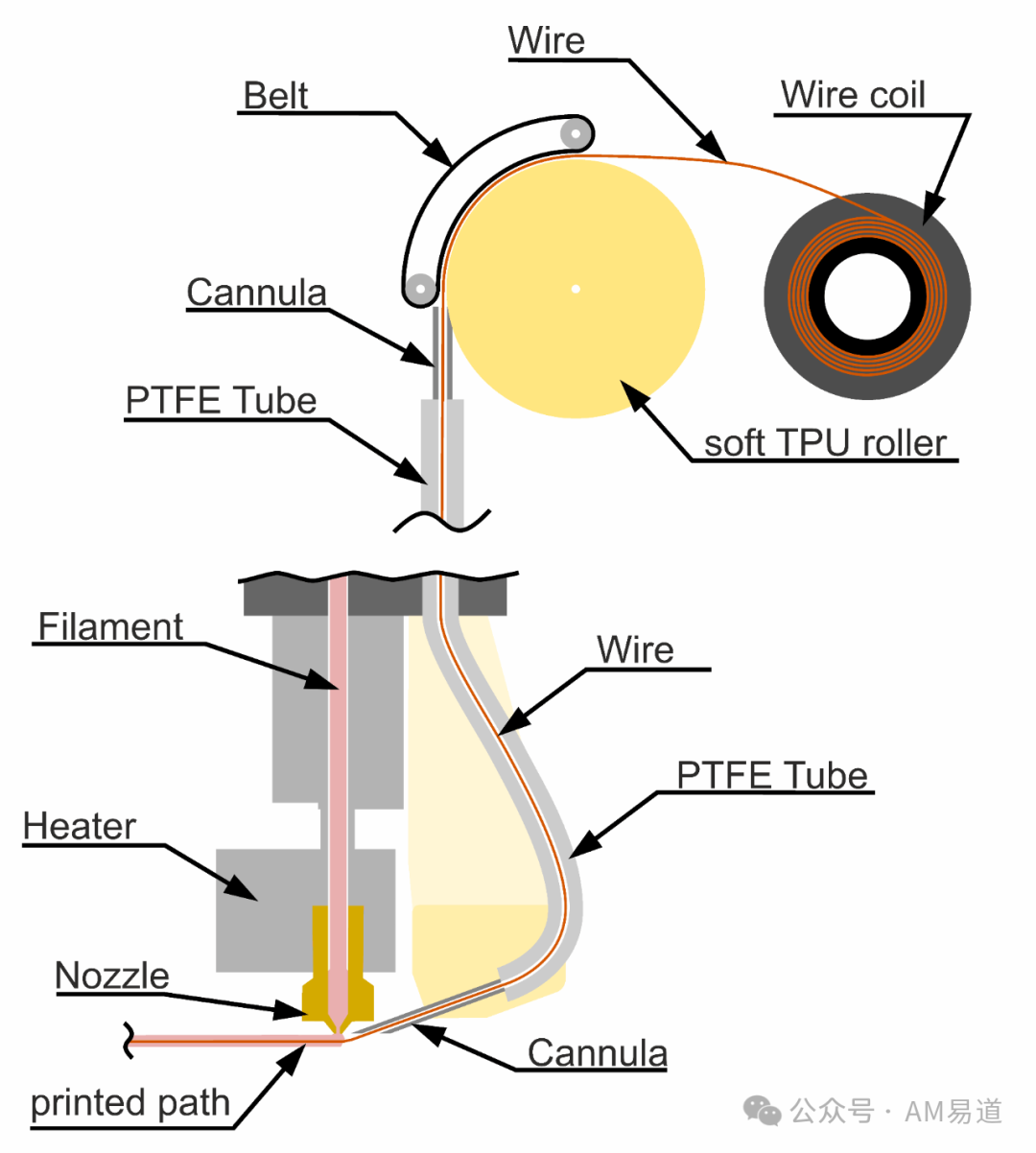
This time, Fraunhofer IWU brought a WEAM print head that is close to mass production, directly integrated into CR3D’s system, to Formnext.
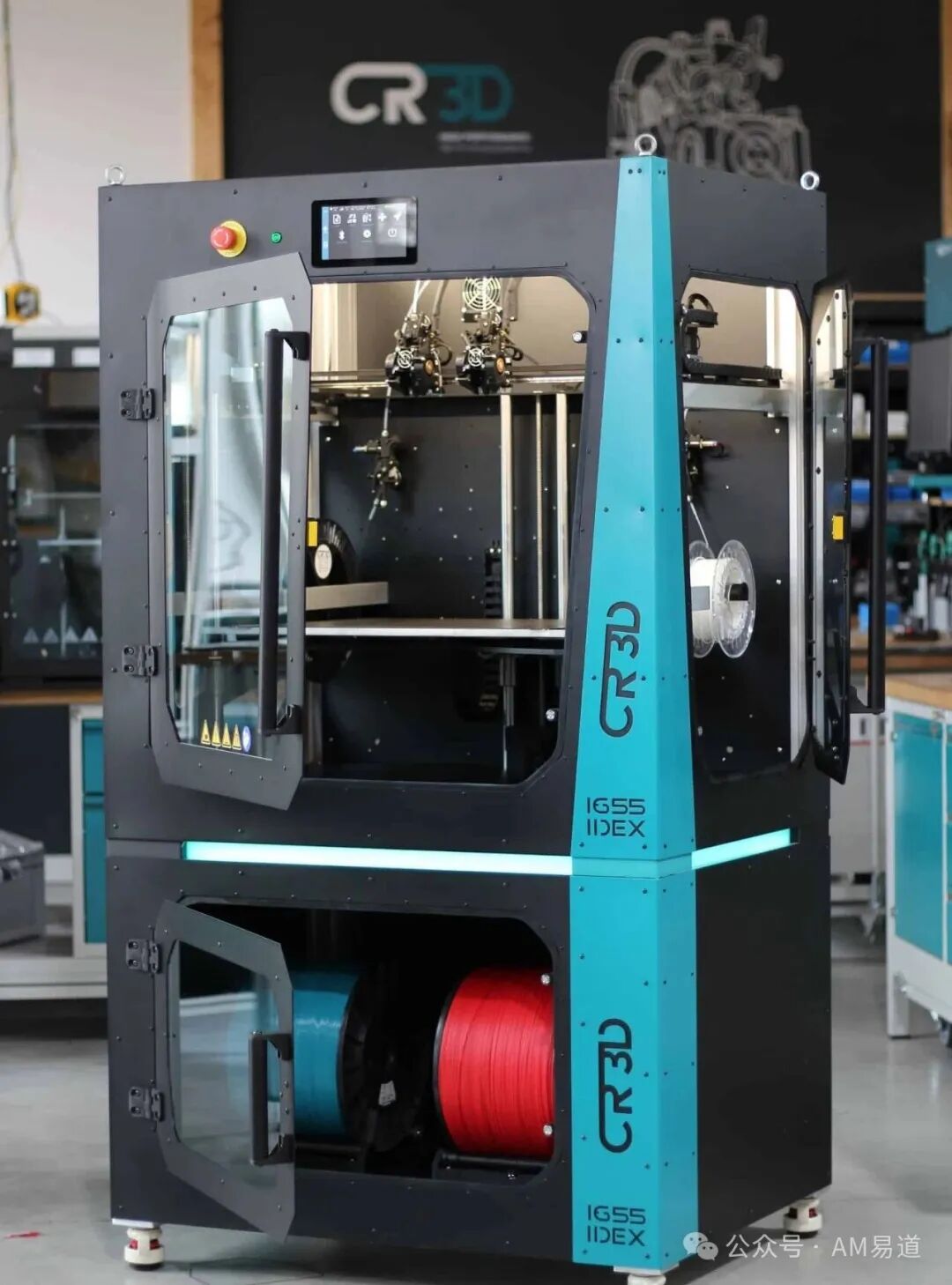
What are the possibilities of WEAM?
From Fraunhofer’s description, the entire system has a lot of adjustable degrees of freedom:
First is the alloy system.
Using copper is the most intuitive choice, as it is highly conductive, mature, and inexpensive.
However, if you want to create strain/temperature sensors, you might choose alloys with a more suitable temperature coefficient (like those commonly used in strain gauges, such as copper and nickel-chromium), or simply use multi-material parallel/series structures for redundancy and multi-channel applications.
For electromagnetic induction and coils, resistance, magnetism, and mechanical fatigue performance are all interrelated considerations.
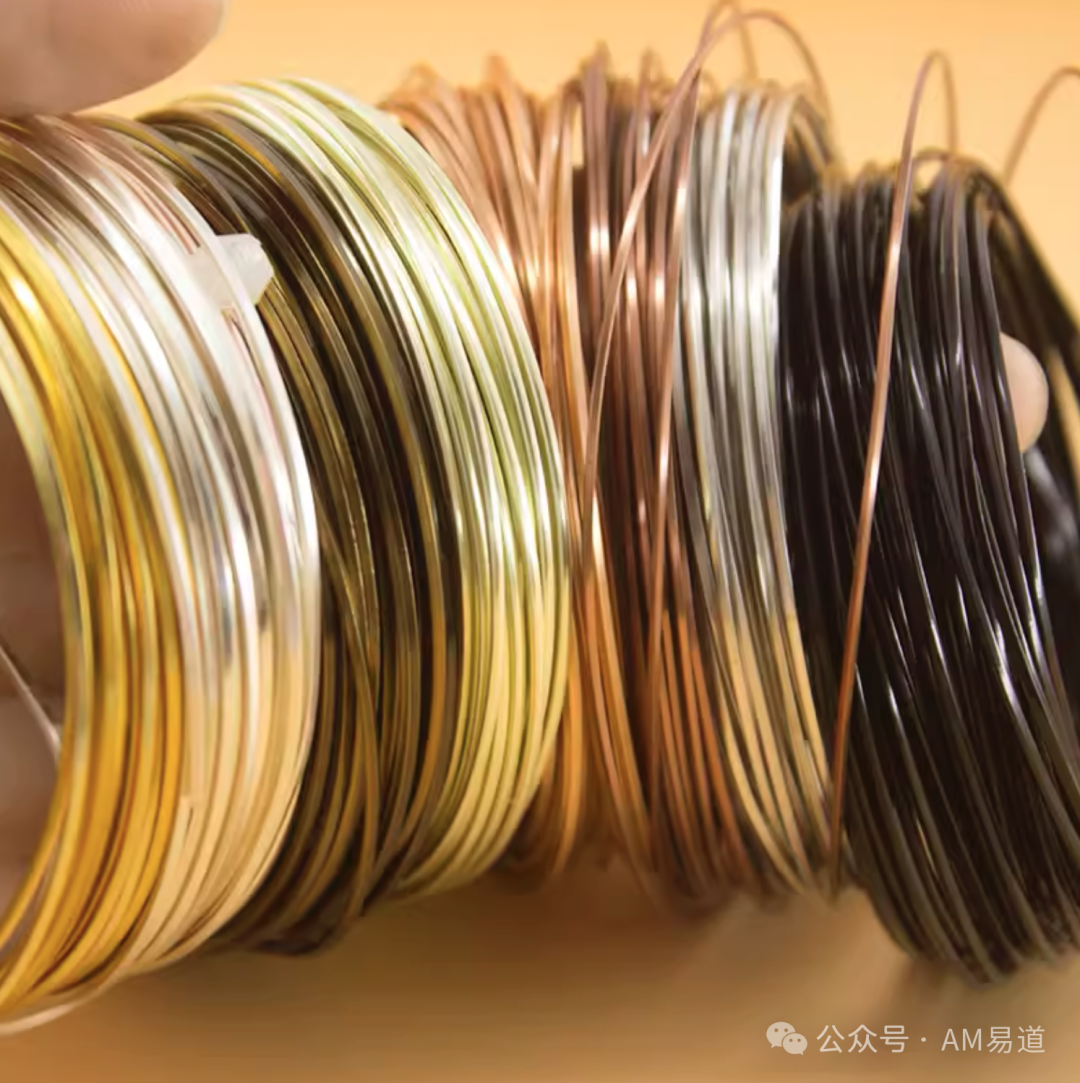
Next is the wire diameter.
Compared to conductive inks that are only a few microns thick, wires with diameters of 0.1–0.3mm or even thicker mean completely different levels of current-carrying capacity and heat dissipation, allowing for safe handling of power-level applications, such as heating, power supply, and even some motor windings.
This also directly changes the design thinking:
You no longer treat it as printed circuits, but as structured wiring harnesses/busbars.
Furthermore, there is the wiring layout.
Traditional PCB engineers care about impedance matching, electromagnetic compatibility, and manufacturing process constraints.
Once in a 3D structure, the spatial path of the wires will simultaneously affect stress distribution, heat dissipation paths, and the assembly sequence of the entire machine.
Fraunhofer specifically mentioned that the wiring layout can precisely control electrical behavior, essentially performing a comprehensive design of 3D PCBs + coils + shielding in 3D space.
Four Demos Worth Noting
Fraunhofer brought four industrial demos to Formnext, covering automotive electronics, flexible electronics, and small drones.
On the surface, these are all reasonable applications, but each corresponds to a pain point in the existing supply chain.
First, let’s look at the radar cover heater made for Nissha.
We all know that under L2+/L3 level autonomous driving architectures, the usable time of the radar covers at the front and rear of the vehicle is a hard indicator of system reliability.
Ice, snow, and dirt can directly blind millimeter-wave radar, so car manufacturers have been piling various heating solutions onto radar covers in recent years:
Integrated heating glass, adhesive heating films, and even adding a small heated brim in front of the radar.
The WEAM route directly prints heating wires onto a thin film, which is then formed and back-injected with plastic.
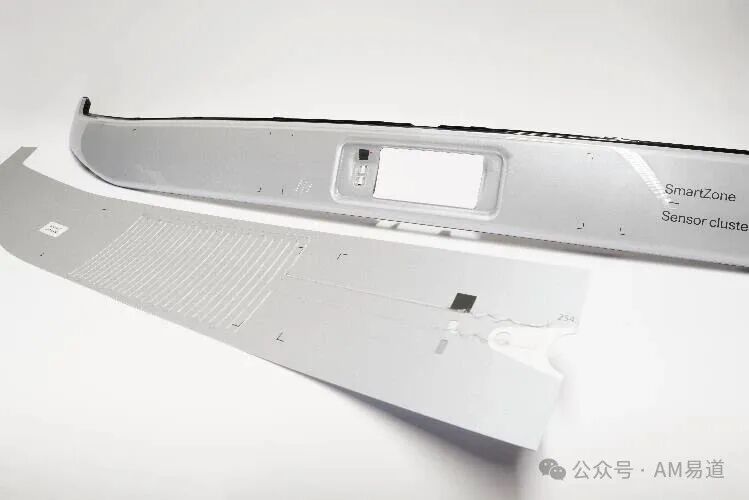
The heating wire and substrate essentially form an integrated molten coating relationship, rather than relying on glue to stick an independent layer, resulting in better peel strength and resistance to thermal shock.
Additionally, because the three-dimensional layout of the heating wire can be precisely controlled, you can design scene-specific heating based on radar beam distribution, ice-prone locations, and even airflow paths, rather than just sticking a uniform resistive film.
The second demo is a flexible/stretchable circuit printed on a 0.1mm TPU film.
0.1mm TPU itself is a very thin elastic substrate, which is completely different in mechanical properties from the PI (polyimide) traditionally used in FPCs.
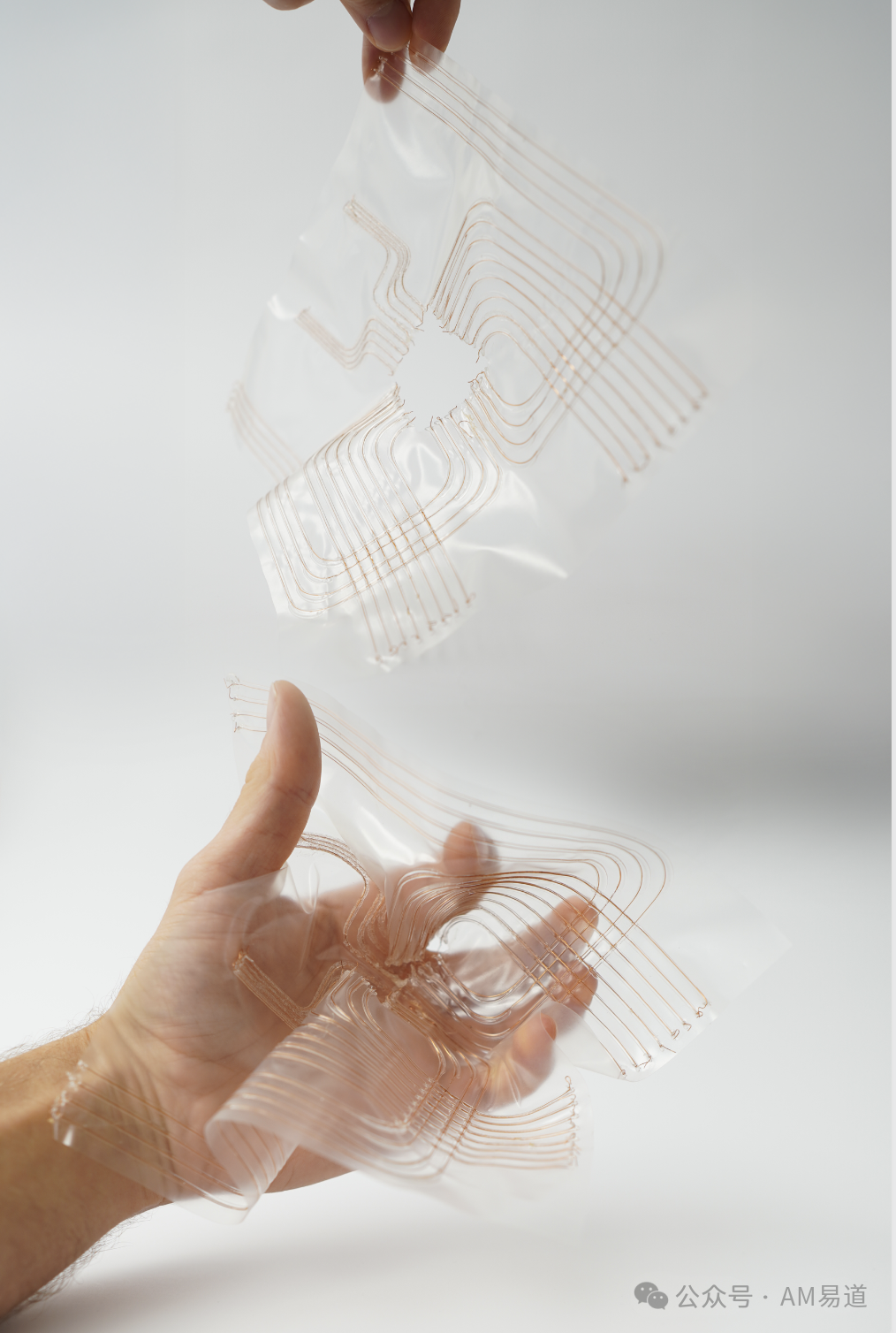
PI is more suitable for repeated bending but not much stretching, while TPU is better for scenarios where the circuit needs to stretch, twist, or undergo significant surface deformation, such as in wearable devices, soft robots, or complex leather components in car interiors.
The third demo is a super lightweight 4D printed textile headphone, with electrical functions also directly integrated into the structure via WEAM.
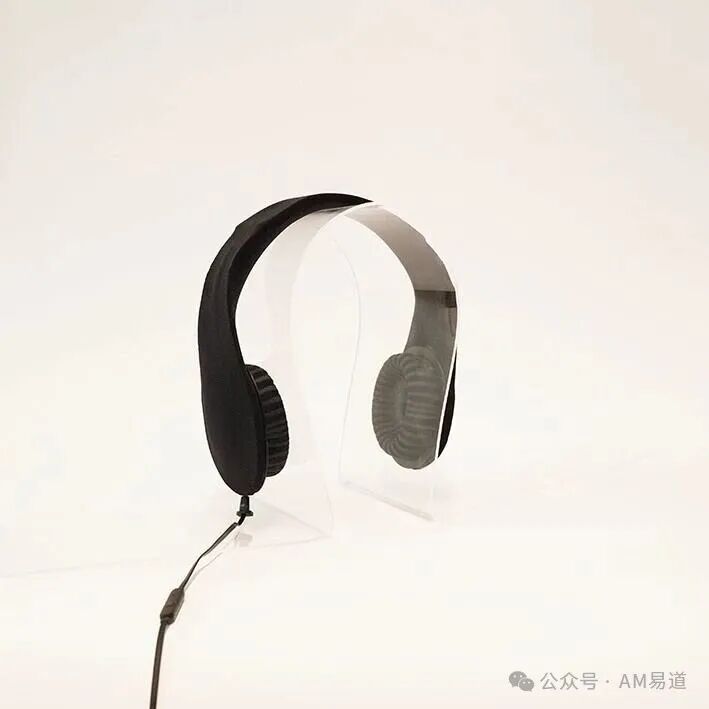
The starting point of the project is a very simple question:
Our current established impression of headphones, and indeed most consumer electronics, is actually limited by injection molding, CNC, traditional PCBs, and wiring processes.
If you replace it with a completely different set of manufacturing tools—such as textiles + FDM + WEAM + 4D deformation, can it force a change in design language?
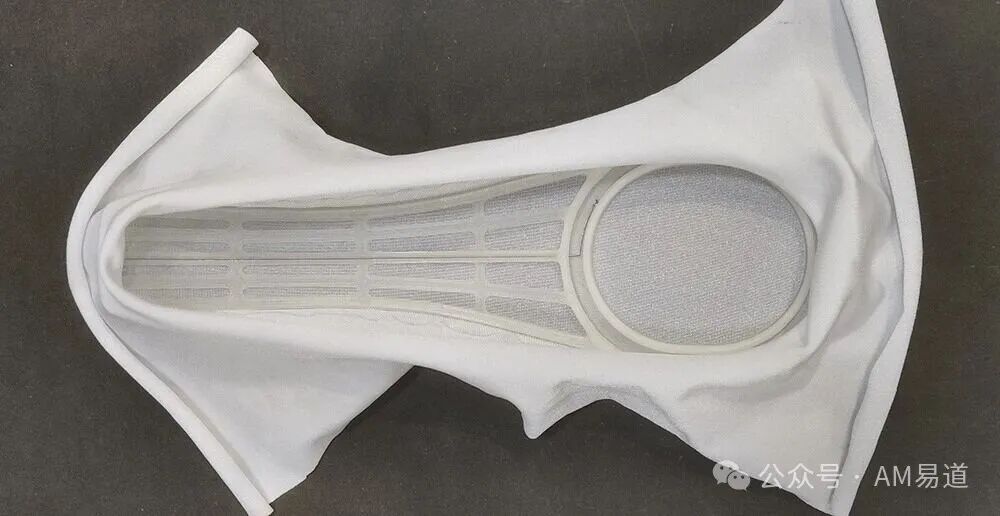
While printing the headphone shell, the Fraunhofer team simultaneously used WEAM to lay wires, add functional components, and electronic elements directly in the same plane.
Conductors are embedded in a textile + plastic composite, forming a complete circuit topology, including drive units, sensors, and possible control and power paths.
This means that the wiring harness + PCB for the headphones is completed in a single pass in a 2D unfolded state.
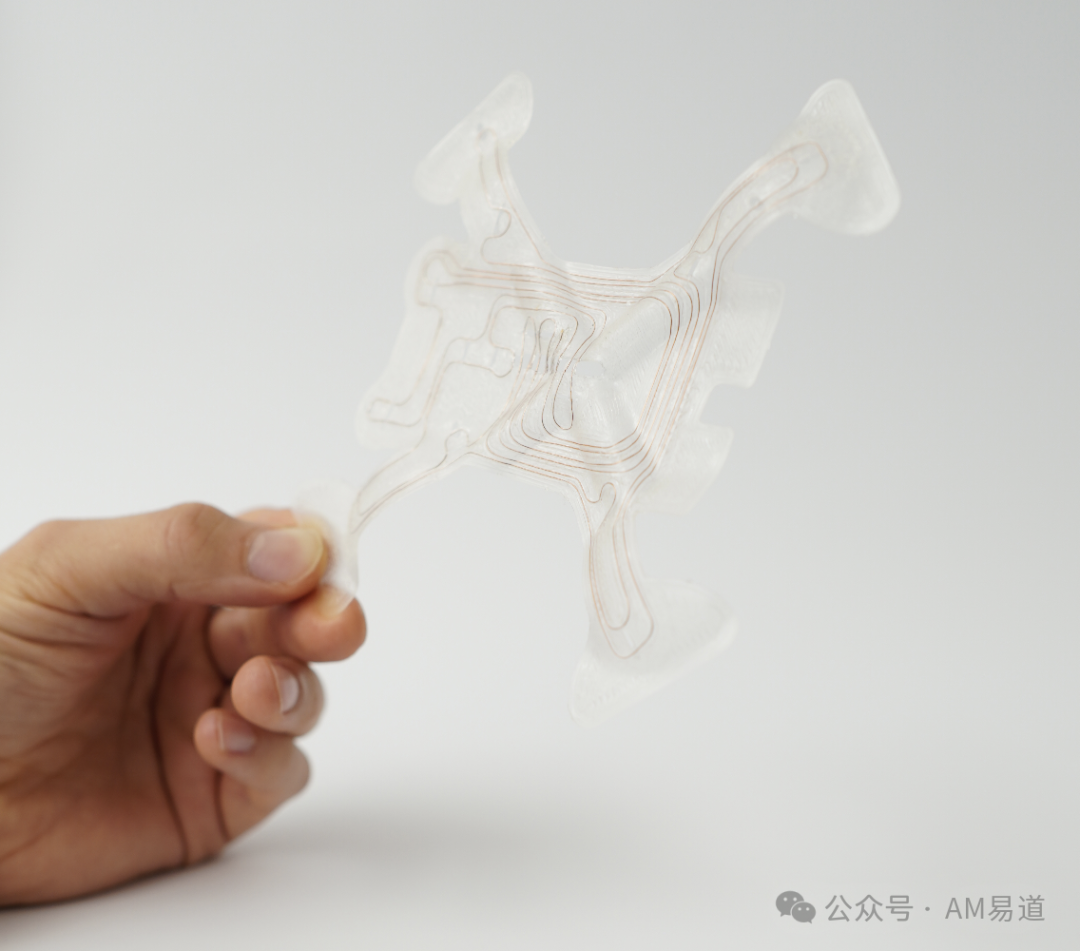
The final demo is a drone body embedded with coils and sensors:
This is what Fraunhofer refers to as housing-as-PCB.
From an electronic architecture perspective, a drone is a highly integrated small system:
Motor drives, IMU, GNSS/RTK, communication links, power management, sensor networks, and even antennas and shielding structures are all crammed into a small body.
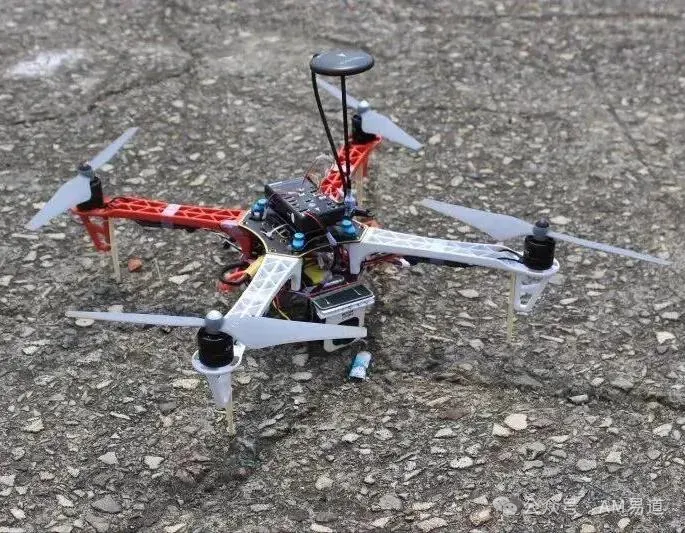
Traditional methods either use multiple PCBs + wiring harnesses + independent shielding shells, or use multilayer boards combined with complex cable routing.
Weight and assembly complexity are very sensitive cost factors in small bodies.
If the body itself is a PCB, it means several things:
First, some wiring harnesses disappear, and signals and power can be directly distributed through the embedded wires in the body;
Second, coils can directly become part of the structure, such as wireless charging receiving coils, position sensing coils, or even some electromagnetic shielding nets;
Third, sensors can be very close to key areas of stress/heat without being limited by the shape of a flat PCB.
Moreover, because it is part of the additive process, the relative position between the coils and the structure can ensure precision during design, without worrying about deviations caused by post-assembly.
Who Will Be the First to Take the Plunge, and Who Will Be Forced to Transform?
This concept of housing-as-PCB is not only applicable to drones.
From the demand side, several priority candidates are obvious.
First is high-end automotive electronics (radar, camera modules, smart interiors), as they face both volume/weight pressures and are constantly pushed to optimize architectures due to functional integration and cost.
Second are industrial robots and collaborative robot end effectors, where there is a strong demand for customization and simplification of wiring harnesses.
Third are unmanned systems (drones, AMRs, AGVs, etc.), which are naturally willing to pay for weight reduction and simplified assembly.
From the internal perspective of additive manufacturing, WEAM represents another leap from geometric freedom to functional freedom in the industry.
In the past decade, we have talked the most about dimensional accuracy, surface roughness, material mechanical properties, and printing speed;
Now, more and more technologies that integrate other elements are emerging:
Composite printing with embedded optical fibers, direct printing of motor windings and cooling channels, and now the addition of embedded wiring harnesses and circuits.
This has several subtle impacts on the entire industry:
The design side will be forced to upgrade.
Simply being able to build 3D models is no longer enough; you need to understand materials, electricity, and heat, or at least collaborate closely with engineers in these fields.
Service providers will further move towards verticalization.
General printing services will struggle to adopt this process, as it involves system-level design and verification for clients;
Those who can truly succeed will be vertical service providers familiar with specific industry applications (such as automotive radar, drones, medical devices).
In Conclusion
If the technology in this article is industrialized, when a component is printed, it will already be a subsystem that integrates mechanical structure, electrical connections, and sensing functions.
When 3D printers can reliably and cost-effectively integrate standard electrical, optical, and sensing components, they will transform from part manufacturing machines tosystem manufacturing machines.
We are uncertain when full industrialization will occur, but we are sure that when that day comes, it will open a larger market door.
Follow AM Yidao to understand the changes in 3D printing.
AMYD.CN: You can read the public beta version of AM Yidao on the web! Early registered users and those who submit bugs via private messages will receive hidden benefits!
Recruiting full-timeeditor: 5+ years of experience in the 3D printing industry, no restrictions on professional direction. Looking forward to collaborating with partners who have deep thinking abilities, writing skills, and creative interests to create quality content together. Interested parties please add yihanzhong for detailed discussion.
In-depth content submissions: We welcome submissions of in-depth original content about 3D printing to AM Yidao,Interested parties please add yihanzhong for detailed discussion.
Corporate partnership program: Become an industry partner of AM Yidao and receive free access to resources for customer acquisition, financing, overseas expansion, and industry-academia-research-government connections.Reader group addition prompt: Add amyidao to join the reader group (note to add group), to obtain original source links or content that is inconvenient to publish, and to discuss everything about 3D printing with AM Yidao’s like-minded readers.AM Yidao suggests readers star the public account to receive updates from AM Yidao in real-time.Serious Disclaimer:AM Yidao images and videos are sourced from the internet and are for auxiliary reading purposes only, with no commercial intent. Copyright belongs to the original author, and if there are any infringement issues, please contact the rights holder in a timely manner, and we will delete it as soon as possible. The copyright of the images in this article belongs to the copyright holder, and the AM Yidao watermark is automatically added for auxiliary reading and does not represent ownership of the copyright. If you need to use the images, please consult the relevant copyright holders. AM Yidao articles do not constitute any investment advice and do not bear any direct or indirect losses caused by the use of the information in this article.