As of the end of 2024, all of MediaTek’s Wi-Fi 7 chip solutions have been developed, with only the final chip solution’s MP (mass production) remaining to be completed. The entire development cycle for the Wi-Fi 7 new products lasted three years, during which five NPU and five MAC+BB chips (excluding RFIC) were released. This article will provide a detailed introduction to the development history, specifications, and corresponding products of MediaTek’s Wi-Fi 7 chip solutions, helping readers familiarize themselves with MediaTek’s chip solutions while also assisting communication equipment manufacturers in their selection process.
Note that this article directly introduces MediaTek’s Wi-Fi 7 chip solutions and does not cover the technical details related to Wi-Fi 7 or the 802.11be protocol. If you are not familiar with the related technologies, many terms in this article may seem challenging, so please do some preliminary research on the relevant technical terminology before reading.
MediaTek launched its first Wi-Fi 7 chip solution sample at the end of 2022, and then quickly caught up with competitors in 2023 and 2024, resulting in the chip layout shown in the following figure.
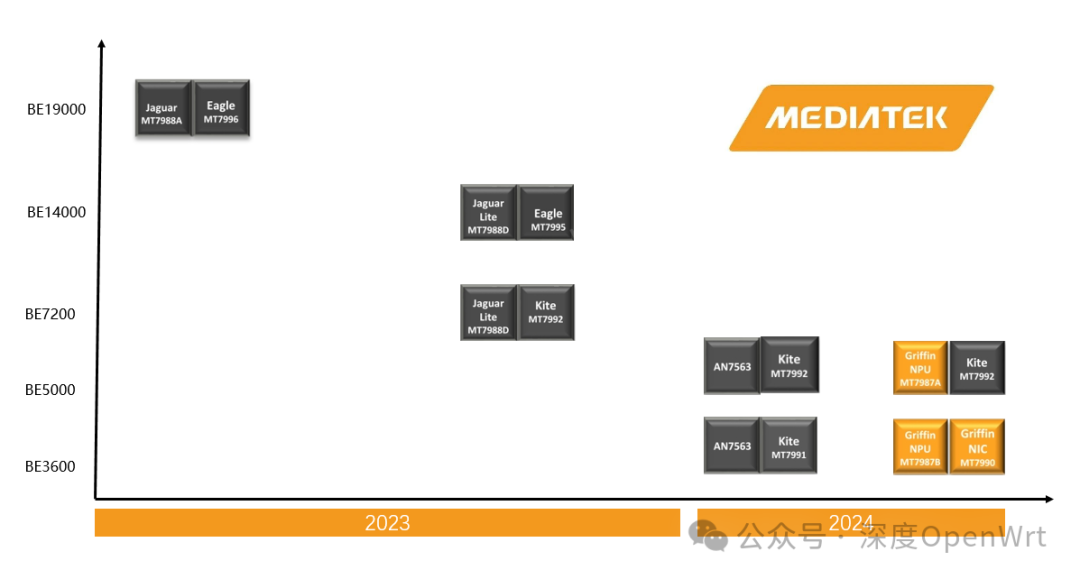
It can be seen that MediaTek’s Wi-Fi 7 chip layout covers a wide range of speed tiers and distinguishes itself from competitors, especially with the BE5040 specification, which is not available from other competitors, further enhancing its product advantages in the mid-to-low-end market. Additionally, MediaTek has a unique naming convention for its chips, often using animal names (while Qualcomm prefers plant names), such as:
-
Jaguar: Jaguar
-
Eagle: Eagle
-
Panther: Panther
-
Cheetah: Cheetah
-
Kite: Kite (bird of prey)
-
Griffin: Griffin
MediaTek’s chip solutions break down the minimum system of a WLAN product into three parts, namely:
-
NPU: Network Processing Unit, generally a SoC, with the Wi-Fi 7 series products having switched to ARM architecture cores, enhancing network protocol processing and acceleration capabilities.
-
NIC: Network Interface Card, mainly handling the MAC layer of the Wi-Fi protocol, sometimes referred to as baseband chips. The NIC connects to the SoC primarily via the PCIe bus, although some products prior to Wi-Fi 7 integrated it into the NPU SoC.
-
RFIC: Radio Frequency Integrated Circuit, mainly processing the PHY layer of the Wi-Fi protocol, primarily handling analog signal processing, which often has higher power consumption. Other manufacturers typically integrate the NIC and RFIC into a single chip, while MediaTek’s approach reduces the power consumption of a single chip but increases the PCB area compared to single-chip solutions.
Next, I will first introduce all the NPU specifications, followed by the NIC & RFIC specifications, and finally discuss possible product combinations.
NPU Chip Introduction
Based on the previous introduction, MediaTek’s Wi-Fi 7 NPU chip solutions mainly consist of the following five chips:
-
MT7988A
-
MT7988D
-
AN7563
-
MT7987A
-
MT7987B
MT7988A
This is MediaTek’s first Wi-Fi 7 chip solution platform, codenamed Jaguar, belonging to the Filogic 880 series. The main specifications of this chip are as follows:
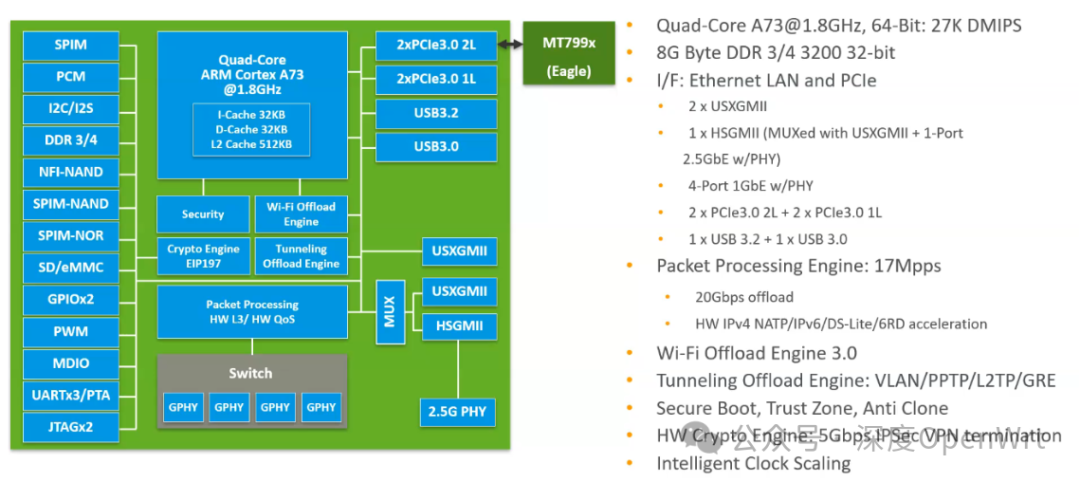
This chip uses a quad-core Cortex-A73 architecture with a clock speed of 1.8GHz, achieving a performance of 27K DMIPS, making it the most powerful among MediaTek’s currently released WLAN chip solutions. However, compared to competitors like Qualcomm and Broadcom, its performance is slightly lower.
In terms of network protocol processing, the packet processing engine has a performance of 17Mpps and supports hardware acceleration of up to 20Gbps. In addition to general IPv4/IPv6 packet acceleration, it also supports 5Gbps IPSec VPN acceleration. Furthermore, it supports hardware acceleration for forwarding between wireless WLAN and Ethernet protocols.
Regarding network interfaces, it has a built-in gigabit switch with 4 GE PHYs and 1 2.5G PHY. This design allows for the creation of a wireless router with a 2.5GE port and 4 gigabit LAN ports without any additional expansion. Additionally, it supports 2 10GE USXGMII interfaces, which can connect to 10G SPF+ optical ports or 10GE electrical ports. However, one of the USXGMII interfaces shares functionality with the 2.5GE HSGMII interface and the built-in 2.5GE PHY, meaning that only one of these three functions can be selected.
For other scalability aspects, it has 2 PCIe 3.0 dual-channel buses and 2 PCIe 3.0 single-channel buses, providing sufficient performance for manufacturers needing to connect external high-speed devices.
MT7988D
MT7988D is a trimmed-down version of MT7988A, serving as the second Wi-Fi 7 processor platform, codenamed Jaguar Lite. However, the CPU core count is somewhat unusual, featuring a triple-core architecture, which raises some questions:
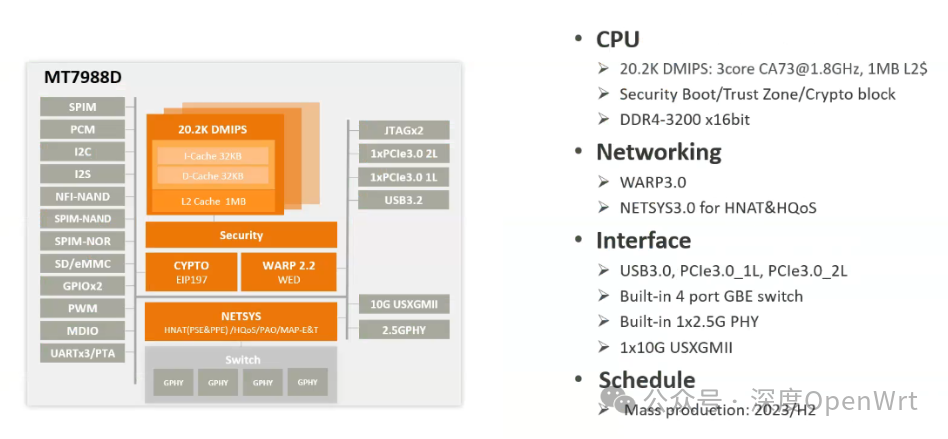
This chip has one Cortex-A73 core disabled compared to MT7988A, maintaining the same clock speed, resulting in a performance drop to 20K DMIPS.
In terms of network interfaces, it still retains a built-in gigabit switch with 4 GE PHYs and 1 2.5G PHY. However, it has removed the multiplexed 10G USXGMII and 2.5G HSGMII interfaces found in MT7988A, leaving only one 10G USXGMII interface. If you have a 10G requirement, the expansion cost will be slightly higher.
For scalability, it retains one PCIe 3.0 dual-channel bus and one PCIe 3.0 single-channel bus, which is sufficient for scenarios with lower scalability requirements.
AN7563
From its name, it is clear that AN7563 is not a pure MediaTek product; it originates from its subsidiary Airoha’s network processor (formerly known as ECONET), primarily focused on broadband services (commonly referred to as operator procurement). The overall performance specifications of this chip drop significantly:
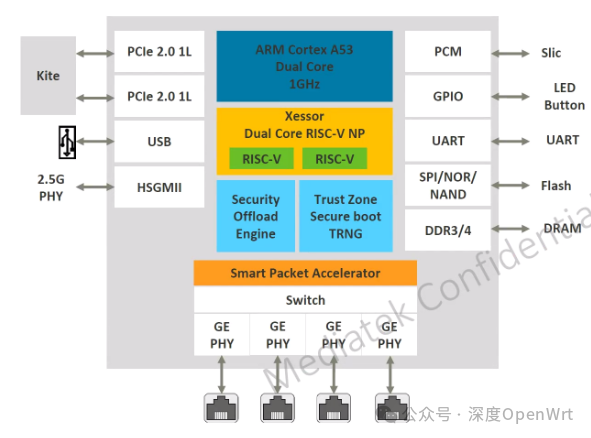
The main specifications of this chip are as follows:
-
Dual-core ARM Cortex-A53 @1.0GHz
-
Hardware acceleration performance for 64-byte packets of 8Gbps
-
Wi-Fi hardware acceleration performance greater than 3Gbps
-
VPN hardware acceleration performance greater than 2Gbps, but it does not specify whether it is L2 or L3 VPN
-
Built-in 1 gigabit switch and 4 GE PHYs
-
1 2.5G HSGMII interface
It is evident that this is a Wi-Fi 6 AX3000 specification processor platform, with the advantage of low cost, making it suitable for cost-sensitive projects like operator procurement. However, performance is relatively tight, so careful consideration is needed during selection.
MT7987A
This is the last Wi-Fi 7 series platform processor launched by MediaTek, and it may also be used in future Wi-Fi 8 products, codenamed Griffin, belonging to the Filogic 860 series. It is not yet in mass production, but samples and public board hardware can be requested.
The main specifications are as follows:
-
Quad-core ARM Cortex-A53 @2.0GHz, with a performance of 18.4K DMIPS. Although it uses a quad-core processor and has a higher clock speed, its performance is still lower compared to the MT7988D, which uses a triple-core Cortex-A73.
-
Wi-Fi hardware acceleration performance of 800Kpps, which is not impressive; to put it in perspective, the MT7988A has a forwarding performance of 17Mpps, meaning the packet forwarding performance is several dozen times lower. Converting to 64-byte packets gives 800x64x8/1024=400Mbps, while for 1500-byte large packets, the forwarding performance is 800x1500x8/1024=9375Mbps, which looks acceptable but needs to be tested in practice.
-
The packet processing engine’s 64-byte packet hardware acceleration performance is 7.5Gbps, which is also quite weak; for reference, the AN7563’s small packet acceleration performance is 8Gbps.
-
In terms of network interfaces, it has a built-in 1 2.5GE PHY and 2 HSGMII interfaces (one of which shares functionality with a USB 3.2 interface).
-
1 PCIe 3.0 dual-channel bus, which can also be split into 2 PCIe 3.0 single-channel buses. Scalability is further reduced compared to MT7988D.
The MT7987 series NPU is essentially MediaTek’s cost-reduction product in the Wi-Fi 7 era. Although the CPU performance on paper looks good, the network data packet processing (hardware acceleration) has significantly decreased, as the gap compared to MT7988A is still very large, and the specific impact needs to be confirmed through testing.
MT7987B
MT7987B is a further cost-reduced version based on the MT7987A chip solution, still codenamed Griffin, belonging to the Filogic 855 series, with adjustments in the following specifications:
-
Dual-core ARM Cortex-A53 @2.0GHz, with a performance of 9.2K DMIPS.
-
1 PCIe 2.0 dual-channel, which can also be split into 2 PCIe 2.0 single-channel buses.
-
In terms of network interfaces, it has a built-in 1 2.5GE PHY, 1 2.5G HSGMII interface, and 1 USB 3.2 interface. Compared to MT7987A, it lacks one 2.5G HSGMII interface that could share functionality with the USB 3.2 interface.
-
Wi-Fi hardware acceleration performance of 400Kpps, equivalent to a forwarding performance of 4687Mbps for 1500-byte large packets.
-
MT7987B must be paired with the BE3600 (MT7991B/MT7990) RF module and is not sold separately, so it cannot be used for wired gateway products.
Note: In addition to the previously mentioned MT7987A/MT7987B specifications, there is also an MT7987AI, which is an industrial-grade chip with an operating temperature range of -40 to 85°C, primarily used in enterprise-grade AP scenarios, with other specifications consistent with MT7987A.
NIC Chip Introduction
NIC refers to the digital circuit part of the WLAN RF chip, so it is sometimes referred to as D-Die. Since many manufacturers implement the MAC layer protocol part only in this chip, it is also referred to as MAC chips or baseband chips. The Wi-Fi 7 NIC chip solutions mainly consist of five models:
-
MT7996AV (Eagle)
-
MT7995AV (Eagle)
-
MT7992A (Kite)
-
MT7991A (Kite)
-
MT7990A (Griffin)
MT7996AV
MT7996 is MediaTek’s highest specification Wi-Fi 7 NIC chip solution, with an overall introduction shown in the following figure.
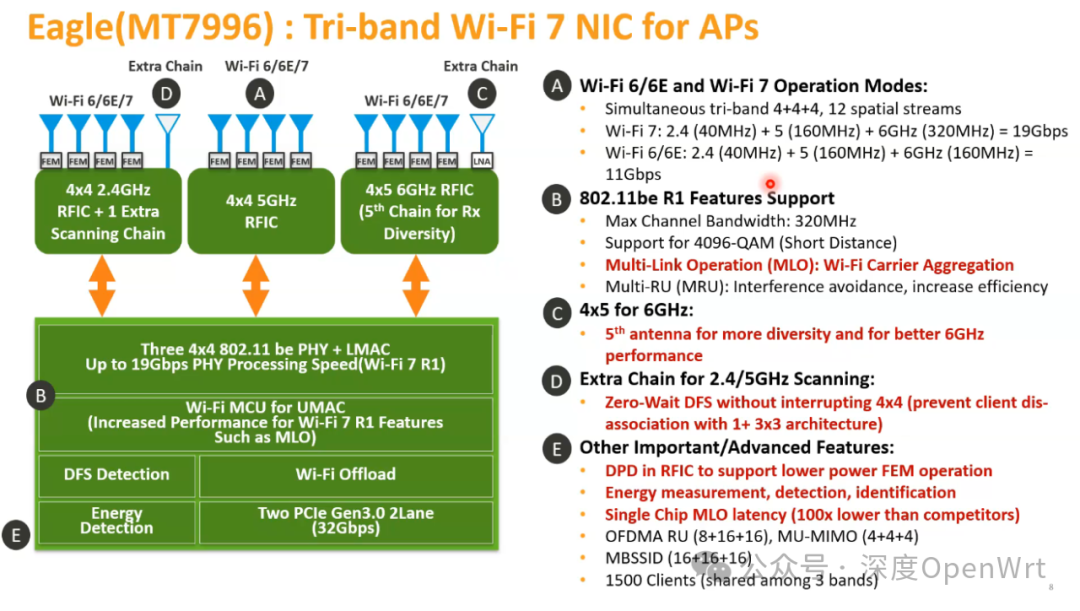
This chip supports 4+4+4 tri-band 12 spatial streams, with a theoretical maximum PHY rate of 19Gbps, making it the highest specification Wi-Fi 7 chip solution in the industry. The differentiation mainly lies in the Extra Chain aspect:
-
In the 2.4G band, an additional scanning chain is added, allowing simultaneous support for scanning in both the 2.4G and 5G bands, although this means that the 2.4G band can only support up to 3×3 spatial streams.
-
The 6G band supports 4T5R, with an additional antenna providing better signal coverage.
MT7995AVMT7995 is a trimmed-down version of MT7996, featuring 2+3+3 tri-band 8 spatial streams, with a theoretical maximum rate of 14Gbps. Other specifications can be referenced from MT7996.MT7992AMT7992A is also a downscaled product from MT7996, supporting 4+4 dual-band 8 spatial streams, with the main feature being the lack of support for the 6G band, thus the maximum supported rate is 7200Mbps.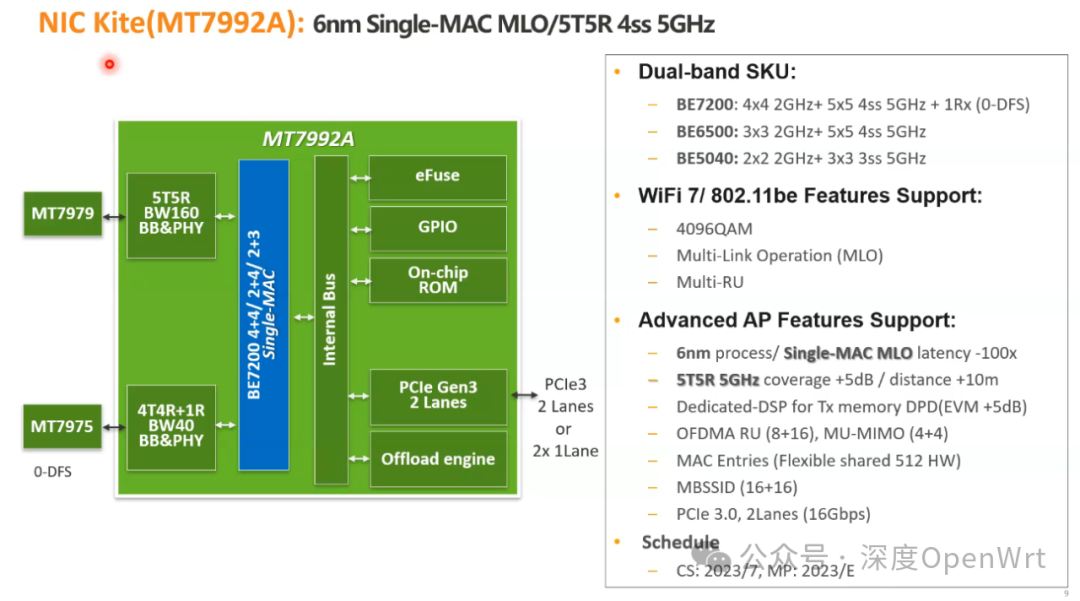 MT7991A
RFIC Chip Introduction
RFIC refers to the analog circuit part of the WLAN RF chip, so it is sometimes referred to as A-Die. MediaTek also has an advantage in that it integrates FEM (or iPA), thanks to the acquisition of a Taiwanese PA company years ago, allowing its RFIC products to often meet most application scenarios with built-in FEM.
Wi-Fi 7 Chipset Solutions
Having introduced the specifications of MediaTek’s Wi-Fi 7 NPU, NIC, and RFIC chips, the next article will discuss possible chipset solutions.