↑↑↑
Follow us to stay updated!
 👆 After clarifying the core differences between AI workflows and AI Agents, this article will focus on the latter, delving into the principles, architecture, and future potential of AI Agents.👇
From language interaction to task execution, AI agents are reshaping the paradigm of human-machine collaboration🔥
Looking back at 2023, we were still amazed by ChatGPT’s language generation capabilities; now, large model technology has quietly entered a new phase of “from saying to doing.” From OpenAI’s GPT-4o to Anthropic’s Claude 3.5, and from domestic models like Tongyi Qianwen to the continuous iteration of Wenxin Yiyan, the capability curve of large models is approaching a critical threshold:🚀 When the parameter scale and inference cost reach a new balance, the differentiated advantages will no longer be limited to the model itself, but will depend more on how the model integrates into real business processes, possessing the ability to call tools like humans, maintain long-term memory, and complete complex tasks.
This critical point has given rise to the emergence of AI Agents, which act as a bridge, transforming the “cognitive potential” of large models into tangible “business value.” This article will explore how AI Agents transition from concept to implementation and gradually become the “digital colleagues” of the future.
1. AI Agent: The Evolution from Copilot to Autonomous Intelligent Agents
In the past two years, Copilot (intelligent assistance) products have experienced explosive growth, covering scenarios such as code completion, content refinement, and meeting minutes generation.
However, the interaction model of Copilot has always been “human-in-the-loop”—humans issue commands, review results, and then decide the next steps.
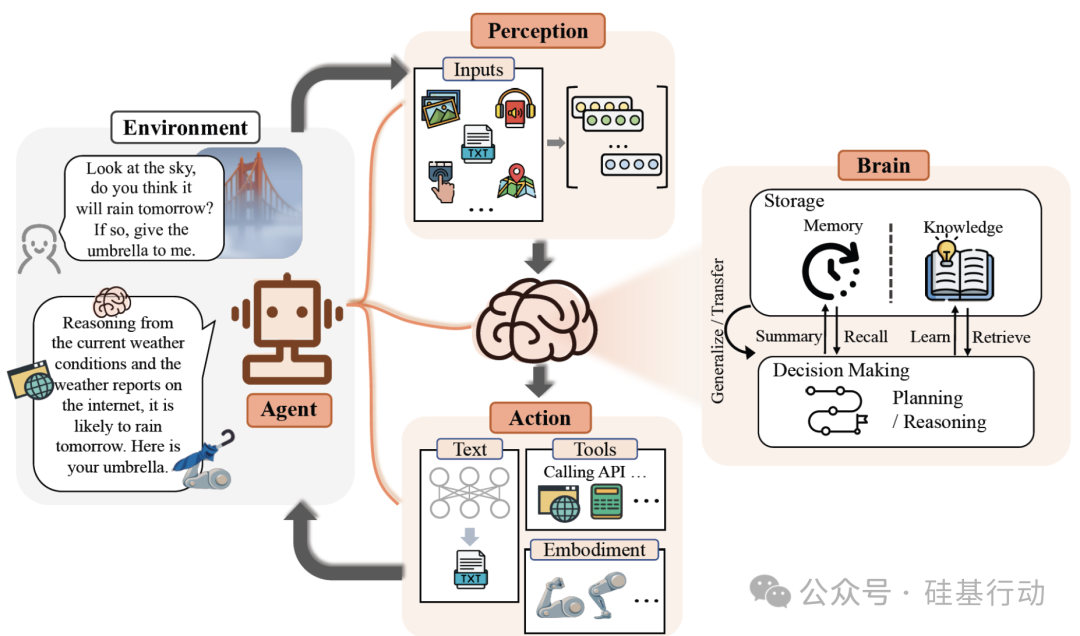
🤖 The emergence of AI Agents has removed the last human gate, enabling the system to achieve fully autonomous closed-loop operation. Therefore, we can imagine an Agent as an intelligent entity with a “soul,” possessing three core characteristics:
- 👀 Perception Ability to acquire and understand environmental information through sensors (cameras, microphones) and contextual protocols
- 🧠 Decision-Making Ability to autonomously choose the optimal action strategy based on perceived information, knowledge base, and preset goals
- 🛠️ Execution Ability to actually influence the environment by calling APIs, executing code, or controlling physical devices
This transformation is attributed to the maturation of three key factors:
📉 Significant Reduction in Inference Costs: The Stanford HAI 2024 annual report shows that the inference cost of GPT-4 has decreased by 87% within 18 months, while domestic models have achieved a 92% reduction through computational optimization. Currently, the cost of completing a complex task (such as cross-system data entry and generating a PPT) is less than the price of a cup of coffee, making “model replacement of human labor” commercially viable.
🔧 Improving Tool Ecosystem: According to LangChain data, by mid-2024, the number of callable APIs worldwide has exceeded 4.2 million, with 38% adapting to OpenAI’s function call specifications. Domestic companies like Shizai Intelligent have completed simulation training for over 1,000 enterprise software applications, covering mainstream systems such as ERP, CRM, and OA.
💾 Popularization of Memory Systems: Vector databases like Pinecone and Weaviate have seen prices drop by about 60% within a year, significantly lowering the barrier for enterprises to integrate private knowledge bases into Agents.
💫 The synergistic effect of these three factors is accelerating the transition of AI Agents from “laboratory concepts” to “deployable products.”
2. Technical Architecture: The Four-Layer System Design of AI Agents
A mature AI Agent typically adopts a four-layer architecture design, with each layer serving specific functions:
🌐 Context Protocol Layer: Responsible for converting heterogeneous information from the external world (such as databases, APIs, and user historical dialogues) into a unified format that the model can process, significantly improving token utilization efficiency. The Model Context Protocol (MCP) proposed by Anthropic is becoming the industry standard.
🧩 Cognitive Planning Layer: As the “decision-making center” of the Agent, this layer decomposes the target task into executable sub-tasks and introduces a “self-criticism” mechanism after each execution step to prevent model hallucinations and error accumulation. The current mainstream approach combines ReAct and Reflexion architectures.
📚 Memory and State Layer: Mimicking the human memory system, it is divided into short-term memory (stored in GPU memory) and long-term memory (relying on vector databases). Research shows that using a dual-library structure of “procedural memory” (tool usage methods) and “declarative memory” (business knowledge) can improve cross-task accuracy by 14%.
⚡ Execution and Feedback Layer: Responsible for implementing the planned action scheme and re-encoding the execution results into the context, forming a complete closed loop. The innovative “RPA model” ensures safe and reliable execution in sensitive enterprise systems by simulating user behavior.
🛠️ The Core Capability of AI Agents—”Tool”
The core capability enabling AI Agents to achieve the leap from “saying to doing” is tool usage (Tool Use). This capability allows Agents to break through their model limitations, accessing external applications and system APIs to complete complex and precise tasks.
🔬 For example, when handling complex scientific calculations, an LLM may produce hallucinations or calculation errors, while an AI Agent will automatically call specialized tools like Wolfram Alpha to ensure the accuracy of the results.
🛠️ There are two major technical schools in the field of tool usage
⚙️ Engineering School (MCP & Function Call): Function Call is an early technology that enables LLMs to understand API function descriptions and generate corresponding parameters. MCP (Model Context Protocol) standardizes protocols based on this, unifying various heterogeneous information formats, significantly enhancing the efficiency and accuracy of Agents.
👁️ Algorithm School (Operator): The Operator technology introduced by OpenAI reads web information visually (e.g., through screenshots) and simulates user operations. Its advantage lies in the ability to interact with web pages without API interfaces and lower token consumption. However, due to high client implementation costs and challenges in error rate control, it has not yet formed widespread consensus.
👥 From a user experience perspective, the engineering school’s MCP presents code-level interactions, while the algorithm school’s Operator directly showcases the page operation process, with the latter being more intuitive and transparent, thus fostering greater user trust.
3. Business Models: Three Paths for Agent Implementation
AI Agents are not a single product but a reusable capability stack. According to Gartner’s 2025 report, the commercialization of Agents presents three models:
🔌 Embedded Agents: Integrating Agent capabilities into existing SaaS products. For example, Salesforce’s Einstein Copilot embeds intelligent agent functions into Sales Cloud, automatically completing tasks such as lead scoring and email outreach, reducing the average sales cycle by 27%.
🎯 Vertical Agents: Focusing on complex processes in specific domains. The legal tech company Harvey’s Litigation Agent can draft a 50-page litigation document, fact-check, and cite precedents within 15 minutes, achieving an accuracy rate of 92%, and has been adopted by leading law firms in the UK.
🌉 General Agent Platforms: Providing enterprises with orchestratable Agent pipelines. These platforms allow business personnel to describe processes in natural language, with the system automatically generating debuggable directed acyclic graphs (DAGs), compressing traditional RPA processes that would take two weeks of development into just 30 minutes.
🌟 The common feature of these three models is the decentralization of complex prompt engineering to the business personnel level, truly achieving “technological democratization.”
4. Data Flywheel: The Self-Evolution Mechanism of Agents
The core advantage of AI Agents lies in their self-evolution capability. Each invocation becomes fuel for the Agent’s evolution: when deployed in real business scenarios, every successful or failed attempt feeds back into the reinforcement learning environment, forming valuable training data.
📊 Internal data from OpenAI shows that when the monthly invocation volume of ChatGPT Plugins exceeds 100 million, the model’s success rate for API calls improves by 11%, and its self-recovery ability for erroneous code increases by 19%.
🛒 The domestic e-commerce platform JD.com collected 41 million multi-turn dialogue data after deploying the “Smart Shopping Guide Agent” within six months, which was used for fine-tuning the model after desensitization, ultimately increasing the conversion rate from 3.4% to 5.1%.
⚡ Once this “data flywheel” effect is initiated, AI Agents transform from mere tools into continuously learning experts. However, initiating this flywheel requires enterprises to streamline data collection, permission management, and feedback loops, making the implementation complexity often exceed that of the algorithms themselves.
5. Future Trends: Opportunities and Challenges for Digital Employees
AI Agents are reshaping the paradigm of human-machine interaction, transitioning from passive response tools to proactive partners that understand, plan, and execute tasks.
From customer service to content generation, from code development to process optimization, AI Agents demonstrate immense potential across various fields. As technology matures, we will see more intelligent agents capable of understanding complex instructions, coordinating multiple tasks, and learning from experience.
However, AI Agents also bring new challenges: how to ensure decision transparency and explainability? How to establish reliable trust mechanisms? How to define accountability issues?
🌈 Solutions to these questions will determine whether AI Agents can truly become trustworthy “digital colleagues” rather than just advanced tools. The future is here, and your first digital employee is waiting to onboard.
If you found today’s content enlightening, don’t forget to give us a【like】 and【look】—this is our greatest motivation for continued creation!
Of course, you are also welcome to click the upper right corner【share】 and forward.
🏃🏃🏃
*If you have anything to say, feel free to leave us a message*
👀
For more exclusive content, click below to follow us
👇
(Please indicate the source when reprinting)