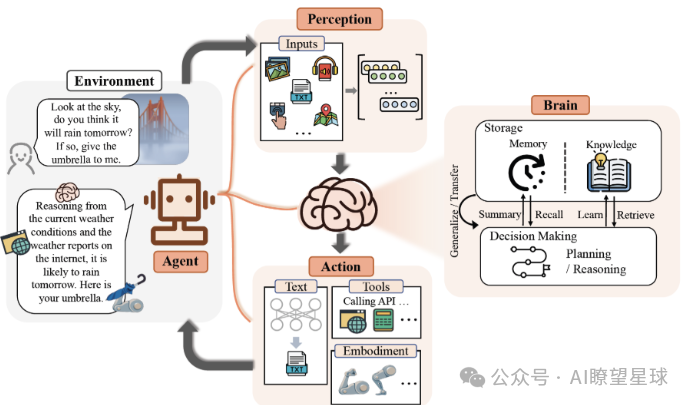
By 2025, AI agents capable of “thinking and acting” will have quietly taken their positions. Authoritative media reports indicate that AI agents will be at the forefront of the top ten strategic technology trends in 2025, with numerous domestic and international companies making strides in this field.
So, what exactly is an AI agent? What are its core components?
What is its relationship with large models? What are the main application scenarios? What are the development trends?
Today, we will provide a detailed explanation.
1
What is an AI Agent?
OpenAI defines an AI agent as a system driven by a large language model that possesses the ability to autonomously understand perception, planning, memory, and tool usage, enabling it to automate the execution of complex tasks.
Unlike traditional tools that only “passively work,” it can act like a “digital employee,” taking on tasks, making plans, finding methods, and continuously optimizing itself. Imagine hiring a “super employee”: it can decompose tasks, proactively call tools, and evolve continuously without slacking off.
In simple terms, it possesses three “core skills”:
👁️ Can see: It can perceive customer behavior, text, voice, images, and other information.
🧠 Can think: It understands task objectives and autonomously formulates execution plans.
🦿 Can execute: It can automatically send emails, update systems, generate reports, interact with customers, and more.
You can think of an AI agent as a virtual marketing assistant equipped with “eyes + brain + limbs”; it can understand your words, comprehend your needs, and help you complete tasks. Available around the clock, it works efficiently and does not slack off.
2
Core Components
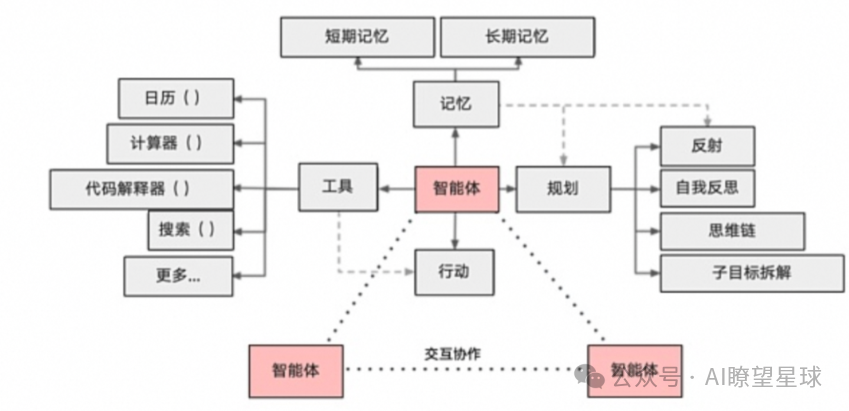
An AI agent typically consists of the following modules:
✅ Planning Module:
Responsible for planning the actions of the large model.
✅ Tools Module:
Enables the large model to connect to external tools through MCP.
✅ Memory Module:
Manages the memory of the large model’s conversations, implemented through vector databases like ChromaDB.
✅ Action Module:
Manages the basic processes of the large model’s actions.
3
Characteristics of Agents
Traditional software programs are like “puppets on strings” driven by preset rules.
In contrast, agents have evolved from “tools” to “thinkers,” with understanding human intent as a core capability. They can autonomously perceive their environment, make decisions, and execute actions to achieve specific goals, characterized by autonomy, reactivity, sociality, and evolution, which fundamentally distinguishes them from traditional software programs:
✅ Autonomy:
They can decompose tasks automatically without human intervention (e.g., breaking down “buying coffee” into locating → selecting a store → paying).
✅ Reactivity:
They respond in real-time to environmental changes (e.g., an autonomous vehicle automatically brakes when encountering a pedestrian).
✅ Sociality:
They can collaborate with multiple agents (e.g., warehouse robot clusters scheduling goods).
✅ Evolution:
They continuously optimize strategies through data feedback (e.g., JD.com’s customer service agents handling 18% of after-sales issues).
4
Relationship with Large Models
AI agents and LLMs (large language models, such as GPT-4, Claude, etc.) are two key concepts in the field of artificial intelligence, closely related yet distinctly different.
✅ On one hand, LLMs are one of the core components of agents. Modern agents typically rely on LLMs as their core reasoning and decision-making engine. LLMs provide capabilities such as natural language understanding, generation, and logical reasoning, enabling agents to handle complex tasks (e.g., answering questions, writing code, planning steps, etc.).
✅ On the other hand, agents are a functional extension of LLMs. Pure LLMs only perform text conversion from input to output, while agents integrate tools, memory, and planning modules to achieve proactivity and multi-step task execution.

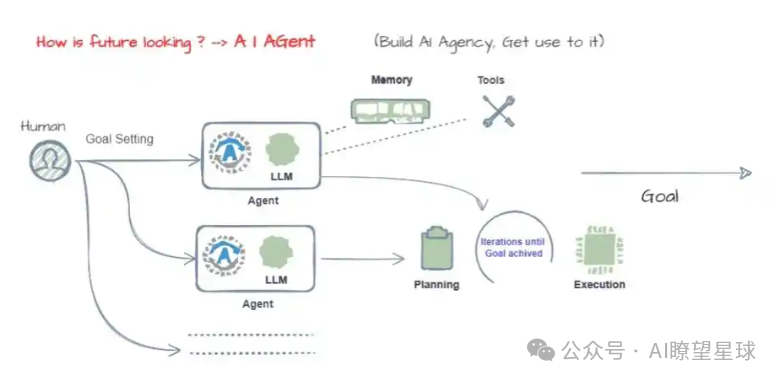
LLMs are the foundation for agents to achieve intelligence, while agents systematically extend the capabilities of LLMs, upgrading them from “text generators” to “autonomous problem solvers.”
💡 To put it more plainly, LLMs are the brain, responsible for understanding, judging, and planning. Agents are the body, with the brain directing the hands (tools), feet (execution), and eyes (perception).
5
Application Scenarios of Agents
AI agents exhibit strong application potential across multiple fields, from intelligent customer service to autonomous driving, from financial trading to smart healthcare, with their application scenarios continuously expanding.
✅ Intelligent Customer Service
They can understand customer inquiries, search for relevant product information through knowledge graphs, engage in multi-turn dialogues, answer questions, and recommend suitable products.
✅ Autonomous Driving
Vehicle sensors perceive road conditions in real-time, while agents plan driving routes, make decisions on how to drive, and execute actions to ensure driving safety.
✅ Financial Trading
In the financial trading sector, agents can predict stock price fluctuations based on market data and formulate trading strategies.
✅ Smart Healthcare
Using patient medical records, imaging data, etc., agents can generate diagnostic reports and provide risk warnings.

6
Development Trends
✅ Continuous Expansion of Application Scenarios
As technology matures, the application scenarios of AI agents are expanding from simple customer service and Q&A to broader fields.
✅ In-depth Development of Multimodal Fusion
In the future, AI agents will integrate text, voice, image, and video multimodal information more deeply.
✅ Enhanced Proactive Services and Predictive Capabilities
AI agents will shift from passively responding to commands to proactively providing services and possessing stronger predictive capabilities.
✅ Closer Collaboration Among Multiple Agents
In complex tasks and large systems, collaboration among multiple AI agents will become increasingly tight and efficient.
✅ Deep Integration with the Internet of Things
AI agents will deeply integrate with the Internet of Things (IoT), further expanding their application boundaries.
7
Conclusion
A truly good agent should possess efficient planning and execution capabilities, multimodal understanding and output, strong tool integration and invocation abilities, and robust memory and context control.
💡 This is the AI agent—an AI employee capable of autonomous thinking, action, and iteration.
Source: “AI Outlook Planet” public account