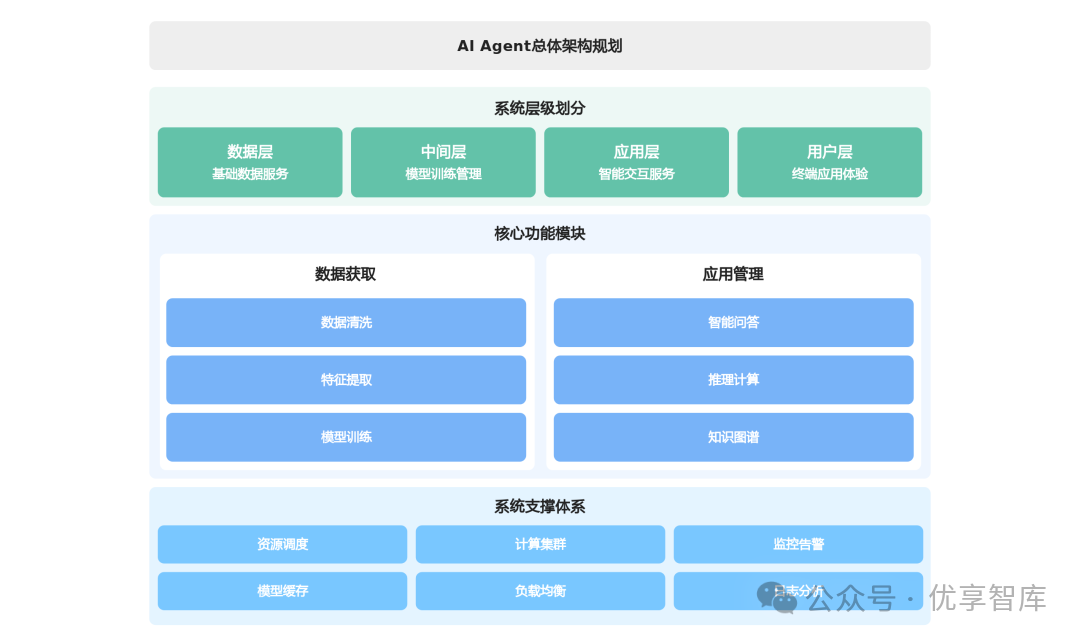
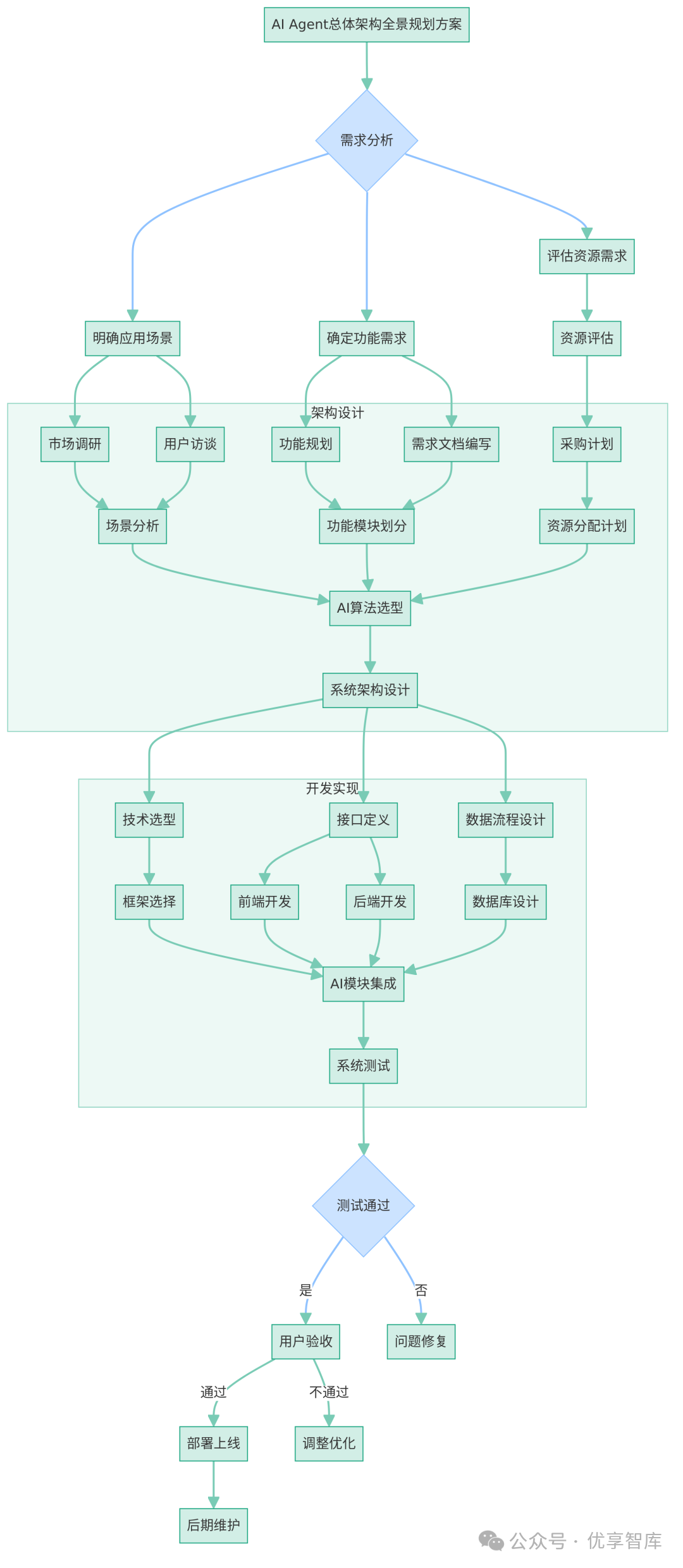
The modern AI Agent architecture exhibits multi-layered and modular characteristics, with its core focused on building intelligent systems capable of autonomous perception, decision-making, and execution. This architecture achieves a complete closed loop from raw data to intelligent services through the organic collaboration of the data layer, model layer, strategy layer, and interaction layer. Data serves as the foundation of the architecture, continuously input through structured and unstructured channels; the model context protocol acts as the neural hub, coordinating multi-model collaboration; enhanced retrieval generation strategies provide dynamic knowledge support for the system; underlying vector technologies and reordering mechanisms ensure semantic understanding accuracy; the business intelligence module achieves domain-specific processing; and the visualization interface completes the human-computer interaction loop. This panoramic architectural design maintains the independence of each module while achieving efficient linkage through standardized interfaces, providing a paradigm reference for building the next generation of enterprise-level intelligent systems.

Data Sources: The “Knowledge Blood” of the Intelligent Brain
Data, as the core production material of AI systems, directly determines the cognitive boundaries of the Agent. In modern society, data has become the cornerstone for the survival and development of artificial intelligence systems. For AI systems, data is not merely a pile of numbers and information; it is a decisive factor for their cognitive abilities and intelligence levels. Therefore, constructing a multi-modal, multi-source data supply chain, through the collaborative supply of structured and unstructured data, provides continuous nourishment for model training and inference.
Table: Comparison of Data Source Types and Functions
|
Data Source Type |
Data Format |
Main Functions |
Typical Application Scenarios |
Key Technologies |
Representative Platforms/Tools |
|
DaaS Platform |
Structured Data |
Integrates business system data through standardized API interfaces, providing efficient data input |
CRM, ERP system data integration |
API integration, data standardization |
Salesforce, SAP |
|
Data Warehouse |
Structured Data |
Utilizes a star schema topology to achieve data cleaning and dimensional modeling through ETL processes |
Financial transaction records, user profile management |
ETL tools, dimensional modeling |
Snowflake, Redshift |
|
Professional Public Account |
Unstructured Data |
Provides industry dynamics, expert opinions, and other textual information, requiring dynamic web scraping |
Industry trend analysis, public opinion monitoring |
Web scraping, NLP |
WeChat Official Accounts, industry blogs |
|
Transaction Center |
Semi-structured Data |
Provides transaction records, market data, etc., requiring parsing of JSON/XML formats |
Financial market analysis, commodity price forecasting |
Data parsing, real-time stream processing |
Stock exchanges, commodity trading platforms |
|
Authoritative Websites |
Unstructured Data |
Publish announcements, white papers, and other authoritative information, requiring differentiated parsing strategies |
Policy analysis, compliance checks |
Knowledge graphs, information extraction |
CSRC official website, government portals |
|
Pharmaceutical R&D Reports |
Multi-modal Data |
Includes molecular formulas, clinical data, etc., requiring association extraction and integration |
Drug discovery, clinical trial analysis |
Knowledge graphs, multi-modal fusion |
PubMed, ClinicalTrials.gov |
Table: Comparison of Data Collection and Processing Technologies
|
Technology Name |
Applicable Data Format |
Core Functions |
Advantages |
Limitations |
Typical Tools/Frameworks |
|
Dynamic Scraper Matrix |
Unstructured Data |
Designs differentiated parsing strategies for different information sources to achieve efficient data collection |
Highly adaptable, supports multi-source heterogeneous data |
Requires maintenance of parsing rules, anti-scraping restrictions |
Scrapy, BeautifulSoup |
|
ETL Process |
Structured Data |
Achieves data extraction, transformation, and loading, ensuring data quality and consistency |
High automation, supports large-scale data processing |
Poor real-time performance, complex architecture |
Informatica, Talend |
|
Knowledge Graph Technology |
Multi-modal Data |
Associates extraction of entities and relationships, constructing semantic networks |
Supports complex reasoning, enhances data relevance |
High construction cost, requires domain knowledge |
Neo4j, Apache Jena |
|
API Integration |
Structured Data |
Real-time access to business system data through standardized interfaces |
Strong real-time performance, standardized data formats |
Dependent on interface stability, strict permission management |
RESTful API, GraphQL |
|
Real-time Stream Processing |
Semi-structured Data |
Instantly analyzes and processes high-speed generated data streams |
Low latency, high throughput |
Complex state management, high fault tolerance requirements |
Apache Kafka, Flink |
|
Multi-modal Fusion |
Multi-modal Data |
Integrates text, images, video, and other different modal data to enhance model understanding capabilities |
Information complementarity, enhances model robustness |
Alignment difficulty, high computational resource consumption |
PyTorch, OpenAI CLIP |
DaaS and Data Warehouse: Efficient Input for Structured Data
Enterprise-level Data as a Service (DaaS) platforms convert structured data from business systems such as CRM (Customer Relationship Management) and ERP (Enterprise Resource Planning) into a nutrient matrix that models can digest through standardized API interfaces. Data warehouses utilize a star schema topology to achieve data cleaning and dimensional modeling through ETL processes, ensuring the temporal and spatial consistency of key information such as financial transaction records and user profiles. In this way, enterprises can better manage and utilize their data, providing richer and more accurate data support for AI systems.
Professional Public Accounts, Transaction Centers, Authoritative Websites: The “Wild Resources” of Unstructured Data
Unstructured data collection requires establishing a dynamic scraper matrix, designing differentiated parsing strategies for authoritative sources such as CSRC announcements and industry white papers. Knowledge graph technology plays a key role in the integration of such data, for example, in the association extraction of molecular formulas and clinical data in pharmaceutical R&D reports. These data sources are diverse, including professional public accounts, transaction centers, and authoritative websites, serving as “wild resources” for AI systems to acquire unstructured data. For these data, a dynamic scraper matrix needs to be established, designing differentiated parsing strategies based on different information sources to ensure data completeness and accuracy. Knowledge graph technology plays a crucial role in the integration of unstructured data, such as the association extraction of molecular formulas and clinical data in pharmaceutical R&D reports. Through this approach, AI systems can gain a more comprehensive and in-depth understanding of domain knowledge, enhancing the representation and reasoning capabilities of models.
MCP (Model Context Protocol): The Neural Hub for Multi-Model Collaboration
MCP (Model Context Protocol) is a crucial technical component, especially in designing complex systems for multi-model collaboration, serving as the central nervous system responsible for coordinating planning and standardizing information transfer and context inheritance mechanisms among various models. This protocol delves into multiple levels, detailing the parameter encoding methods, session management, dialogue state preservation, and cross-modal instruction translation during model interactions.
|
|
|
MCP Working Principle and Application Scenarios |
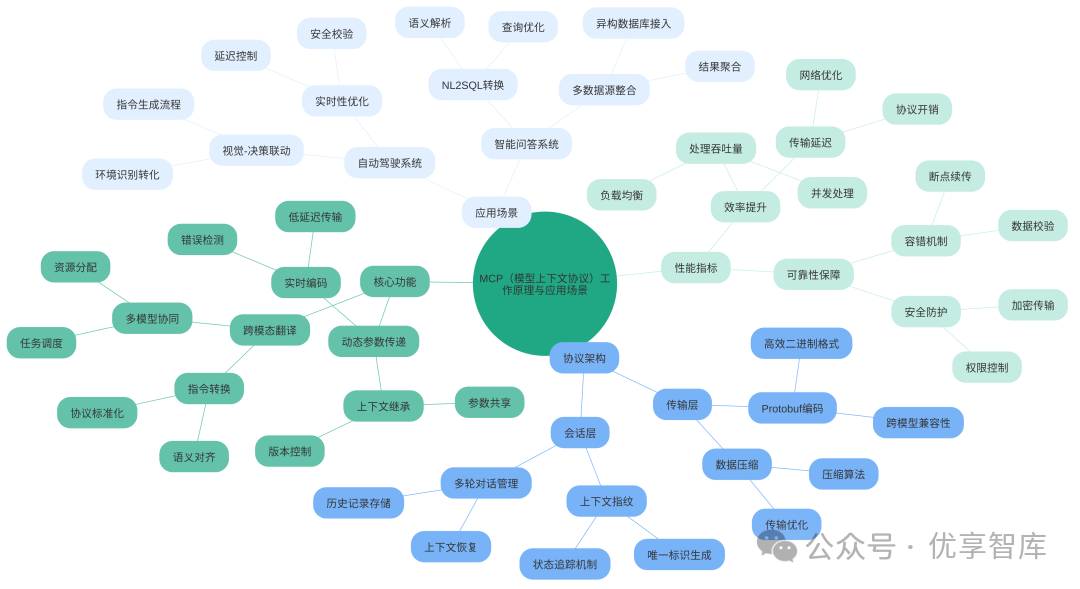
The Core Mission and Functions of MCP
In the architecture of the MCP protocol, the transport layer employs Protobuf, an efficient binary encoding format, ensuring the speed and accuracy of data transmission between models; the session layer maintains the important responsibility of preserving multi-turn dialogue context, generating unique context fingerprints for each interaction to achieve precise matching and coherence of information; while the application layer focuses on cross-modal instruction translation between different types of models, for example, in autonomous driving scenarios, converting visual recognition results into action instructions that the decision model can understand.
For instance, in an autonomous driving system, by applying the MCP protocol, when the vehicle faces complex road conditions, the visual recognition system can capture and analyze surrounding environmental information in real-time, such as identifying pedestrians, vehicles, and other obstacles. This raw data is efficiently encoded using Protobuf and quickly transmitted to the decision model. Meanwhile, as the session layer accurately maintains the context fingerprint of the previous dialogue, the decision model can quickly access the current situation, significantly reducing the delay time from visual recognition results to the decision model receiving the correct instructions to 23 milliseconds, greatly enhancing the vehicle’s response speed and driving safety.
Intelligent Query: The First Application Scenario of MCP
In the field of business intelligence, the first application scenario of the MCP protocol is the intelligent question-answering system. When users pose complex queries such as “Quarterly sales trend in East China” through natural language, MCP can fully leverage its capabilities. It first coordinates the workflow between the semantic parsing model and the database gateway, where the semantic parsing model deeply understands and analyzes the user’s question, converting it into a machine-readable form; subsequently, MCP transmits this transformed abstract query to the database gateway.
The database gateway executes a series of SQL operations (such as JOIN queries) based on the received instructions, filtering out the specific information required by the user from vast amounts of data. Throughout this process, MCP effectively resolves the conversion challenge between natural language and structured queries, achieving seamless integration from user questions to specific operations executed by the database. This not only improves the accuracy and efficiency of queries but also significantly enhances the data analysis and decision support capabilities in enterprise-level application systems.
RAG Strategy Library: The Knowledge Backbone of Intelligent Generation
In the current era of information explosion, how to quickly and accurately obtain valuable information from massive data and transform it into reliable knowledge is a significant challenge faced by the field of artificial intelligence.Retrieval-Augmented Generation (RAG) technology was born to address this challenge, constructing a bridge between a dynamic knowledge base and generative models, effectively solving the hallucination problem of large models.
|
|
|
RAG Workflow Diagram |
Definition and Working Principle of RAG
The RAG system cleverly employs a two-stage retrieval mechanism to accurately lock in the required information. In the coarse ranking stage, by utilizing efficient inverted indexing technology, the system can quickly filter out a collection of documents related to the query, significantly narrowing the search scope. In the fine ranking stage, a Cross-Encoder evaluates the relevance of each paragraph to the query, ensuring the accuracy and relevance of the information. Additionally, the design of the knowledge update module is very clever, as it monitors changes in data sources in real-time. Once a new FDA drug approval announcement is detected, it immediately triggers the incremental update process of the vector database, ensuring that the information output by the system remains up-to-date.
Dify and RagFlow: The Dual Engines of RAG Capability
The Dify platform provides a powerful visual orchestration interface for RAG technology, allowing users to flexibly configure different retrieval strategies based on their needs. Whether it is a single keyword search or a complex combination query, Dify can respond quickly and provide detailed results. RagFlow, on the other hand, focuses on optimization in the financial sector, with its unique patented word segmentation algorithm achieving an accuracy rate of 92.7% in recognizing specialized terms in prospectuses, significantly higher than general solutions. This advantage makes RagFlow more accurate and efficient when processing financial data.
Underlying Capabilities: Embedding, ReRank, and Multi-Modal Adaptation
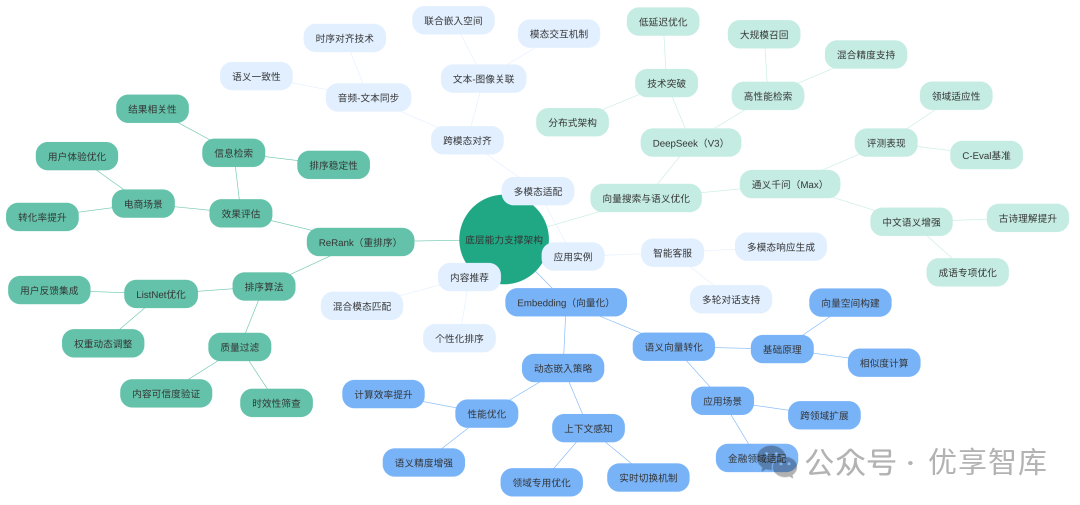
The infrastructure for semantic understanding is akin to the terminal nerves of AI, and its importance is self-evident. In the field of artificial intelligence, the underlying capabilities of the system—Embedding, ReRank, and multi-modal adaptation technologies—play a decisive role in enhancing the system’s accuracy in capturing user intent. These technologies not only form the foundation of intelligent behavior in AI systems but are also key to achieving higher-level AI applications.
|
|
|
Underlying Capability Support Architecture Diagram |
Embedding: Transformation and Application of Semantic Vectors
Embedding technology, which transforms natural language text into dense numerical vectors, is a fundamental means for modern deep learning models to understand and process text data. Through contrastive learning-trained embedding models, words or phrases with similar meanings can be brought closer together in vector space, for example, the concepts of “financing” and “lending” will form a close relationship in vector representation while maintaining a reasonable distance from “merger,” which represents the meaning of corporate mergers, thus ensuring that semantic differences are reflected in vector operations.
For instance, a bank’s customer service system, when faced with inquiries about financial products, employs a dynamic embedding strategy that automatically switches to a finance-specific embedding space based on the dialogue context, allowing the system to accurately match professional vocabulary and expressions in the financial domain, greatly improving the accuracy of Q&A and user experience. This embedding space is not limited to a single domain but can extend to complex scenarios across multiple domains, ensuring that AI maintains high semantic sensitivity and accuracy when handling various tasks.
ReRank: Filtering and Sorting of Retrieval Results
ReRank technology is an important tool for deep optimization based on preliminary retrieval results. On e-commerce platforms, the ListNet algorithm continuously optimizes product ranking weights based on user behavior feedback, resulting in an average increase of 3 positions for high-conversion products, thereby enhancing the overall shopping experience and platform revenue. Meanwhile, the quality filtering module automatically screens and blocks outdated policy and regulatory information, ensuring that the content recommended to users is timely.
DeepSeek (V3) and Tongyi Qianwen (Max): Vector Search and Chinese Semantic Optimization
DeepSeek (V3), as a high-performance vector search engine, supports mixed-precision vector retrieval functions, maintaining a recall rate of up to 98% even when facing data scales of billions, fully demonstrating its efficient and accurate search capabilities. Tongyi Qianwen (Max) is a model that has undergone deep optimization for semantic understanding in specific Chinese contexts, specifically targeting the understanding of Chinese idioms and classical poetry, resulting in a significant improvement in ancient text comprehension scores in the C-Eval benchmark test, with an increase of up to 15%, showcasing its strong capabilities in handling complex Chinese texts.
Business Intelligence Agent: AI-Driven “Decision Assistant”
With the continuous development of artificial intelligence technology, enterprise-level AI applications have gradually evolved from simple question-and-answer interactions to more complex and proactive service models. This evolution enables AI systems to deeply understand the business needs of enterprises and provide comprehensive, closed-loop decision support. In this process, the business intelligence Agent, as an AI-driven “decision assistant,” is playing an increasingly important role.
LangChain + LangGraph: Workflow Scheduling and Knowledge Graph Reasoning
By utilizing LangChain’s Workflow engine technology, the drug development process is finely divided into 78 indivisible atomic tasks. These tasks cover all aspects from initial laboratory research to clinical trials, production, and quality control. LangGraph, on the other hand, is a knowledge graph-based reasoning engine that can link molecular properties with clinical trial data. When researchers query information related to the “PD-L1 inhibitor target,” the system can automatically associate it with phase III clinical data and patent layout.
DB-GPT: Expert in Handling Structured Queries
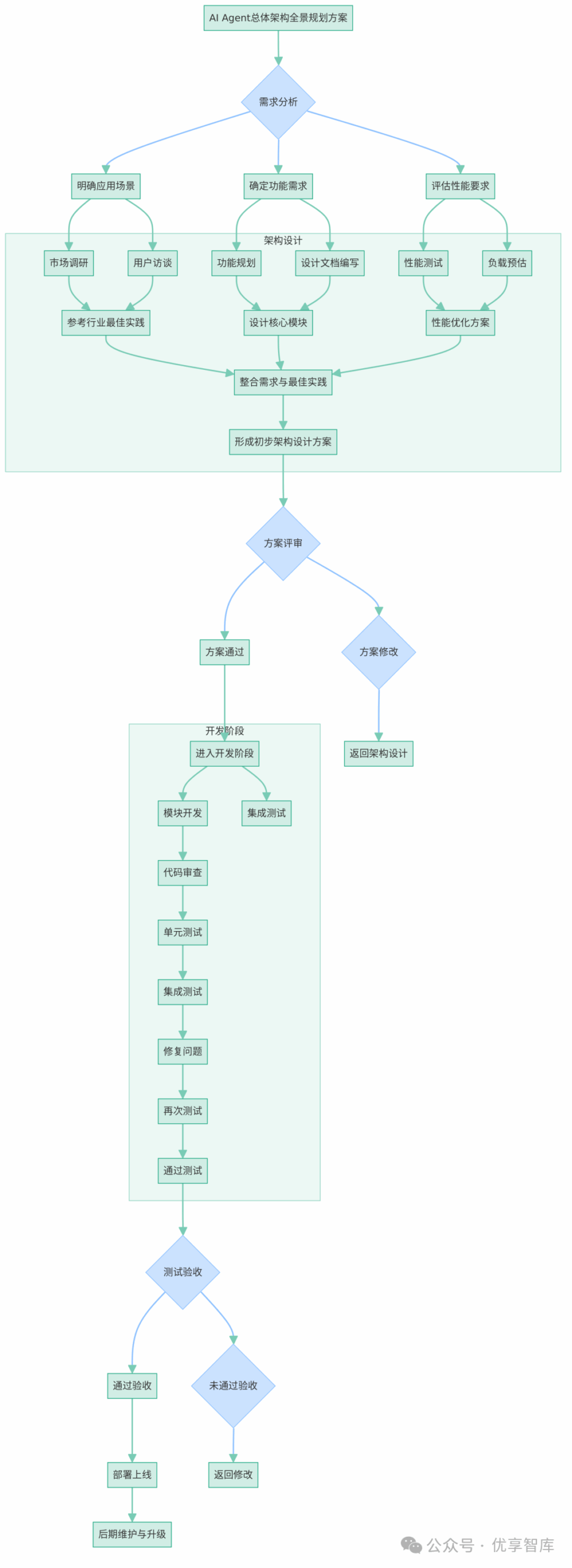
DB-GPT is another key module in the system, adept at handling structured queries. By employing syntax tree transformation technology, DB-GPT can convert complex financial report analysis tasks such as “Identify companies on the Growth Enterprise Market with ROE exceeding 15% in the past three years” into quantitative query languages containing Wind codes. This transformation process ensures the accuracy and efficiency of the queries. In stress tests, DB-GPT’s average response time for complex financial report analysis tasks is strictly controlled to within 4.8 seconds, fully demonstrating its powerful capabilities in handling complex problems.
|
|
|
DB-GPT Workflow Diagram |
Visualization and User Interaction: The “Artistic Presentation” of Data
The way information is presented directly affects decision-making efficiency, and intelligent visualization systems are reshaping the paradigm of human-computer interaction.
AI Visualization (AG-UI): Chart Configuration as a Service
The schema-based automatic chart recommendation system analyzes data distribution characteristics, prioritizing trend charts for time series data and automatically matching sunburst charts for categorical variables. After integration with a brokerage research report platform, the time spent on chart production was reduced by 67%, and the efficiency of research report production improved by 50%.
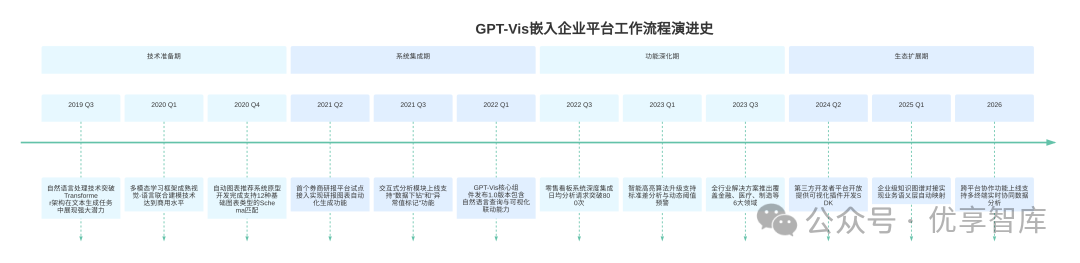
GPT-Vis: Full-Scene Embedded Q&A Component
This component supports natural language interactive exploration. When users follow up with questions like “Which provinces have abnormal growth?”, the system instantly highlights the negative growth areas on the map and pops up a standard deviation analysis panel. In retail dashboards, the component triggers deep analysis requests an average of 1200 times per day.
|
|
|
GPT-Vis Embedded Enterprise Platform Workflow |
Conclusion: Five Key Words of AI Agent Architecture and Future Outlook
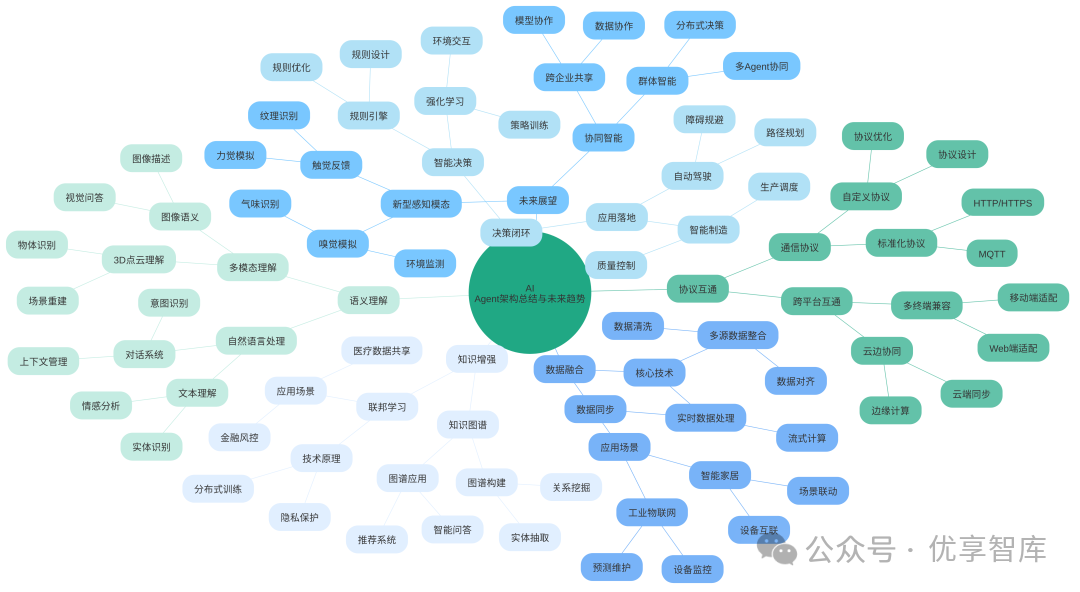
Data fusion, protocol interoperability, knowledge enhancement, semantic understanding, and decision-making closed loop are the five key words that constitute the core capability matrix of contemporary AI Agents. Data fusion and protocol interoperability enable AI Agents to seamlessly connect and exchange information, while knowledge enhancement and semantic understanding equip AI Agents with the ability to comprehend and process complex information. The decision-making closed loop allows AI Agents to make more efficient and intelligent decisions based on these capabilities. With the addition of new perception modalities such as 3D point cloud understanding and olfactory simulation, AI Agents will break through the cognitive boundaries between the digital and physical worlds, possessing more powerful perception capabilities and a more comprehensive understanding of the world. The maturity of federated learning technology is expected to achieve cross-enterprise knowledge sharing, further enhancing the collaborative intelligence of AI Agents. In the future, AI Agents will demonstrate their powerful capabilities and broad application prospects in more fields.
|
|
|
Summary of AI Agent Architecture and Future Trends |