Concept
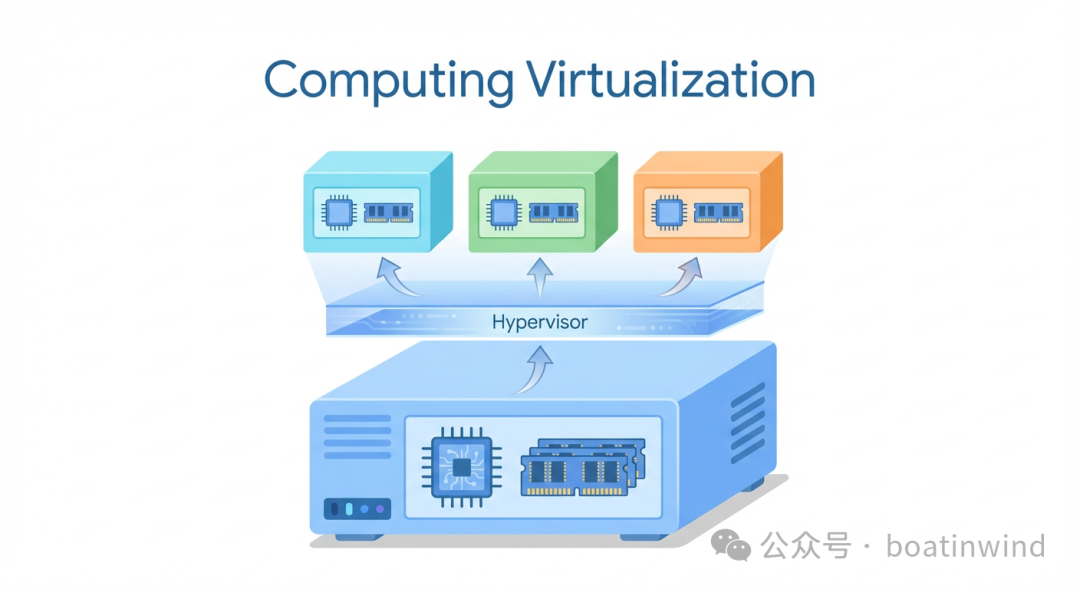
Computing virtualization is a technology that transforms physical computer resources into logical resources. In simple terms, it is like creating multiple “virtual computers” on a single physical computer, with each virtual computer capable of independently running its own operating system and applications, just like a real physical computer. This technology achieves abstraction and allocation of computing resources such as CPU and memory by adding a virtualization layer (known as Hypervisor or Virtual Machine Monitor, VMM) between the physical hardware and the operating system.
The core value of virtualization lies in improving resource utilization. Traditional server resource utilization typically ranges from 5% to 15%, resulting in a significant waste of computing power. Through virtualization technology, a single physical server can simultaneously run multiple virtual machines, each isolated from one another, increasing resource utilization to 60% to 80%, thereby greatly reducing hardware costs and energy consumption.
Origin
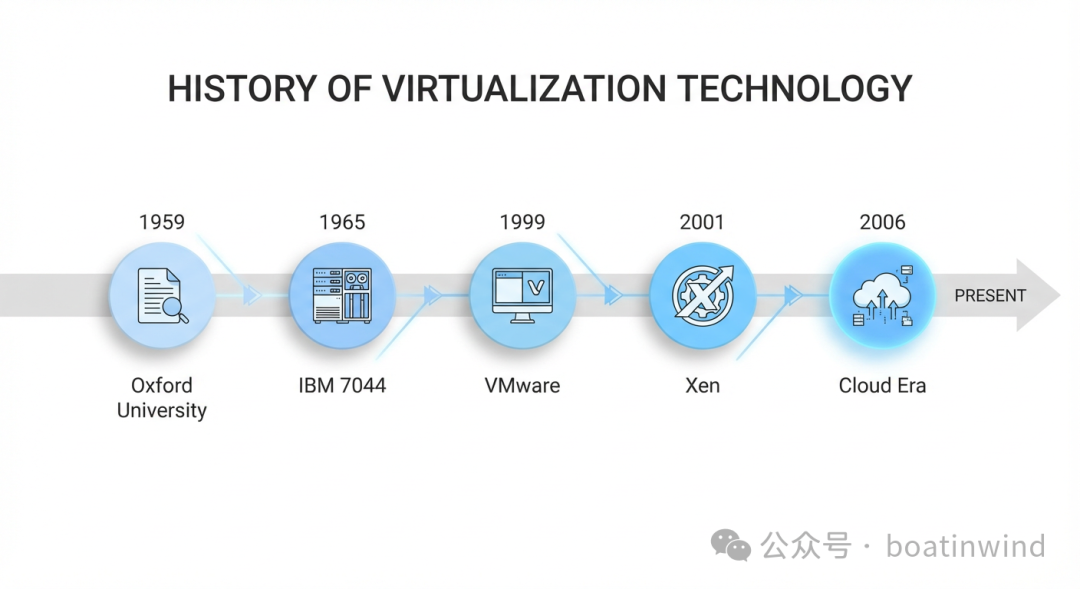
The history of virtualization technology dates back to 1959, when Professor Christopher Strachey from the University of Oxford presented a paper titled “Time-Sharing in Large High-Speed Computers” at the International Conference on Information Processing, where he first introduced the basic concept of “virtualization,” which is considered the earliest discussion of virtualization technology.
In 1965, IBM implemented the first virtualization application on a commercial system—the IBM 7044 mainframe, which allowed users to run multiple operating systems on a single host, fully utilizing the expensive mainframe resources. For more than 20 years, virtualization technology was primarily applied in the mainframe domain. Due to the limited processing power of the x86 platform, virtualization progressed slowly on PC servers.
1999 marked a significant turning point in the development of virtualization technology, as VMware launched commercial virtualization software that could run smoothly on the x86 platform, bringing virtualization technology down from the mainframe pedestal into the PC server domain. In 2001, the University of Cambridge in the UK released the open-source virtualization project Xen. In 2003, Microsoft acquired Connectix to enter the virtualization market. From 2006 to the present, virtualization technology has entered a period of explosive growth, becoming a core technology for data centers and cloud platforms with the advent of multi-core CPUs and the rise of cloud computing.
Elements and Relationships
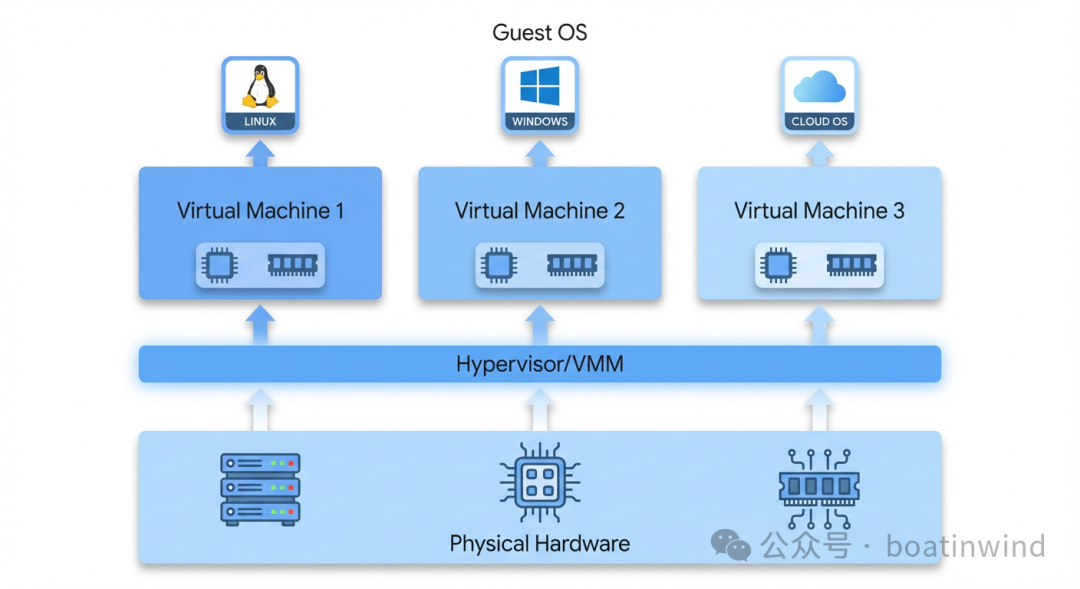
A computing virtualization system consists of four core elements: physical hardware, virtualization layer, virtual machines, and guest operating systems. Physical hardware is the foundational layer, including real computing resources such as CPU, memory, storage, and network devices. The virtualization layer (Hypervisor/VMM) is the critical intermediate software layer that sits between the physical hardware and the virtual machines, responsible for abstracting physical resources and allocating them for use by virtual machines.
A virtual machine (VM) is a logical computing environment created by the virtualization layer, with each virtual machine possessing virtual CPU, memory, hard disk, and network interfaces. The operating system running on the virtual machine is referred to as the guest operating system, which is unaware that it is operating in a virtual environment, functioning as if it were running on a real physical machine.
The relationship between these elements is that the Hypervisor intercepts and redirects the guest operating system’s access requests to the hardware, enabling resource sharing, abstraction, and simulation. It provides each virtual machine with a complete virtual hardware interface while ensuring strict resource isolation and security between virtual machines, ensuring that a failure in one virtual machine does not affect the operation of others.
Core Technologies
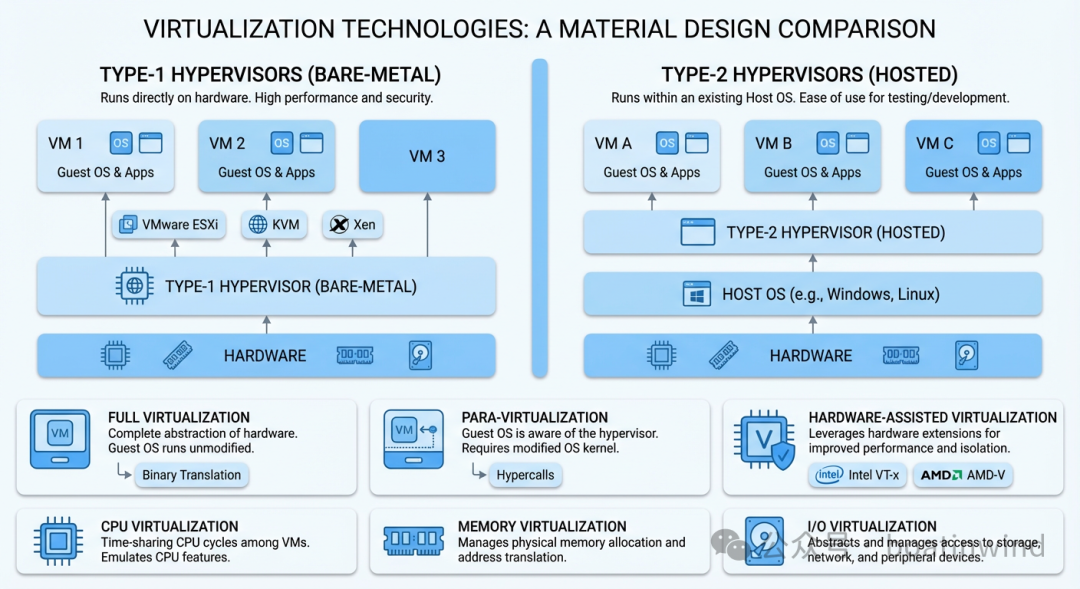
Based on the deployment method of the Hypervisor, virtualization technology is divided into two main types. Type-1, also known as bare-metal virtualization, runs the Hypervisor directly on the physical hardware without the need for a host operating system, offering higher performance and reliability. Representative products include VMware ESXi, KVM, Xen, and Microsoft Hyper-V. Type-2, also known as hosted virtualization, runs the Hypervisor on top of a host operating system as an application, achieving relative simplicity but lower performance. Representative products include VMware Workstation and Oracle VirtualBox.
From the perspective of virtualization implementation, there are three main technical paths. Full virtualization completely simulates the hardware environment through binary translation technology, allowing the guest operating system to run without modification, but with significant performance overhead. Paravirtualization requires modifications to the guest operating system kernel to make it aware of the virtualization environment, communicating with the Hypervisor through Hypercalls, offering better performance but limited compatibility. Hardware-assisted virtualization relies on CPU virtualization extensions (such as Intel VT-x and AMD-V), supporting virtualization at the hardware level, significantly improving performance and simplifying implementation.
Virtualization technology needs to address three core issues: CPU virtualization allows multiple virtual machines to share the physical CPU through time-slicing or hardware assistance; memory virtualization maps the virtual machine’s physical addresses to real physical addresses using shadow page tables or EPT/NPT technology; I/O virtualization provides virtual disks, network cards, and other devices through device emulation or virtio paravirtualized drivers. These three technologies together form a complete virtualization solution.
Applicable and Inapplicable Scenarios
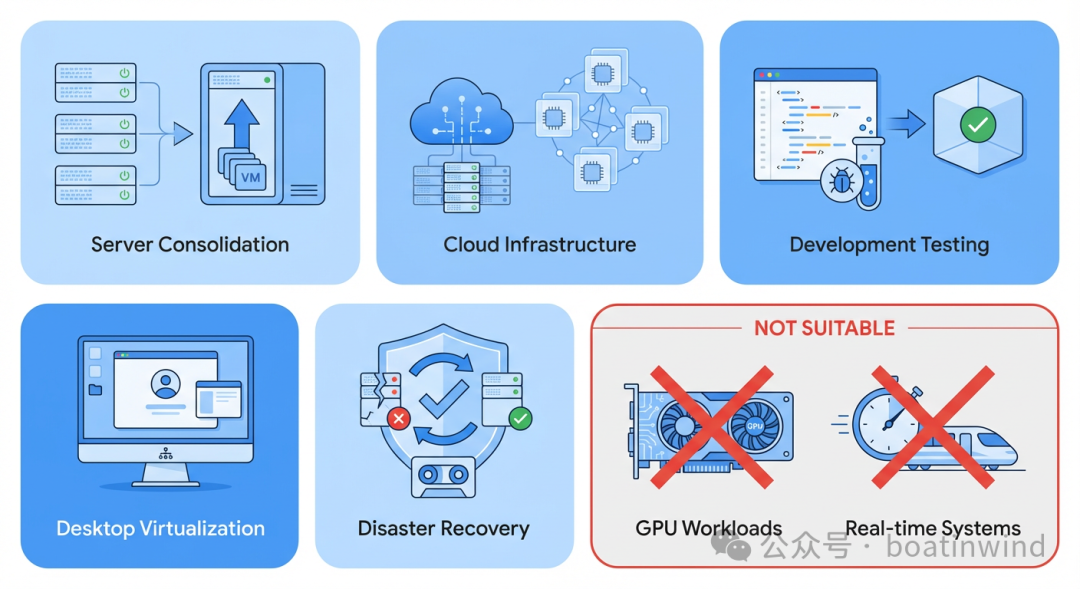
Computing virtualization technology has a wide range of applications across multiple fields. Server consolidation is the most typical application scenario, integrating multiple low-utilization physical servers into a few high-performance servers, reducing hardware costs, data center space, and energy consumption. Cloud computing infrastructure is almost entirely built on virtualization technology, with both public and private clouds using virtualization to provide flexible computing resources. Development and testing environments utilize virtualization to quickly create, clone, and delete test environments, significantly improving development efficiency.
Desktop virtualization centralizes users’ desktop environments in data centers, allowing users to access their virtual desktops from any location and device, enhancing the flexibility of mobile work and data security. In disaster recovery, virtual machines can be quickly backed up, migrated, and restored, significantly reducing business interruption time. Additionally, virtualization is widely used in education and training, simulation, and other scenarios.
However, virtualization is not suitable for all scenarios. Applications requiring high-performance graphics processing, video rendering, or 3D design are better suited to run on physical machines due to limitations in GPU virtualization technology. Applications that require special hardware support (such as encryption cards or dedicated capture cards) may not have direct access in a virtualized environment. Real-time systems that are extremely sensitive to latency (such as industrial control or high-frequency trading) may find the additional latency introduced by virtualization unacceptable. Applications with extremely high resource consumption (such as large-scale scientific computing) may experience significant performance loss when running in virtual machines, making direct use of physical servers more appropriate.
Prospects
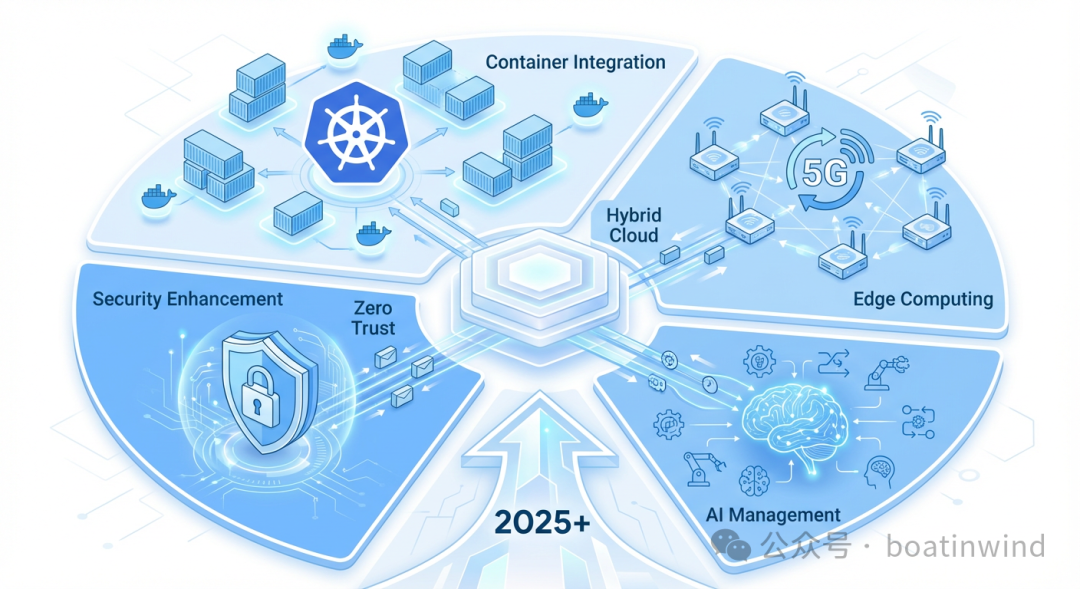
The future development of virtualization technology shows several clear trends. The integration of containerization technology with traditional virtualization is an important direction, as containers provide a more lightweight isolation solution than virtual machines. The hybrid deployment of container orchestration platforms like Kubernetes with virtualization infrastructure will become the norm, with critical business retaining the virtualization layer to ensure stability while microservices transition to containerized deployments for enhanced flexibility.
Edge computing virtualization is rapidly developing, as computing power is shifting towards edge nodes with the popularization of 5G and the Internet of Things. Lightweight virtualization engines and self-organizing network technologies for edge node clusters will enable edge devices to enjoy the resource optimization and management convenience brought by virtualization. Cloud-edge collaborative architectures will achieve three-layer collaboration between terminal device layers, edge virtualization layers, and regional cloud centers through virtualization technology, enabling local processing with millisecond-level response while collaborating with the cloud for model training.
Intelligent management is an important direction for the evolution of virtualization technology. AI-based predictive scheduling engines can anticipate resource needs and trigger resource rebalancing, while self-healing systems can automatically detect virtual machine failures and perform migration recovery. Dynamic energy efficiency management technologies can reduce the PUE value of data centers to below 1.1. Security continues to enhance through a three-layer protection system built with hardware-level TPM/SEV encryption, micro-segmentation strategies at the virtualization layer, and zero-trust verification at the application layer.
The thriving open-source ecosystem is also driving advancements in virtualization technology, with open-source projects like KVM, QEMU, and Kata Containers continuously optimizing performance, enhancing security, and improving compatibility. Market research predicts that the global virtualization market will maintain a compound annual growth rate of 12-15%, and after 2025, the deep integration of virtualization with technologies such as artificial intelligence, the Internet of Things, and edge computing will provide stronger infrastructure support for enterprise digital transformation and cloud computing development.