※ Think Tank for Information Society Policy Exploration ※※ Barometer of Cutting-edge Information and Communication Technology ※
Author Introduction
Huang Xiaojie
Master’s student at the School of Information and Communication Engineering, Beijing University of Posts and Telecommunications, majoring in computing power networks and industrial internet.
Song Wenxuan
Master’s student at the School of Information and Communication Engineering, Beijing University of Posts and Telecommunications, majoring in computing power networks and industrial internet.
Zhang Hengsheng
Senior Engineer at the Technology and Standards Research Institute, China Academy of Information and Communications Technology, focusing on data communication technology, IP network technology, industrial internet networks, etc.
Xu Fangmin
Associate Professor at the School of Information and Communication Engineering, Beijing University of Posts and Telecommunications, focusing on IoT networks and future network technologies.
Zhao Chenglin
Professor at the School of Information and Communication Engineering, Beijing University of Posts and Telecommunications, PhD supervisor, focusing on short-range wireless transmission technology, cognitive radio technology, millimeter-wave technology, industrial internet networks, etc.
Paper Citation Format:
Huang Xiaojie, Song Wenxuan, Zhang Hengsheng, et al. Challenges and Design of Computing Power Network for AIGC Services[J]. Information Communication Technology and Policy, 2023,49(6):10-16.
Challenges and Design of Computing Power Network for AIGC Services
Huang Xiaojie1 Song Wenxuan1 Zhang Hengsheng2 Xu Fangmin1 Zhao Chenglin1
(1. School of Information and Communication Engineering, Beijing University of Posts and Telecommunications, Beijing 100876; 2. Technology and Standards Research Institute, China Academy of Information and Communications Technology, Beijing 100191)
Abstract: Currently, new computing services such as AIGC are booming, and the development of computing power networks also shows new trends and characteristics to meet the development needs of new services. This paper focuses on the challenges and design of computing power networks for AIGC services, firstly introducing the necessity of integrating computing networks with AIGC services, and the significance and value of their combined development; secondly, a new computing power network architecture for AIGC services is designed, and finally, based on the current development trends and challenges, references for subsequent research work are provided.
Keywords: computing power network; AIGC; computing-network convergence
0 Introduction
2023 marks the inaugural year for the application of large models in artificial intelligence (AI), where advancements in various dimensions have propelled the emergence of Artificial Intelligence Generated Content (AIGC), which demonstrates extraordinary performance in applications such as knowledge Q&A, translation, summarization, and content creation, becoming a new engine in the digital economy era. Currently, AIGC technology has become a hot topic in the field of artificial intelligence and has extended to various application fields such as smart homes, autonomous driving, and smart healthcare.
Currently, the computational demands of AI applications are growing exponentially, with algorithm models evolving towards larger scales. The parameters of AI models have increased by a factor of one hundred thousand over the past decade[1]. Therefore, AIGC-type new computing services have very high requirements for computing power and communication, necessitating a matching computing power network to support their development. As the degree of digitalization accelerates and the demand for computing power from large models continues to rise, the future development of the digital economy will increasingly rely on computing power networks, and the combination of AIGC-type new services and computing power networks will create more intelligent, digital, and human-centered service applications. This paper will focus on the challenges and design of computing power networks for AIGC-type new computing services, providing recommendations for research and development directions for technicians in related fields. In the future, we look forward to more extensive and in-depth applications of computing power networks and AIGC, while also paying attention to the risks and challenges in technological development, promoting relevant departments to formulate policies and take measures to ensure that the development of artificial intelligence technology can better serve human society.
1 Necessity of AIGC Services and Computing Power Networks
1.1 Development and Application of AIGC Services
General Artificial Intelligence (AGI) refers to an artificial intelligence system that can possess human-level intelligence. The main characteristics of AGI include the ability to handle various complex tasks through learning, understanding, reasoning, and creation, including language understanding, image recognition, and Natural Language Processing (NLP). AIGC, as the first step in the development of AGI, integrates technologies such as artificial intelligence, communication technology, and cloud computing to achieve intelligent data processing and analysis. AIGC is classified from the perspective of content producers, serves as a method of content production, and is a set of technologies used for automated content generation[2]. Although AGI technology is still in the research phase, the related applications of AIGC have rapidly developed with the emergence of large models.
Currently, the development and application of AIGC services are very widespread, including audio, text, image, and video generation, as well as cross-modal generation among images, videos, and texts. AIGC has already achieved significant results in many practical applications such as text generation, artistic creation, and game development. Many companies and researchers have successfully applied AIGC technology in actual projects and products.
Among them, the Generative Pre-trained Transformer (GPT) model is mainly based on three technologies: the sequence-to-sequence model Transformer based on attention mechanisms in natural language processing[3]; the use of the Prompt mechanism to guide the model to generate specific types of outputs; and the Fine-tune technique for training pre-trained models with a small labeled dataset to improve performance on new tasks or domains.
Taking GPT[4] as an example, 2023 has seen a surge of large language models (LLMs)[5-6] and research in AIGC-related fields[7-8]. Large-scale pre-trained models represented by GPT-3 and GPT-4 have replaced some smaller algorithm models with their data and computing power advantages, demonstrating a feasible path towards general artificial intelligence[9]. Table 1 lists the mainstream AIGC large models and applications both domestically and internationally.
Table 1 Overview of Mainstream AIGC Large Models and Applications
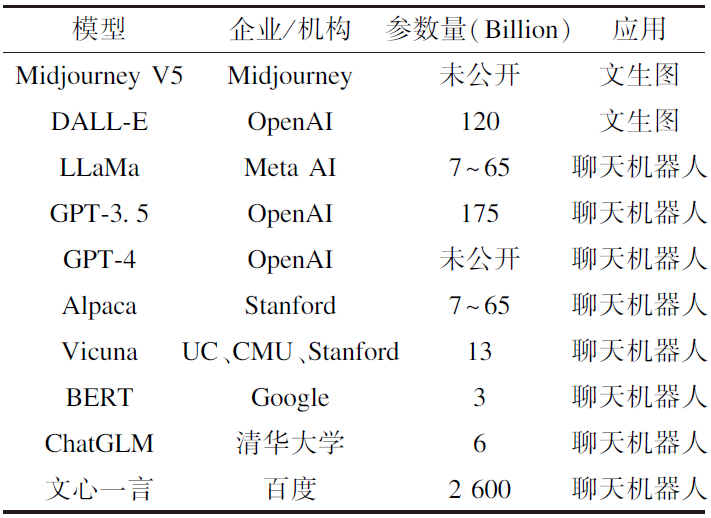 The collective emergence of AIGC large models provides direction and practice for the research on deploying AIGC-related applications in computing power networks, while also posing challenges for the computing power requirements, data security, and privacy protection of businesses. In summary, with the continuous development of technologies such as artificial intelligence, the Internet of Things, and cloud computing, the application of AIGC technology will become increasingly widespread, bringing more efficient, secure, and intelligent services to various industries.1.2 Characteristics of AIGC ServicesAIGC services use large models with substantial computing power to extract effective information from massive amounts of data, achieving automated data processing and decision-making, as shown in Figure 1. AIGC services have the following characteristics.
 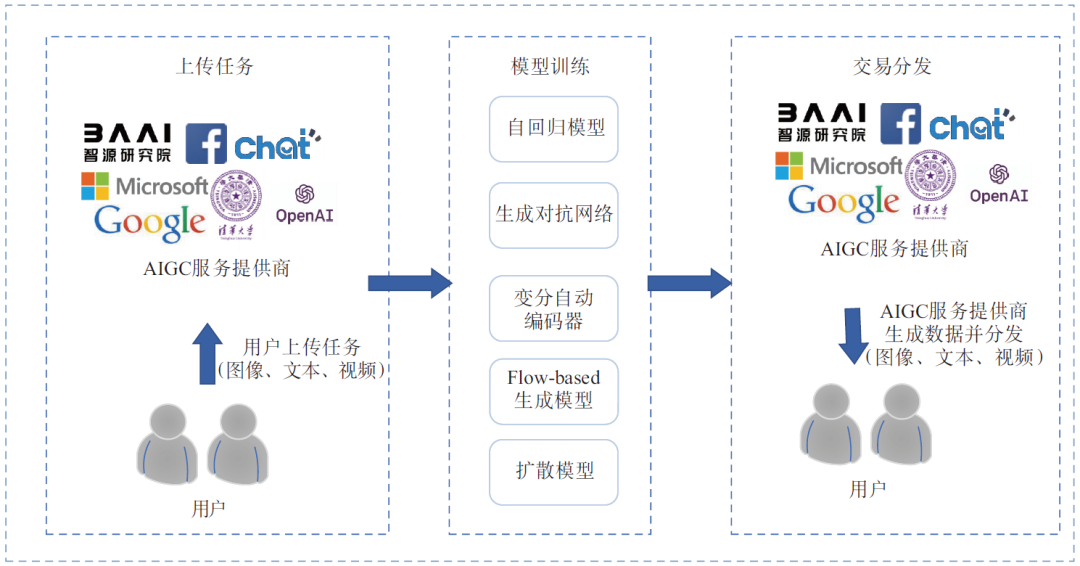 Figure 1 AIGC Service Process1.2.1 Large and Diverse Data Upload and DistributionIn AIGC services, data upload typically refers to data collection and transmission, including preprocessing and labeling various types of data. This includes structured, unstructured, and semi-structured data from different sources such as sensors, monitoring devices, social networks, and mobile devices. Data needs to be cleaned, transformed, and integrated for the application of deep learning and machine learning algorithms. Due to the usually large volume of transmitted data, high bandwidth and low latency networks are needed for support. Data distribution refers to the transmission of trained models, algorithms, and results back to clients or other systems. As the scale and diversity of data increase, the ability to process data must also continuously improve.1.2.2 Expanding Models Require Significant Computing PowerSupport for large models applied in AIGC typically consists of multi-level complex structures that need to process millions of parameters and variables. These models and algorithms usually require substantial computational resources for training and inference. To handle massive data and complex models, parallel computing and distributed computing technologies must be used to leverage multiple computers or processors to process data simultaneously. This approach can significantly improve computational efficiency, shorten training times for models, and help resolve computing capacity bottlenecks. Additionally, efficient algorithm design and optimization are necessary to reduce computing and storage costs, enhancing system scalability and stability. Therefore, for AIGC services, substantial computing power is the foundation and core of their development and application, and the demand for computing power is one of the main challenges they face. In ordinary computing tasks and services, traditional computing methods such as edge computing and cloud computing have certain limitations and cannot fully meet the needs of AIGC services. For instance, in addressing data latency issues, cloud computing and edge computing cannot guarantee low latency when processing large amounts of AIGC service data; regarding transmission bandwidth, cloud computing and edge computing typically rely on network connections for data transmission, while network bandwidth is limited, especially in edge computing where edge devices usually have lower bandwidth and storage capabilities, making it difficult to handle large data transmission tasks; in terms of data privacy and security, the privatization of models and the data in AIGC services often contain sensitive information, increasing the risk of data being stolen or tampered with when transmitted to data centers or edge devices for processing. Cloud computing and edge computing play important roles in many common computing tasks and services. However, for some complex and large-scale computing tasks, traditional computing methods are limited by computing power, data processing capabilities, and model expressiveness, etc. Therefore, for these scenarios, introducing artificial intelligence technology in conjunction with computing power network transaction distribution, based on the AIGC service computing network architecture, can provide more efficient, accurate, and automated solutions. In summary, AIGC services have large amounts of data to upload and distribute, and large models require substantial computing power. Traditional computing methods can no longer meet the needs of AIGC services, necessitating an efficient method for data transmission and processing to support the rapid development of services. The computing power network possesses robust computing power, data processing, and automation tools, along with a highly scalable, reliable, and elastic system design capability. As the infrastructure for implementing AIGC, computing power networks organize and schedule the cloud-edge-end three-tier computing structure into an efficient and secure network, collaboratively completing large-scale computing tasks. The main role of computing power networks is to provide distributed computing services capable of handling various complex computing tasks, such as artificial intelligence, machine learning, and big data analysis. In computing power networks, to address data upload and distribution as well as the computing power issues of large models, AIGC services typically adopt distributed systems and cloud-edge-end collaborative computing technologies to support efficient data transmission and processing. For example, through distributed storage and computing technologies, data and computing tasks can be dispersed across multiple computers, thereby improving data processing and model training efficiency. Additionally, edge and cloud servers provide abundant computing resources and services, including high-speed networks and high-performance computing, which can enhance data processing and model training efficiency, thereby meeting the needs of AIGC services.2 Architecture and Design of Computing Power Networks for AIGC ServicesTraditional computing power networks can be logically divided into computing service layers, computing network management layers, computing resource layers, computing routing layers, and network resource layers. Among them, the computing routing layer includes control and forwarding planes to achieve ubiquitous computing and service perception, dynamic distribution of computing and storage resources interconnection. The key point in the design of computing power network architecture for AIGC services is how to effectively coordinate heterogeneous and diverse computing resources scattered across the cloud-edge-end and numerous fragmented AIGC services, enabling smooth operation of business applications across various computing resources and fully utilizing massive computing resources[10]. Compared to traditional computing power network architecture design, the architecture for AIGC services merges the network resource layer and computing resource layer into a network infrastructure layer to achieve unified control and management of computing and network resources; transitioning from network scheduling to joint scheduling of network and computing, from network metrics to interconnection, metrics, and modeling of network elements and computing nodes; AIGC requires a large scale of computing resources, and the design of the computing-network convergence layer enhances the training efficiency of large models through distributed services and storage. AIGC services typically require large-scale computing resources to support their complex computing needs[11]. The process of AIGC services involves users uploading raw data tasks (including text, images, videos) to the computing nodes of the computing power network, where the computing provider accepts the tasks and utilizes model training to generate content. The models include autoregressive models, generative adversarial networks, variational autoencoders, flow-based generative models, diffusion models, and other large models; after a transaction is concluded, the AIGC service provider distributes the generated content to users. The architecture and design of computing power networks for AIGC services need to fully consider business needs and technical implementations, providing high-performance, high-reliability, and secure computational resource support. As shown in Figure 2, the new computing power network architecture can be divided into a network infrastructure layer, a computing-network convergence layer, and an application service layer.
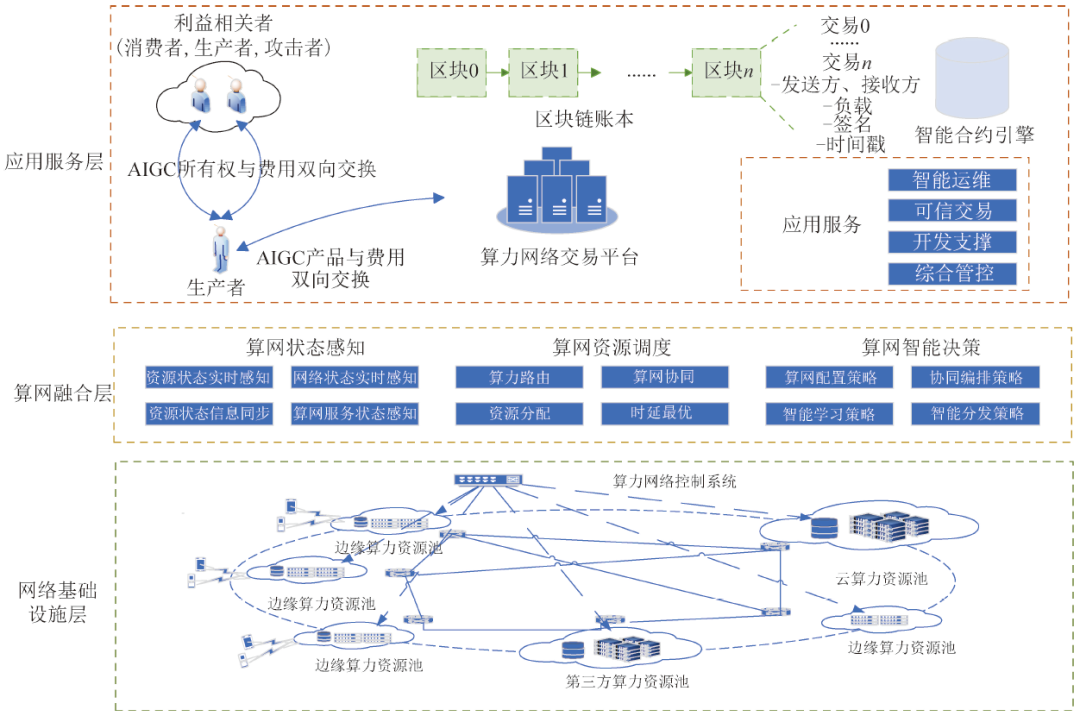 Figure 2 Design of New Computing Power Network for AIGC Services2.1 Network Infrastructure LayerThe network infrastructure layer serves as the foundational base of the new computing power network architecture, capable of constructing a multi-level heterogeneous computing power network, including a computing resource pool composed of cloud computing nodes, edge computing nodes, and end-side computing nodes. The network infrastructure includes the 5G/super 5th generation mobile communication system (B5G) access network, deterministic edge networks, deterministic wide-area networks, and deterministic data center networks, etc.2.2 Computing-Network Convergence LayerThe computing-network convergence layer is the central system of the new computing power network architecture, primarily implementing three major functions: computing-network status perception, computing-network resource scheduling, and intelligent decision-making for the computing-network. Regarding computing-network status perception, in the design of computing power networks for AIGC, precise perception of the operating status of edge computing nodes and network devices is achieved through the collection or monitoring of computing and network resource status information, thus supporting scheduling decisions for computing tasks and providing data support for the operation and maintenance of edge computing nodes and network devices. In terms of computing-network resource scheduling, by collecting, processing, and analyzing computing and network resource status information and integrating machine learning algorithms, predictions of the computing conditions of edge computing nodes and network status can be achieved, thereby enhancing the perception capabilities of computing and network resource status and enabling refined allocation of resources and real-time scheduling of computing tasks. For intelligent decision-making, based on intelligent perception of computing-network status, automated analysis, modeling, and decision-making are conducted within the computing power network, with decision results fed back to the computing power network control system, providing intelligent decision-making capabilities for computing-network resource management.2.3 Application Service LayerThe application service layer primarily includes four major functions: intelligent operation and maintenance, trusted transactions, development support, and comprehensive management and control, where AIGC services conduct transactions through the computing power network transaction platform. To ensure security and reliability, transactions adopt a blockchain distributed ledger for record-keeping, utilizing a chain data structure to store transaction information and preserving the information on-chain to ensure that all data is authentic and immutable.3 Challenges and ProspectsIn the design of computing power networks for new AIGC computing services, the high demands of AIGC services on computing power networks include high computation, high bandwidth, high storage, low latency, and reliability. The bottlenecks and challenges of computing power networks in the context of AIGC services include: the dispersion of computing resources, the complexity of resource scheduling, bandwidth limitations in data transmission, and ensuring data privacy and security. Among these, adjusting offloading scheduling algorithms and routing strategies, ensuring security, and optimizing service transactions are three key issues. In adjusting offloading scheduling algorithms and routing strategies, due to the specificity of AIGC services, traditional scheduling algorithms and routing strategies are no longer applicable. Since large models require substantial computing power support, selecting appropriate nodes and paths is crucial to ensuring that services can operate efficiently and maximize the utilization of computing resources. This involves resource allocation, coordination, and management within the computing power network, necessitating the design of new algorithms and protocols to address the aforementioned issues. Based on specific application scenarios and requirements, the following three solutions are proposed. · Static scheduling scheme based on network topology: Depending on the differences in AIGC services and network topology, computing tasks are scheduled to different nodes for execution to achieve load balancing and minimize data transmission costs. · Dynamic scheduling scheme based on machine learning algorithms: Utilizing machine learning algorithms to predict computing tasks, enabling dynamic scheduling of tasks and adaptive resource allocation to enhance overall system performance and efficiency. · Hierarchical routing scheme: Dividing the network according to a hierarchical structure, routing data based on different layers to achieve low-latency and high-throughput data transmission. In ensuring security, the large-scale data upload and distribution of AIGC services, along with the computing processes of large models, may involve confidential data and sensitive information. Therefore, ensuring data security and privacy is crucial. Additionally, due to the high demands of AIGC services on computing power networks, attackers may exploit vulnerabilities in computing power networks to launch attacks, such as Distributed Denial of Service (DDoS) attacks and malicious node attacks. Thus, efficient security mechanisms need to be designed and implemented to protect the computing power network and AIGC services. In optimizing service transactions, due to the unique nature and large-scale demands of AIGC services, transaction modes and mechanisms need to be restructured and optimized. Efficient service matching and transactions must be achieved while ensuring fairness and transparency of transactions. An efficient automated service management and monitoring mechanism must also be established to improve service quality and reliability. By designing a computing power transaction scheme that combines smart contracts with blockchain, utilizing the decentralized advantages of blockchain and distributed data synchronization and storage technologies, computing power transactions can be distributed across various computing resource nodes. To ensure transaction security and trustworthiness, both computing power demanders and resource providers must apply for digital certificates and private keys from a third-party digital certificate issuing authority to sign and confirm transaction results before proceeding with computing power transactions, as shown in Figure 3.
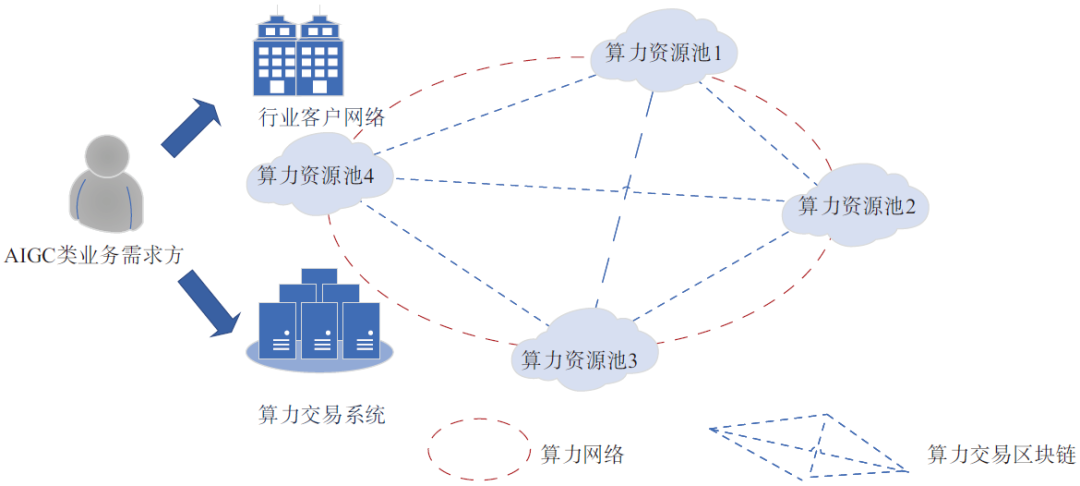 Figure 3 Computing Power Transaction Model Based on Blockchain Smart ContractsTherefore, in the process of integrating computing power networks with AIGC, through interdisciplinary research and collaboration, leveraging advanced technologies such as machine learning and blockchain, innovative adjustments to offloading scheduling algorithms and routing strategies can be made to ensure security and optimize services, ensuring the efficient, secure, and reliable operation of computing power networks and AIGC services.4 ConclusionThis paper discusses the design and challenges of computing power networks for new AIGC computing services, proposes the necessity of integrating computing networks with AIGC services, designs the future computing power network architecture for AIGC services, and discusses the challenges faced and future development trends. In the future, the industry will closely follow the demands of computing power network technology and AIGC services and their application fields, continuously focusing on related computing power network design and implementation solutions. Challenge and design of computing power network for new AIGC computing servicesHUANG Xiaojie1, SONG Wenxuan1, ZHANG Hengsheng2, XU Fangmin1, ZHAO Chenglin1(1. School of Information and Communication Engineering, Beijing University of Posts and Telecommunications, Beijing 100876, China; 2. Technology and Standards Research Institute, China Academy of Information and Communications Technology, Beijing 100191, China)Abstract: New computing services such as Artificial Intelligence-Generated Content (AIGC) are booming. The development of computing power network also presents new trends and characteristics to meet the needs of new business development. This paper focuses on the challenge and design of computing power network for new AIGC computing services. Firstly, the necessity of introducing the computing network for AIGC services is introduced, and the significance and value of the combination is introduced. Secondly, a new computing power network architecture bearing AIGC services is designed. Finally, the current development trend and challenges are analyzed, which points out the direction for the follow-up research work.Keywords: computing power network; AIGC; computing and network convergence
This article is published in Information Communication Technology and Policy, 2023, Issue 6
Hosted by: China Academy of Information and Communications Technology
Information Communication Technology and Policy is a professional academic journal supervised by the Ministry of Industry and Information Technology and hosted by the China Academy of Information and Communications Technology. This journal positions itself as a barometer of cutting-edge information and communication technology, a think tank for information society policy exploration, focusing on technological trends in the information and communication field, public policy, national/industry/company strategies, publishing cutting-edge research results, analysis of focal issues, interpretation of hot policies, etc., promoting innovation and development in technologies such as 5G, industrial internet, digital economy, artificial intelligence, blockchain, big data, cloud computing, etc., guiding the formulation of national technology strategies and industrial policies, and building a high-end academic exchange platform for production, academia, research, and application.
Submission Guidelines for Information Communication Technology and Policy!
To further improve the informatization level of the journal and provide better quality services for scholars, the official website of our journal has officially launched, and we welcome submissions!

Recommended Reading
Special Topic: Research on Non-bid Procurement Entity Relationship Extraction Based on BERTSpecial Topic Guide: Advanced Computing Innovation and ApplicationTable of Contents and Abstract of Information Communication Technology and Policy, 2023, Volume 49, Issue 5
Are you “looking” at me?