Table of Contents | 2024 Issue 3 Special Topic: 6G Communication Perception and Computation Integration
Discussion on the Application of Integrated Communication Perception and Computation in the Internet of Vehicles
Immersive XR Practice and Outlook Based on 6G Communication Perception and Computation Integration
Key Technologies for Integrated Communication Perception and Computation in Three-Dimensional Transportation Systems
Exploration of 6G Communication Perception and Computation Intelligent Integration Architecture and Scene Empowerment
Wireless Resource Management and Control Under Deep Integration of Communication, Perception, Computation, and Storage
Communication-Perception-Computation Integration for Edge Intelligent Networks: Architecture, Challenges, and Outlook
Mobile Communications 2024 Issue 3
07【6G Communication Perception and Computation Integration】 Special Topic
Cloud-Edge-Device Communication-Computation Integration Architecture Based on Placement Delivery Array
Li Kou, Yan Qifa, Zhou Zhengchun, Tang Xiaohu
(School of Information Science and Technology, Southwest Jiaotong University, Key Laboratory of Information Coding and Transmission, National Joint Research Center for Modern Transportation Communication and Sensing Networks, Chengdu, Sichuan 611756)
【Abstract】With the development of 6G, collaboration among cloud, edge, and terminal nodes has become a current research hotspot, while MapReduce is a parallel computing model for large-scale data processing. This paper proposes a cloud-edge-device collaborative computing and transmission design architecture based on Placement Delivery Array by combining MapReduce with the cloud-edge-device architecture. This architecture fully utilizes the rich computing and storage resources of cloud and edge, deploying redundant computing tasks at the edge and terminal, and leveraging multicast coding to significantly reduce the communication load between the cloud-edge link and edge-terminal link, thereby achieving collaboration between communication and computation among cloud, edge, and terminal, efficiently serving the computational needs of terminals.
【Keywords】Placement Delivery Array; Cloud-Edge-Device Architecture; MapReduce
doi:10.3969/j.issn.1006-1010.20240301-0002
Classification Number: TN92 Document Mark Code: A
Article Number: 1006-1010(2024)03-0047-07
Citation Format: Li Kou, Yan Qifa, Zhou Zhengchun, et al. Cloud-Edge-Device Communication-Computation Integration Architecture Based on Placement Delivery Array[J]. Mobile Communications, 2024,48(3): 47-53.
LI Kou, YAN Qifa, ZHOU Zhengchun, et al. Cloud-Edge-Device Communication-Computation Integration Architecture Based on Placement Delivery Array[J]. Mobile Communications, 2024,48(3): 47-53.

0 Introduction
With the development of Internet of Things technology and the continuous expansion of application scenarios, cloud-edge-device networks have become one of the important technologies supporting the development of intelligent transportation, industrial internet, and smart cities. It combines cloud computing, edge computing, and terminal devices to achieve efficient resource utilization and rapid data processing[1-4]. MapReduce is a classic distributed computing model that decomposes computing tasks into two phases: Map and Reduce, enabling large-scale data processing through the collaborative work of multiple computing nodes[5-6]. In this context, deploying MapReduce tasks in cloud-edge-device systems can fully leverage the resource advantages of cloud, edge, and terminal, flexibly allocating computing tasks to various computing nodes based on data distribution and computational needs, thereby improving task execution efficiency and reliability.
MapReduce decomposes computing tasks into mapping (Map) and reducing (Reduce) phases, enabling large-scale data parallel processing through the collaborative work of multiple computing nodes. After completing the mapping tasks and obtaining intermediate values, MapReduce requires interaction between different computing nodes to exchange intermediate values for subsequent reduction, a process known as data exchange. In recent years, the rapid advancement of artificial intelligence has led to a tremendous increase in wireless data traffic driven by data computation and model training and inference, posing unprecedented challenges for data exchange[7-8]. To address the data exchange bottleneck in MapReduce systems, Li et al. proposed a CDC (Coded Distributing Computing) scheme for end-to-end networks for MapReduce tasks in 2018, referred to as coded computing in this paper. In the mapping phase, it structurally backs up files across different nodes, creating multicast opportunities for data exchange, significantly reducing communication load and yielding optimal computation-communication trade-off curves; thus, multicast coding plays a crucial role in reducing the communication load of MapReduce systems end-to-end[9-10].
Multicast coding first appeared in the coding caching technology proposed by Maddah-Ali and Niesen[11-12], which allows different users’ information to be sent in an overlaid manner on broadcast links by structurally deploying side information at multiple receivers, thereby significantly reducing communication bandwidth. To characterize multicast coding technology, Yan et al. proposed the concept of PDA (Placement Delivery Array)[13]. PDA is a mathematical tool for characterizing coded multicast, which has been generalized to various scenarios, such as hierarchical caching networks with two-layer networks[14-15], end-to-end networks[16-17], and end-to-end MapReduce systems[18-21]. Furthermore, Pang et al. combined hierarchical networks with MapReduce systems, considering special cases where the cloud cannot store any files but can only exchange data[22]. In fact, the industry generally believes that the cloud and edge have abundant storage and computing resources, while terminals are relatively scarce.
This paper is inspired by the HPDA (Hierarchical PDA) proposed for hierarchical caching networks[15] and the MapReduce task framework, proposing a framework for deploying data at different nodes in cloud-edge-device networks to complete diverse computation tasks at terminals based on two given PDAs. One PDA describes the storage and computing data deployment scheme of edge layer nodes, while the other PDA describes the data storage and computing scheme of terminal nodes. Both PDAs jointly describe the signal encoding scheme between the cloud and edge. Through this architecture, any PDA that matches the parameters of the cloud-edge-device network can be used to design coded computing schemes, and the computational load of each node and the communication load of the two-layer links can be easily derived. In particular, this paper analyzes the computational and communication load of the coded computing scheme based on the PDA described by Maddah-Ali and Niesen (i.e., MN-PDA). The results indicate that the communication load of the cloud-edge link decreases as the computational load of the edge and terminal layers increases, while the communication load of the edge-terminal link decreases as the computational load of the terminal nodes increases. Compared to unencoded computing schemes, the coded computing scheme based on MN-PDA can significantly reduce the communication load on both layers.
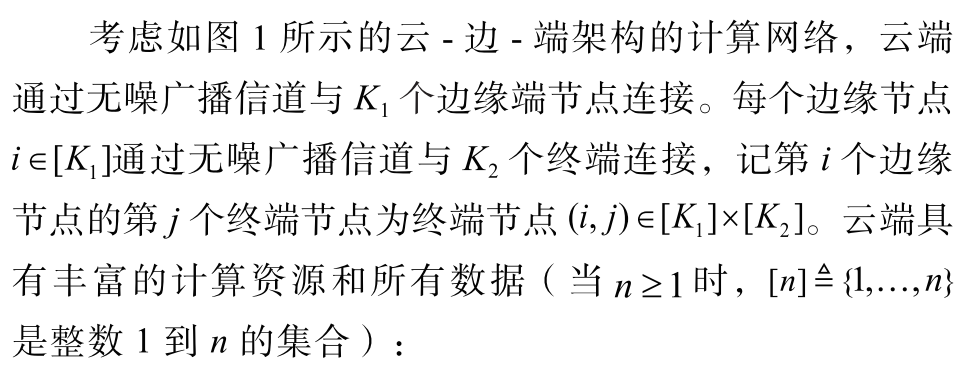
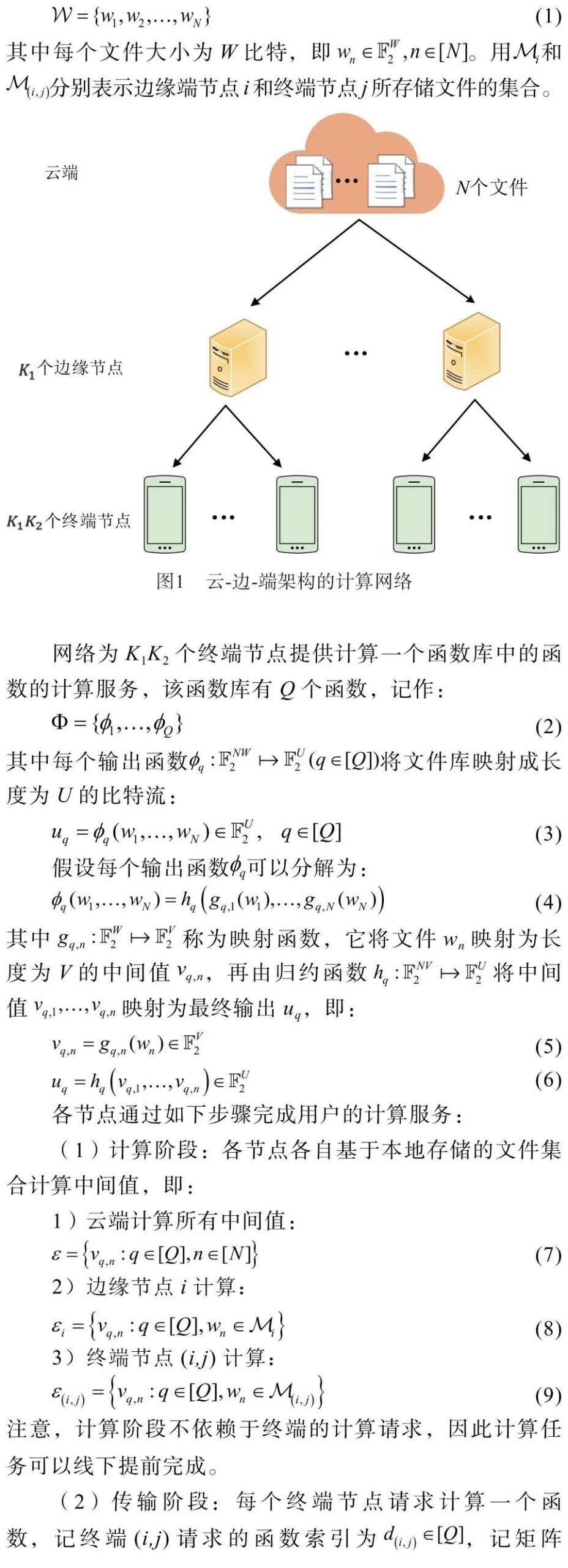
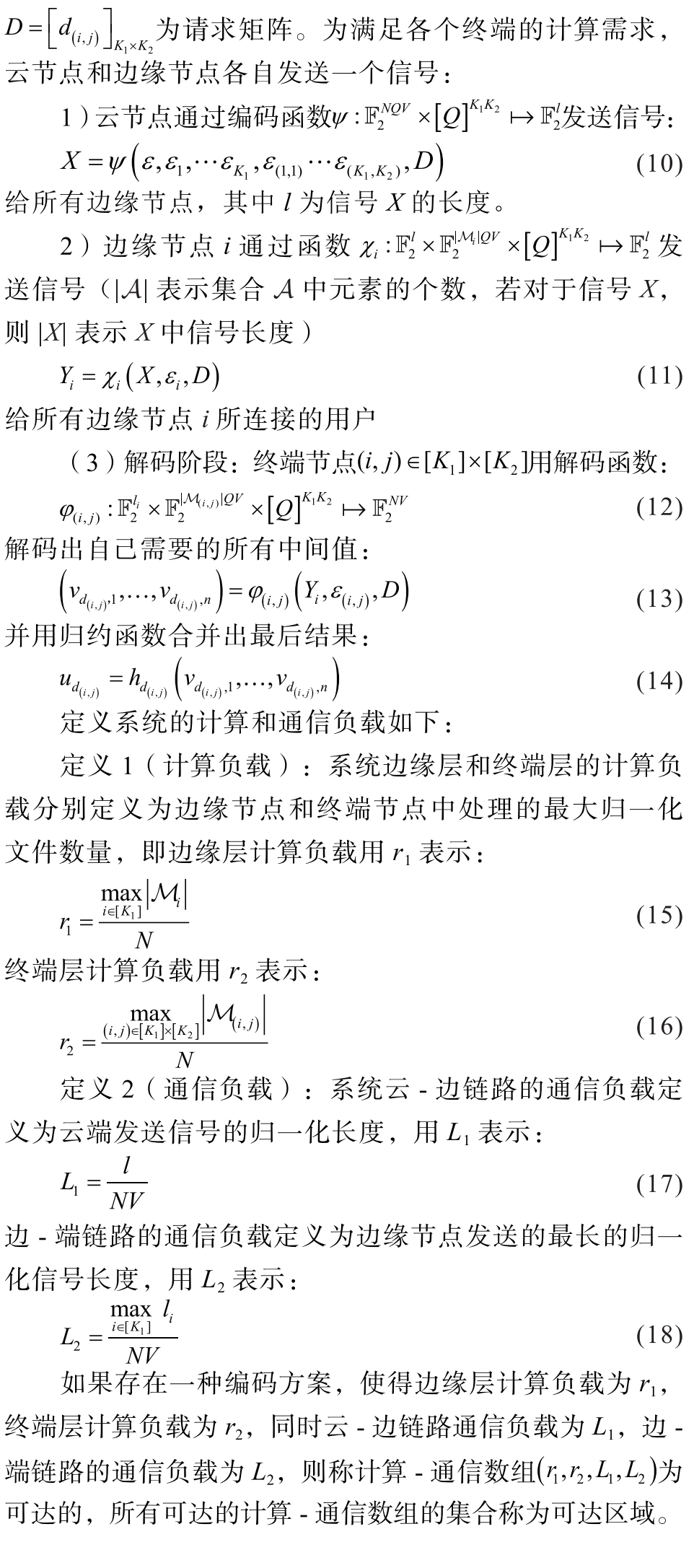
1 Cloud-Edge-Device Network Computing Service Model
2 Cloud-Edge-Device Communication-Computation Integration Framework Based on PDA
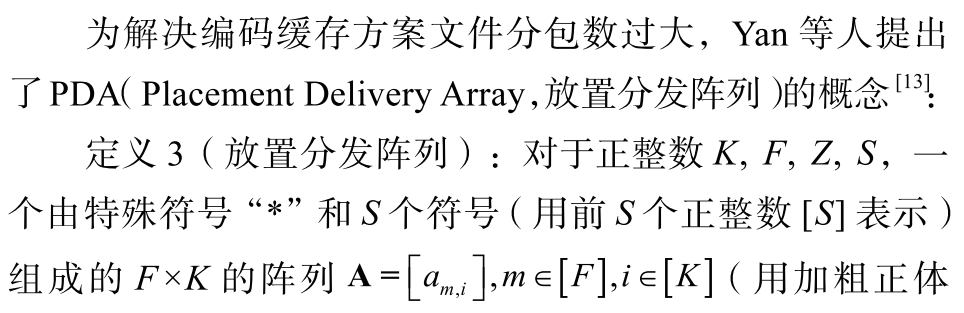
2.1 Placement Delivery Array
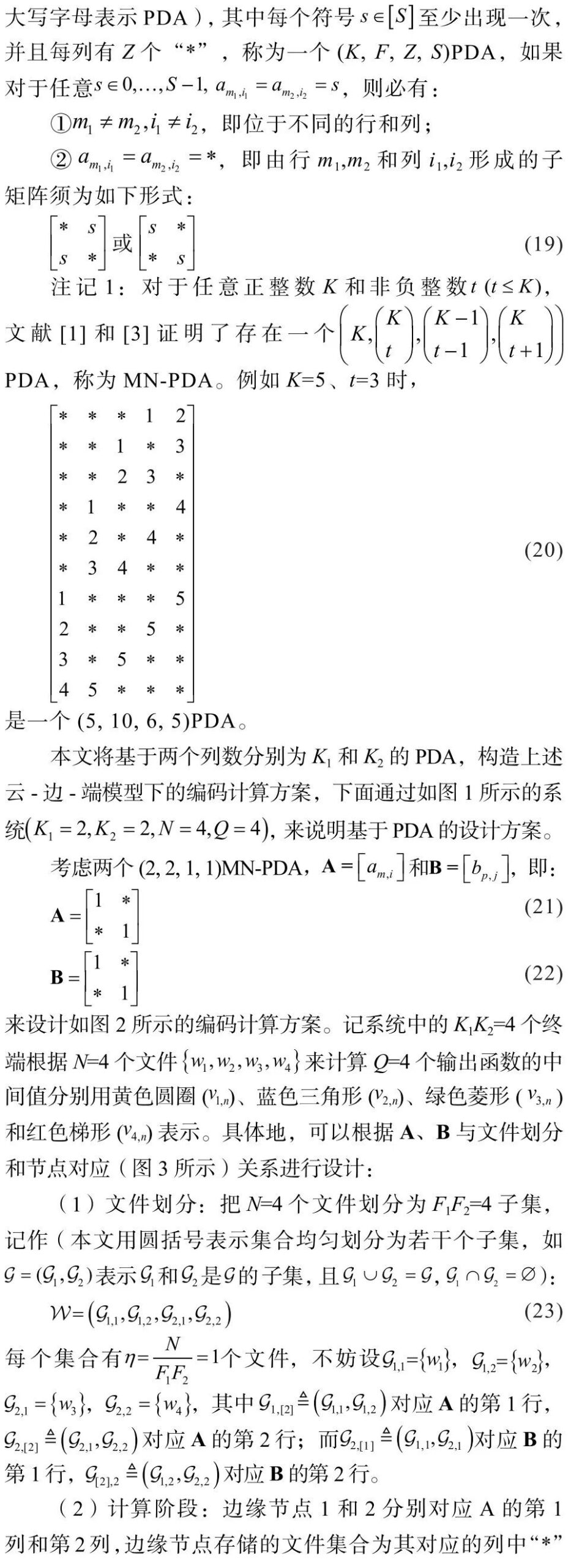
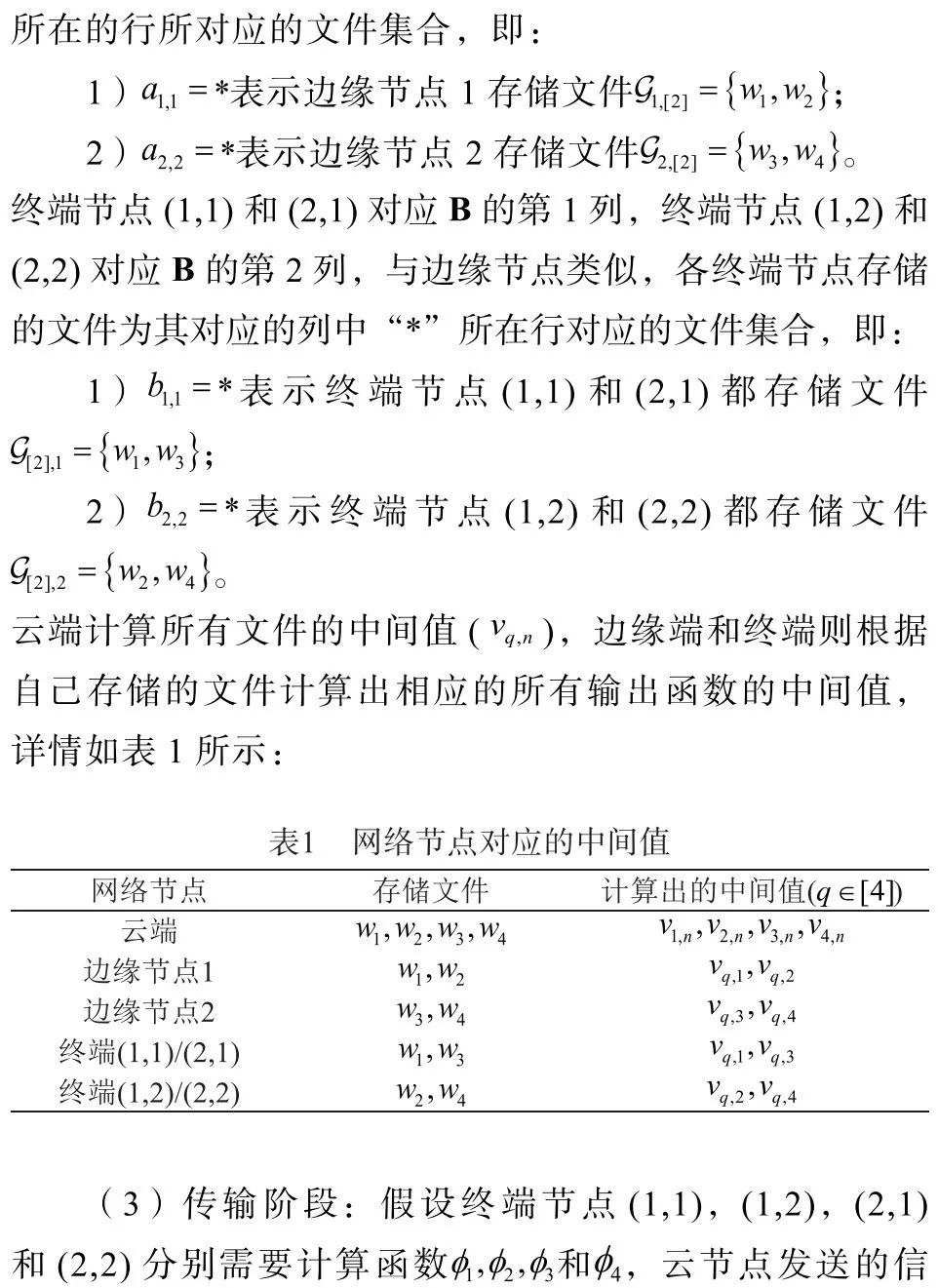
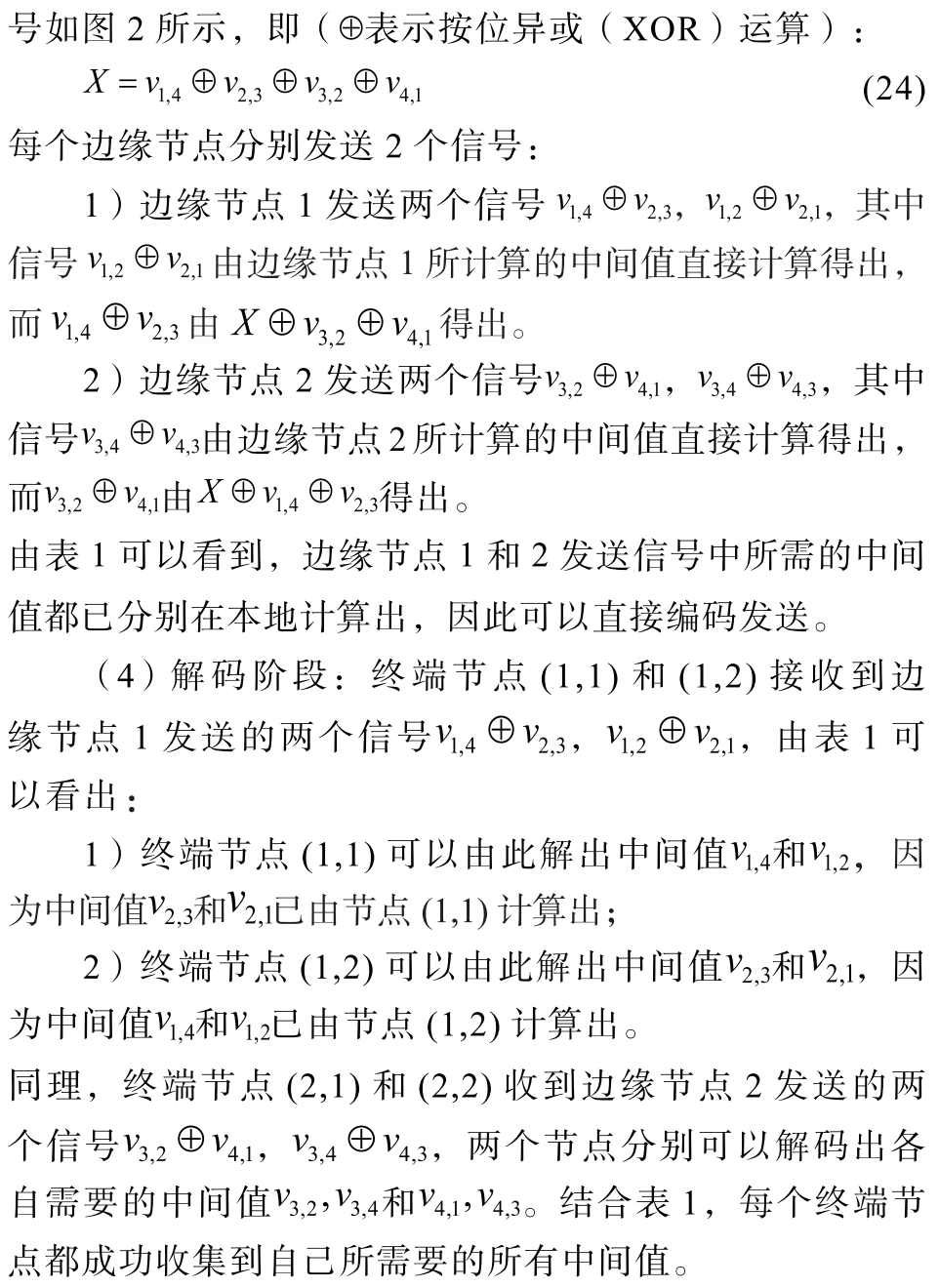
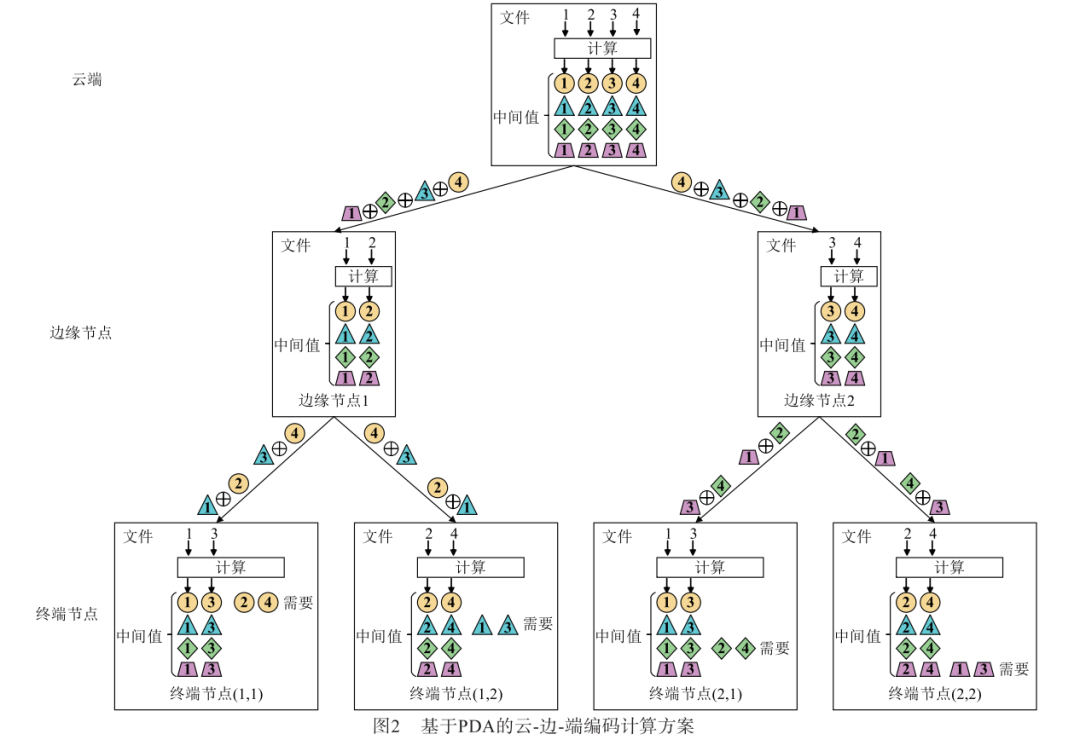
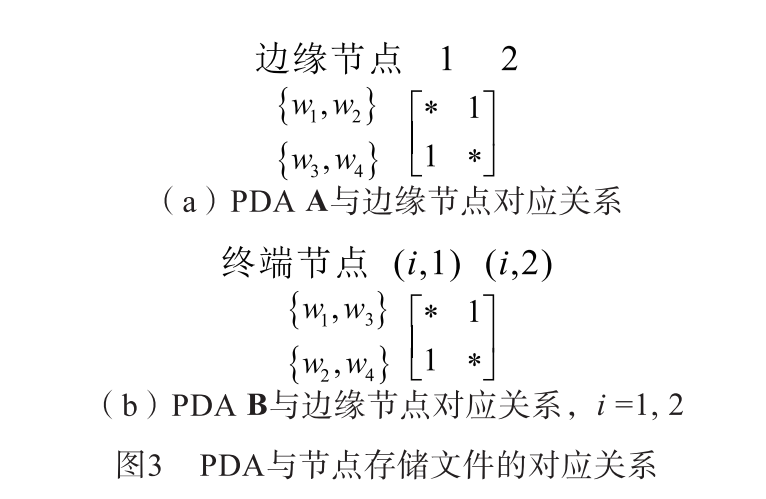
2.2 Coded Computing Scheme Based on PDA
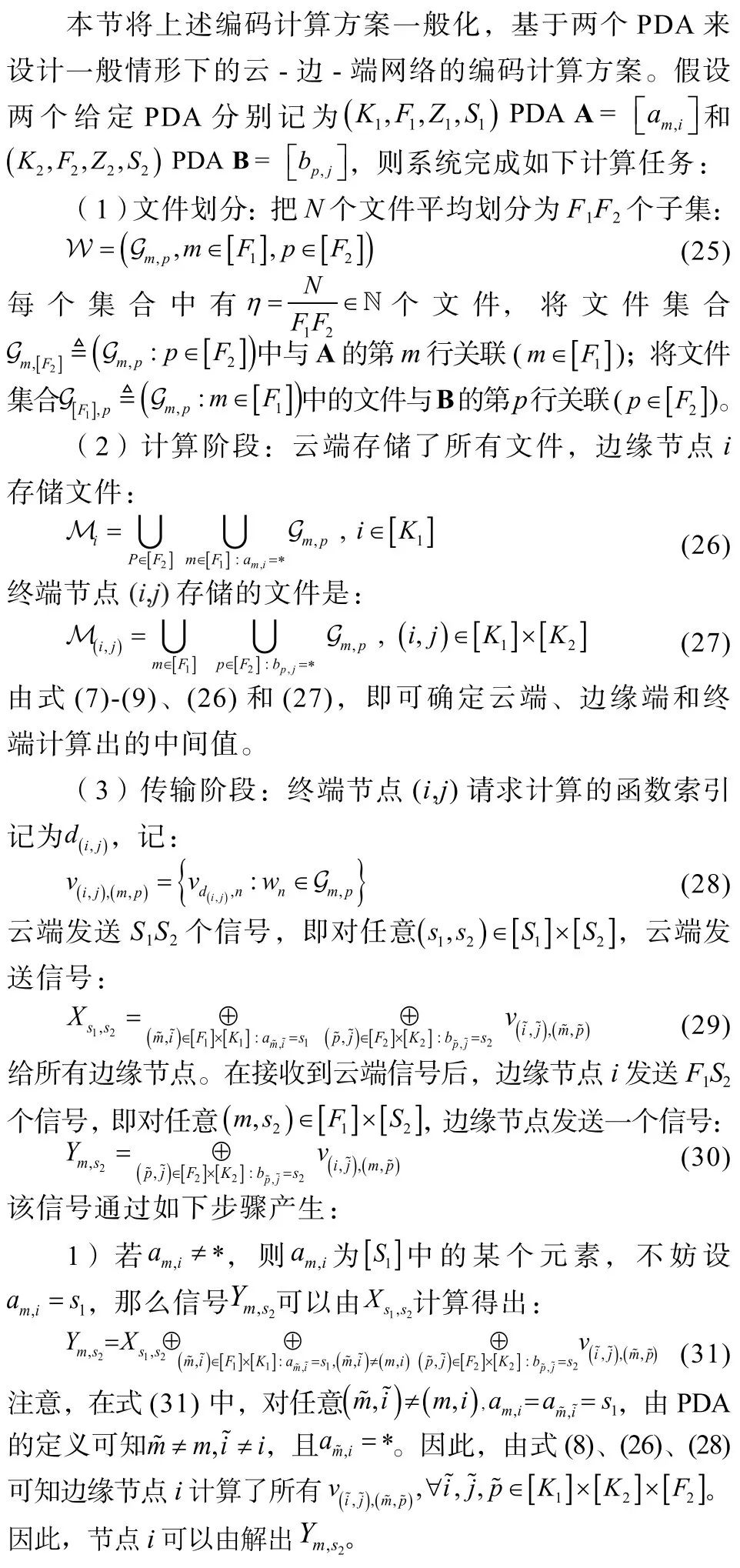
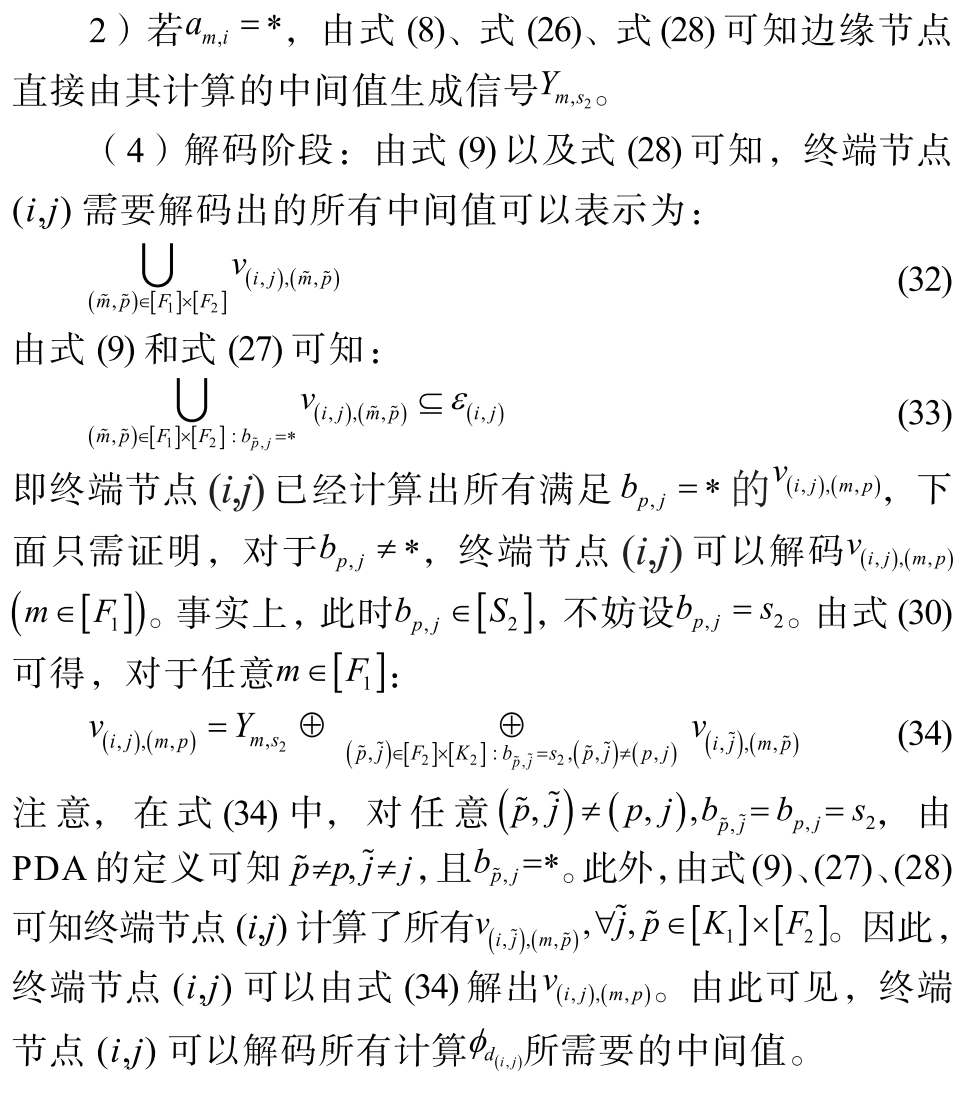
3 Performance Analysis
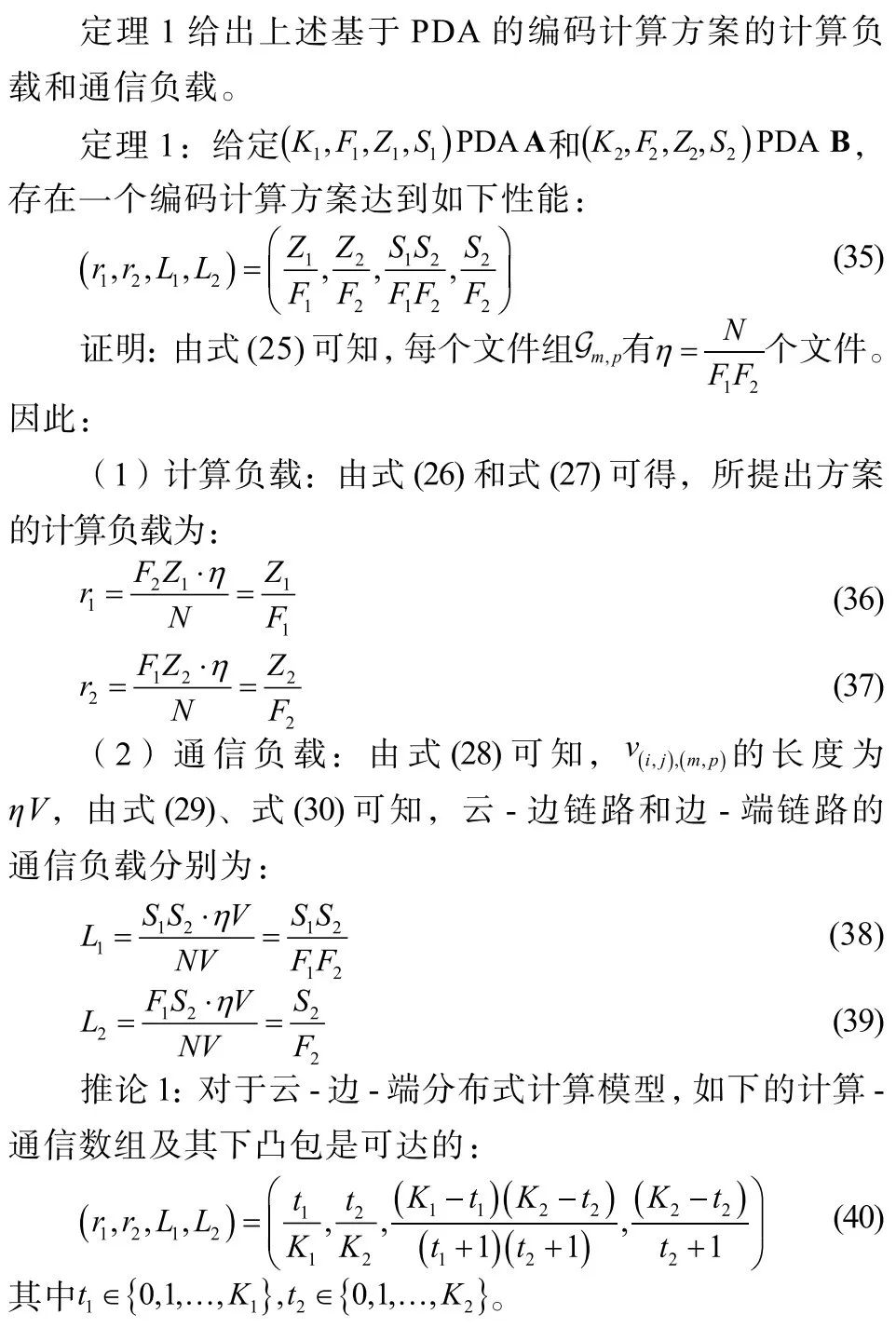
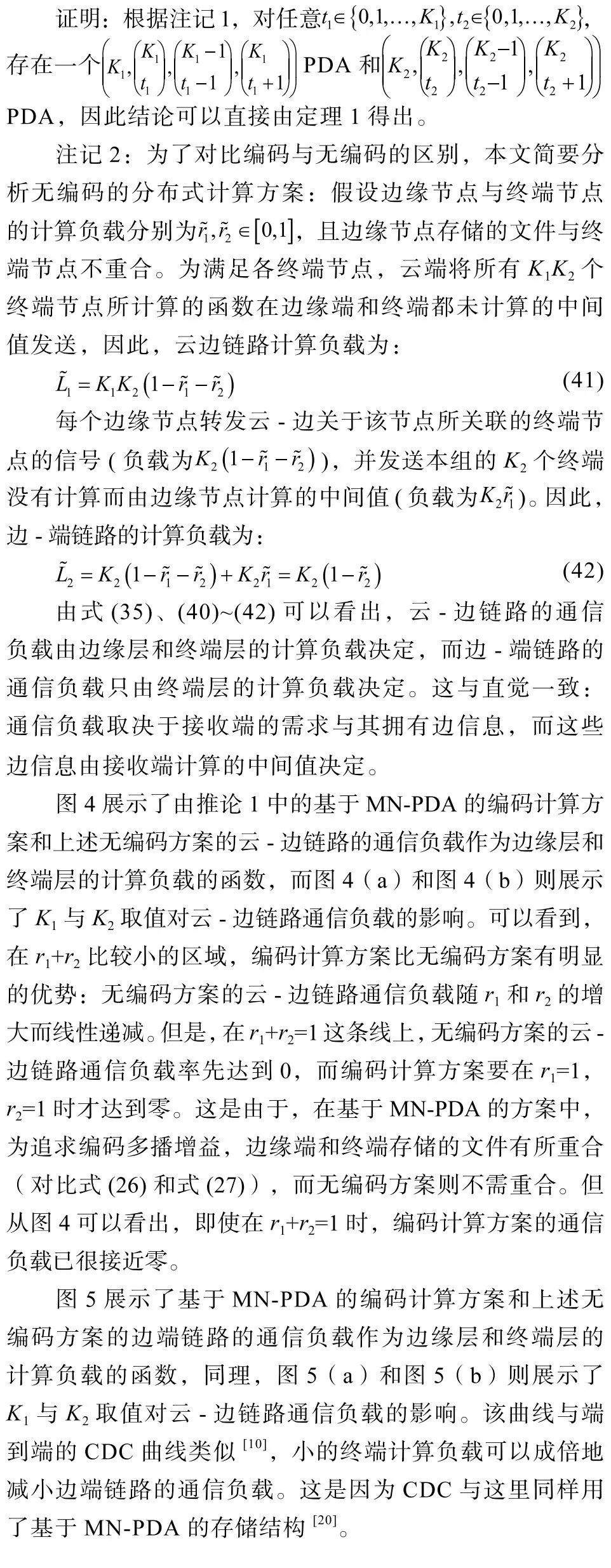
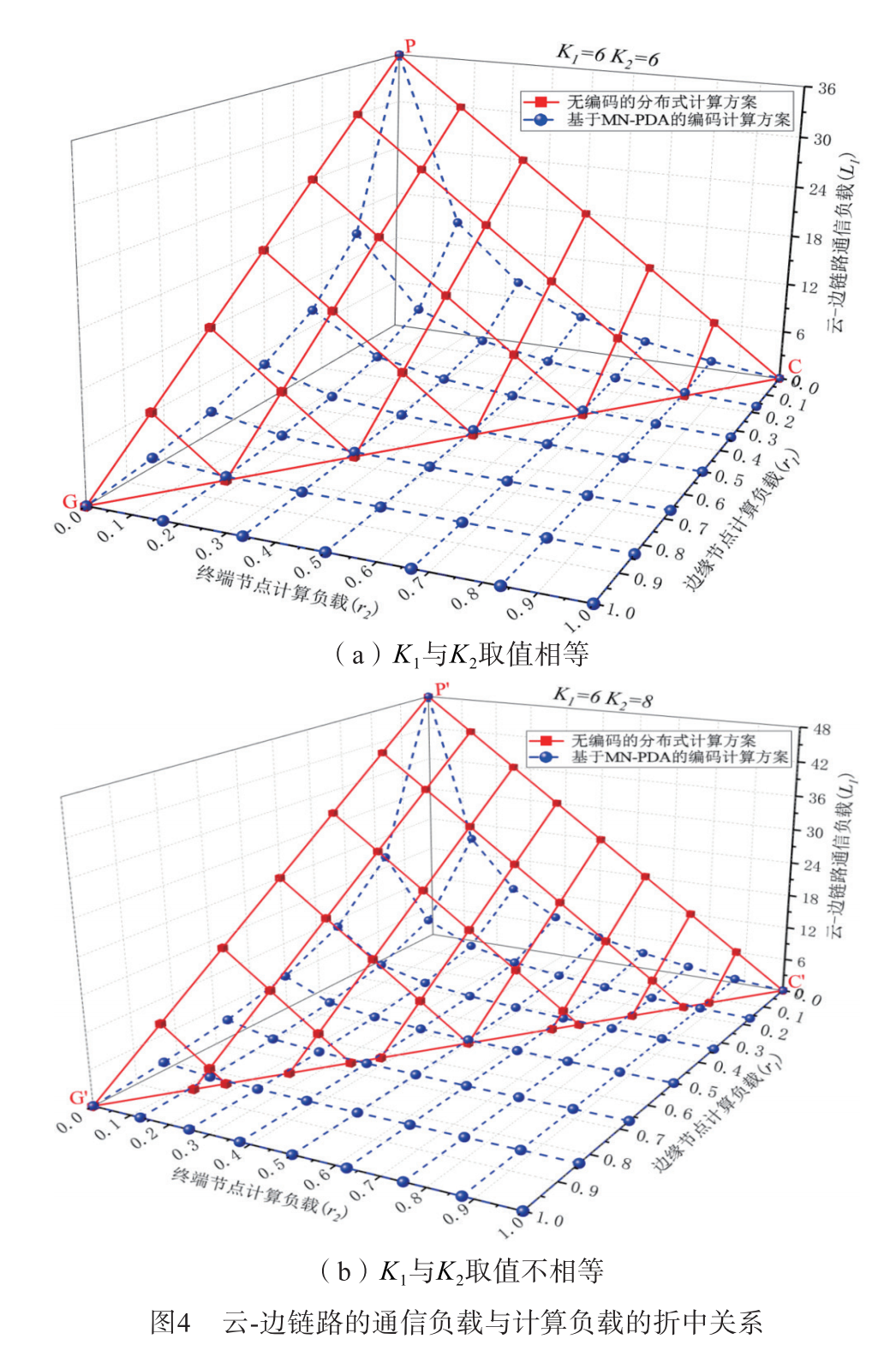
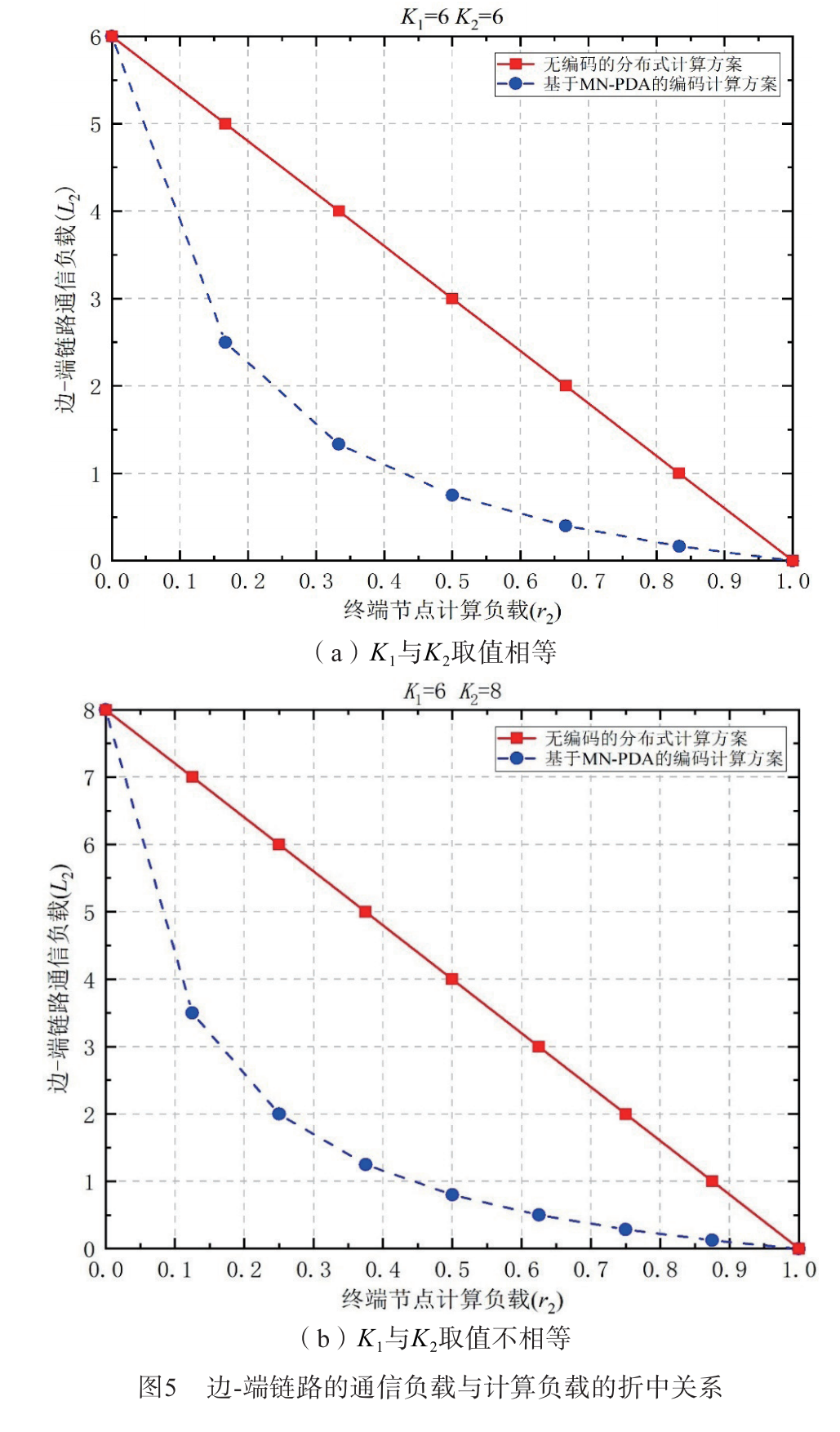
4 Conclusion
This paper describes a distributed computing architecture for deploying the MapReduce computing model in cloud-edge-device networks and proposes a design method for coded computing schemes based on Placement Delivery Array (PDA), analyzing its general performance and the achievable computation-communication performance trade-off. This architecture comprehensively utilizes the abundant computing resources of the cloud and the proximity of edge layer nodes to terminals, achieving global terminal signal encoding multicast on the cloud-edge link and encoding multicast of signals among terminal nodes at the same edge node on the edge-terminal link using two PDAs to guide the storage design of the edge and terminal layers, respectively. The analysis in this paper indicates that encoded multicast is significant for achieving a unified design of computation and communication integration.
References: (Scroll to browse)
[1] Armbrust M, Fox A, Griffith R, et al. A view of cloud computing[J]. Commun. ACM, 2010: 50-58.
[2] Shi W, Cao J, Zhang Q, et al. Edge Computing: Vision and Challenges[J]. IEEE Internet of Things Journal, 2016,3(5): 637-646.
[3] Ren J, Yu G, He Y, et al. Collaborative Cloud and Edge Computing for Latency Minimization[J]. IEEE Transactions on Vehicular Technology, 2019,68(5): 5031-5044.
[4] Ren J, He Y, Yu G, et al. Joint Communication and Computation Resource Allocation for Cloud-Edge Collaborative System[C]//2019 IEEE Wireless Communications and Networking Conference (WCNC). Marrakesh, Morocco: IEEE, 2019: 1-6.
[5] Dean J, Ghemawat S. MapReduce: Simplified data processing on large clusters[J]. Commun. ACM, 2008,51(1): 107-118.
[6] Isard M, Budiu M, Yu Y, et al. Dryad: Distributed data-parallel programs from sequential building blocks[C]//Proc. 2nd ACM SIGOPS/EuroSys Eur. Conf. Comput. Syst., 2007: 59-72.
[7] Chowdhury M, Zaharia M, Ma J, et al. Managing data transfers in computer clusters with orchestra[J]. ACM SIGCOMM Comput. Commun. Rev., 2011,41(4): 98-109.
[8] Zhang Z, Cherkasova L, Loo B T. Performance Modeling of MapReduce Jobs in Heterogeneous Cloud Environments[C]//2013 IEEE Sixth International Conference on Cloud Computing. Santa Clara, CA, USA: IEEE, 2013: 839-846.
[9] Li S, Maddah-Ali M A, Avestimehr A S. Fundamental tradeoff between computation and communication in distributed computing[C]//2016 IEEE International Symposium on Information Theory (ISIT). Barcelona, Spain: IEEE, 2016: 814-1818.
[10] Li S, Maddah-Ali M A, Yu Q, et al. A Fundamental Tradeoff Between Computation and Communication in Distributed Computing[J]. IEEE Transactions on Information Theory, 2018,64(1): 109-128.
[11] Maddah-Ali M A, Niesen U. Fundamental Limits of Caching[J]. IEEE Transactions on Information Theory, 2014,60(5): 2856-2867.
[12] Maddah-Ali M A, Niesen U. Decentralized Coded Caching Attains Order-Optimal Memory-Rate Tradeoff[J]. IEEE/ACM Transactions on Networking, 2015,23(4): 1029-1040.
[13] Yan Q, Cheng M, Tang X, et al. On the Placement Delivery Array Design for Centralized Coded Caching Scheme[J]. IEEE Transactions on Information Theory, 2017,63(9): 5821-5833.
[14] Karamchandani N, Niesen U, Maddah-Ali M A, et al. Hierarchical Coded Caching[J]. IEEE Transactions on Information Theory, 2016,62(6): 3212-3229.
[15] Kong Y, Wu Y, Cheng M, et al. Hierarchical Cache-Aided Linear Function Retrieval with Security and Privacy Constraints[J]. Available: ArXiv, abs/2209.03633, 2022.
[16] Ji M, Caire G, Molisch A F. Fundamental Limits of Caching in Wireless D2D Networks[J]. IEEE Transactions on Information Theory,2016,62(2): 849-869.
[17] Wang J, Cheng M, Yan Q, et al. Placement Delivery Array Design for Coded Caching Scheme in D2D Networks[J]. IEEE Transactions on Communications, 2019,67(5): 3388-3395.
[18] Yan Q, Yang S, Wigger M. A Storage-Computation-Communication Tradeoff for Distributed Computing[C]//2018 15th International Symposium on Wireless Communication Systems (ISWCS). Lisbon, Portugal: IEEE, 2018: 1-5.
[19] Yan Q, Yang S, Wigger M. Storage, Computation, and Communication: A Fundamental Tradeoff in Distributed Computing[C]//2018 IEEE Information Theory Workshop (ITW). Guangzhou, China: IEEE, 2018: 1-5.
[20] Yan Q, Yang S, Wigger M. Storage-Computation-Communication Tradeoff in Distributed Computing: Fundamental Limits and Complexity[J]. IEEE Transactions on Information Theory, 2022,68(8): 5496-5512.
[21] Yan Q, Wigger M, Yang S, et al. A Fundamental Storage-Communication Tradeoff in Distributed Computing with Straggling Nodes[J]. 2019 IEEE International Symposium on Information Theory (ISIT). Paris, France: IEEE, 2019: 2803-2807.
[22] Pang C, Wu Y. Code Distributed Computing for Hierarchical MapReduce Systems[C]//2023 8th International Conference on Computer and Communication Systems (ICCCS). Guangzhou, China: IEEE, 2023: 488-493.
Scan the QR code to read and download this paper on Zhihu

★Original text published in Mobile Communications2024 Issue 3★
doi:10.3969/j.issn.1006-1010.20240301-0002
Classification Number: TN92 Document Mark Code: A
Article Number: 1006-1010(2024)03-0047-07
Citation Format: Li Kou, Yan Qifa, Zhou Zhengchun, et al. Cloud-Edge-Device Communication-Computation Integration Architecture Based on Placement Delivery Array[J]. Mobile Communications, 2024,48(3): 47-53.
LI Kou, YAN Qifa, ZHOU Zhengchun, et al. Cloud-Edge-Device Communication-Computation Integration Architecture Based on Placement Delivery Array[J]. Mobile Communications, 2024,48(3): 47-53.
 Author IntroductionLi Kou:Master’s student at the School of Information Science and Technology, Southwest Jiaotong University, majoring in coding caching, distributed coding, and computing.Yan Qifa:PhD, currently an associate professor and master’s supervisor at the School of Information Science and Technology, Southwest Jiaotong University, main research areas include distributed coding and computing, artificial intelligence, and information theory.Zhou Zhengchun:PhD, currently a professor and doctoral supervisor at the School of Information Science and Technology, Southwest Jiaotong University, main research areas include novel algebraic coding, sequence design, compressed sensing, and information security technology.Tang Xiaohu:PhD, currently a professor and doctoral supervisor at the School of Information Science and Technology, Southwest Jiaotong University, main research areas include coding technology and its applications, distributed computing and storage systems, robust machine learning, and information security and privacy protection.
Mobile Communications submission method is online submission
Please log in to the web submission system
Link Address:http://ydtx.cbpt.cnki.net
 Highlights【2024 Special Call for Papers – Issue 7】6G Endogenous Intelligent Technology【2024 Special Call for Papers – Issue 8】Integration of 6G and AI【2024 Special Call for Papers – Issue 9】Integrated Network of Air, Land, and SeaTable of Contents | 2024 Issue 4 Special Topic: RIS-Assisted Communication Perception IntegrationTable of Contents | 2024 Issue 3 Special Topic: 6G Communication Perception and Computation IntegrationTable of Contents | 2024 Issue 2 Special Topic: Semantic CommunicationTable of Contents | 2024 Issue 1 Special Topic: Star-Ground Integrated Network Technology for 6G
 #Scan to follow us#Mobile CommunicationsInterpreting Communication with Papers
Mobile Communications magazine is supervised by China Electronics Technology Group Corporation and sponsored by the Seventh Research Institute of China Electronics Technology Group Corporation. It is a “dual-effect journal” of the Chinese journal matrix, a fine electronic journal of the Ministry of Industry and Information Technology, a source journal of Chinese science and technology papers statistics, and a journal included in the high-quality scientific journals grading directory of the Information Communication Society of China and the Electronic Society of China. Domestic continuous publication number: CN44-1301/TN, International continuous publication number: ISSN1006-1010, Postal delivery code: 46-181.