Creative Electronic Design Training Camp
Session 12 Projects





Registration Instructions


Hello everyone! Welcome to register for the Creative Electronic Design Training Camp – Session 12. This session offers 22 topics for groups to choose from. Please form teams based on your personal preferences. The registration channel will open shortly. Interested students can also contact the respective topic supervisors for discussions. The specific requirements for this training camp are as follows:
Requirements:
1. Fully utilize creativity to integrate your ideas and concepts into the system design;
2. Conduct software programming, hardware circuit design, and software-hardware integration testing;
3. After completing the project, record a presentation video, write a project report, and showcase your work during a defense session;
4. This semester will have a total of 30 training teams, with each team consisting of 2-3 members. Each instructor has 10 team slots, which will be selected based on registration and project proposals;
5. The final project score will be evaluated based on the completeness of the work, the project report, and the defense performance.
Notes:
1. The laboratory is available for student use during free time;
2. Development boards and components must be purchased by the students. If a project is completed and remains in the laboratory, basic material costs can be reimbursed with an invoice later;
Invoice Information:
Invoice Title: Xi’an Jiaotong University
Tax Number:12100000435230200R
3. Students are supported in applying for major innovation projects and various competitions based on their works;
4. Students are supported in publishing papers and applying for patents based on outstanding works (publication fees supported);

01 Group One Project Introduction

01
Thousand-Year Glance
Requirements:
The basic requirement is to use the K10 development board and a camera, combined with Baidu AI image recognition technology, to achieve the following functions: recognize fruits and vegetables (such as grapes, walnuts, carrots, etc.) placed in front of the camera; after successful recognition, the development board narrates the history of the fruit or vegetable; the screen simultaneously displays the corresponding image and introduction of the fruit or vegetable; through this project, understand the basic process of image recognition and list traversal logic.
02
Interactive Design Based on Language Models
Requirements:
Based on the background of AI development, fully utilize creativity, and combine various large language models for interactive training based on microcontroller systems for AI interaction design, integrating your ideas and concepts into the system design, with interactive manifestations of sound, graphics, colors, and actions based on different needs.
03
Creative Electronic Hourglass 3.0
Requirements:
Design a creative electronic hourglass with gravity sensing, requiring a creative design for timing display to mimic the function of an hourglass, while also using a gravity sensor to determine the direction of the hourglass. A button can be used to set the hourglass time. This project prohibits the use of LED dot matrix for sand display.
04
Smart Weather Station
Requirements:
Based on microcontrollers and various sensors for weather signal collection, such as temperature, humidity, weather, clothing guidance, pressure, altitude, etc., process these signals and display them on an OLED screen. This project requires exquisite appearance packaging to form a displayable work.
05
Home Assistant
Requirements:
Students are required to integrate commonly used modules in home scenarios to achieve voice commands, voice broadcasting, digital tube display of related distances, temperature and humidity, light values, sound levels, light changes, curtain or window action simulation, ventilation and temperature control, etc. This project requires exquisite appearance packaging to form a displayable work.
06
Interactive Music Box
Requirements:
An interactive music device based on voice recognition and music generation technology. Its principles and technologies involve voice recognition, music synthesis, and interactive design. Through the voice recognition module, control the playback of the music box, providing users with a creative, interactive, and personalized music experience. This project requires exquisite appearance packaging to form a displayable work.
07
Time-Space Performer
Requirements:
A virtual piano performance system realized using laser or photoelectric sensor technology, which can play music in the air through hand movements without an actual physical keyboard. This project requires exquisite appearance packaging to form a displayable work.
08
Color Recognition
Requirements:
The basic requirement is to select appropriate sensors or cameras to achieve color recognition and classification, and return the recognized information to the display screen. Advanced requirements can include shape or specific image recognition, which can provide solutions for subsequent controls.
09
Little Mover
Requirements:
Based on microcontroller hardware and software design, create a small vehicle that achieves automatic detection, recognition, and obstacle avoidance functions. Design a reasonable mechanical structure for the little mover, and implement object grabbing and placement using a servo motor.
10
Project Training for Robotics Competitions
Requirements:
Students interested in participating in robotics competitions and with a certain foundation in microcontrollers and mechanical design should practice related topics based on various competition indicators. This topic requires preliminary selection to identify students who truly possess the ability and energy to participate in competitions, with subsequent requirements to participate in related competitions under unified guidance in the training camp.

02 Group Two Project Introduction
01
Identification – AI Waste Classification
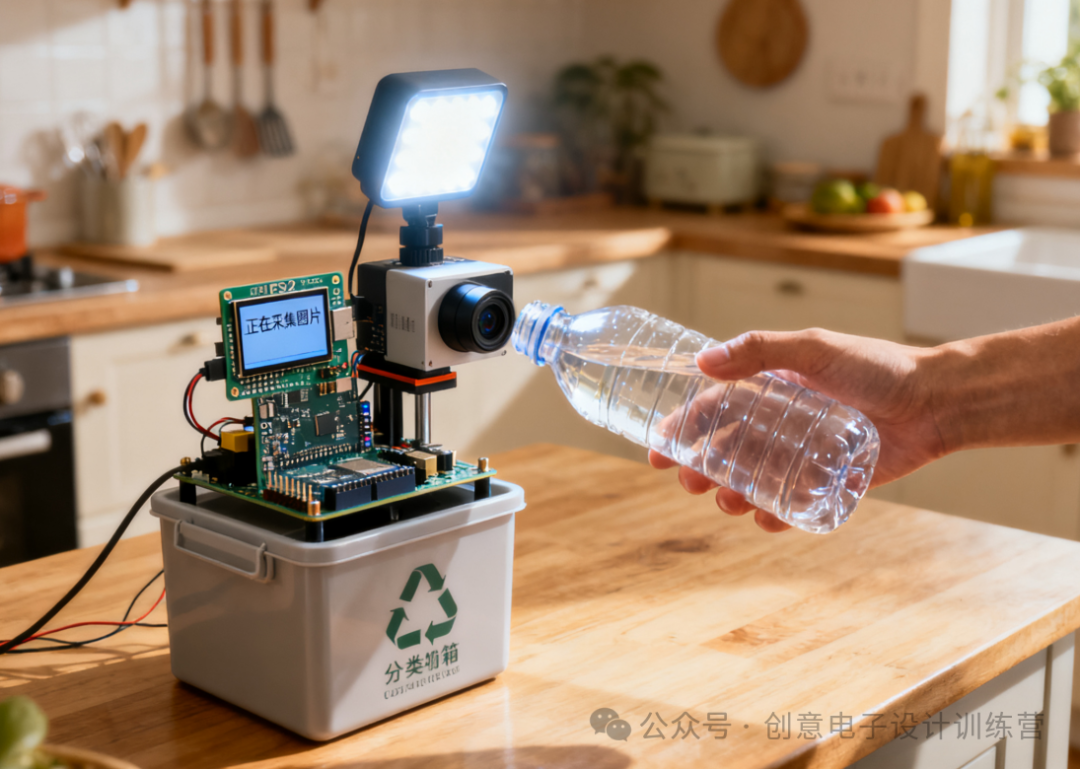
Task: Use Arduino/ESP32, combined with a display screen and camera, to design an AI waste classification device to better manage and protect the environment.
The implementation of the object classification algorithm consists of three processes: collection, training, and recognition.
1. Collect waste images. Use the camera to capture images of different types of waste, establishing an image set for subsequent training and recognition.
2. Train waste classification. Based on the established image set, process the images with the development board to train a model specifically for waste classification.
3. Recognize waste types. Use the trained waste classification model to identify the types of waste captured by the camera and display prompt information.
02
Tracking – Electronic Fence
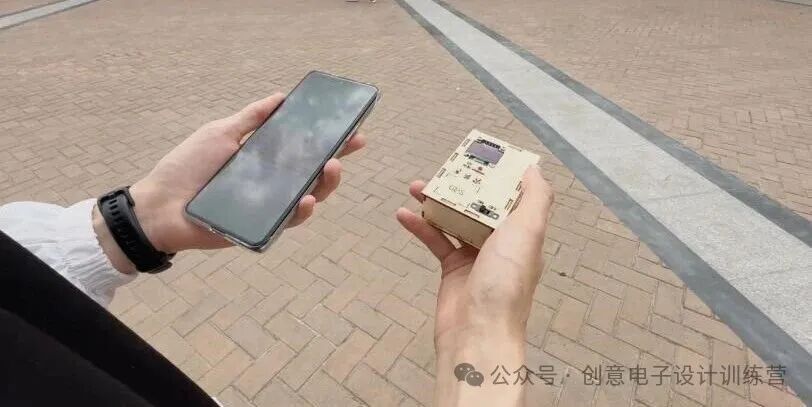
Task: After the system starts, it will automatically read GPS data, setting the current location as the starting point. After the device moves, it will calculate the distance from the starting point in real-time. When a certain distance is reached, a buzzer will sound an alarm. The positioning information will be displayed in real-time on the OLED screen.
Architecture: Requires acrylic board or 3D printed model presentation.
Hardware: Main control board ESP32_C3, GPS module Air530, I2C OLED128*64 display.
03
Mineral Water – Water Quality Fluctuation
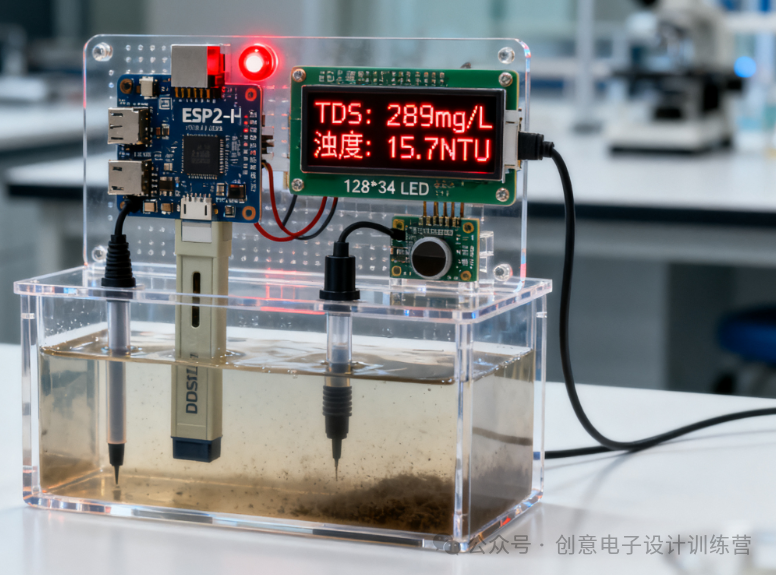
Task: Monitor real-time changes in water quality TDS and turbidity, achieving dynamic recording of water quality changes in the water tank, providing decision-making basis for managers regarding the cleaning and maintenance timing of water supply equipment such as water tanks.
Architecture: Physical water tank and control model constructed with acrylic board.
Hardware: ESP32-E as the main control, TDS sensor, turbidity sensor, I2C OLED128*64 display.
04
Sensing – Classroom Weather Monitoring
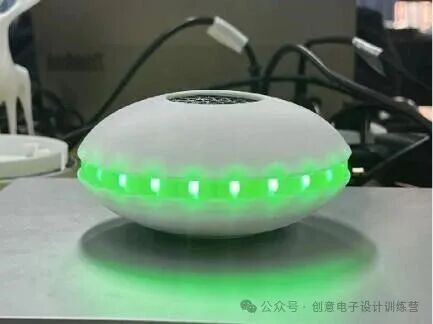
Task: Design a classroom weather environment display system. Use various sensors to collect real-time data on classroom phenomena. Draw suitable interface styles, displaying one sensor value per line.
Architecture: Requires acrylic board or 3D printed model presentation.
Hardware: Main control core Arduino/ESP32, air temperature and humidity sensor, air quality sensor, decibel sensor, ambient light sensor, oxygen sensor, etc.
05
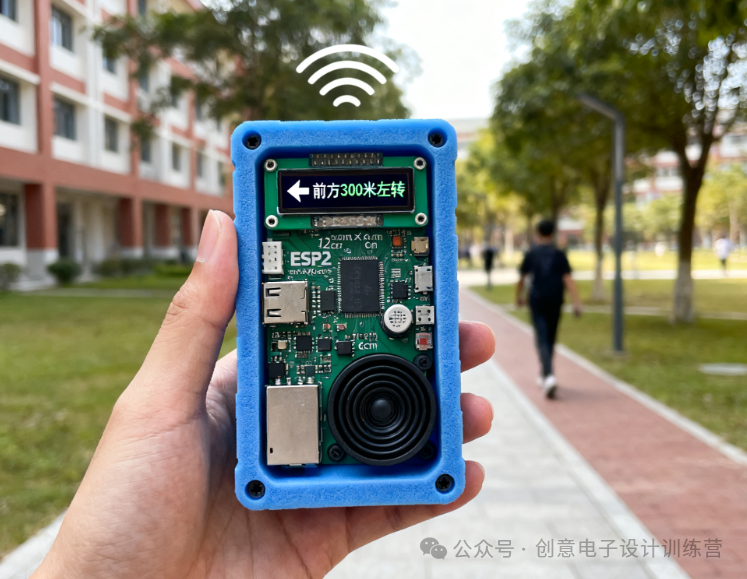
Understanding – Campus Voice Navigation
Task: Use a microprocessor and voice recognition module to design a campus voice navigation device that quickly finds the campus landmarks by speaking.
Architecture: Requires acrylic board or 3D printed model presentation.
Hardware: Main control core Arduino/ESP32, voice recognition module.
06
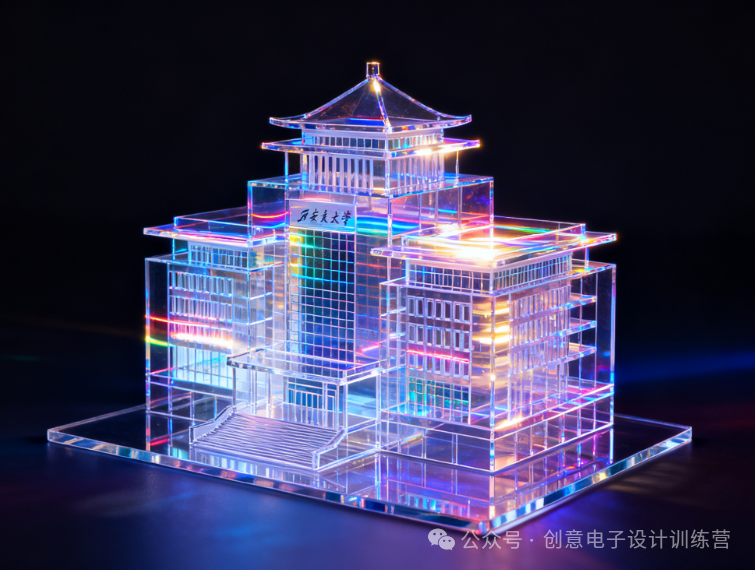
Flowing Light and Color
Task: Change the colors and brightness of the work according to the rhythm and volume of music or sound, with the color and brightness changes presented in a three-dimensional intersecting form.
Architecture: Requires acrylic board or 3D printed model presentation.
Hardware: Arduino, sound sensor, LED strip, etc.
07
Magic Mirror, Magic Mirror
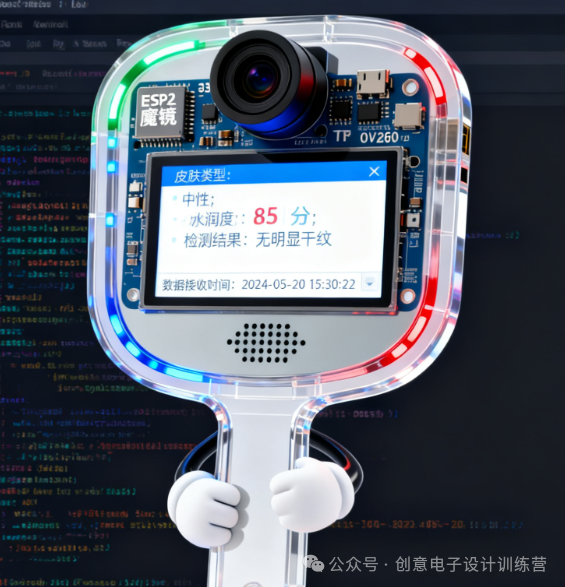
Task: Based on the “ESP32-S3 AI Camera”, use the built-in camera to capture facial image information and generate images, converting the images into data information via Base64, and finally transmitting it to the DeepSeek large model to return the recognized data, displaying the data in the serial monitor.
Architecture: Requires acrylic board or 3D printed model presentation. Hardware: ESP32-S3, microphone, voice recognition module, display screen, etc.
08
Desktop Pet
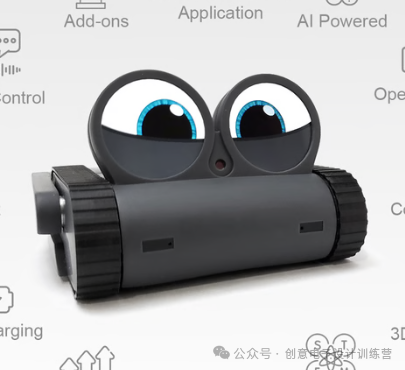
Task: Design a miniature desktop robot with a glowing, blinking expression screen that can sense your touch and surrounding obstacles, expressing emotions such as “happy”, “curious”, and “sleepy”.
Architecture: Requires acrylic board or 3D printed model presentation.
Hardware: Arduino, touch sensor, ultrasonic distance measuring module, servo, display screen, etc.

03 Group Three Project Introduction
01
Self-Balancing Robot
Function: Design a two-wheeled self-balancing device using a gyroscope sensor, controlled via Bluetooth for forward and backward movement to maintain upright balance.
Device Reference: Arduino nano, MPU6050, driver module, Bluetooth, etc.
Independently design the architecture of the two-wheeled self-balancing robot.
02
Micro-Powered Glider
Function: Design a micro-powered glider with ESP32 as the main control, controlled via Bluetooth (or remote control) for gliding speed.
Device Reference: ESP32C3 mini, micro DC motor, driver module, single propeller, etc.
Independently design the structure and propeller of the glider.
03
Thermal Imaging Follower
Function: Design a device that follows while maintaining a controllable distance using a thermal imaging camera.
Device Reference: Arduino nano, thermal imaging camera, infrared distance sensor, display screen, etc.
Independently design the architecture of the follower.
04
Dual-Engine Remote-Controlled Aircraft
Function: Use a hand-thrown machine (or production) to complete a dual-engine remote-controlled aircraft.
Device Reference: STC8 microcontroller, LT8920, micro DC motor, propeller, driver module, etc.
Independently design the architecture of the dual-engine remote-controlled aircraft.
Contact Us


1-X Instructor: Teacher Yuan
Email: [email protected]
Address: Room 119, East Building 1
2-X Instructor: Teacher Chen
Email: [email protected]
Address: Room 121, East Building 1
3-X Instructor: Teacher Li
Email: [email protected]
Address: Room 105, East Building 1
Welcome to Join Us~

► Creative Electronic Design Training Camp
Text | Mu Luo Wei Xiang
Images | Mu Luo Wei Xiang
Resource Attribution | Xi’an Jiaotong University
Electrical and Electronic Technology Laboratory