In the ecosystem of the electronics manufacturing industry, OEM (Original Equipment Manufacturer), ODM (Original Design Manufacturer), and OBM (Original Brand Manufacturer) constitute three distinctly different yet interrelated business models. These models not only differ in their business forms but also exhibit significant differences in the technical applications, management focus, and value creation in PCB processing. Below are the full English names and core explanations of OEM, ODM, and OBM:
1. OEM – Original Equipment Manufacturer
· Chinese Name: 原始设备制造商 · Core Interpretation: “Contract Manufacturing”. · OEM manufacturers are responsible for producing products based on design drawings, specifications, and technologies provided by another company (the brand owner). · The produced products will ultimately bear the trademark and brand of the brand owner for sale. · Key Point: The design belongs to the brand owner; OEM is only responsible for manufacturing.
2. ODM – Original Design Manufacturer
· Chinese Name: 原始设计制造商 · Core Interpretation: “Design Contract Manufacturing”. · ODM manufacturers are responsible not only for production but also for providing product design. · The brand owner can choose from existing product design solutions from the ODM manufacturer or request minor adjustments, then sell under the brand owner’s name. · Key Point: The design belongs to the ODM; the brand owner may only be “rebranding”.
3. OBM – Original Brand Manufacturer
· Chinese Name: 原始品牌制造商 · Core Interpretation: “Own Brand”. · OBM manufacturers create and own their brands, taking full responsibility for product design, manufacturing, marketing, and sales. · They do not do contract manufacturing for other brands or operate their own brand independently outside of contract manufacturing. · Key Point: Own brand, control all aspects of the value chain.
—
In summary:
· OEM: You design, I produce. · ODM: I design and produce, you rebrand for sale. · OBM: I design, I produce, I sell under my own brand.
—
01 Technical Application Differences Among the Three Models
In the field of PCB manufacturing, the OEM, ODM, and OBM models exhibit distinct technical application characteristics, which directly determine their product direction and market positioning.
OEM manufacturers focus on pure manufacturing, with their technical applications primarily centered on process implementation and large-scale production.
In single-sided PCB manufacturing, they may use via hole etching or graphic plating methods; the former provides uniform lines conducive to impedance control, while the latter allows for easier production control.
For OEM manufacturers, the focus of technical application is on how to accurately implement the design specifications provided by customers, ensuring stable quality and large-scale delivery capability.
ODM manufacturers, on the other hand, add design services on top of manufacturing, making their technical applications more diversified.
They need to master the entire process technology from conceptual design to finished product manufacturing, including specialized knowledge of PCBs with different layers. For example, when addressing the differences between double-sided and multi-layer boards, ODM manufacturers must possess corresponding technical capabilities: double-sided boards achieve electrical connections through vias, increasing circuit complexity and component density.
Precision multi-layer PCBs involve high-density interconnect (HDI), microvias, blind vias, and buried vias technologies, which require high precision in processing and process control.
OBM manufacturers’ technical applications are entirely guided by brand value and market demand.
They not only need to master design and manufacturing technologies but also deeply understand end-user needs, making technological innovation a core element of brand differentiation.
OBM manufacturers may invest more resources in researching 3/3mil line width/spacing capabilities, even further enhancing it to 2/2mil—this is a significant leap that requires overall factory strength to support.
02 Core Differences: From Contract Manufacturing to Brand Creation
These three models have essential differences in business forms, technical focus, and value chain positions, constituting an evolutionary path from contract manufacturing to brand creation.
In terms of business form, OEM develops and manufactures products based on contracts from brand companies, using the original company’s trademark, and is a cooperative production method operated by the original company.
ODM goes a step further than pure OEM contract manufacturing, as ODM manufacturers have their own developed technologies and designs, even forming products.
OBM achieves a qualitative leap, requiring companies to register their trademarks and develop markets while leveraging design and manufacturing advantages to create their own brands.
The level of design involvement is a key factor distinguishing the three models. In OEM product development design cases, business units bypass the design unit and directly contact the manufacturing unit, thus the development case lacks relevant design strategy applications.
ODM provides product concept design based on customer needs, often modifying existing products, so it mostly employs imitation and differentiation strategies.
OBM, however, actively develops, requiring the use of leading and advantageous strategies to create topics for the brand.
In terms of value chain position, OEM is at the lowest end of the value chain, primarily relying on economies of scale and cost control to generate profits; ODM enhances value acquisition capabilities through design services; while OBM occupies the highest end of the value chain through brand operation.
Research indicates that the transition from OEM to ODM to OBM is a development model for enterprises, accompanying different operational methods and profit models at various stages of enterprise development, and is an inevitable choice for enterprises pursuing sustainable development.
03 Management Control Points: Accurately Grasping the Core of Each Model
Different business models require different management control focuses, and accurately grasping these points is key to successful enterprise operation.
In design and development management, there are significant differences in design strategies between OEM and ODM models.
Based on customer pressure to reduce costs and time, non-autonomous ODM product development design cases provide product concept design requirements, where customers often modify existing products, so they mostly employ imitation and differentiation strategies.
In contrast, autonomous ODM product development design cases aim to attract customer development willingness, often using leading and advantageous strategies to create trends for customers.
For the OBM model, the OBM product development case on the market must attract consumer attention, and it is recommended to use leading and advantageous strategies to create topics for the brand.
In terms of production organization and processes, research shows that OEM and non-autonomous ODM product development, due to simple demand and clear development direction, are more suitable for repetitive functional organizational forms.
Autonomous ODM and OBM product development, as enterprises need to control and plan development directions, are more suitable for collaborative development-type lightweight matrix project organizations to reduce blind spots in the communication process.
Supply chain and cost control are also key. Small and medium-sized PCB enterprises can adopt a new production model, mainly optimizing engineering production and merging orders, combining all orders under 10 square meters, including different process requirements, surface treatments, and ink colors.
This model can save a lot of time in processing data compared to the traditional model of one production number per market order.
04 Quality Control: Each Focuses on Different Aspects
In different models, the focus and methods of quality control also show significant differences.
OEM model particularly emphasizes issues in production manufacturing. The effectiveness of process inspection is crucial, as PCBs serve as carriers for all electronic components, and their reliability is very important.
ODM models differ, with non-autonomous ODM product development focusing on timeliness in the design phase. Due to customer pressure to reduce costs and time, ODM manufacturers must quickly respond to customer needs while ensuring quality.
Autonomous ODM and OBM product development particularly emphasize analysis and planning in the concept phase.
OBM models have the most comprehensive quality requirements, as they directly face end consumers, and quality performance directly affects brand reputation.
A PCB board may be scrapped due to a tiny hair or a speck of dust, or it may lead to potential failure risks; therefore, OBM manufacturers must establish a comprehensive quality assurance system.
05 Transformation Path: From Manufacturing to Creation
For many enterprises, transitioning from OEM to ODM and then to OBM is a natural evolutionary path, but this transformation is not easy.
The challenges of transformation mainly lie in the differences in product development management. Research has found that enterprises originally operating under OEM or ODM business models face the greatest differences when transitioning to OBM, particularly emphasizing planning in the concept phase of design strategies and product development processes.
Resource restructuring is equally important. Enterprises transitioning to OBM must reallocate resources and strengthen design and marketing capabilities. Mature enterprises are often “dumbbell-shaped,” with strong technology and market capabilities, while manufacturing is partially or fully outsourced.
At the same time, for the status of new products after market launch, OBM manufacturers should invest more resources in continuous tracking to gather market information for future generations of new products.
Overview of Core Comparisons Among OEM, ODM, and OBM in PCB Manufacturing
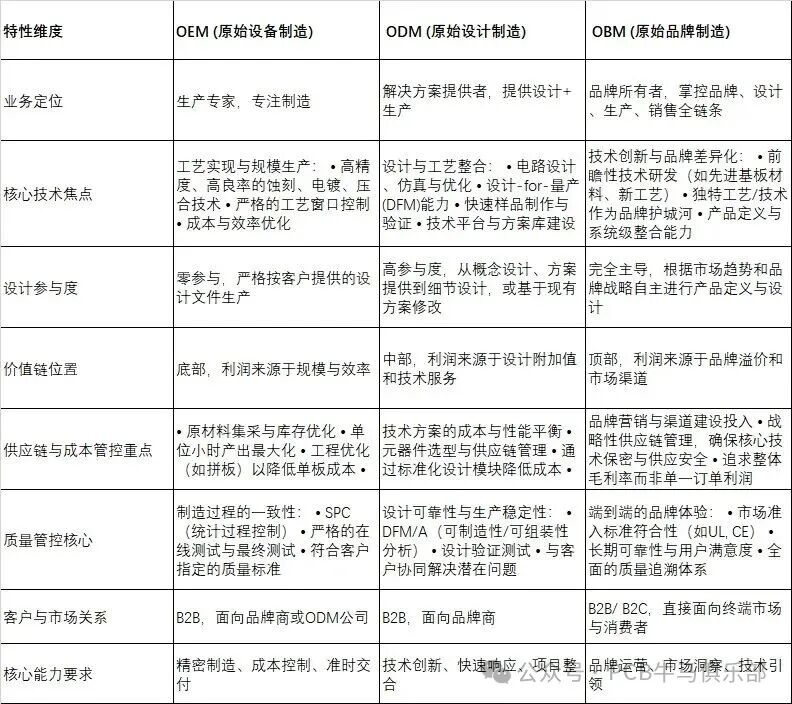
Summary and Analysis
From the above table, it is clear that OEM, ODM, and OBM are three progressively layered and distinctly positioned business models.
1. Different Paths of Value Creation
· OEM creates value through standardized and large-scale fine management, with its core competitiveness being “doing it better, cheaper, and faster.”
· ODM creates value through technology and design services, with its core competitiveness being “able to design and manufacture competitive products,” saving customers R&D costs and time.
· OBM creates value through brand value and market insights, with its core competitiveness being “knowing what the market wants and being able to sell it through brand appeal.”
2. Different Depth and Breadth of Technical Applications
· OEM’s technical application is “deep,” focusing on the manufacturing process itself, striving for excellence in a single link.
· ODM’s technical application is “broad,” requiring cross-disciplinary knowledge in design, materials, processes, testing, etc., and possessing strong integration capabilities.
· OBM’s technical application is “leading,” focusing not only on existing technologies but also on future technology trends, transforming them into unique selling points for products.
3. Different Balances of Risk and Reward
· OEM has the lowest risk (order-driven, no inventory and R&D risks), but also the thinnest profit, easily falling into price competition.
· ODM has medium risk (requires R&D investment, but shared by multiple customers), with profits higher than OEM, but its development is constrained by downstream brand customers.
· OBM has the highest risk (requires investment in brand building, market promotion, facing market uncertainties), but once successful, it can achieve the highest brand premium and profit margin.
For PCB enterprises, the choice of which model to adopt is not fixed but a comprehensive decision based on their development stage, resource endowment, and strategic vision. Many successful Chinese enterprises have followed a path of transformation from OEM (learning manufacturing) to ODM (mastering technology) and then to OBM (creating brands). Regardless of the path chosen, the key lies in building core capabilities that match the model and being irreplaceable in the corresponding value chain segments.
Special Note: The above discussion is for reference only and serves as a starting point for further thought! Each factory’s chemicals/processes/equipment/product structures, etc., have various differences, and one must not rigidly apply these concepts; effective improvement measures must come from experimental data! As a professional quality of engineering technicians, it is essential to “speak with data.”
This public account will continue to update information related to PCB manufacturing and cutting-edge technologies.
Thank you, not only for being so good-looking and handsome but also for moving your golden fingers to make money, please follow + collect + like + share + comment!!!
Original content is not easy; if you want to reprint, please private message the author, obtain consent, and indicate the source before reprinting, thank you for your cooperation!